








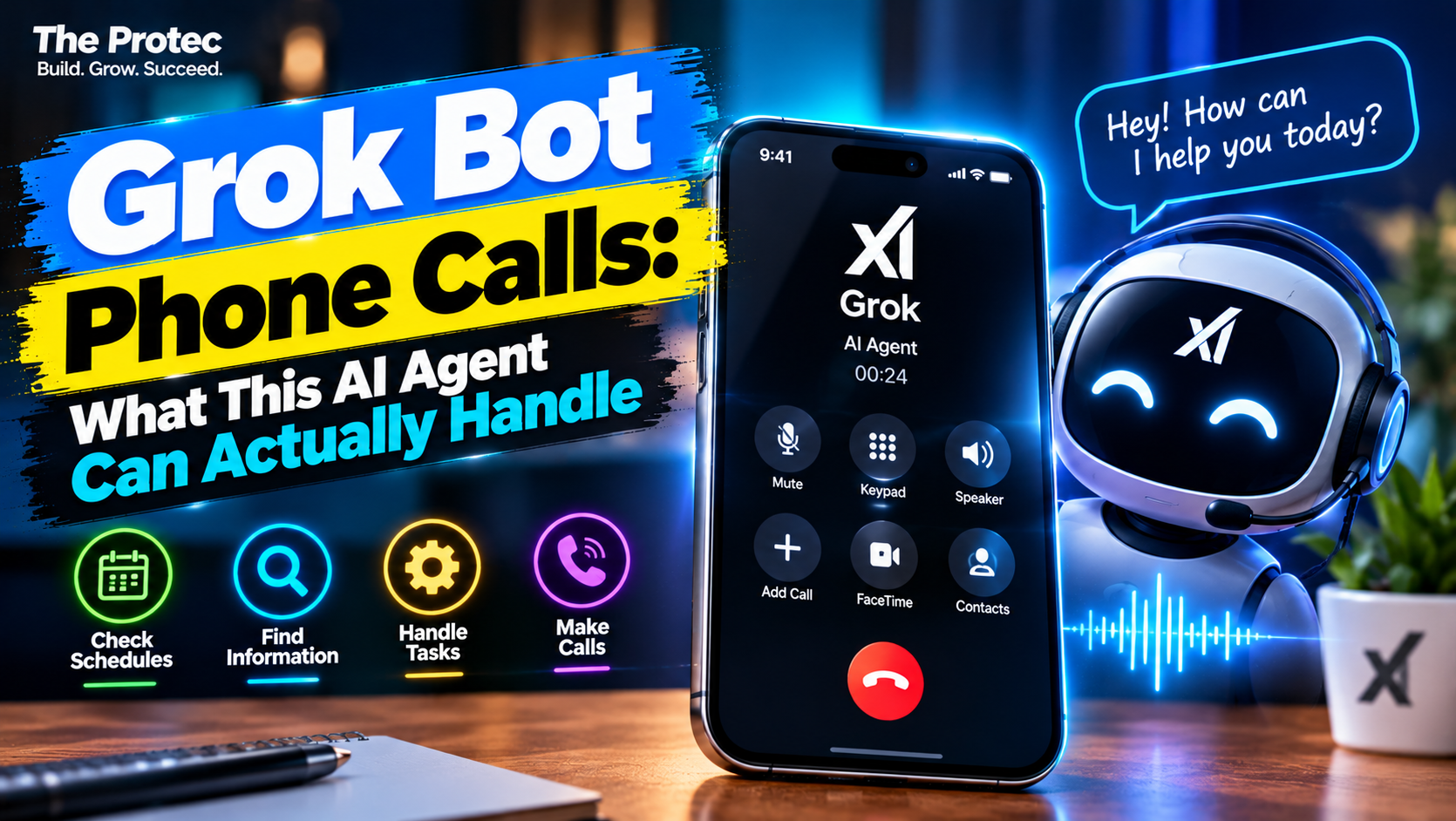
Imagine asking an AI assistant to call a store, check whether an item is in stock, and report back without putting you on hold. Reports about Grok Bot phone calls suggest that this kind of delegation may be possible, but the headline needs an important qualification: voice-agent technology is not the same thing as a universally available button that lets every Grok user place autonomous calls. The underlying capabilities are real, while access, telephony integration, and the tasks an agent can complete depend on the product or service implementing them.
This distinction matters because demonstrations can make experimental or developer-built systems look like standard consumer features. Before entrusting an AI with an appointment, reservation, or customer-service request, users should know what xAI has documented, what a third party may be adding, and what remains unverified.
Is Grok Bot officially able to make phone calls?
As of the publication review on October 26, 2026, official xAI materials support a narrower conclusion than some social posts imply. xAI offers developer-facing voice-agent technology capable of holding real-time spoken conversations. Its official voice-agent documentation describes the tools developers can use to build conversational voice experiences.
However, that documentation does not by itself prove that outbound calling is enabled for every person using Grok on the web, in the Grok mobile app, or through X. A voice model generates and understands speech; reaching an ordinary telephone number normally requires a separate telephony service, call-routing infrastructure, and compliance controls.
The most accurate way to interpret current reports is therefore:
- Confirmed: xAI provides technology for real-time, spoken AI agents.
- Implementation-dependent: Developers can connect a voice agent to telephone infrastructure and create an AI that makes phone calls.
- Not established as universal: A general outbound-calling feature should not be assumed to exist on every Grok account, device, region, or subscription.
- Unconfirmed naming: There is insufficient official evidence to treat Grok Voice 3.0 as the formal name of a publicly released xAI product version. The label may come from a demonstration, third-party service, informal post, or unofficial description.
If a video shows Grok dialing a business, check who published it and what software appears on screen. An authentic demonstration can prove that a particular setup worked under particular conditions. It does not automatically confirm a broad consumer rollout.
How Grok Bot phone calls would work
A calling workflow can differ by implementation, but a properly configured Grok Bot AI agent would generally involve four components: the user interface, the xAI model, a telephony provider, and an application that controls the task.
- The user provides a goal. A request might be: “Call the pharmacy and ask when the prescription counter closes. Do not discuss my medication.”
- The application converts the request into instructions. These instructions define the permitted questions, information the agent may share, and actions it must not take.
- The telephony service places the call. Once someone answers, the Grok-powered voice agent listens and responds in real time.
- The system returns a result. Depending on the integration, the user might receive a transcript, extracted details, notes, or a short summary.
A more sophisticated implementation could allow the agent to ask follow-up questions, repeat information, handle interruptions, or call a second number if the first is unavailable. Some systems can also send keypad tones to navigate an interactive voice response menu. That capability is not automatic: the surrounding application must support DTMF tones, recognize menu prompts, and know when to press a key rather than speak.
The same caveat applies to note-taking. A voice model can produce a summary, but the service must capture the conversation and present that summary to the user. Those steps may be features of a third-party platform rather than Grok itself.
Which platforms, regions, and accounts are supported?
There is no single answer covering every Grok-based calling implementation. Access should be evaluated at two separate levels.
Consumer Grok access
Having access to Grok through its app, website, or an X subscription does not necessarily include outbound telephone calling. Voice chat inside an app lets a person speak with the assistant; it does not inherently allow the assistant to dial an external phone number. Users should look for an explicit calling option, supported-country list, terms of use, and pricing information in the product they are using.
Developer and third-party access
A custom AI phone call assistant may require an xAI developer account, API access, billing credits, and a separate account with a telephony provider. Supported destinations depend on that provider, local regulations, number availability, and the application operator’s policies. U.S. calling support does not imply international availability.
Call charges may include model usage, audio processing, phone-number rental, per-minute telephony fees, taxes, and surcharges. A Grok subscription should not be assumed to cover these external costs. Organizations should also confirm whether the selected service permits their intended type of outbound call.
Practical tasks the AI could handle
The strongest use cases are narrow, low-risk, and easy to verify. The agent should have a clear question and a defined stopping point.
Checking business hours
An agent could ask whether a store has different holiday hours, when a department closes, or whether walk-ins are accepted. This is useful when online listings conflict, although the returned answer can still be misunderstood or summarized incorrectly.
Asking about product availability
A caller could provide a product name, model, size, or color and ask whether it is in stock. Results are more reliable when the user supplies an exact model number. The agent should avoid placing a hold or making a purchase unless the user explicitly authorized that action.
Confirming appointments
A calling agent may confirm a date, time, address, or preparation instruction. Rescheduling is riskier because it creates a commitment. The application should require user approval before accepting a new time, cancellation fee, or policy.
Requesting basic information
Routine questions about parking, accessibility, return policies, service areas, and required documents fit the technology well. An agent can gather several details consistently and organize them into a checklist.
Gathering customer-service details
The assistant could ask which department handles an issue, what documents are required, or whether a request can be submitted online. It may also record a case number if permitted. Account-specific changes, financial disputes, or identity verification should generally be handed back to the user.
What Grok’s AI calling agent may struggle with
Real telephone conversations are less predictable than polished demonstrations. Even a capable xAI AI assistant can encounter conditions that reduce accuracy or cause a task to fail.
- Complex conversations: Negotiations, complaints, medical questions, and nuanced policy disputes require context and judgment that a tightly scripted agent may lack.
- Accents and audio quality: Strong accents, muffled speech, speakerphones, weak connections, and background noise can lead to incorrect transcriptions.
- Interruptions: People often talk over one another, change subjects, or correct themselves. The agent may miss a correction or answer the wrong part of a question.
- Automated menus: Long prompts, changing options, CAPTCHAs, and menus requiring account data can stop the workflow.
- Authentication: Businesses may require a password, one-time code, date of birth, security answer, or spoken consent from the account holder.
- Payments: Sharing card details with an autonomous agent creates substantial privacy and authorization risks. A service may also refuse payment from an AI caller.
- Human judgment: An agent should not make consequential decisions about health, law, credit, employment, insurance, or personal safety.
The agent can also hallucinate. It might claim a business confirmed something that was never clearly stated, confuse two available times, or omit an important condition from its summary. Fluent speech is not proof of an accurate result.
Privacy, consent, and legal safeguards
Placing a phone call involves more than model performance. Users and developers must consider who consented to the call, what data is disclosed, whether audio is retained, and which laws apply.
An AI caller should identify itself when required and should not impersonate the user or another person. The Federal Communications Commission has clarified that AI-generated voices fall within restrictions governing artificial or prerecorded voices under the Telephone Consumer Protection Act. The FCC’s guidance on AI-generated voice calls is particularly relevant to automated outreach, advertising, and calls made without proper consent.
Recording and transcription rules also vary. Federal law generally establishes a one-party-consent baseline, while some states require all parties to consent. Interstate calls can create additional uncertainty. The safest practical approach is to disclose that an AI is speaking and that the call may be transcribed or recorded, then obtain consent before continuing. This is general information, not legal advice.
Users should minimize the personal data placed in the prompt. Do not provide Social Security numbers, passwords, full payment-card details, medical information, or authentication codes unless a trusted service has a clear need, appropriate security, and explicit authorization. Check how transcripts, audio, phone numbers, and summaries are stored or used.
How to use an AI phone call assistant safely
- Choose a low-stakes task. Start with public information such as hours, inventory, or service requirements.
- Set boundaries. Tell the agent not to purchase, book, cancel, disclose sensitive data, or agree to fees.
- Provide precise details. Include model numbers, preferred dates, spelling, and the exact questions to ask.
- Require clarification. Instruct the agent to repeat dates, prices, names, and confirmation numbers.
- Review the transcript or summary. Look for uncertainty, contradictions, and missing qualifications.
- Confirm important commitments independently. Verify reservations, appointments, cancellations, payments, and deadlines directly with the business.
These precautions reduce the risk of mistaken bookings and AI-generated misinformation. They also make it easier to determine whether the service completed the task or merely produced a plausible-sounding account of it.
How this differs from a conventional voice assistant
Traditional voice assistants typically act within a controlled ecosystem: setting a timer, playing music, composing a message, or dialing a contact while the user remains involved. Autonomous AI agents are designed to pursue broader goals across several steps, adapt questions based on answers, and return a completed result.
That flexibility makes a Grok-based agent potentially more useful, but also harder to supervise. The concept is not unique to Grok, and xAI should not be described as the first or only company working on AI phone calls. The meaningful comparison is not which assistant speaks most naturally; it is which service offers transparent permissions, reliable task controls, appropriate disclosure, secure data handling, and an auditable record of what occurred.
Frequently asked questions
Can every Grok user make AI phone calls?
No universal availability should be assumed. Official xAI technology supports voice agents, but outbound telephone access may require a specific product, limited rollout, developer integration, or third-party telephony service. Check the interface and current documentation for your account and region.
Is Grok Voice 3.0 an official xAI product?
The name should be treated as unconfirmed unless it appears in a dated xAI announcement or official product documentation. A label used in a video, app, or social post may refer to an unofficial integration rather than an xAI release.
Potentially, but only if the implementation can recognize menu prompts and send keypad tones or appropriate spoken responses. Complicated menus, authentication requests, and anti-bot checks may still require a human.
Can the AI book an appointment for me?
A properly configured agent may be able to request or confirm a basic appointment. Users should require approval before the agent accepts fees, cancellation terms, or an alternative time, and they should independently verify the final booking.
The bottom line
Grok-powered calling could save time for people who regularly chase routine information, including caregivers, busy professionals, small-business teams, and users who find phone queues difficult. Its best role is as a supervised assistant handling clearly defined, reversible tasks.
The technology should not be treated as an unsupervised representative for sensitive, expensive, or consequential decisions. Confirm that the calling feature is genuinely available through the service you use, understand who operates the telephony layer, limit the data shared, and review every result. For business hours or product availability, an AI agent may be convenient. For payments, disputes, medical decisions, or binding commitments, a human should remain in control.