








The Brian Chesky AI warning matters because artificial intelligence is changing more than the tasks people perform. It is also changing how organizations assess productivity, leadership and professional value. As software assumes more drafting, summarizing, reporting and coordination work, employees increasingly need to show what they contribute beyond moving information—and managers need to understand the work they lead.
Chesky, Airbnb’s co-founder and CEO, has spent years advocating a more hands-on approach to company building. His perspective reflects Airbnb’s experience restructuring its operations, simplifying management layers and incorporating AI into customer service and product development. But his comments are an executive’s opinion, not proof that particular jobs will disappear. The useful question is what his warning reveals about the capabilities employers may value as AI workplace transformation accelerates.
What Did Brian Chesky Actually Say About AI and Workers?
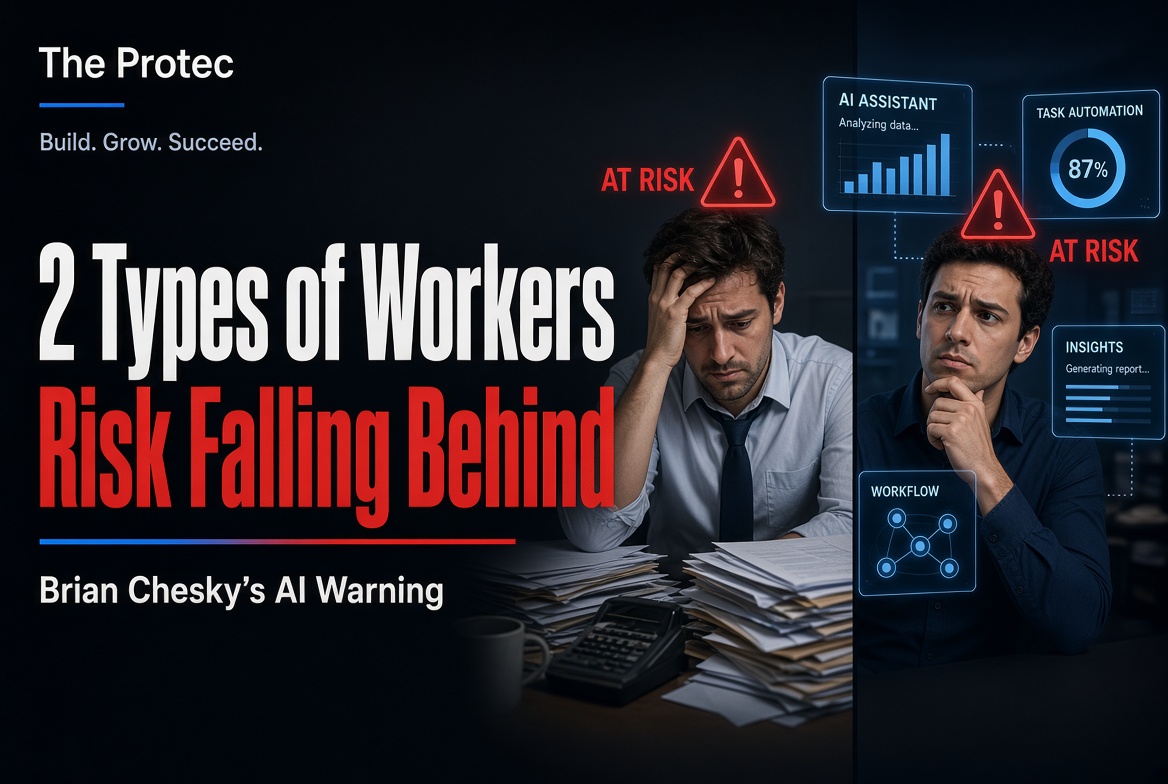
The widely shared claim traces to Chesky’s interview on Decoder, published by The Verge on May 14, 2025. In the published interview and transcript, he identified two groups he believed would be “in trouble”: “people that only manage people and don’t do the work” and “people that don’t know how to use AI.”
The context is important. Chesky was discussing organizational design, the role of managers and how Airbnb expected AI to alter work. He was not announcing layoffs, presenting a labor-market study or saying that every manager and nontechnical employee would lose a job. Nor did he say that workers were guaranteed to “survive” or fail based on one skill. Headlines describing the two types of workers AI may disrupt are therefore best understood as a concise interpretation of his position—not a certain forecast.
His first category concerns managers detached from the substance of their teams’ work. His second concerns people unwilling or unable to learn how AI fits into their jobs. Together, the remarks point to a broader shift: coordination alone may carry less value, while informed leadership, domain expertise and adaptability may carry more.
Group One: Managers Who Only Manage People
Traditional management can involve assigning tasks, collecting status updates, scheduling meetings, preparing reports and transmitting information between organizational layers. Those activities are not inherently useless. Teams need priorities, accountability and communication. The vulnerability arises when coordination is essentially all a manager contributes.
AI-enabled project tools can summarize meetings, draft progress reports, classify risks, organize documentation and surface overdue work. If a manager’s role consists mainly of gathering and repackaging that information, automation may expose how little judgment the position adds.
That does not mean people managers AI tools can support are becoming obsolete. Good management involves work that is difficult to reduce to automated summaries:
- Understanding enough of the domain to evaluate trade-offs and challenge weak assumptions
- Setting priorities when data is incomplete or stakeholders disagree
- Coaching employees and giving candid, useful feedback
- Resolving conflict and creating psychological safety
- Taking responsibility for outcomes rather than merely tracking activity
- Recognizing when an AI-generated recommendation is misleading, unsafe or irrelevant
The stronger model is a leader who remains close enough to the work to ask intelligent questions and help solve difficult problems. A software engineering manager does not need to write every line of code, but should understand architecture, testing, security and the limitations of AI coding assistants. A marketing director should be able to assess positioning and evidence—not simply approve a machine-generated campaign calendar.
How Management Value Changes
AI can reduce the cost of producing information while increasing the importance of interpreting it. That shifts management value from monitoring inputs toward improving decisions and outcomes. Instead of celebrating the number of reports, tickets or campaigns produced, leaders should ask whether the work is accurate, useful, compliant and connected to business goals.
Effective managers may also become more important as teams adopt unfamiliar systems. Employees need guidance about acceptable tools, confidential data, quality controls and accountability. Leadership remains human work even when parts of coordination are automated.
Group Two: Employees Who Refuse to Adapt to AI
Chesky’s second category is not limited to engineers or data scientists. AI literacy increasingly means knowing when an approved tool can help, how to give it useful context and how to verify what it produces. An accountant, recruiter, support agent or operations analyst may all apply those capabilities differently.
There is also a major difference between responsible caution and blanket resistance. Workers have legitimate reasons to question AI. Models can generate false information, reproduce bias, expose sensitive data and encourage employers to impose unrealistic workloads. Employees should not upload customer records, source code, financial data or proprietary documents to unapproved services. They should challenge automated decisions that affect people’s rights or livelihoods.
Resistance becomes risky when a worker refuses to experiment with approved tools, learn revised workflows or update skills despite clear changes in the role. The issue is not enthusiasm for every new product. It is the willingness to test relevant technology critically and learn where it improves—or degrades—the work.
The World Economic Forum’s Future of Jobs Report 2025, based on employer expectations rather than guaranteed outcomes, found that AI and information-processing technologies were expected to be highly transformative through 2030. Employers also anticipated substantial skill disruption and emphasized analytical thinking, resilience, leadership and technological literacy. Those findings support the broader case for adaptation, although they do not prove Chesky’s specific prediction.
AI and the Future of Work Across Six Business Functions
The practical effects of AI depend on the job, industry, data and quality of implementation. These examples show how tasks may change without assuming that entire professions can be replaced.
Software Development
Developers can use AI to explain unfamiliar code, draft tests or suggest routine functions. Their value still depends on defining requirements, reviewing security, selecting architecture and validating whether code works in production. An engineering manager who cannot assess those issues may struggle to guide an AI-assisted team.
Marketing
AI can propose headlines, audience segments and first drafts. Marketers remain responsible for original insight, brand judgment, factual accuracy, copyright concerns and campaign performance. Publishing more content is not a meaningful productivity gain if the material is generic or untrustworthy.
Customer Support
Systems can summarize cases, retrieve knowledge articles and suggest responses. Human agents are essential when policies are ambiguous, customers are distressed or an exception requires judgment. Experienced agents can also identify recurring failures that should inform product improvements.
Operations
Operations teams may automate document classification, scheduling and anomaly detection. Professionals still need to redesign processes, investigate unusual results and understand real-world constraints. A dashboard alert cannot independently negotiate with a supplier or determine why a warehouse process failed.
Finance
AI can assist with variance explanations, document review and scenario drafts. Finance professionals must protect confidential information, reconcile results with source systems and apply accounting and regulatory standards. Plausible-looking output is not an adequate substitute for an audit trail.
Project Management
Project managers can automate meeting notes, status summaries and risk registers. Their durable contribution lies in clarifying scope, managing dependencies, resolving disagreements and helping teams make trade-offs. The role becomes weaker when it is limited to calendar administration and stronger when it enables sound execution.
AI-Proof Skills Are a Misleading Promise
No capability can make a career permanently “AI-proof.” Technologies change, organizations restructure and economic conditions differ across industries. A more realistic goal is to build skills that complement automation and transfer across tools.
These include domain expertise, critical thinking, creativity, communication, ethical judgment and the ability to verify evidence. AI literacy belongs on the list, but it should not be confused with memorizing prompts for one platform. Tools will evolve. The durable skill is learning how to evaluate a system’s usefulness, limitations and risks in a specific professional context.
Professionals should also preserve the ability to work without AI when accuracy, confidentiality or resilience requires it. Someone who cannot explain or defend an AI-assisted result may not truly understand the work.
Action Checklist for Employees and Managers
- Map repetitive tasks. Identify summarization, classification, drafting, research or reporting work that consumes time but follows a repeatable pattern.
- Choose relevant, approved tools. Focus on systems supported by the employer rather than chasing every product release.
- Start with low-risk experiments. Test AI on nonconfidential work where errors can be detected before they affect customers or decisions.
- Verify every important output. Check claims against reliable sources, inspect calculations and review generated code or documents.
- Protect sensitive information. Follow company rules on personal data, intellectual property, client records and regulated material.
- Measure quality, not volume alone. Track accuracy, resolution time, customer outcomes, rework and business impact—not just how much content is produced.
- Strengthen complementary skills. Invest in judgment, communication, negotiation, coaching, problem framing and specialized expertise.
- Document what works. Record effective workflows, known failure modes and situations in which human review is mandatory.
What Employers Should Learn From the Brian Chesky AI Warning
Employers cannot demand adaptation while withholding training, approved tools and clear policies. They should explain which uses are permitted, provide role-specific education and create safe opportunities for experimentation. Training should include verification, privacy, security and bias—not merely product demonstrations.
Organizations may also need to redesign roles. If AI removes part of a coordinator’s reporting workload, leaders should deliberately shift that capacity toward analysis, stakeholder support or process improvement. Quietly adding more responsibilities without changing priorities is not transformation; it is work intensification.
Productivity expectations deserve similar care. A faster first draft does not mean every project can be completed in half the time. Review, collaboration, compliance and execution may still be the binding constraints. Employers that reward output volume alone risk producing more errors and low-value work.
Finally, companies should avoid indiscriminate headcount cuts based on AI hype. A successful pilot in one task does not demonstrate that an entire occupation is automated. Decisions should be grounded in measured performance, customer impact, operational risk and the actual composition of jobs.
FAQ
Will AI replace managers?
AI is more likely to automate portions of management—such as summaries, scheduling and routine reporting—than to eliminate leadership as a whole. Managers who contribute judgment, coaching, accountability and domain understanding remain valuable. Roles centered almost entirely on information transfer may face greater pressure.
Which skills are most valuable in the AI era?
Useful capabilities include AI literacy, domain expertise, analytical thinking, communication, creativity, ethical judgment and verification. Professionals also need to frame problems clearly and recognize when automated output is wrong or inappropriate.
How can workers adapt without becoming AI experts?
Start with one approved tool and one recurring task. Compare the AI-assisted result with the existing process, check accuracy and document where human review adds value. Practical, job-specific learning is usually more useful than trying to master every technical detail.
Was Chesky predicting that these workers will definitely lose their jobs?
No. He said the two groups would be “in trouble,” expressing his view about future workplace value. He did not establish a deadline, predict universal job losses or claim that adaptation guarantees employment.
The Bottom Line
Chesky’s warning is best treated as a prompt for reflection, not a prophecy. Managers who understand the work and help teams make better decisions are not equivalent to managers who only relay updates. Employees who question unsafe AI use are not equivalent to employees who refuse to learn.
Workers who combine human judgment and genuine expertise with effective AI use may be better positioned for change. Even then, outcomes will depend on the industry, role, employer, economic environment and quality of implementation. Adaptability is not an insurance policy—but it is a more credible career strategy than either hands-off management or reflexive resistance.