







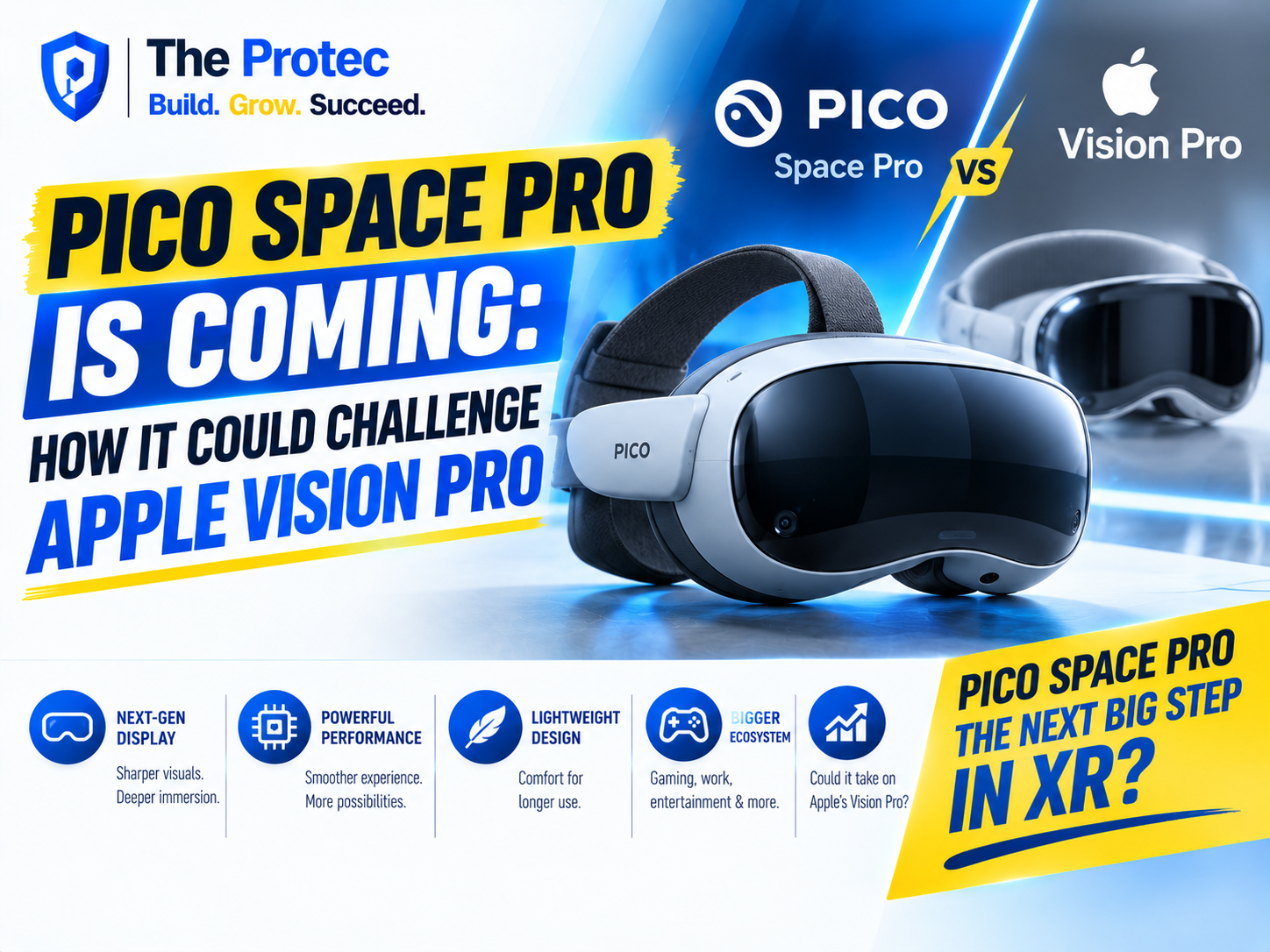
The premium mixed-reality market is about to become considerably more interesting. ByteDance’s PICO is reportedly preparing a new flagship headset called PICO Space Pro, and early details suggest it will aim far beyond the company’s familiar consumer VR territory.
Rather than simply replacing an existing PICO VR headset, Space Pro appears positioned as a high-end spatial computing device built around micro-OLED displays, advanced passthrough and a more compact form factor. Its rumored connection to an internal effort called Project Swan also points to a broader attempt to challenge the assumptions established by Apple Vision Pro.
The headline claim is an extremely high display density of approximately 4,000 pixels per inch. If PICO can pair that clarity with effective optics, accurate tracking and a price below Apple’s headset, the result could be a compelling Apple Vision Pro alternative. It would also place Space Pro in direct competition with Samsung Galaxy XR and the wider Android XR ecosystem.
However, important questions remain. Can PICO build a headset that is genuinely comfortable? Will its software match the hardware? And when will people actually be able to buy it? Here is what the latest information available as of September 2026 tells us—and what remains unconfirmed.
What Is PICO Space Pro?
PICO Space Pro is the name associated with ByteDance’s upcoming premium mixed-reality headset. Unlike the more gaming-oriented PICO 4 family, the new model is expected to emphasize spatial applications, entertainment, productivity and high-quality mixed reality.
ByteDance acquired PICO in 2021, giving the social media giant an established hardware platform, a VR operating system and access to international markets. PICO subsequently competed most directly with Meta, particularly in regions where Meta’s headsets were widely available. Space Pro would move the brand into a more ambitious category occupied by Apple Vision Pro and Samsung Galaxy XR.
This distinction matters. A premium PICO mixed reality headset needs more than faster processors and higher display resolution. It must blend digital content with the physical world, support intuitive eye and hand input, and remain comfortable during movies, work sessions and immersive experiences. That is a much broader challenge than producing a conventional standalone gaming headset.
PICO has not yet published a complete specification sheet, retail price or final launch schedule for Space Pro. Consequently, reported details should be treated as developing information rather than guaranteed production specifications.
PICO Space Pro Micro-OLED Displays Could Be Its Defining Feature
The most intriguing PICO Space Pro specs concern its displays. Reports have linked the headset to micro-OLED panels with a pixel density near 4,000 PPI. That would put visual sharpness at the center of the product’s appeal.
Micro-OLED differs from the larger LCD panels used in many mainstream VR headsets. The technology deposits OLED pixels onto a silicon backplane, enabling extremely small pixels, strong contrast and deep black levels. It is particularly well suited to compact head-mounted displays where image quality must be delivered only a short distance from the wearer’s eyes.
A PICO Space Pro 4000 PPI display could improve several aspects of the experience:
- Text legibility: Higher pixel density can make browser windows, menus and virtual monitors easier to read.
- Reduced screen-door effect: Smaller gaps between pixels help images appear continuous rather than grid-like.
- Sharper immersive video: Fine details in spatial footage and high-resolution films can remain visible across the field of view.
- More convincing mixed reality: Clear virtual objects can sit more naturally beside real-world surfaces.
- Smaller optical systems: Compact microdisplays may help PICO pursue a thinner visor, depending on the lenses and cooling design.
Pixel density alone does not determine perceived quality, however. Panel resolution, brightness, refresh rate, field of view, lens distortion and optical efficiency all matter. A 4,000 PPI figure sounds impressive, but users will judge the complete image delivered through the lenses—not the panel specification in isolation.
Expected PICO Space Pro Specs Beyond the Display
No final PICO Space Pro specs have been confirmed publicly, but a credible premium headset requires a predictable set of capabilities. The device is expected to use a standalone extended-reality processor rather than relying on a connected PC. A recent Qualcomm XR platform or customized successor would be a logical choice, although ByteDance has not confirmed the chipset.
Other likely features include:
- High-resolution color passthrough cameras for mixed reality
- Inside-out positional tracking without external base stations
- Eye tracking for interface control and foveated rendering
- Natural hand tracking alongside optional motion controllers
- Spatial mapping and scene understanding
- Integrated spatial audio and multiple microphones
- Wi-Fi connectivity for streaming and cloud-based services
- A detachable or rear-mounted battery to reduce facial pressure
Eye tracking would be particularly important. Foveated rendering allows the headset to devote its graphics resources to the area at which the wearer is looking while reducing detail in peripheral vision. That could make high-resolution micro-OLED panels practical without demanding that every pixel be rendered at maximum quality continuously.
Passthrough will be another decisive specification. Low latency, convincing scale and readable real-world detail are essential if PICO expects users to walk around, find a keyboard or interact with people while wearing the headset. Apple has made passthrough central to the Vision Pro experience, while Google and Samsung have treated it as a foundation of Android XR.
How Project Swan May Connect to PICO Space Pro
Project Swan has been associated with PICO’s development of a high-end spatial computing platform. Although the relationship has not been explained through a detailed public announcement, Space Pro is widely viewed as the potential commercial expression of that work.
The codename suggests the headset may represent more than an incremental hardware update. Project Swan could encompass industrial design, optics, interaction methods, software and content tools intended to create a cohesive premium experience.
That cohesion is crucial. Apple Vision Pro demonstrated that polished window management, eye tracking and hand gestures can make a headset approachable without requiring controllers for every action. Samsung Galaxy XR has answered with an AI-centered approach based on Google’s Android XR platform. PICO needs its own clear interaction model rather than a collection of impressive components.
ByteDance also brings expertise in recommendation systems, short-form video, creator tools and social platforms. Those strengths could influence Space Pro’s software, although the company must avoid making the device feel like hardware built around a single social application.
PICO vs Apple Vision Pro: Where Could Space Pro Compete?
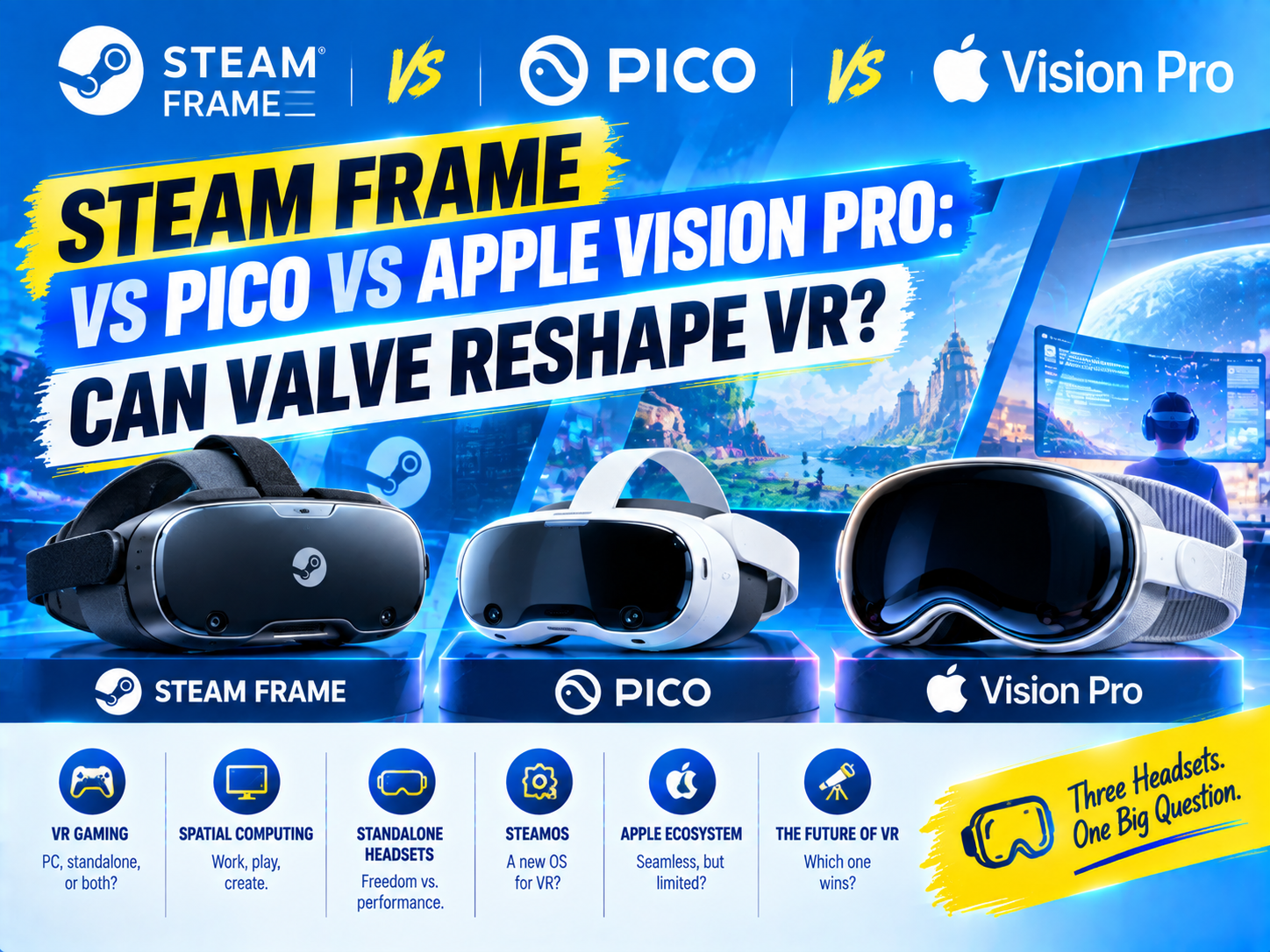
The PICO vs Apple Vision Pro comparison begins with display quality, but it will not end there. Vision Pro established a high visual benchmark through its dual micro-OLED system, precise eye tracking and polished visionOS interface. Apple also benefits from deep integration with Mac, iPhone, iCloud and its broader developer ecosystem.
PICO is unlikely to defeat Apple by copying that formula feature for feature. Its opportunity lies in addressing the compromises that have limited premium spatial computing adoption.
A Lighter, More Wearable Design
Weight distribution remains one of the category’s largest problems. A technically advanced headset can become uncomfortable if its mass sits primarily on the cheeks and forehead. Reports surrounding PICO Space Pro have emphasized compactness, raising hopes for a lighter visor or a design that moves the battery away from the face.
A lower number on the scale would help, but balance, strap design, ventilation and facial interface materials are equally important. PICO must deliver comfort over an entire film or work session, not just during a short demonstration.
A More Accessible Price
Apple Vision Pro’s premium pricing restricts its audience, even as Apple continues refining the hardware. PICO could create a stronger consumer proposition by preserving high-end displays while accepting carefully chosen compromises elsewhere.
Space Pro does not need to be inexpensive in absolute terms. It needs to feel attainable relative to Vision Pro and sufficiently differentiated from mainstream gaming headsets. A price positioned between mass-market VR and Apple’s premium tier could attract enthusiasts, developers and early spatial-computing users.
Fewer Ecosystem Advantages
Apple’s greatest defense may be its ecosystem rather than any individual specification. PICO currently lacks an equivalent to macOS integration, Apple’s retail support network or the depth of established iOS developer relationships. Even sharper displays will not compensate for an empty application catalog.
ByteDance must therefore make development straightforward, preserve compatibility where possible and fund experiences that demonstrate why Space Pro exists. Productivity tools, immersive media and creator applications will be especially important.
Could It Be a Samsung Galaxy XR Alternative?
Samsung Galaxy XR occupies a strategically important middle ground. It combines Samsung hardware, Google software and Qualcomm processing in a device designed around multimodal AI, spatial applications and premium entertainment. It is also more affordable than Apple Vision Pro, making it an obvious reference point for PICO.
As a Samsung Galaxy XR alternative, Space Pro could distinguish itself through display density, a slimmer design and PICO’s existing VR content base. Samsung, however, has major advantages in global distribution, brand recognition and integration with Android phones and services.
The competition may ultimately come down to priorities. Galaxy XR offers access to a broad platform backed by Google and Samsung. PICO Space Pro could appeal to buyers who value specialized VR hardware, display clarity and aggressive pricing. Apple remains the option with the most tightly controlled hardware-and-software stack.
PICO Space Pro Price and Release Date Expectations
There is no officially confirmed PICO Space Pro price as of September 2026. Based on its rumored micro-OLED hardware and premium positioning, it would be unrealistic to expect pricing comparable to an entry-level standalone VR headset. Microdisplays, advanced sensors and high-performance processors remain expensive.
A competitive strategy would place Space Pro below Apple Vision Pro while challenging Samsung Galaxy XR on value. That still leaves a broad potential range, and regional availability, storage capacity and included controllers could substantially affect the final cost.
The PICO Space Pro release date is similarly unsettled. Reports point toward a late-2026 introduction or a launch extending into a later market window, but PICO has not provided a firm retail date. Component yields, software readiness and regional certification could all influence timing.
Anyone searching for PICO Space Pro 2026 availability should distinguish between an announcement, developer access and general retail sales. Premium headsets sometimes debut in limited markets before expanding, and PICO’s previous hardware has not been sold uniformly worldwide.
What Could Prevent PICO Space Pro From Succeeding?
Hardware ambition does not guarantee commercial success. PICO faces several significant obstacles:
- Software depth: A premium headset needs applications that justify repeated use.
- Geographic availability: Limited distribution would reduce developer interest and consumer awareness.
- Battery life: High-resolution displays and continuous camera processing demand substantial power.
- Thermal management: A thinner visor must still dissipate heat quietly and safely.
- Trust and privacy: Eye tracking, room mapping and outward-facing cameras require transparent data controls.
- Pricing pressure: Space Pro must cover expensive components without drifting too close to Apple’s price.
The headset also needs a clear identity. If it is marketed only as a cheaper Vision Pro, it will remain defined by Apple. PICO must show how its combination of VR, mixed reality and creator-focused services produces a distinct experience.
Why PICO Space Pro Could Push Mixed Reality Forward
The most important impact of the ByteDance VR headset may be competitive pressure. Apple proved that consumers care about exceptionally sharp displays and natural input. Samsung and Google expanded the field with Android XR. PICO can now challenge both approaches by pushing high-density micro-OLED hardware toward a potentially lower price.
If Space Pro is lighter, sharp enough for comfortable text and accessible to a broader audience, it could help move mixed reality beyond expensive demonstrations. It could also pressure rivals to improve ergonomics, lower prices and invest in better immersive content.
That outcome is not assured. The rumored specifications are promising, but execution will determine whether PICO Space Pro becomes a serious platform or another impressive headset searching for a daily purpose. The product to watch is not simply the one with the most pixels—it is the one people still want to wear after the novelty fades.
Frequently Asked Questions
What is PICO Space Pro?
PICO Space Pro is a rumored premium standalone mixed-reality headset being developed by ByteDance-owned PICO. It is expected to focus on high-resolution micro-OLED displays, color passthrough, eye and hand tracking, spatial applications and a more compact design.
Does PICO Space Pro have 4,000 PPI displays?
Reports have associated the headset with micro-OLED panels offering approximately 4,000 PPI. PICO has not yet released a final public specification sheet, so the exact panel resolution, size, brightness and production configuration remain unconfirmed.
When is the PICO Space Pro release date?
No firm release date has been announced. Current expectations point to a late-2026 unveiling or a later commercial rollout, potentially beginning in selected markets. An announcement date should not be assumed to be the same as widespread retail availability.
How much will PICO Space Pro cost?
The PICO Space Pro price is not confirmed. Its micro-OLED displays and premium sensors suggest it will cost more than mainstream PICO headsets, but ByteDance has an opportunity to position it below Apple Vision Pro and competitively against Samsung Galaxy XR.
Will PICO Space Pro be better than Apple Vision Pro?
It may be lighter, less expensive or sharper in specific measurements, but overall quality will depend on optics, passthrough, tracking, applications and comfort. Apple retains major ecosystem advantages, while PICO’s strongest route to success is delivering premium mixed reality with fewer cost and weight barriers.