








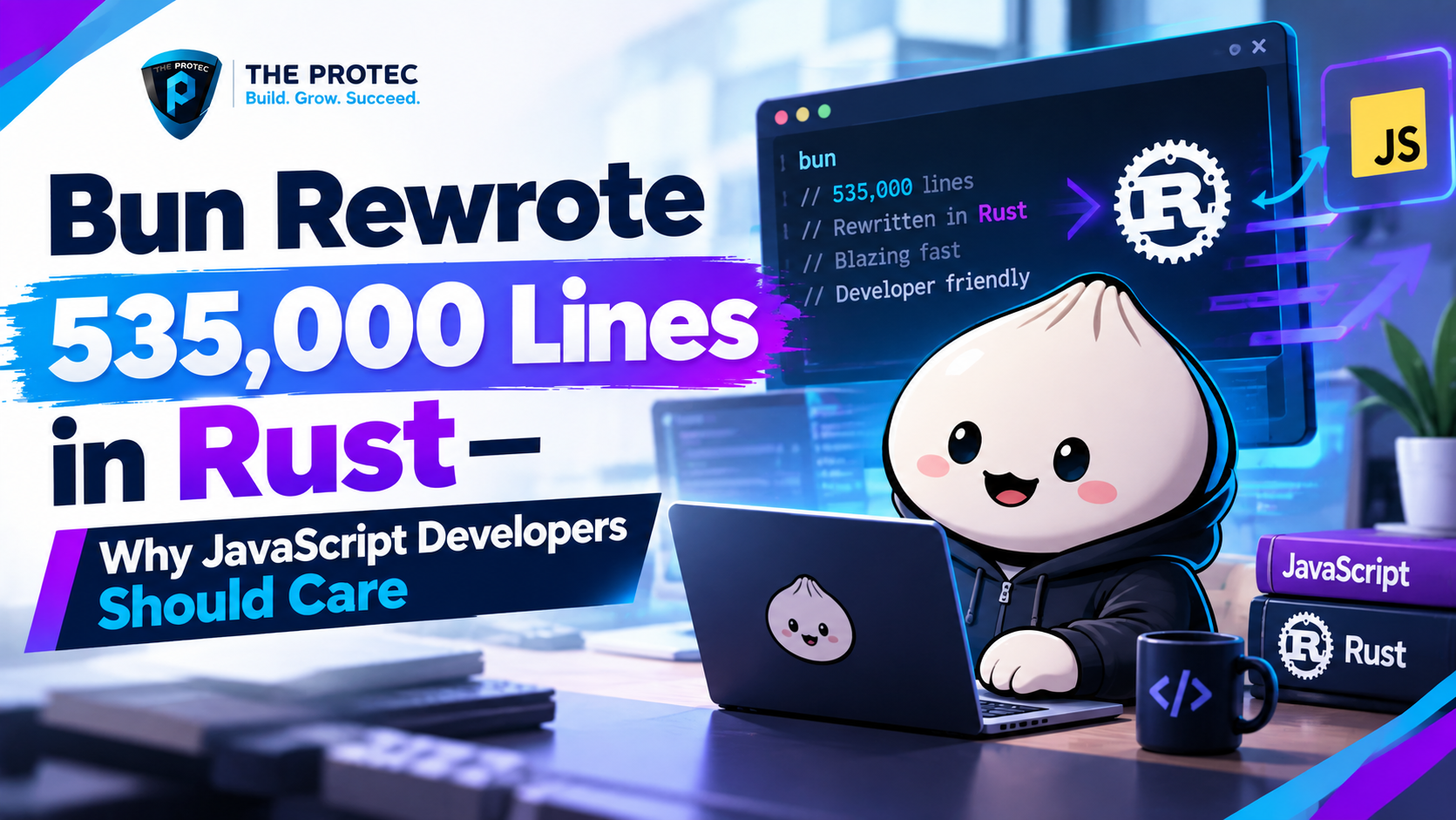
Rewriting a production JavaScript runtime is the kind of project developers and engineering teams normally avoid. It is expensive, risky, and full of subtle compatibility traps. Yet Bun reportedly migrated roughly 535,496 lines of its Zig codebase to Rust, completing the mechanical port in about 11 days and carrying the broader effort through validation and the stable Bun 1.4 release in roughly four months.
Those numbers are attention-grabbing, but they are not the most important part of the story. The Bun Rust rewrite was not simply a case of asking an AI model to translate one language into another. It depended on years of architectural work, a language-independent TypeScript test suite, parallel Claude coding agents, automated porting workflows, compiler feedback, adversarial review, security audits, fuzzing, and experienced engineers deciding what could safely change.
For JavaScript developers, Bun’s migration offers a practical look at three trends converging at once: memory-safe systems programming, increasingly capable AI coding agents, and growing competition among JavaScript runtimes and developer tools.
What Actually Changed in the Bun Rust Rewrite?
Bun began as a high-performance JavaScript runtime and toolkit written primarily in Zig around Apple’s JavaScriptCore engine. It combines functionality commonly spread across a runtime, package manager, test runner, bundler, and other JavaScript tooling. That integrated design helped position Bun as a prominent Node.js alternative.
The Bun 1.4 project moved approximately 535,496 lines from Zig to the Rust programming language. That figure describes a major codebase migration; it should not be interpreted as every dependency or every underlying component suddenly becoming Rust. JavaScriptCore, for example, remains a separate engine with its own implementation.
Even with that qualification, the scale is exceptional. A Bun rewritten in Rust changes the safety model of a large portion of the runtime while attempting to preserve behavior visible to JavaScript and TypeScript applications.
The 11-Day Port and Four-Month Release Timeline
The timeline requires careful explanation. Current reporting distinguishes between the initial mechanical port and the complete production effort. The bulk translation of the Zig source was completed in approximately 11 days using automated workflows and parallel AI coding agents. That did not mean a production-ready runtime appeared on day 12.
The subsequent work included fixing semantic mismatches, investigating test failures, reviewing unsafe boundaries, addressing security findings, running fuzzers, measuring Bun performance, and preparing the stable Bun 1.4 release. Measured from the initial effort to the completed release, the project is described as taking about four months.
This distinction matters because source translation is only one stage of a rewrite. A runtime must preserve module resolution, file-system behavior, package installation, process APIs, networking, testing semantics, and countless edge cases that real applications depend on. Generated code compiling successfully is a milestone—not proof of compatibility or security.
Why Bun Moved from Zig to Rust
Bun creator Jarred Sumner identified recurring use-after-free bugs, double-free errors, and memory leaks as major motivations for the migration. These problems are especially dangerous in a runtime, where long-lived processes repeatedly allocate memory and process input from packages, applications, files, networks, and developer tools.
Zig gives systems programmers precise control over memory and provides useful safety checks, particularly in development configurations. That control is valuable, but it also places substantial responsibility on the programmer and the surrounding conventions. Manual memory-management mistakes can survive into complex production code.
Rust takes a different approach. Its ownership rules, lifetimes, and borrow checker reject many unsafe patterns during compilation. A reference cannot normally outlive the value it points to, and mutation or ownership transfers must satisfy explicit constraints. As a result, many use-after-free and double-free scenarios become compiler errors rather than runtime incidents.
Rust memory safety does not make software automatically correct. Logic bugs, deadlocks, resource exhaustion, unsafe blocks, foreign-function interfaces, and memory leaks can still occur. Rust can leak memory without violating its safety guarantees. Nevertheless, the language moves a broad category of failures from testing and production into the compiler feedback loop.
The Bun Zig Rust comparison is therefore more useful as an engineering trade-off than as a language contest. Zig emphasizes simplicity, control, and explicit allocation. Rust accepts a steeper ownership model in exchange for stronger compile-time guarantees. Bun concluded that those guarantees better matched the needs of its growing JavaScript runtime.
How AI Coding Agents Made the Rewrite Possible
The Bun Rust rewrite demonstrates a more mature model of AI-assisted coding than copying a prompt into a chatbot. The team divided work into bounded tasks and ran multiple Claude coding agents in parallel. Agents could port modules, react to compiler diagnostics, run tests, and iterate on failures without requiring a human to type every translated function.
Automated Porting in Manageable Units
Large rewrites become more tractable when the codebase is decomposed into packages, files, interfaces, or dependency layers. Instead of translating all 535,000-plus lines as one operation, automated workflows could assign constrained areas to separate agents. Smaller scopes reduced context pressure and made failures easier to isolate.
The Compiler as a Continuous Reviewer
Rust’s compiler was central to the process. A coding agent could produce an initial translation, receive precise errors about ownership, borrowing, types, or concurrency constraints, and revise the implementation. This created a rapid loop in which AI generated candidate code while the compiler enforced rules that prose instructions alone could not reliably guarantee.
That pairing is significant for AI software development. Strong type systems and strict compilers provide machine-readable feedback, making them valuable partners for coding agents. Rust can be difficult for humans to learn, but its explicit constraints also give agents a clear signal when a proposed implementation is structurally invalid.
Parallel Agents and Adversarial Review
Parallelism shortened the mechanical phase, but independent review helped control its risks. Code produced by one agent could be examined by another agent tasked with finding incorrect assumptions, unsafe shortcuts, incomplete error handling, or behavior that diverged from the original implementation.
This adversarial approach is more robust than asking the same model to approve its own output. Human engineers still had to define acceptance criteria, investigate ambiguous failures, review sensitive code, and decide when translation should give way to redesign.
TypeScript Tests Were the Rewrite’s Real Foundation
Bun’s language-independent TypeScript test suite made the migration possible without tying correctness to either Zig or Rust. The tests described observable behavior through the public interfaces JavaScript developers actually use. Both implementations could therefore be evaluated against the same expectations.
This is one of the rewrite’s most transferable lessons. A comprehensive behavioral test suite acts as an executable specification. It lets a team replace internal implementation details while continuously checking that package APIs, command-line behavior, error handling, and compatibility remain stable.
Tests are not perfect specifications, of course. They only cover scenarios someone anticipated. But without a broad implementation-neutral suite, an AI code rewrite of this scale would amount to hundreds of thousands of lines with no reliable definition of equivalent behavior.
Why Security Reviews and Fuzzing Still Mattered
Compiler success and passing unit tests were not the finish line. Runtime code accepts complex and sometimes hostile inputs, so Bun’s validation included security review and fuzzing. Fuzzers generate unusual combinations of data and operations that conventional tests may miss, helping uncover crashes, parser failures, state corruption, and unexpected interactions.
Reviewers also had to inspect unsafe Rust, native interfaces, allocation-sensitive paths, and assumptions inherited from the Zig implementation. Rust memory safety narrows the risk surface, but boundaries involving JavaScriptCore, operating-system APIs, and low-level libraries still demand careful engineering.
What Bun 1.4 Means for JavaScript Developers
Most application developers will never interact directly with the Rust borrow checker, but they can benefit from the guarantees it provides. Fewer memory-corruption defects may mean more predictable development servers, test runs, package installations, and production services. Reducing Bun memory leaks is particularly relevant for servers and build processes that stay alive for long periods.
The migration could also improve maintainability. When ownership expectations are encoded in types, future contributors receive immediate feedback when a change violates them. That matters as Bun expands and as AI coding agents contribute a larger share of routine implementation work.
However, developers should separate safety claims from Bun performance claims. Rewriting code in Rust does not automatically make every workload faster. Performance depends on algorithms, allocation patterns, I/O, engine behavior, compiler optimizations, and application characteristics. Teams evaluating Bun vs Node.js should benchmark their own services rather than extrapolating from a language choice.
Compatibility remains equally important. Node.js has a mature ecosystem, extensive operational knowledge, and broad library support. Bun’s integrated tooling and speed may be compelling, but adoption decisions should include package compatibility, observability, deployment infrastructure, startup time, memory consumption, and failure behavior.
Rust Adoption Across the JavaScript Ecosystem
Bun joins a wider movement toward Rust-based JavaScript tooling. Bundlers, compilers, linters, formatters, package tools, and framework internals increasingly use Rust to combine native performance with stronger memory-safety guarantees. Application code can remain JavaScript or TypeScript while performance-sensitive infrastructure moves underneath it.
This layered model is likely to matter more than a simplistic Rust JavaScript rivalry. JavaScript remains productive for application logic and benefits from an enormous ecosystem. Rust is increasingly used where tools need predictable resource management, parallel execution, native integration, or protection from memory corruption.
Developers interested in the technical foundations can explore the Rust ownership model, while release and runtime details are available through the official Bun blog.
A New Model for AI-Assisted Software Development
The headline that AI generated or translated hundreds of thousands of lines can create the wrong impression. Lines of code are an output metric, not a quality metric. The meaningful achievement was constructing a system in which generated changes could be constrained, compiled, tested, challenged, fuzzed, reviewed, and either accepted or rejected.
This model could make previously impractical migrations more feasible. Teams may use AI coding agents to modernize legacy modules, replace unsafe components, adopt stronger type systems, or maintain parallel implementations during gradual transitions. The economic boundary of a rewrite changes when agents can perform repetitive translation and correction around the clock.
But Bun’s experience also establishes the prerequisites. AI-assisted software development works best when a project has clear module boundaries, deterministic builds, strong automated tests, useful compiler diagnostics, reproducible benchmarks, security processes, and engineers capable of recognizing plausible but incorrect code.
Lessons Engineering Teams Should Take from Bun
- Build tests before attempting a rewrite. Behavior-focused tests provide a stable target independent of implementation language.
- Use AI for bounded execution. Narrow tasks, explicit interfaces, and automated checks are safer than unrestricted repository-wide generation.
- Choose feedback-rich tools. Compilers, linters, tests, sanitizers, and fuzzers give agents objective signals.
- Separate translation from release readiness. An 11-day port can still require months of validation.
- Keep humans responsible for risk. Architecture, security decisions, performance trade-offs, and final approval cannot be delegated blindly.
Frequently Asked Questions
Did Bun really rewrite 535,496 lines in only 11 days?
The reported 11-day figure refers to the main mechanical port from Zig to Rust. Validation, debugging, security work, fuzzing, performance analysis, and preparation for the stable Bun 1.4 release extended the overall project to roughly four months.
Why did Bun choose Rust instead of remaining with Zig?
Recurring use-after-free bugs, double-free errors, and memory leaks were major motivations. Rust’s ownership model and borrow checker can prevent many memory-safety mistakes at compile time, although they do not eliminate logic errors or every possible leak.
Was the Bun Rust rewrite completed entirely by AI?
No. Claude coding agents accelerated translation and iteration, but the project relied on human-designed architecture, an extensive TypeScript test suite, compiler enforcement, adversarial review, security analysis, fuzzing, and human engineering judgment.
Does Bun’s Rust rewrite make it better than Node.js?
Not universally. The rewrite may improve safety and maintainability, while Bun’s integrated tools can offer performance and workflow advantages. Node.js still provides exceptional ecosystem maturity and compatibility. The right choice depends on an application’s packages, infrastructure, performance profile, and operational requirements.
The Bigger Story Is the Engineering System
Bun 1.4 is an important milestone for memory-safe JavaScript infrastructure, but its broader significance lies in how the work was organized. AI accelerated a huge Rust migration because the agents operated inside a disciplined engineering system built from tests, compiler constraints, reviews, fuzzing, and measurable release criteria.
That is why JavaScript developers should care. The future of AI coding is not merely faster code generation. It is the ability to attempt ambitious infrastructure changes while using stronger languages and automated evidence to keep those changes accountable. Bun’s rewrite suggests that large migrations can become dramatically faster—but only when human engineering rigor scales alongside the machines.