







The next major smartphone performance contest is no longer just about benchmark scores. The Snapdragon 8 Elite Gen 6 vs Apple A20 Pro battle marks the arrival of 2nm-class silicon in premium phones, bringing denser transistors, ambitious CPU frequencies and increasingly capable on-device artificial intelligence.
Qualcomm is targeting the broad premium Android market with its Snapdragon 8 Elite Gen 6 family, including a higher-binned Snapdragon 8 Elite Extreme Gen 6. Apple, meanwhile, is using the A20 Pro to power its iPhone 18 Pro generation. Both platforms promise substantial gains, but they pursue them through different hardware, software and thermal strategies.
As of September 2026, early benchmark results require careful interpretation. Reference devices, engineering samples and short benchmark runs do not necessarily represent finished retail phones. This comparison therefore separates confirmed architectural direction from preliminary testing—and keeps standard Snapdragon 8 Elite Gen 6 results distinct from Extreme Gen 6 numbers.
Snapdragon 8 Elite Gen 6 vs A20 Pro: Key Differences
The headline similarity is the move to a 2nm-class manufacturing process. Smaller process technology can increase transistor density and improve performance per watt, but the node alone does not decide the winner. Chip layout, cache, voltage management, packaging, memory and phone cooling remain critical.
- Snapdragon 8 Elite Gen 6: Qualcomm Oryon CPU, Adreno GPU, Hexagon NPU and support for a wide range of premium Android devices.
- Snapdragon 8 Elite Extreme Gen 6: A more aggressively binned version intended to deliver higher peak performance under suitable power and cooling conditions.
- Apple A20 Pro: Apple-designed CPU and GPU cores, tightly integrated memory and a dual Neural Engine approach optimized for the iPhone 18 Pro hardware and software stack.
This is consequently more than a simple Snapdragon vs Apple chip comparison. Qualcomm must build a platform that works across several manufacturers and phone designs. Apple can tune its Apple 2nm chip, operating system, compilers and applications for a much smaller set of devices.
CPU Performance: Qualcomm Oryon Reaches 5GHz
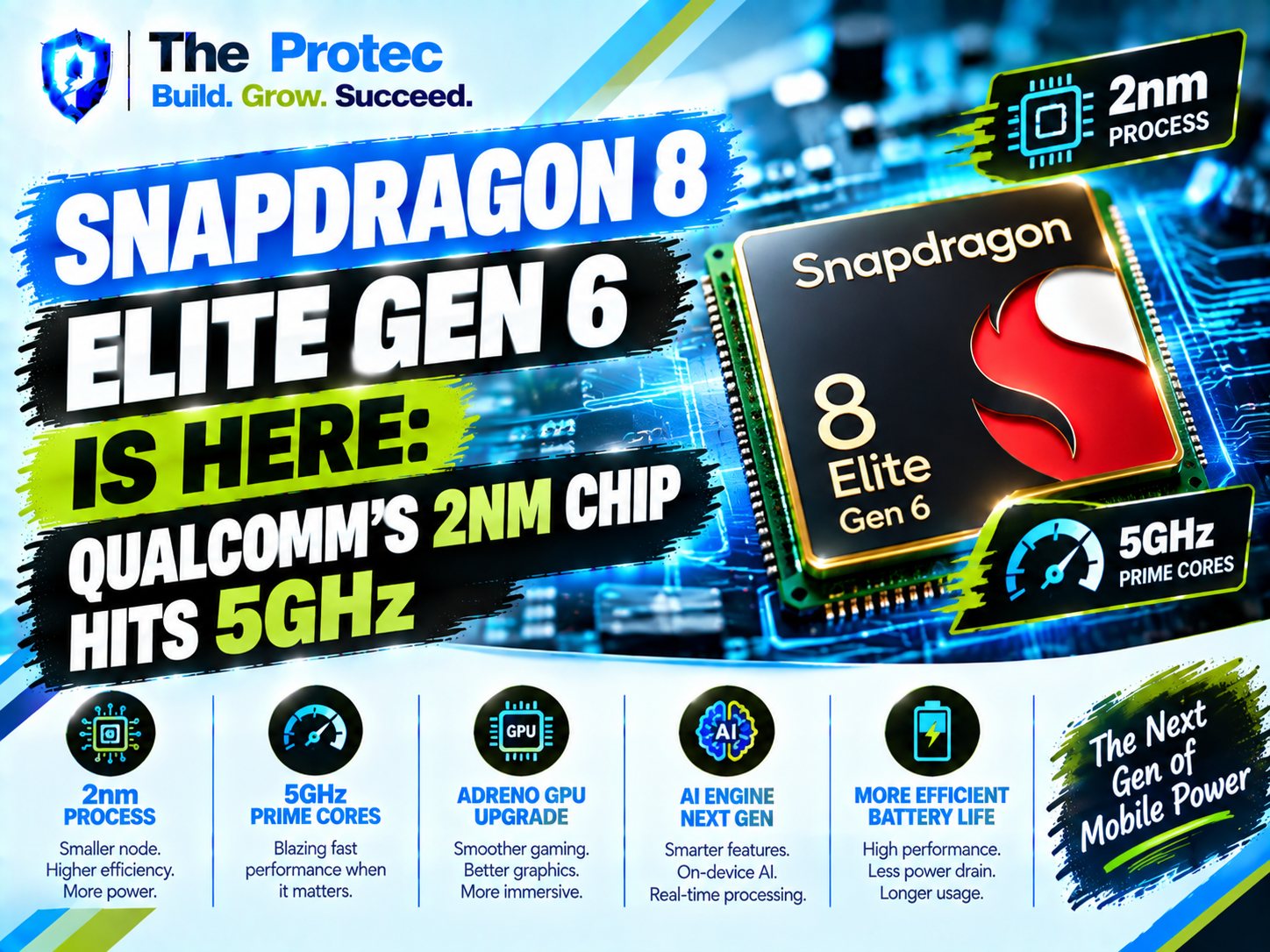
The most attention-grabbing feature is the reported Snapdragon 8 Elite Gen 6 5GHz peak clock. Qualcomm reaches that level through its custom Oryon CPU architecture, advanced process technology, selective chip binning and an operating point designed for brief, demanding bursts.
A 5GHz specification does not mean every CPU core runs at 5GHz continuously. It generally applies to the fastest prime core under favorable thermal and power conditions. The processor must increase voltage as frequency rises, and power consumption can climb sharply near the top of the frequency curve. Cache capacity and low-latency memory access also help Oryon complete more work without constantly reaching external memory.
This design should make Snapdragon 8 Elite Gen 6 performance especially strong in application launches, browser workloads and other short CPU tasks. The Extreme model may hold its maximum frequency longer in a well-cooled gaming phone, but that outcome cannot be assumed for every handset.
The A20 Pro performance strategy is less dependent on promoting one headline frequency. Apple traditionally combines high instructions-per-clock throughput, large caches, efficient branch prediction and deep integration with iOS. That can produce fast responsiveness without requiring the highest advertised clock.
In single-core testing, the contest will depend on whether Qualcomm’s clock advantage can overcome Apple’s per-clock efficiency. In multicore workloads, core configuration, scheduler behavior and thermal limits become equally important. A short Snapdragon 8 Elite Gen 6 benchmark may favor peak speed, while a longer video export could reveal a different result.
Adreno vs A20 Pro GPU: Gaming Becomes the Key Contest
The Snapdragon 8 Elite Gen 6 GPU is the latest Adreno design, and gaming is likely to be one of Qualcomm’s strongest areas. Adreno architectures have delivered competitive rasterized graphics, improving ray tracing and mature support for high-refresh Android displays. Qualcomm also supplies game-focused driver and upscaling technologies to manufacturers.
The A20 Pro GPU benefits from Apple’s control over Metal, iOS and the target hardware. Developers can optimize for a limited selection of devices, which reduces some of the variability found across Android phones. Apple is also likely to emphasize console-style effects, hardware-accelerated ray tracing and upscaling for premium games.
Peak frame rates tell only part of the story. A useful GPU comparison should measure:
- Performance after 20 to 30 minutes of continuous play
- Frame-time consistency rather than average frames per second alone
- Power consumption at matched graphics settings
- Ray-tracing performance and visual quality
- Device temperature and display brightness reduction
The Extreme Gen 6 may lead some short graphics tests, particularly in phones with large vapor chambers. It should not be presented as the standard chip’s result. Likewise, an actively cooled reference device is not representative of a thin retail flagship.
Snapdragon AI vs Apple Neural Engine
On-device AI is now central to smartphone chip performance. The Snapdragon 8 Elite Gen 6 AI platform combines the Hexagon NPU with CPU, GPU and sensor-processing resources. Qualcomm’s heterogeneous approach allows software to assign different operations to the engine best suited to them.
Potential workloads include live translation, voice transcription, image generation, photo editing, camera enhancement and local assistants. The platform’s value will depend on supported model formats, memory capacity and whether applications can use the NPU without falling back to less efficient processing.
The A20 Pro AI performance story centers on a dual Neural Engine architecture. Its two AI-processing resources can divide latency-sensitive and high-throughput workloads while working with Apple’s CPU, GPU and software frameworks. Integration with iOS gives Apple an opportunity to optimize system features around a predictable hardware target.
Raw operations-per-second claims are not directly comparable. Precision, sparsity, model compilation, memory movement and supported operators can change real performance dramatically. The best mobile AI processor will be the one that completes useful models quickly while consuming less energy and keeping data on the device—not necessarily the chip with the largest theoretical number.
2nm Efficiency and Sustained Performance
Both the Snapdragon 8 Elite Gen 6 2nm platform and A20 Pro 2nm design should gain from improved transistor density. Yet 2nm does not make heat disappear. A manufacturer can spend the efficiency improvement on longer battery life, higher speed or a mixture of both.
Qualcomm’s challenge is variation across Android hardware. A thick gaming phone with active cooling may sustain the Qualcomm 2nm chip at far higher power than a slim camera flagship. Battery size, chassis material, cooling area and manufacturer firmware can create meaningful differences between phones using the same processor.
Apple controls those variables more tightly. The company can tune its chip around the iPhone 18 Pro enclosure and battery, although that does not guarantee an automatic efficiency victory. Apple’s own thermal targets and device dimensions still determine how long the A20 Pro can maintain peak performance.
For sustained testing, reviewers should report the first run, lowest loop and stabilized score. Battery drain and external temperature matter as much as the final benchmark number. A processor that retains 85% of a slightly lower peak can feel faster than one that briefly leads before throttling heavily.
Memory Bandwidth and Real-World Responsiveness
Memory bandwidth is becoming more important as AI models, high-resolution games and computational photography compete for data. Qualcomm’s performance will vary with the memory configuration chosen by each Android manufacturer. Faster memory can help, but it may also increase platform power consumption.
Apple’s advantage is end-to-end control over its memory subsystem and software. The A20 Pro can be optimized around known memory capacity, compression behavior and application requirements. Neither company can rely on bandwidth alone, however. Large caches and efficient data reuse reduce the energy cost of moving information off-chip.
Memory should be evaluated through practical workloads: switching between large applications, processing ProRAW images, running local generative models and maintaining frame rates in complex games. These tests reveal more than a bandwidth specification viewed in isolation.
How to Read Snapdragon 8 Elite Gen 6 and A20 Pro Benchmarks
Independent results will become more useful as additional retail phones reach reviewers. Until then, any Snapdragon 8 Elite Gen 6 benchmark or A20 Pro benchmark should be checked for test conditions, device state and software version.
- Do not mix standard Gen 6 and Extreme Gen 6 results.
- Identify reference devices, engineering samples and active cooling.
- Compare phones at similar temperatures and battery levels.
- Use cross-platform tests cautiously because APIs and compilers differ.
- Prioritize repeated loops and energy use over one peak score.
Qualcomm’s official Snapdragon platform information and Apple’s Newsroom announcements are useful for specifications, but manufacturer claims should be paired with independent retail-device testing.
Real-World Smartphone Workloads
For most buyers, the meaningful question is not which chip wins every chart, but which one improves daily use. CPU speed influences browser responsiveness, code compilation and application loading. GPU performance affects gaming and creative interfaces. AI acceleration supports transcription, photo cleanup and personalized assistants.
The Snapdragon platform offers manufacturers flexibility. One phone may prioritize gaming, another cameras and another battery life. That variety can produce an Android device tuned for a particular buyer, but it also means Snapdragon 8 Elite Gen 6 performance will not be identical everywhere.
Apple offers consistency and close hardware-software integration. The A20 Pro may extract more predictable results from iPhone applications, especially when developers use Apple’s frameworks. The trade-off is that buyers cannot choose among radically different cooling systems or hardware formats using the same chip.
The Bigger Qualcomm vs Apple Silicon Battle
The search for the best smartphone processor 2026 reflects two competing platform strategies. Qualcomm wants its 2nm family to power premium Android flagships from multiple brands, with the Extreme version serving performance-focused devices. Apple uses the A20 Pro to differentiate the iPhone 18 Pro generation and reinforce its vertically integrated ecosystem.
The likely outcome is not a clean sweep. Qualcomm may lead selected GPU, multicore or AI workloads, particularly in aggressively cooled phones. Apple may retain advantages in single-threaded efficiency, software optimization or consistent sustained behavior. Retail implementation will determine which strengths reach users.
Final Verdict
The Snapdragon 8 Elite Gen 6 vs Apple A20 Pro contest is the most consequential mobile processor comparison of the early 2nm era. Qualcomm’s 5GHz Oryon CPU, Adreno graphics and Hexagon AI engine make it an ambitious platform with substantial peak-performance potential. Apple’s A20 Pro counters with a tightly integrated CPU, GPU, memory system and dual Neural Engine design.
No responsible verdict should be based solely on leaked scores or reference hardware. The decisive evidence will come from independent testing of retail phones, with standard and Extreme Gen 6 results clearly separated. Peak speed matters, but efficiency, sustained output and application support will decide which processor delivers the stronger experience.
Frequently Asked Questions
Is Snapdragon 8 Elite Gen 6 faster than Apple A20 Pro?
It may be faster in certain GPU, multicore or AI tests, while the A20 Pro may lead other CPU and efficiency workloads. A final answer requires independent comparisons using retail devices, current software and matched thermal conditions.
What is Snapdragon 8 Elite Extreme Gen 6?
The Snapdragon 8 Elite Extreme Gen 6 is a higher-performance member of Qualcomm’s family. It may use more aggressive frequency and power targets, so its benchmark results should never be attributed to the standard Snapdragon 8 Elite Gen 6.
Does the Snapdragon 8 Elite Gen 6 really run at 5GHz?
Its fastest Oryon CPU core can reach a peak frequency around 5GHz under appropriate conditions. That does not mean all cores remain at 5GHz, and sustained frequency depends on cooling, power limits and the phone manufacturer’s tuning.
Which chip is better for AI?
Qualcomm offers a flexible Hexagon-based platform across Android devices, while Apple integrates its dual Neural Engine closely with iOS. The better option depends on application support, model compatibility, memory requirements and measured energy efficiency rather than theoretical AI throughput alone.