







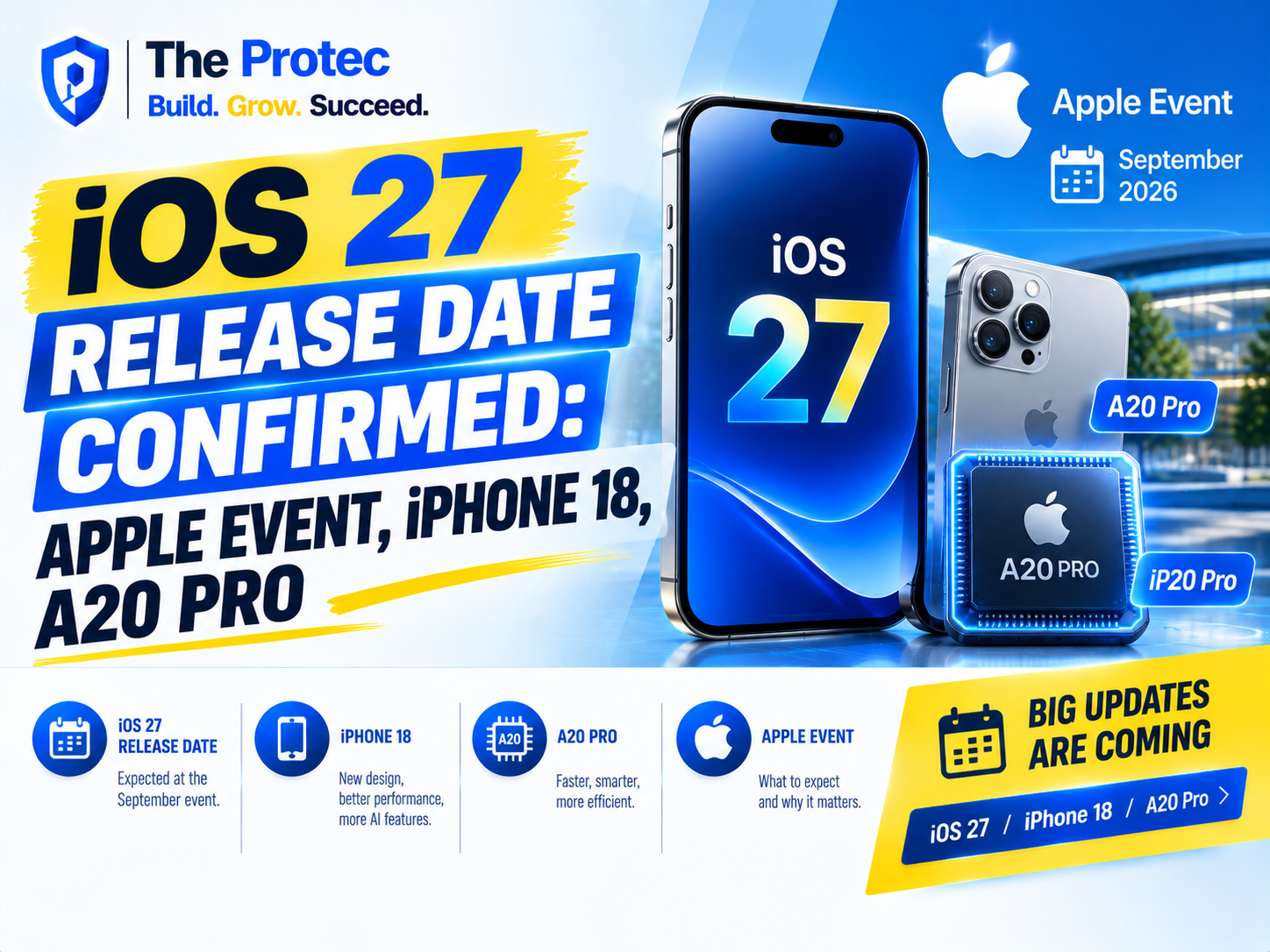
Apple’s September hardware event has answered the biggest question for iPhone users: the iOS 27 release date is Monday, September 14. The public rollout follows the September 8 Apple Event and arrives just before Apple’s newest Pro iPhones reach customers, maintaining the company’s familiar sequence of software first and hardware shortly afterward.
This release is about more than a routine annual update. iOS 27 brings Apple’s recent visual changes into a more mature phase, expands Apple Intelligence and gives Siri AI a more capable role across apps. On new hardware, it is also designed to take advantage of the Apple A20 Pro, the advanced chip powering the iPhone 18 Pro and iPhone 18 Pro Max.
The September Apple event also clarified Apple’s evolving iPhone strategy. The Pro models remain the flagship launch for the fall, while the standard iPhone 18 follows a different product cycle. That distinction matters for buyers deciding whether to upgrade immediately, wait for the regular iPhone 18 or install iOS 27 on an existing device.
When is the iOS 27 release date?
Apple confirmed that iOS 27 will be available as a free software update on Monday, September 14. Eligible users can expect the update to begin appearing through Settings under General and Software Update, although availability may roll out gradually across regions and devices during the day.
The final release comes after Apple introduced iOS 27 at its developer conference, distributed months of developer and public betas, and used the Apple event September 2026 presentation to demonstrate the software on shipping iPhone hardware. A release candidate delivered around the event gives developers a final opportunity to test apps before the public installation window opens.
Users who rely on an iPhone for work, travel or authentication may prefer to wait a day or two before upgrading. Major iOS releases can produce heavy download traffic, longer installation times and occasional compatibility issues with third-party apps. Backing up through iCloud or a computer remains the safest step before installation. Apple publishes release information and device guidance on its official iOS page.
What the Apple Event revealed about the iPhone 18 lineup
The September Apple event placed the iPhone 18 Pro and iPhone 18 Pro Max at the center of Apple’s premium strategy. Both phones ship with iOS 27 and the A20 Pro, giving Apple a tightly integrated platform for computational photography, gaming, local AI processing and more responsive system intelligence.
The regular iPhone 18 is part of Apple’s broader lineup, but the company’s staggered release strategy separates it from the fall Pro launch. That means shoppers should not assume every device carrying the iPhone 18 name will arrive at the same time or use identical silicon. The standard model is expected to occupy a more mainstream price and performance tier, while the Pro devices introduce the newest processor, camera systems and display technology first.
This distinction also helps explain searches for “iPhone 18 A20 Pro.” The A20 Pro is associated with the iPhone 18 Pro and iPhone 18 Pro Max, not necessarily every iPhone 18-branded model. Apple commonly differentiates its phones through GPU capability, memory bandwidth, media engines and advanced camera features, even when chips come from the same generation.
iPhone 18 Pro and iPhone 18 Pro Max
For Pro buyers, iOS 27 and the A20 Pro function as one platform rather than two separate upgrades. The operating system schedules AI workloads across the CPU, GPU and Neural Engine, while the chip supplies the processing power and efficiency needed to complete more tasks locally.
The iPhone 18 Pro Max offers the same core software experience as the smaller Pro model, with its larger body providing room for a bigger display and battery. The practical differences therefore center on size, endurance and camera configuration rather than access to basic iOS 27 features. Certain photography or AI functions may still depend on model-specific hardware.
Key iOS 27 features users will notice
Apple has treated iOS 27 as a refinement release as well as an intelligence upgrade. Instead of replacing the interface introduced by the previous generation, the company has concentrated on responsiveness, consistency and reducing friction in everyday interactions.
- A more polished interface: Apple has refined transparency, motion, controls and readability across the system. Menus and navigation feel more consistent without forcing users to relearn the iPhone.
- Expanded Apple Intelligence: More summarization, writing, image and contextual tools run across supported apps, with additional processing performed directly on the device.
- Smarter Siri AI: Siri can better understand follow-up requests, use relevant personal context and work with information visible on the screen.
- Improved cross-app actions: Supported requests can connect information and actions across multiple apps, reducing the number of manual steps required to complete a task.
- Communication upgrades: Messages, Phone and FaceTime gain better filtering, translation and assistance features intended to make conversations easier to manage.
- Performance and battery tuning: Scheduling improvements help iOS distribute background, graphics and AI workloads more efficiently on both existing and new iPhones.
- Stronger privacy controls: Apple continues to emphasize permission visibility, on-device processing and secure cloud execution for requests that need larger models.
The most important point is that access varies by hardware. Interface improvements, security updates and many app changes reach every supported iPhone. More demanding Apple Intelligence features require sufficient memory, Neural Engine performance and compatible processors.
Apple Intelligence and Siri AI move closer to the center
Apple Intelligence is no longer presented as a collection of isolated writing and image tools. In iOS 27, it acts more like a system layer connecting Siri, apps, personal data and on-device models. Apple’s objective is to make intelligence available when it is useful without turning every interaction into a separate chatbot session.
Siri AI is central to that approach. Improved language understanding allows the assistant to follow less precisely worded commands and retain context between related requests. On-screen awareness lets Siri respond to content a user is viewing, while personal context can help locate relevant messages, files, calendar details and other information when permission is available.
App actions are equally important. A useful assistant must do more than provide an answer; it needs to complete supported tasks. Apple is expanding the frameworks developers use to expose app functions securely, although the depth of integration will depend on developer adoption and the type of data involved.
Privacy remains Apple’s primary point of differentiation. Smaller tasks can run locally, while more complex requests may use Private Cloud Compute or an explicitly selected external model. The company says its architecture limits data exposure and verifies how cloud requests are processed. That approach may be less visibly aggressive than adding AI to every screen, but it supports Apple’s wider privacy positioning.
Which iPhones are compatible with iOS 27?
The iOS 27 compatible iPhones list begins with the iPhone 12 generation and includes newer mainstream, Pro and supported SE models. That covers the iPhone 12 family, iPhone 13 family, iPhone 14 series, iPhone 15 series, iPhone 16 generation, iPhone 17 generation and Apple’s newest iPhone 18 Pro models. The third-generation iPhone SE also remains within the supported range.
Compatibility does not guarantee an identical feature set. An iPhone 12 can receive the redesigned system components, app improvements and current security protections, but it lacks the newer processing and memory architecture needed for the complete Apple Intelligence experience. Recent Pro devices and Apple Intelligence-capable models receive more of the advanced Siri and generative features.
Owners of older supported phones should also consider battery condition and free storage before updating. iOS 27 is tuned for a broad hardware range, but a degraded battery or nearly full device can affect installation and post-update performance.
Why the Apple A20 Pro matters
The Apple A20 Pro is the hardware foundation for Apple’s most advanced iOS 27 experiences. Built using a leading-edge manufacturing process and paired with updated packaging and memory technologies, it is designed to improve performance per watt rather than chase peak speed alone.
A20 Pro performance spans several areas:
- CPU performance for app launches, browser workloads, productivity and complex system tasks.
- GPU performance for high-end games, sustained graphics and computational photography.
- Neural processing for local language models, image generation, transcription and Siri AI requests.
- Media acceleration for recording, editing and exporting high-resolution video efficiently.
- Power management that balances demanding workloads with battery life and thermal limits.
Raw speed remains important, but Apple’s larger advantage comes from controlling the chip, operating system and developer frameworks. An iOS 27 feature can be designed around specific A20 Pro accelerators, while developers gain access through consistent APIs rather than having to target several unrelated hardware configurations.
A20 Pro vs Snapdragon 8 Elite Gen 5
The A20 Pro vs Snapdragon 8 Elite Gen 5 comparison is relevant because Qualcomm’s platform powers a range of premium Android phones still competing with Apple’s newest devices. However, it is not a perfectly direct contest. Qualcomm supplies a processor to multiple manufacturers, while Apple designs the A20 Pro exclusively for its own hardware and software stack.
Apple traditionally performs strongly in single-core CPU workloads, sustained app responsiveness and media processing. The A20 Pro also benefits from iOS optimization and close integration with Apple’s graphics and machine-learning frameworks. Those advantages can translate into fast creative workflows and predictable performance across supported applications.
Snapdragon 8 Elite Gen 5 devices may be highly competitive in multicore workloads, GPU-heavy gaming and vendor-specific AI features. Results can vary substantially depending on cooling, battery capacity, memory speed and software tuning chosen by each Android manufacturer. Qualcomm provides detailed platform information through its Snapdragon product portal.
Benchmark scores alone should not decide the comparison. Sustained performance, energy use and application support matter more than a short peak result. For Apple, the strongest A20 Pro argument is how efficiently it runs iOS 27 features, particularly camera processing and private on-device AI. Snapdragon’s advantage is flexibility across different device designs and a broad Android ecosystem.
How iOS 27 fits Apple’s broader strategy
The iOS 27 Apple Event story reveals a company aligning product schedules around premium hardware, services and AI. The fall launch gives the iPhone 18 Pro and iPhone 18 Pro Max maximum visibility, while a staggered standard iPhone cycle lets Apple address different buying seasons without placing every model into one crowded announcement.
At the same time, Apple Intelligence gives the company a reason to connect software capability more closely to processor generations. Older iPhones continue receiving useful operating-system and security updates, but newer chips unlock the most demanding features. This creates a clearer upgrade path without making every basic iOS improvement exclusive to new hardware.
The strategy also extends beyond the iPhone. Common intelligence frameworks can support the iPad, Mac and other Apple devices, while developers can build features that operate consistently across the ecosystem. The A20 Pro is therefore not simply a faster mobile processor; it is one part of Apple’s transition toward locally processed, privacy-focused personal computing.
Should you install iOS 27 or upgrade to iPhone 18 Pro?
Most users with a compatible iPhone should install iOS 27 after creating a backup and confirming that essential apps are ready. The security improvements and core app updates make it worthwhile even on devices that cannot access every Apple Intelligence feature.
An iPhone 18 Pro upgrade makes the most sense for users who want the full Siri AI experience, advanced cameras, demanding mobile games or faster media workflows. Owners of relatively recent Apple Intelligence-capable phones may find that iOS 27 itself delivers the most noticeable changes without requiring new hardware. Buyers interested in the standard iPhone 18 should compare Apple’s staggered release timing and avoid assuming that it includes the same A20 Pro capabilities as the Pro lineup.
Frequently asked questions
What is the confirmed iOS 27 release date?
Apple has confirmed Monday, September 14 as the public iOS 27 release date. The update will be free for compatible iPhones and can be installed through the Software Update menu.
Will the iPhone 18 Pro ship with iOS 27?
Yes. The iPhone 18 Pro and iPhone 18 Pro Max ship with iOS 27 and are designed to use its complete range of supported Apple Intelligence, Siri AI, camera and performance features.
Does every iPhone 18 use the A20 Pro?
No. The Apple A20 Pro is the flagship chip associated with the iPhone 18 Pro and iPhone 18 Pro Max. Standard iPhone models can use a different version of Apple’s silicon with fewer GPU or performance capabilities.
Will older iPhones receive all iOS 27 features?
No. Compatible devices receive the core update, but advanced Apple Intelligence and Siri AI functions depend on processor, memory and Neural Engine requirements. Newer models receive the broadest feature set.
Is the A20 Pro faster than Snapdragon 8 Elite Gen 5?
The A20 Pro is expected to lead in several CPU, media and iOS-optimized tasks, while Snapdragon devices can compete strongly in gaming, multicore performance and manufacturer-specific AI. Real-world results depend on cooling, software and sustained power limits, so no single benchmark defines the overall winner.