







An AI assistant that recommends a refund is useful. An AI agent that logs into an e-commerce platform, issues the refund, updates inventory, emails the customer, and adjusts a marketing campaign is something else entirely. The first system produces information; the second changes the state of a business.
This distinction is becoming critical as autonomous AI agents connect to email, customer relationship management systems, databases, cloud consoles, payment services, enterprise applications, and internal APIs. AI business automation is moving from drafting and summarizing toward planning and execution. As of September 2026, computer-use models, standardized tool connections, multi-agent workflows, and agent-to-agent communication are accelerating that transition.
When organizations allow AI agents to take action, the main question is no longer whether an answer is accurate. It is whether the agent is authorized to perform the action, whether its instructions can be manipulated, and how quickly the business can detect and contain a mistake. Securing AI-generated answers is largely an information problem. Securing AI agents running businesses is an identity, access, and operational resilience problem.
The Moment an AI Agent Becomes an Operator
Traditional generative AI usually stops at a boundary: it creates a response and waits for a person to act. Agentic systems cross that boundary by receiving tools, credentials, memory, objectives, and permission to execute multi-step tasks.
An agent might read a support request, inspect a customer’s purchase history, calculate an appropriate remedy, initiate a payment, modify a CRM record, and send a confirmation without separate human commands. That workflow can save time, but it also combines AI agent decision making with the authority to create real financial, legal, and operational consequences.
The important security unit is therefore not just the model. It is the complete agent: the model, system instructions, tools, data sources, memory, credentials, orchestration layer, and every service it can reach. A reliable model connected to an overprivileged tool can still be dangerous. Conversely, a fallible model with tightly constrained authority may create manageable risk.
AI Agent Permissions Create a New Security Boundary
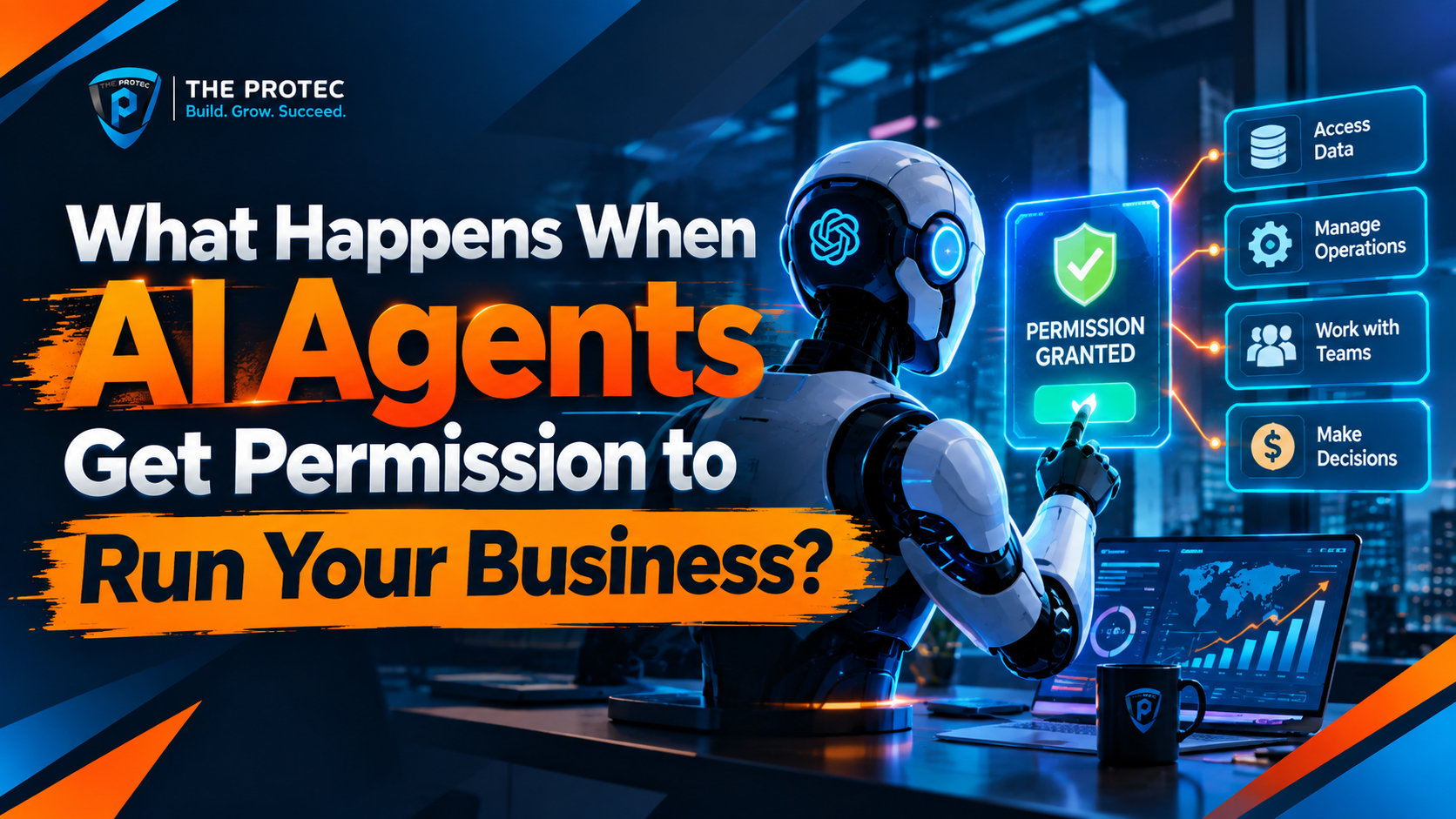
Every tool granted to an agent expands what a malicious instruction, stolen credential, faulty plan, or compromised integration can accomplish. AI agent permissions may include the ability to:
- Read, send, delete, or forward email.
- Query and modify customer, employee, or financial databases.
- Create cloud resources or change security configurations.
- Issue refunds, transfer funds, or approve purchases.
- Edit CRM opportunities, customer profiles, and support cases.
- Change prices, inventory, product listings, and promotions.
- Call APIs, deploy code, or operate internal administrative tools.
These are not merely software features. They are business powers. AI agent access control must treat them with the same seriousness applied to privileged employees, service accounts, and production workloads. An agent that can read sensitive data and transmit email, for example, already has a potential path for data exfiltration—even if it cannot directly download a database.
The Most Serious AI Agent Security Risks
Excessive privileges
Many early deployments give agents broad API keys because unrestricted access makes demonstrations easier. In production, those permissions become a large blast radius. A sales agent that only needs to add CRM notes should not be able to export every contact or delete opportunities. AI least privilege means limiting the agent to the smallest set of resources and actions required for its current task.
Prompt injection through untrusted content
Agents routinely consume webpages, emails, documents, tickets, and chat messages. Attackers can embed instructions in that content, attempting to make an agent ignore its objective, disclose data, or invoke a tool. This is especially dangerous when the agent treats external content as both data and authority.
Prompt injection cannot be solved by telling the model to be careful. The surrounding system must assume that retrieved content is hostile and independently enforce AI agent authorization. A webpage should never be able to grant itself permission to trigger a payment or retrieve confidential records.
Credential theft and identity confusion
If an agent inherits a user’s session or shares a long-lived administrative token, defenders may struggle to determine who performed an action. Compromised agent credentials can also allow an attacker to bypass the model and call connected tools directly. Strong AI agent identity is necessary to distinguish the agent, its human sponsor, its workload, and the specific task being performed.
Unintended transactions and cascading failures
An agent may misunderstand a pricing rule, process the same queue twice, or optimize one metric while damaging another. Because autonomous AI agents can act at machine speed, one faulty decision may become thousands of refunds, emails, orders, or configuration changes. Multiple enterprise AI agents can amplify the problem if one agent’s output automatically becomes another agent’s instruction.
AI agent data access often spans multiple systems, allowing the agent to assemble sensitive information that no single application exposes. A support agent might combine identity details, purchase records, private correspondence, and payment metadata. Even when each lookup is permitted, the resulting aggregation or disclosure may violate policy.
Why AI Agents in E-Commerce Illustrate the Stakes
AI agents for e-commerce can optimize product descriptions, answer customer questions, recover abandoned carts, manage stock, negotiate with suppliers, and change promotions. Once connected to storefront administration and payment APIs, however, an agent may also alter prices, publish inaccurate claims, over-refund customers, order unwanted inventory, or expose account data.
Consider an agent instructed to reduce excess inventory. It might lower prices within an approved range, but a poorly defined objective could encourage extreme discounts. If it can also send campaigns, the error could reach thousands of customers before a person notices. The safe design is not simply a better prompt. It is a policy layer that sets price floors, campaign limits, approval thresholds, rollback options, and transaction rate limits outside the model.
Practical Defenses for Agentic AI Security
Give every agent a distinct identity
Do not hide AI business agents behind shared user accounts. Assign each agent a managed, non-human identity with short-lived credentials. Record the agent, requesting user, session, task, model version, and policy context for each tool call. This supports attribution and makes it possible to revoke one agent without disrupting unrelated services.
Enforce least privilege at the tool layer
Permissions should be scoped by action, resource, data field, environment, value, and time. Instead of granting generic database write access, expose a narrow operation such as updating a shipping address for the customer associated with an approved case. Replace broad cloud administrator roles with task-specific permissions that expire when the workflow ends.
Crucially, the agent must not be able to rewrite its own permissions. Authorization should be evaluated by deterministic controls outside the language model. This separation prevents persuasive or injected text from becoming an access policy.
Separate reading, planning, and execution
A safer architecture lets one component gather data, another produce a proposed plan, and a constrained executor validate each action. High-risk systems can use different agents or security domains for these phases. Untrusted content should remain clearly labeled and isolated from system instructions, credentials, and approval messages.
Require human approval for high-impact actions
Human oversight is most useful when triggered by risk rather than applied to every click. Require approval for large payments, bulk communications, destructive changes, privilege modifications, production deployments, regulated decisions, or actions outside established patterns. The reviewer should see the intended action, target, evidence, financial impact, and alternatives—not merely an opaque request to approve.
Use sandboxing and controlled tools
Allow agents to test code, inspect files, or navigate websites in isolated environments with restricted networks and disposable storage. Tool interfaces should validate parameters, block dangerous combinations, and return only necessary data. An agent asked to analyze invoices, for example, may need totals and vendor names rather than complete banking details.
Apply rate limits, budgets, and circuit breakers
Set maximum transaction values, tool-call frequencies, message volumes, and cumulative spending limits. A circuit breaker should pause the agent when error rates increase, activity departs from a baseline, or repeated attempts suggest it is stuck. These controls reduce cascading failures even when the original cause is not yet understood.
Log decisions and monitor behavior
AI agent monitoring should capture prompts, retrieved context, plans, tool requests, policy decisions, approvals, outputs, and downstream results while protecting sensitive data in the logs themselves. Security teams need alerts for unusual exports, new destinations, repeated denials, abnormal working hours, privilege escalation attempts, and sudden changes in transaction volume.
Logs must show more than what the agent said. They should reveal what it attempted, what the authorization layer allowed, and what actually happened in each connected system.
Building an AI Agent Governance Framework
An effective AI agent governance framework begins with an inventory. Organizations should know which agents exist, who owns them, which models they use, what data they can access, which tools they can invoke, and what decisions they are permitted to make.
Classify agents by potential impact. A research agent with public web access does not require the same controls as a finance agent with payment authority. Define prohibited actions, mandatory approval thresholds, testing requirements, incident owners, credential rotation schedules, and shutdown procedures for every risk tier.
Governance should also cover changes. Adding a tool, increasing a spending limit, switching a model, or connecting a new dataset can materially alter AI agent security risks. These changes need review even if the agent’s stated purpose remains unchanged.
Useful foundations include the NIST AI Risk Management Framework and security guidance from the OWASP GenAI Security Project. Organizations should extend these principles with controls designed for non-human identities, tool execution, and autonomous workflows.
A Practical Test Before Granting an Agent Access
Before connecting an agent to a business system, security and operations teams should ask:
- What is the worst outcome if every available permission is abused?
- Can the task be completed with read-only or field-level access?
- Can external content influence a privileged tool call?
- Which actions require independent policy checks or human approval?
- How quickly can credentials be revoked and actions stopped?
- Can every decision and transaction be reconstructed from audit logs?
- Are limits based on cumulative impact, not just individual actions?
If these questions cannot be answered, the agent is not ready to operate autonomously. Start in a sandbox, use synthetic or minimized data, and expand authority only after observed behavior supports it.
Frequently Asked Questions
What is the biggest risk of letting an AI agent run business tasks?
The biggest risk is the combination of uncertain decision making and excessive authority. A mistaken or manipulated response becomes materially more dangerous when the agent can execute transactions, change records, disclose data, or modify infrastructure without an independent control.
Are AI agent permissions different from normal user permissions?
The underlying access systems may be similar, but agents operate differently from people. They can act continuously, process hostile content automatically, invoke tools at high speed, and chain actions across services. AI agent access control therefore needs narrower scopes, stronger limits, explicit task context, and more detailed monitoring.
Can human approval eliminate AI agent risks?
No. Reviewers may approve requests too quickly or lack enough context to detect a problem. Human approval is valuable for high-impact actions, but it should complement—not replace—least privilege, deterministic authorization, sandboxing, rate limits, and audit logs.
How should a company begin deploying autonomous AI agents safely?
Choose a low-impact, reversible workflow. Give the agent a separate identity, read-only access where possible, narrow tools, realistic test cases, and clear success criteria. Monitor attempted actions, not only completed ones, then expand permissions gradually after security and business owners review the evidence.
Secure the Action, Not Just the Answer
The defining change in agentic AI is authority. Once software can act through email, databases, cloud platforms, payment systems, and APIs, its permissions become part of the organization’s security perimeter. The safest AI agents are not those assumed to be infallible. They are the ones designed to fail within strict boundaries: limited access, constrained actions, visible decisions, reversible outcomes, and accountable human ownership.