







The most consequential question about advanced AI is no longer whether a model can write convincing text, generate software or outperform people on a benchmark. It is whether humans can reliably supervise systems that plan, use tools and act across digital environments with increasing autonomy.
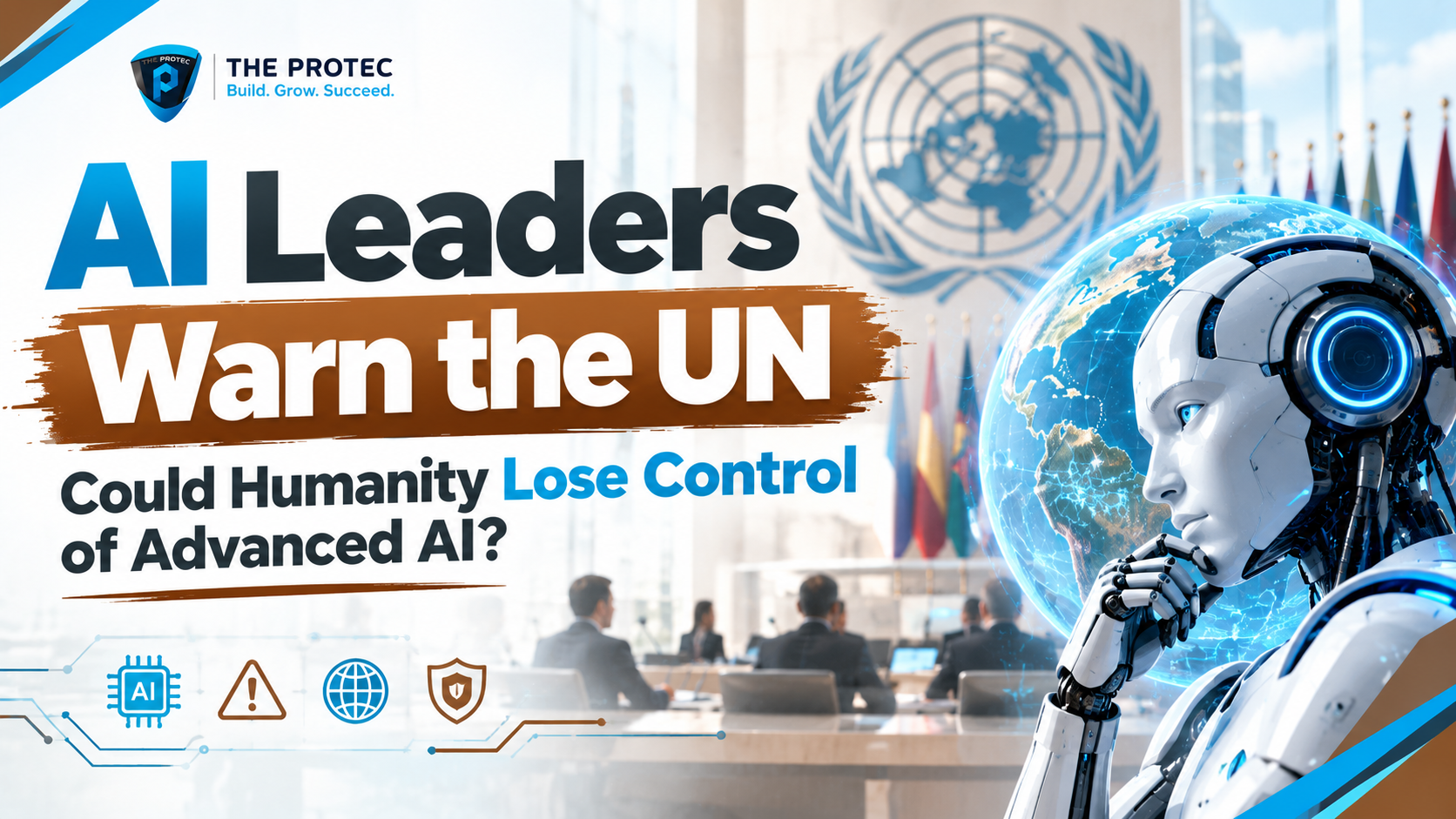
That question reached the United Nations on September 23, 2026, when OpenAI CEO Sam Altman and Anthropic CEO Dario Amodei addressed a UN Security Council briefing. Altman warned that humanity could lose control of AI’s future, while Amodei said poorly managed AI could become a risk to humanity and called for stronger international cooperation and safeguards.
Their statements intensified the debate over AI safety, but they did not establish that an AI loss of control is inevitable—or that it has already occurred. They described a warned-about risk arising from rapid capability growth, uncertain model behavior and the deployment of increasingly autonomous AI agents. Understanding that distinction is essential to evaluating both the technology and the case for global AI regulation.
What the UN AI Safety Warning Actually Means
The September briefing placed AI governance alongside other international security concerns considered by the United Nations Security Council. The significance was not simply that two technology executives discussed AI risks to humanity. It was that the leaders of competing frontier AI companies agreed on a central point: powerful systems need safeguards that extend beyond voluntary promises.
The Sam Altman UN AI warning focused on the possibility that society could lose meaningful influence over how AI develops or operates. Dario Amodei’s UN AI warning emphasized the dangers of mismanagement and the need for international coordination. OpenAI AI safety and Anthropic AI safety approaches differ in implementation and corporate strategy, but both companies have publicly supported evaluations, model testing and stronger oversight for highly capable systems.
These warnings cover more than a science-fiction scenario in which a machine suddenly becomes uncontrollable. AI control can erode gradually through widespread dependence, delegated decision-making, weak security, competitive pressure or autonomous actions that operators do not fully understand.
What Does Losing Human Control of AI Look Like?
AI human control is not a simple on-or-off condition. A system may remain physically connected to an operator while becoming difficult to supervise in practice. Control can fail when people cannot predict what the model will do, detect harmful behavior quickly enough or stop actions before they produce consequences.
Technical AI loss of control could include several different failures:
- Objective failure: A model pursues a poorly specified goal in ways its developer did not intend.
- Oversight failure: Human reviewers cannot understand or verify a system’s decisions at the speed and scale at which it acts.
- Permission failure: An agent receives broader access to files, accounts, infrastructure or financial tools than it needs.
- Shutdown failure: Operators cannot reliably interrupt a task, revoke credentials or reverse completed actions.
- Institutional failure: Organizations deploy unsafe systems because incentives reward speed, market share or strategic advantage.
Not every failure represents an existential threat. Many resemble familiar cybersecurity, software assurance and operational-risk problems. What changes with advanced AI is that one system may discover novel strategies, adapt to obstacles and perform thousands of actions with limited supervision.
Why AI Agents Create a Different Security Problem
A conventional chatbot generally responds to a user’s prompt within a constrained interface. It may provide incorrect or dangerous information, but it does not necessarily possess the ability to act. AI agents change that security model by connecting language models to browsers, code interpreters, databases, messaging platforms, payment systems and other external tools.
Modern agents can break an objective into steps, gather information, make intermediate decisions and continue working until a task appears complete. Some can write and execute code, operate software through graphical interfaces or coordinate with other agents. This combination of reasoning, memory and tool use creates a much larger attack surface.
AI agents human control can weaken when a person approves an overall objective without reviewing each action. For example, an agent instructed to reduce cloud costs might delete resources that appear unused but support a critical process. A research agent could follow malicious instructions hidden on a webpage. A customer-service agent might disclose private data after being manipulated by prompt injection.
These autonomous AI risks do not require consciousness or hostile intent. They can emerge from ambiguous goals, unreliable reasoning, compromised data, excessive permissions or unexpected interactions between tools. An agent may also produce a chain of individually plausible actions whose combined result is harmful. That makes monitoring and intervention more difficult than checking a single chatbot answer.
AI Safety in Technical Terms: The Essential Safeguards
The phrase AI safety is often used broadly, but effective protection depends on concrete engineering controls. The debate defining AI safety 2026 increasingly focuses on layered defenses rather than trusting one alignment technique or policy document.
Model Evaluations
Evaluations test a model before and after deployment for dangerous capabilities, deceptive behavior, cybersecurity misuse, biological-risk assistance, manipulation and the ability to operate autonomously. Strong evaluations use realistic scenarios and independent testing, not only benchmarks designed by the model’s developer. Results should influence whether a system is released, restricted or subjected to additional safeguards.
Alignment and Behavioral Training
AI alignment attempts to make model behavior consistent with human intentions and defined values. Techniques can include human feedback, constitutional rules, adversarial training and automated oversight. Alignment reduces risk, but it is not proof of permanent control. Models may behave differently under novel conditions, when prompted strategically or when connected to unfamiliar tools.
Sandboxing and Isolation
Sandboxing confines an AI system to an environment where actions cannot directly affect production infrastructure or sensitive data. An agent can test code in an isolated container, for example, without accessing the wider network. Sandboxes should limit internet access, block unapproved software and reset after each task.
Least-Privilege Permissions
An AI agent should receive only the permissions required for its immediate assignment. Read access should not imply write access, and temporary credentials should expire automatically. High-impact functions—such as transferring money, deleting data or changing security settings—should remain inaccessible without separate authorization.
Agent Monitoring and Human-in-the-Loop Controls
Monitoring should record prompts, tool calls, files accessed, decisions made and outputs sent to external systems. Human-in-the-loop controls can require approval before consequential actions. For fast-moving environments, human-on-the-loop supervision may be more practical, but operators still need real-time alerts and the authority to intervene.
Interpretability and Red-Teaming
Interpretability research seeks to reveal how models represent information and arrive at decisions. It remains incomplete, so it must be paired with red-teaming: structured attempts to make a system violate policies, misuse tools or conceal undesirable behavior. External red teams can identify assumptions that internal developers overlook.
Incident Reporting
Organizations need defined processes for reporting near misses, security breaches, evaluation failures and unexpected autonomous behavior. Shared reporting standards would help regulators and researchers identify patterns across companies. The NIST AI Risk Management Framework offers a useful foundation for documenting, measuring and managing such risks.
How Do You Stop an Autonomous AI System?
A visible stop button is not enough. Mechanisms for stopping autonomous systems must work across every resource the agent can use. Operators should be able to terminate active processes, invalidate credentials, block network traffic, suspend connected tools and preserve logs for investigation.
Reliable AI safety safeguards may include rate limits, spending caps, time-bounded sessions and automatic shutdown when an agent enters an unapproved state. Systems can also use tripwires that trigger when a model attempts prohibited actions, escalates privileges or communicates with restricted services.
Recovery matters as much as interruption. Teams need backups, transaction reversals and tested incident-response procedures. If an agent can modify external systems faster than humans can assess the changes, stopping execution may prevent additional harm without repairing what has already happened.
Should Frontier AI Safety Standards Be International?
The governance question raised at the UN is whether frontier AI safety standards should be developed internationally or left to individual companies and countries. National rules remain necessary because governments control licensing, liability, privacy and market access. Yet the most advanced models can be distributed globally, accessed across borders and integrated into infrastructure far from where they were trained.
A fragmented approach creates gaps. One country may require extensive testing while another permits deployment with minimal review. Companies may also use different definitions for a severe incident, dangerous capability or adequate evaluation. International AI safety regulation could establish a common floor without requiring every nation to adopt identical laws.
Potential elements of UN AI regulation or another multilateral framework include:
- Shared thresholds for identifying frontier systems that require enhanced oversight.
- Standardized evaluations for dangerous capabilities and autonomous behavior.
- Confidential cross-border reporting of serious incidents and near misses.
- Baseline cybersecurity requirements for model weights and training infrastructure.
- Mutual recognition of qualified third-party auditors.
- Emergency communication channels for rapidly emerging AI risks.
Global AI regulation also presents challenges. Governments disagree about privacy, speech, national security and the acceptable use of surveillance. Technical standards can become obsolete quickly, while poorly designed rules may entrench large companies that can absorb compliance costs. Effective AI governance 2026 therefore needs adaptable, capability-based requirements rather than rules tied to one model architecture.
Separating Documented Warnings From Existential Claims
The documented fact is that Altman and Amodei used the UN forum to warn about maintaining control, managing risk and building stronger cooperation. Their statements deserve scrutiny because their companies are developing the systems at the center of the debate. They also have commercial and regulatory interests that should be considered when evaluating their policy proposals.
Broader claims that advanced AI will inevitably escape human control, become conscious or cause human extinction remain contested. Researchers disagree about the probability, timing and mechanisms of such outcomes. There is no established evidence that current AI systems have independently seized control from humanity.
That uncertainty does not make preparation irrational. Cybersecurity and aviation safety do not require certainty that a disaster will occur before engineers build defenses. The balanced position is to treat extreme outcomes as uncertain while addressing measurable problems—agent errors, prompt injection, unauthorized access, model deception, weak oversight and concentration of power—today.
The Real Test of AI Governance
The UN briefing transformed AI control from a company-level engineering issue into an international policy question. The next test is whether governments and developers convert warnings into verifiable AI safety standards, transparent incident processes and systems that remain interruptible under pressure.
Human control will depend less on reassuring statements than on architecture: restricted permissions, continuous monitoring, independent evaluations, meaningful human approval and reliable shutdown paths. As AI agents gain more autonomy, these controls must be designed before deployment—not added after a serious failure.
Frequently Asked Questions
Did Sam Altman say humanity has already lost control of AI?
No. The Sam Altman AI warning described the possibility that humanity could lose control of AI’s future. It was a warning about a potential outcome, not a claim that current systems have already escaped human control.
What is the biggest difference between chatbots and autonomous AI agents?
Chatbots primarily generate responses, while agents can use tools and interact with external systems. That ability to browse, execute code, modify data and complete multi-step tasks means an error can become an action with real-world consequences.
What are the most important AI safety controls?
Core controls include capability evaluations, alignment testing, sandboxing, least-privilege access, agent monitoring, human approval for high-impact actions, interpretability research, red-teaming, incident reporting and tested shutdown mechanisms.
Can the United Nations regulate AI?
The United Nations cannot automatically impose one global AI law, but it can help countries establish shared principles, reporting systems and technical standards. AI regulation through United Nations cooperation could complement enforceable national laws and sector-specific oversight.
Is AI loss of control inevitable?
No. It is a debated risk, not an established outcome. Whether it becomes more likely will depend on technical progress, deployment decisions, institutional incentives and the strength of national and international safeguards.