








Software development has moved beyond adding a chatbot to an existing application. By August 2026, the strongest developers use artificial intelligence throughout the engineering lifecycle: researching unfamiliar systems, clarifying requirements, generating and reviewing code, running tests, investigating incidents, and operating agentic workflows. They also know when not to use it.
That distinction defines the modern AI-native developer. The role is not simply an engineer who writes effective prompts or accepts code from a copilot. It is a developer who can design reliable software around probabilistic models while preserving the discipline of traditional engineering. Models may generate an implementation quickly, but developers remain responsible for architecture, correctness, security, cost, and business outcomes.
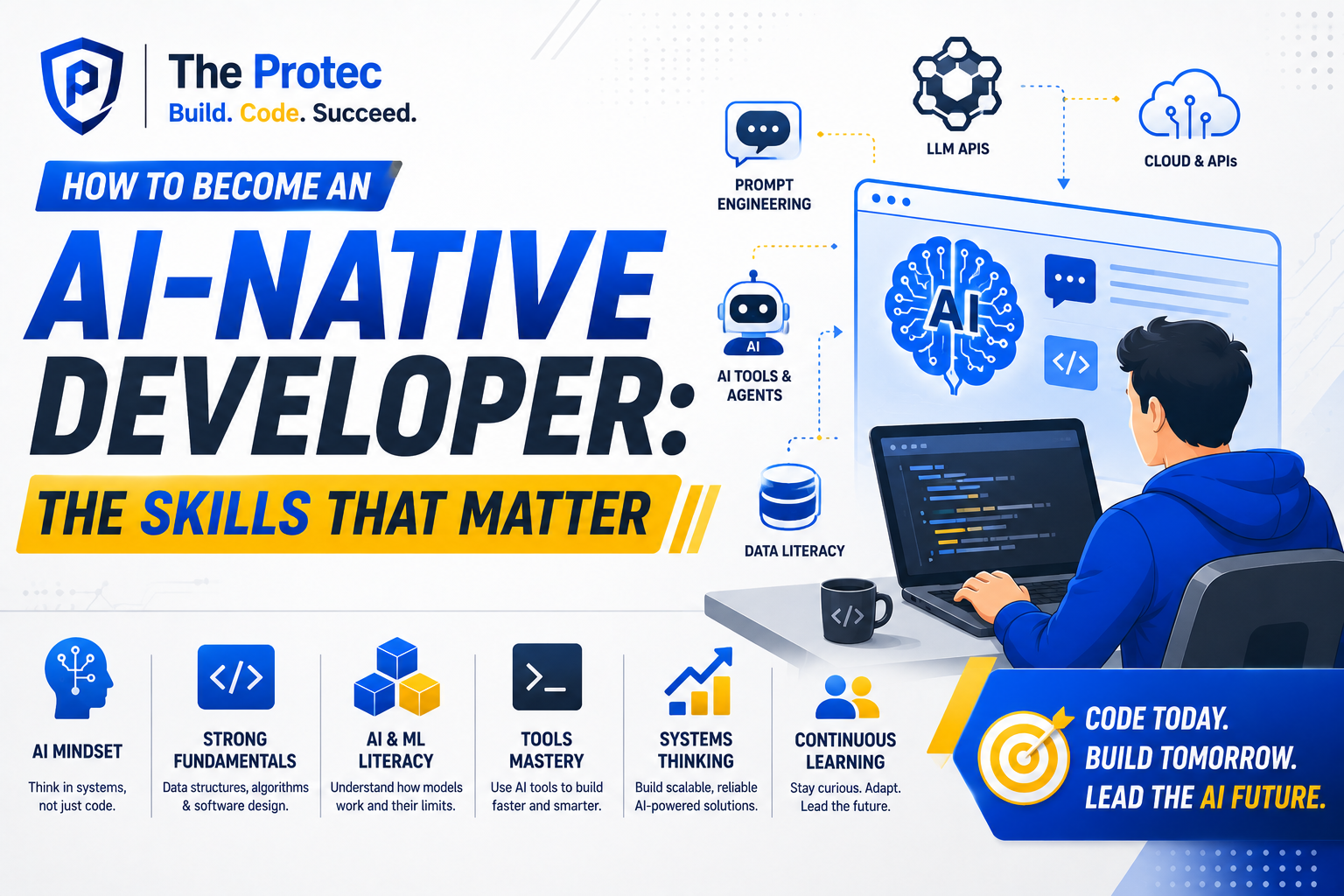
This roadmap covers the AI developer skills that matter now: coding tools, model APIs, agents, evaluation, security, automation, and durable software engineering fundamentals. The goal is not to chase every new model release. It is to build a repeatable way of working that remains useful as tools change.
What Makes a Developer AI-Native?
An AI-assisted developer occasionally uses a model to explain an error or draft a function. An AI-native developer treats models as programmable components and development collaborators. They provide the right context, constrain outputs, connect models to tools, measure results, and build verification into every workflow.
This requires three complementary abilities:
- Engineering judgment: Understanding systems well enough to evaluate generated code and make sound architectural decisions.
- AI systems knowledge: Knowing how models, retrieval, tool calling, agents, context windows, and structured outputs behave.
- Operational discipline: Measuring quality, controlling permissions, monitoring production behavior, and improving workflows from evidence.
The value is not raw code volume. It is the ability to shorten the path from an idea to dependable software without creating an unmaintainable or insecure system.
Start With Traditional Software Engineering Fundamentals
The first step in AI software development is not prompt engineering. It is becoming competent at software engineering. Generated code often looks convincing even when it introduces subtle race conditions, inefficient queries, weak abstractions, or security vulnerabilities. Without a strong technical foundation, speed merely allows mistakes to spread faster.
Build practical proficiency in at least one mainstream language and its ecosystem. Learn data structures, algorithms, networking, databases, operating systems, testing, version control, and debugging. You should be able to trace a request across services, interpret logs, inspect a query plan, reason about state, and explain why a design will scale.
Architecture matters just as much. Practice separating concerns, defining stable interfaces, modeling data, handling failure, and making trade-offs between simplicity and flexibility. Develop the habit of writing small, reviewable changes with meaningful tests. AI can accelerate these activities, but it cannot take responsibility for them.
Reading code is becoming especially important. AI-native developers may review more generated code than they write manually. The ability to identify hidden assumptions, duplicated logic, missing edge cases, and inconsistent behavior is therefore a core productivity skill.
Master AI Coding Tools Without Surrendering Control
Modern coding assistants range from inline completion tools to autonomous environments that can inspect repositories, edit multiple files, execute commands, and prepare pull requests. Effective developers use different levels of autonomy for different tasks.
Inline completion works well for repetitive transformations and familiar implementation patterns. Chat-based tools are useful for exploration, debugging, and comparing design options. Agentic coding tools can handle bounded jobs such as migrating an API, expanding test coverage, updating documentation, or implementing a well-specified feature across several files.
Regardless of the interface, provide structured context. Explain the desired outcome, relevant constraints, accepted patterns, files that must not change, and commands used to verify the work. Ask the tool to inspect the repository before proposing changes. For larger tasks, request a plan first and review it before allowing edits.
Never treat generated code as correct by default. Examine the diff, run tests, use static analysis, and challenge unfamiliar dependencies or abstractions. Smaller tasks produce more reliable results than broad instructions such as “improve this application.” A useful rule is to delegate work that can be clearly described and independently verified.
Learn Model APIs and AI Application Architecture
Using a model through an API is one of the essential AI developer skills. Learn how to manage system instructions, user input, conversation state, context limits, streaming responses, retries, rate limits, and model selection. Use structured outputs or schema validation when software must consume a response; parsing free-form prose is fragile.
You should also understand common architecture patterns. Retrieval-augmented generation can supply private or frequently changing knowledge without retraining a model. Embeddings support semantic search and classification, although they are not the right solution for every search problem. Caching can reduce latency and cost, while routing can direct simple requests to smaller models and reserve more capable models for difficult tasks.
Design the model layer behind an interface so providers or model versions can change without rewriting the application. Track token usage, latency, error rates, and cost for each workflow. Model quality is only one production concern; predictable performance, regional availability, privacy requirements, and total operating cost may determine the better choice.
It is also useful to run smaller or local models when privacy, offline operation, or high request volume matters. An AI-native architecture chooses the smallest system that can reliably complete the job rather than automatically selecting the largest model.
Build Agents as Controlled Workflows
Agents extend models by allowing them to select actions, call tools, observe results, and continue toward a goal. Current systems increasingly connect to repositories, terminals, browsers, databases, ticketing platforms, and internal services. The important skill is not creating an endless autonomous loop. It is designing a controlled workflow with explicit boundaries.
Begin with a single model call and add agency only when the task genuinely requires multiple decisions. Define the available tools narrowly, validate every argument, limit execution time and iterations, and require approval before consequential actions. A deployment agent, for example, may inspect build status automatically but should not promote a release without an authorized checkpoint.
Learn common patterns such as routing, sequential workflows, parallel research, evaluator-reviser loops, and human escalation. Also understand state management: agents need a reliable record of completed actions, tool results, and pending decisions. Do not rely on an expanding conversation transcript as the only source of truth.
Interoperability is becoming increasingly important. Open standards such as the Model Context Protocol provide a consistent way for AI applications to discover tools and access contextual resources. Learn the protocol concepts, but still treat every connected server as part of your security boundary.
Make Evaluation Part of Development
Traditional software is usually expected to produce deterministic outputs. Model behavior varies with inputs, context, model versions, and sampling settings. That makes evaluation a first-class engineering discipline rather than a final quality check.
Create a representative dataset from real use cases, including routine requests, ambiguous inputs, edge cases, adversarial prompts, and known failures. Define what success means before changing prompts or models. Depending on the application, useful metrics may include task completion, factual accuracy, citation correctness, tool-call validity, latency, cost, and escalation rate.
Use deterministic checks wherever possible. JSON can be validated against a schema, generated code can be compiled and tested, and tool calls can be checked against expected parameters. Human review remains valuable for qualities such as clarity and usefulness. Model-based graders can help at scale, but they should be calibrated against human judgments rather than treated as unquestionable authorities.
Run evaluations in continuous integration and compare results before changing a prompt, retrieval strategy, tool definition, or model. In production, collect traces and user feedback so failures can become regression cases. This evaluation flywheel is one of the clearest differences between a demo and a dependable AI product.
Treat AI Security as a System Problem
AI applications introduce risks that ordinary input validation does not fully address. Prompt injection can hide malicious instructions in web pages, documents, emails, or tool output. Sensitive information can leak through prompts, logs, retrieval systems, or model responses. Agents can also misuse legitimate tools when permissions are too broad.
Assume all external content is untrusted, even when it appears inside the model’s context. Separate instructions from data, restrict tools with least-privilege credentials, validate model-generated arguments, and require human approval for destructive or irreversible actions. Isolate code execution in a sandbox with limits on networking, files, memory, and runtime.
Do not place secrets in prompts or source code. Apply data classification and retention policies to model interactions, and confirm how vendors process submitted data. Log enough information to investigate incidents without creating a new store of sensitive content. The OWASP guidance for LLM applications is a useful baseline for threat modeling and security reviews.
Automate the Engineering Lifecycle
AI-native development is most effective when it improves the whole delivery system, not only code generation. Look for repeatable, low-risk steps that have clear inputs and measurable outputs.
- Convert approved specifications into implementation plans and test cases.
- Summarize pull requests while highlighting risky files, migrations, and dependency changes.
- Generate draft unit tests, then use coverage and mutation testing to expose weak assertions.
- Triage failing builds by collecting relevant logs and identifying likely causes.
- Classify incidents, prepare timelines, and suggest runbook steps without executing dangerous actions.
- Keep technical documentation synchronized with verified code and interface changes.
Start with workflows that save time but preserve review gates. Measure cycle time, defect escape rate, review effort, and rework. Automation that produces more pull requests but increases production failures is not a productivity improvement.
A Practical Roadmap to Become an AI-Native Developer
Phase One: Build a Reliable AI-Assisted Workflow
Choose one coding assistant and use it on a real project. Create concise repository instructions covering architecture, style, test commands, and prohibited changes. Practice asking for plans, reviewing diffs, and verifying every result. Track which tasks it handles well and where it fails.
Phase Two: Build an AI Feature
Create a focused application that calls a model API and returns structured output. Add streaming, retries, input validation, logging, cost tracking, and a small evaluation dataset. Then introduce retrieval or a tool only if the product requirement justifies the added complexity.
Phase Three: Add a Bounded Agent
Build an agent with two or three narrow tools, durable state, iteration limits, and an approval step. Capture a trace of every decision and tool call. Test prompt injection, invalid arguments, unavailable tools, and partial failures before expanding its permissions.
Phase Four: Productionize and Measure
Add automated evaluations, security tests, observability, fallback behavior, and model-version controls. Compare at least two model configurations for quality, latency, and cost. Document operational limits and define when the system must defer to a person.
A strong portfolio should show this progression. Include architecture diagrams, evaluation results, threat models, and explanations of trade-offs—not merely screenshots of a chatbot. Employers need evidence that you can turn model capabilities into maintainable software.
Frequently Asked Questions
Do AI-native developers still need to learn coding?
Yes. Coding tools increase the importance of understanding code because developers must review larger volumes of generated work. Programming, debugging, testing, architecture, and security knowledge are necessary to determine whether an output is correct and maintainable.
Is prompt engineering enough to become an AI-native developer?
No. Clear instructions are useful, but production systems also require API design, context management, structured outputs, evaluation, observability, security, and cost control. Prompting is one technique within a much broader engineering discipline.
Which language is best for AI software development?
Python is widely used for model experimentation and data workflows, while TypeScript is common for web applications and agent integrations. Java, C#, Go, Rust, and other languages also have mature AI tooling. Choose a language that fits the product and become proficient enough to evaluate generated code.
Will coding agents replace software developers?
Coding agents will automate more implementation work, especially when tasks are well specified and easy to test. Developers remain responsible for deciding what to build, resolving ambiguous requirements, designing systems, managing risk, and verifying outcomes. The role is shifting from producing every line manually toward directing and validating increasingly capable tools.
The Skill That Matters Most
The most valuable AI-native skill is disciplined judgment. Tools, models, and protocols will continue to change, but the ability to define a problem, provide relevant context, constrain a system, test its output, and take responsibility for the result will remain durable.
Master the fundamentals, use AI coding tools deliberately, learn model APIs, build bounded agents, evaluate continuously, and design security into every layer. That combination turns AI from an impressive demonstration into a dependable engineering capability.