





API gateways have long served as the front door to application services, enforcing access policies, routing requests, and protecting backend systems. Generative AI has complicated that role. Applications now send prompts to multiple models, stream responses, consume variable numbers of tokens, and handle data that may contain confidential or regulated information. A conventional gateway can transport those requests, but it usually does not understand their AI-specific behavior.
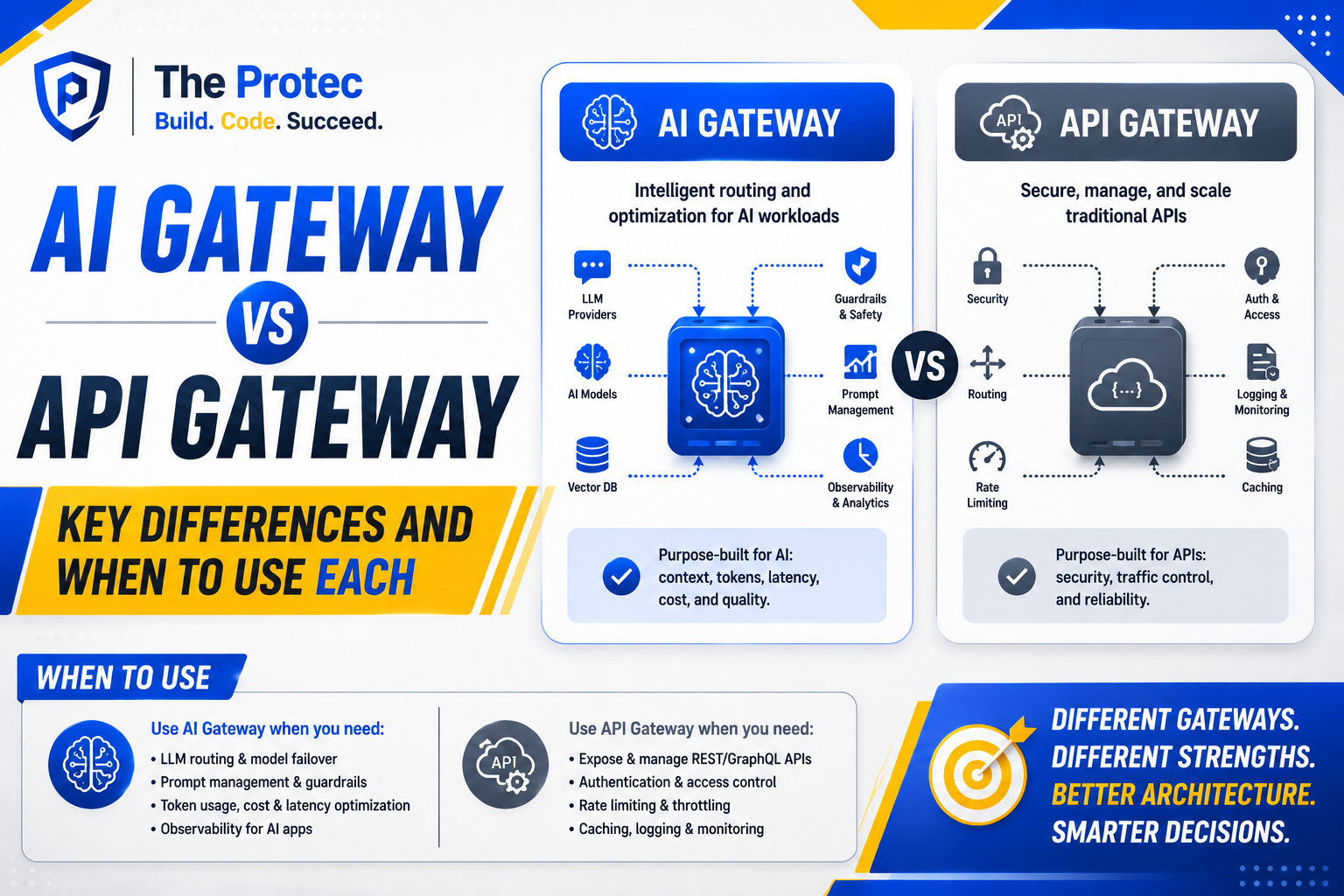
That gap has driven adoption of the AI gateway, also called an LLM gateway or AI API gateway. This specialized layer manages model access, prompt and response policies, provider failover, token usage, and AI-focused telemetry. The technologies overlap, but they are not interchangeable. Understanding the AI gateway vs API gateway distinction is essential when designing secure, reliable, and cost-controlled AI systems.
What Is a Traditional API Gateway?
An API gateway is an intermediary between clients and backend APIs or microservices. It exposes a consistent entry point while hiding the structure of internal services. Instead of requiring a mobile app, web client, or partner integration to connect directly to many backends, the gateway receives the request and forwards it to the appropriate upstream service.
Typical API gateway capabilities include authentication, authorization, TLS termination, request transformation, path-based routing, caching, load balancing, request-per-second limits, and protection against common web threats. Gateways also collect operational metrics such as request counts, HTTP status codes, error rates, and latency.
These functions remain important for AI applications. An API gateway can validate an access token or block an oversized request before it reaches an AI service. However, it generally treats a model request like any other HTTP or gRPC transaction. It does not inherently understand prompts, tokens, model context windows, tool calls, embeddings, or inference costs.
What Is an AI Gateway or LLM Gateway?
An AI gateway is an intermediary designed specifically for generative AI and machine learning inference traffic. It provides one governed interface through which applications can access commercial models, open-weight models, self-hosted inference endpoints, and specialized services such as embedding or reranking models.
The defining feature is AI awareness. An LLM gateway can inspect model parameters, count input and output tokens, apply prompt policies, track time to first token, route requests according to model capability, and calculate spending by provider or application. Many products expose an OpenAI-compatible API so teams can change underlying models with limited application code changes.
The term AI API gateway is sometimes used broadly for any gateway that fronts model APIs. In practice, the important question is not the product label but whether it delivers model-aware routing, governance, observability, and cost controls rather than only conventional API management.
AI Gateway vs API Gateway: The Core Differences
Routing: An API gateway commonly routes by hostname, URL path, header, region, or service health. An AI gateway can also route by model capability, context length, prompt type, quality requirement, latency target, data residency, or estimated cost.
Backend management: API gateways manage services and API versions. AI gateways manage providers, model families, model versions, deployment endpoints, context limits, and inference settings.
Observability: Traditional gateways focus on request latency, status codes, throughput, and availability. AI gateways add token consumption, time to first token, streaming duration, model selection, tool calls, cache performance, safety outcomes, and estimated cost.
Security: API gateways enforce identity and network-level controls. AI gateways add defenses for prompt injection, sensitive-data leakage, unsafe outputs, unapproved models, and risky agent actions.
Rate limiting: API gateways generally count requests or bytes. AI gateways can limit tokens, concurrent generations, model-specific consumption, and financial budgets.
Resilience: Both can retry or fail over, but an AI gateway must account for model compatibility, streaming state, context size, response quality, and the risk of duplicate inference charges.
How AI-Aware Routing Changes the Architecture
Traditional routing answers a relatively simple question: which service should receive this request? AI routing must also determine which model can satisfy the request under current policy and operating conditions.
A low-risk classification request might go to a smaller, inexpensive model, while a complex reasoning task is directed to a more capable model. Requests containing sensitive data may be restricted to a private deployment. If a provider becomes slow or unavailable, the gateway can shift eligible traffic to a compatible alternative. Some platforms also support weighted routing, A/B testing, shadow evaluation, and fallback chains.
This flexibility is increasingly useful as organizations adopt multimodal models, long-context inference, reasoning models, and agentic systems. It also introduces risk: two models may interpret prompts differently or produce incompatible tool-call formats. Effective routing therefore requires tested policies, model-specific validation, and explicit rules for when fallback is safe.
Model Management and Provider Abstraction
An API gateway can hide backend URLs, but an AI gateway can abstract model providers and normalize their interfaces. Applications send requests to a stable endpoint, while platform teams decide which provider, model version, or private deployment fulfills them.
This reduces provider coupling and centralizes credential management. It also enables controlled model rollouts. A team can direct a small percentage of traffic to a new model, compare quality and latency, and roll back without updating every client. Provider abstraction is not perfect, however. Unique features, parameter names, safety behavior, and tool-use formats may still require model-specific handling.
Observability for Probabilistic AI Workloads
HTTP success does not mean an AI request succeeded. A response can return a 200 status while being irrelevant, unsafe, excessively expensive, or structurally invalid. AI gateway observability must connect infrastructure health with model behavior.
Useful signals include input and output tokens, model and provider, end-to-end latency, time to first token, finish reason, retry count, tool-call activity, policy violations, semantic-cache hits, and cost. Traces should connect the gateway request with retrieval, model calls, tools, and downstream actions. Emerging conventions such as the OpenTelemetry generative AI semantic conventions can help teams avoid incompatible telemetry across platforms.
Prompt and response logging requires restraint. Full payloads may improve debugging, but they can expose personal information, source code, credentials, or confidential business data. Redaction, sampling, encryption, access controls, and retention limits should be designed before production traffic is captured.
Security: Beyond Authentication and WAF Rules
A standard API gateway remains valuable for OAuth, API keys, mutual TLS, schema validation, IP restrictions, and web application firewall policies. An AI gateway extends that boundary into the content and behavior of model interactions.
Depending on the use case, AI-specific controls may detect prompt injection patterns, redact sensitive data, restrict prohibited topics, validate generated JSON, or block unauthorized models and tools. For agents, the gateway can enforce which tools are available and require additional approval for high-impact actions. These safeguards should support, not replace, secure application design and least-privilege tool permissions.
Organizations should also separate security controls from quality controls. A hallucinated answer is not always a security event, while a seemingly accurate response may still leak protected information. Threat modeling can draw on resources such as the OWASP Top 10 for Large Language Model Applications, but controls must be tailored to the actual model, data, tools, and users.
Rate Limits and Cost Controls
Request-based quotas are often inadequate for AI. One request might process 200 tokens, while another processes a large document and generates a lengthy response. Both count as a single API call but have very different capacity and cost implications.
An AI gateway can enforce tokens per minute, concurrent inference limits, maximum context size, output-token caps, or budgets by user, team, application, model, and provider. It can also alert on anomalous consumption and prevent retry storms from multiplying charges.
More advanced cost controls include semantic caching, model tiering, prompt-size policies, and budget-aware routing. Semantic caching can reuse responses to sufficiently similar requests, although it should be avoided when answers are user-specific, time-sensitive, or security-sensitive. Cost optimization should never silently route critical tasks to a model that cannot meet their accuracy or compliance requirements.
When Should You Use an API Gateway?
Choose a traditional API gateway when the primary workload consists of REST, GraphQL, gRPC, event, or microservice APIs and AI traffic is limited or operationally simple. It is usually sufficient when one model endpoint is used, provider-native monitoring meets requirements, and there is no need for token budgets, prompt policies, or model-based routing.
An API gateway is also the right outer boundary for organization-wide identity, partner access, API lifecycle management, and consistent network security. Existing gateway investments should not be discarded merely because an application includes an LLM call.
When Should You Use an AI Gateway?
Use an AI gateway when several applications or teams access models and centralized governance becomes necessary. Strong indicators include multiple providers, frequent model changes, self-hosted and managed models, sensitive prompts, agentic workflows, streaming responses, unpredictable token spending, or a need to compare model performance.
An LLM gateway is especially valuable when developers are independently embedding provider keys, implementing inconsistent retries, or building separate logging and safety layers. Centralization can reduce duplicated code and make policies auditable, provided the gateway is designed to avoid becoming a bottleneck or single point of failure.
When You Need Both Gateways
For many enterprises, the answer to AI gateway vs API gateway is not one or the other. A layered architecture uses the API gateway as the external entry point and the AI gateway as the specialized model access layer.
The API gateway handles client identity, application authorization, public API policies, and general traffic protection. The AI gateway then applies model selection, prompt inspection, token limits, AI telemetry, and provider controls. Internal AI-enabled services can also call the AI gateway directly through a private network, subject to workload identity and policy.
Responsibilities should be explicit. Duplicating retries, caching, or rate limits in both layers can create unpredictable behavior. For example, an outer gateway retry combined with an AI gateway retry may produce repeated model calls and duplicate costs. Define which layer owns each policy and trace requests across both.
How to Select and Implement an AI API Gateway
Inventory workloads: Identify models, providers, data classifications, latency targets, context sizes, streaming needs, and tool integrations.
Define routing policy: Document which models are approved for each task and when fallback, experimentation, or regional routing is allowed.
Measure the right signals: Capture token usage, cost, first-token latency, errors, safety decisions, and application-level quality indicators.
Protect payloads: Apply redaction and retention rules before enabling comprehensive prompt logging.
Test failure behavior: Simulate provider outages, quota exhaustion, malformed output, slow streams, and incompatible fallback models.
Keep an escape path: Preserve access to provider-specific features when abstraction would reduce capability or reliability.
Frequently Asked Questions
Can a traditional API gateway route LLM requests?
Yes. It can proxy model API traffic, authenticate clients, terminate TLS, and apply conventional request limits. What it typically lacks is native awareness of tokens, prompts, model capabilities, inference cost, and AI safety policies. That limitation becomes more important as traffic and provider diversity grow.
Is an LLM gateway the same as an AI gateway?
The terms are often used interchangeably. LLM gateway usually emphasizes text-generation models, while AI gateway may include multimodal, embedding, reranking, image, audio, and other inference services. Product capabilities matter more than the label.
Does an AI gateway eliminate model vendor lock-in?
It can reduce lock-in by providing a common endpoint and centralized routing, but it cannot erase differences among models. Context limits, structured output, reasoning controls, tool calls, safety behavior, and multimodal features vary. Applications still need compatibility tests and clear fallback rules.
Will an AI gateway add latency?
Any additional network hop can add latency. Efficient gateways minimize the overhead, and features such as connection pooling, regional deployment, caching, and faster routing may offset it. Measure time to first token and total generation time rather than relying only on standard HTTP latency.
Choosing the Right Gateway Strategy
A traditional API gateway governs how clients reach services. An AI gateway governs how applications consume models. Use the former for broad API management, the latter for model-aware control, and both when enterprise applications need a secure external boundary plus specialized AI governance. The best architecture is the one that assigns clear ownership for routing, security, observability, rate limits, and cost without creating duplicated policies.