







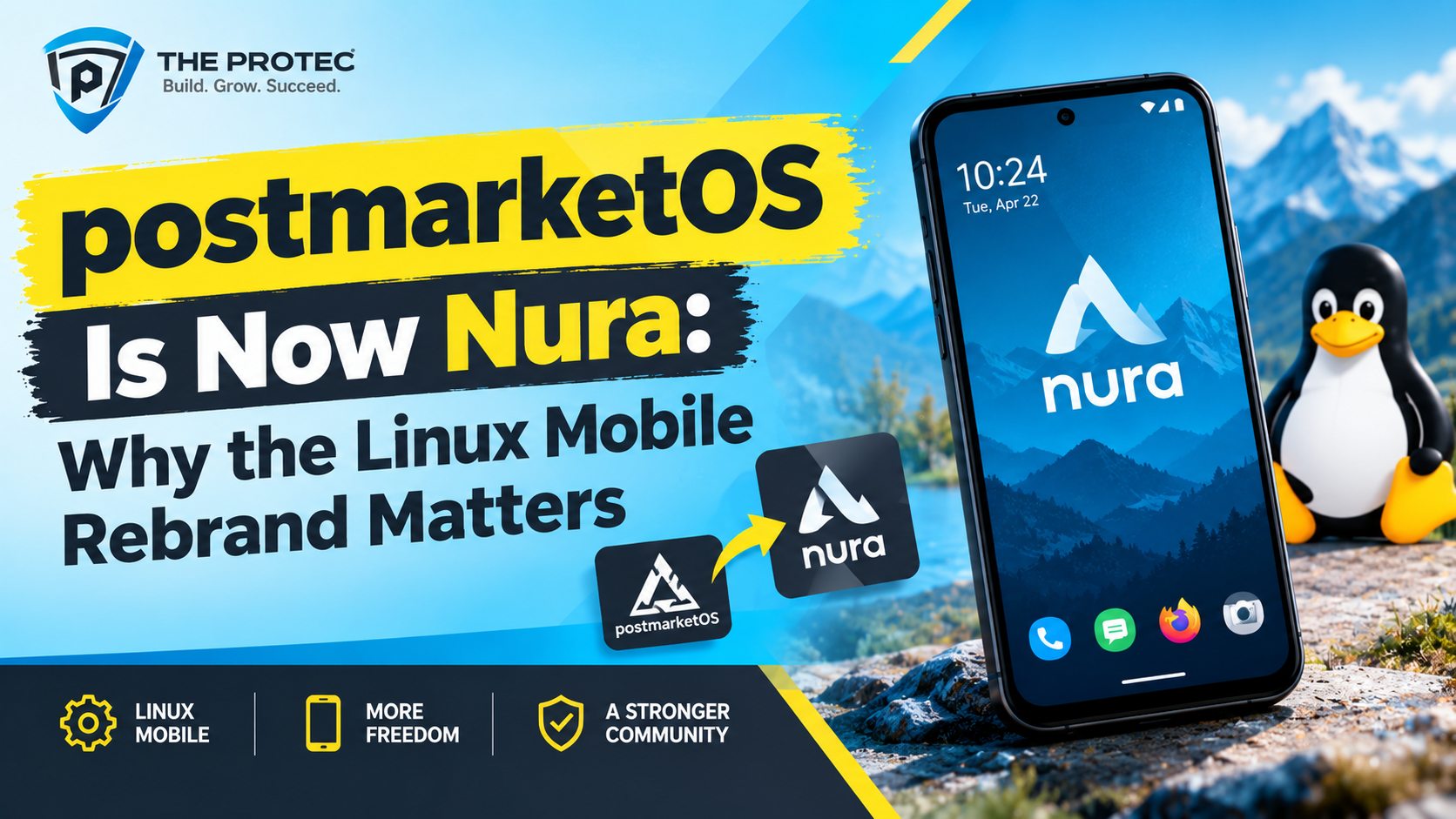
One of the most recognizable names in mobile Linux is changing. On September 27, 2026, postmarketOS announced that it is now Nura, unveiling the new identity during the first postmarketOS and Alpine Linux conference. The announcement followed roughly a year and a half of research, discussion and name selection.
Although the postmarketOS Nura rebrand is significant, it does not mark the replacement of the underlying operating system or the abandonment of its original goals. Nura continues the same open-source effort to bring Linux to smartphones and other devices, extend hardware lifespans and give users greater control over technology that manufacturers may no longer support.
The change is better understood as an evolution of the project’s identity. The postmarketOS name reflected its beginnings, but the community believes it no longer communicates the full scale of what the project has become. Nura is intended to provide a shorter, more memorable and legally protectable identity for its next phase.
Why postmarketOS was renamed Nura
When postmarketOS began, its name neatly summarized its purpose: creating a mobile operating system for devices after their conventional commercial support, or “market,” life had ended. It positioned the project as an alternative to the short software support cycles that routinely turn functional smartphones into electronic waste.
That descriptive quality was initially useful, but it created limitations as the Linux mobile distribution matured. According to the project, postmarketOS is relatively long and can be difficult to pronounce or remember across different languages. Its unusual capitalization has also generated confusion. Users may write postmarketOS, PostmarketOS, Postmarket OS or other variations, making the brand less consistent in conversations, documentation and search results.
The meaning of “post-market” has become restrictive as well. Nura is no longer relevant only after a phone reaches the end of official support. Its work touches upstream Linux development, device enablement, graphical mobile environments, packaging, accessibility, security and sustainable computing. Some people also install the Linux smartphone OS on actively used hardware rather than treating it solely as a rescue system for abandoned phones.
There was a legal concern behind the postmarketOS rebrand too. Because the old name directly described the project’s purpose, the team said it could not be trademarked. A trademark application has been filed for Nura. Filing does not automatically mean that a trademark has been granted, but a distinctive name can give an open-source community better tools to protect its identity and reduce the risk of misleading third-party use.
What the name Nura means
Nura is an abbreviation of Nuraghe, the name for ancient stone structures found across Sardinia. These structures have endured for thousands of years, making them an effective symbol of stability, durability and longevity.
That symbolism aligns closely with the project’s technical and environmental mission. Nura wants smartphones and other devices to remain useful for far longer than the short replacement schedules promoted by much of the consumer electronics industry. A phone may have functional processors, displays, cameras and batteries even after its manufacturer stops delivering updates. A sustainable smartphone OS can help preserve the value of that hardware, provided the community can support its components safely and reliably.
The new name is also intentionally compact. Nura is easier to pronounce, type and remember in many languages than postmarketOS. It can function as a recognizable project name without defining the software only in relation to the commercial market that came before it.
The project’s new nura.eco website reinforces the environmental dimension. The “.eco” domain does more than provide a short web address: it puts sustainability directly alongside the Nura identity without forcing the concept into the operating system’s name.
Nura remains the same open-source mobile Linux project
The most important detail for current users is that postmarketOS has not suddenly been replaced by an unrelated operating system. Nura is the new name for the continuing project, not a technical fork, a ground-up rewrite or a switch away from Linux.
The Nura operating system remains rooted in the open-source mobile Linux ecosystem and continues its close relationship with Alpine Linux. Its broader technical purpose remains running a maintainable Linux-based software stack on smartphones, tablets and other supported devices. Work on kernels, boot processes, hardware adaptation, packages, user interfaces and upstream support continues under the new identity.
In practical terms, the announcement alone does not change the kernel on an installed device, remove a graphical shell or alter hardware compatibility. Those outcomes depend on individual software updates and device-specific development, just as they did under the postmarketOS name. Users should distinguish branding changes from normal technical changes delivered through future releases.
The familiar ambition sometimes summarized as building a “10-year smartphone” also remains central. That phrase does not promise that every supported phone will work perfectly for a decade. Instead, it expresses the goal of separating useful hardware life from the much shorter support windows common in the conventional smartphone market. Nura Linux mobile development will continue pursuing that goal through maintainable software, community collaboration and upstream Linux work.
What the Nura rename means for existing users
Existing postmarketOS users should expect a transition rather than an instant cutover. A project with packages, repositories, documentation, source code, build infrastructure, community channels and device-specific instructions cannot replace every reference to its old identity at once.
The rebrand itself does not mean users need to discard an installation or immediately reinstall their phones. An existing system remains an existing system unless the project publishes a technical migration that requires action. Routine updates are the appropriate mechanism for receiving future package names, visual assets, release information or configuration changes when those changes are ready.
During the transition, users may encounter both names. A guide may refer to postmarketOS while a newer page uses Nura. Command output, package identifiers, repository paths or source code may retain the old wording longer than public-facing pages. That is normal for a careful open-source rename, where preserving functionality and development history is more important than removing every old reference immediately.
Users should avoid assuming that an old-name reference is automatically obsolete. Technical documentation should be judged by the device, release and instructions it covers. At the same time, people should verify downloads and announcements through official project channels, especially while search engines and third-party websites adjust to the postmarketOS Nura rename.
Are postmarketOS phones still supported?
The new name does not by itself add or remove supported phones. Device support in a Linux phone operating system depends on maintainers, kernel status, bootloader access, hardware documentation and the availability of usable drivers. Those technical realities remain the same under Nura.
Phones previously associated with postmarketOS will increasingly be described as Nura-supported devices, but the actual support quality can vary. Some devices may offer broad functionality, while others remain experimental or have incomplete support for cameras, calls, graphics acceleration, suspend behavior or cellular features. Prospective users should continue checking the current device documentation rather than treating inclusion in a device list as a guarantee that every feature works.
Community ports also retain their development history. Renaming the umbrella project does not erase contributors’ work, reset device maturity or convert experimental ports into production-ready ones. Likewise, future support changes should be understood as regular engineering decisions, not automatic consequences of the postmarketOS new name.
Documentation, packages and community projects will take time
A mature mobile Linux distribution extends far beyond its homepage. The postmarketOS name appears in code repositories, package metadata, issue trackers, build scripts, wiki pages, screenshots, conference presentations and third-party tutorials. Community projects may also incorporate the old name into their own descriptions or tools.
Updating that ecosystem safely requires coordination. Renaming a visible logo is straightforward; changing a path or software identifier can break automation, bookmarks and external integrations. Maintainers may therefore preserve compatibility aliases or leave internal names unchanged until a suitable migration is available. Some historical references may never need alteration because they accurately describe the project’s name at the time.
This gradual approach is beneficial for developers. It reduces unnecessary disruption, keeps older technical discussions discoverable and prevents cosmetic work from displacing device enablement or security maintenance. Nura can present a consistent new public identity while allowing low-level references to move on an engineering schedule.
Why the Nura identity matters for mobile Linux
Mobile Linux remains a challenging field. Smartphones contain highly integrated hardware, proprietary components and vendor-specific kernels, while locked bootloaders can prevent users from installing an open source smartphone OS at all. Even when Linux boots, delivering dependable calls, power management, cameras and application compatibility requires sustained work.
A clearer identity cannot solve those engineering problems, but it can make the project easier to discuss, discover and support. Nura is more approachable in conversation and less tied to the idea that the software is only for phones discarded by their manufacturers. That broader framing may help the community reach developers, sustainability advocates, hardware partners and users interested in Linux on smartphones for reasons beyond reviving old devices.
The change may also improve differentiation among postmarketOS alternatives and other mobile Linux projects. Rather than relying on a descriptive phrase, Nura can build recognition around a specific mission: long-lived, community-controlled devices powered by open-source software.
Nura is an evolution, not a reset
The strongest way to interpret the postmarketOS Nura rebrand is as a sign of maturity. The original name explained an early idea, but the project has grown beyond that initial frame. It now needs an identity capable of representing a wider technical ecosystem and a long-term sustainability mission.
Nura preserves continuity where it matters: open development, mobile Linux, device longevity and the effort to return control to users. The new name, Sardinian inspiration and nura.eco domain package those goals in a more memorable form. The technology will continue evolving release by release, but the September 27 announcement changes the sign above the workshop rather than replacing everything inside it.
Frequently asked questions
Is postmarketOS now called Nura?
Yes. The project announced on September 27, 2026 that postmarketOS had been renamed Nura. The name was revealed after an approximately one-and-a-half-year selection process. Users may continue seeing postmarketOS references while websites, documentation and software components are updated.
Is Nura a completely new operating system?
No. Nura OS is the continuation of postmarketOS under a new identity. It remains an open-source mobile Linux project focused on running Linux on smartphones and extending the useful life of supported hardware. The announcement is not a replacement of the existing codebase with an unrelated system.
Do current postmarketOS users need to reinstall?
The rename alone does not require a reinstall. Existing installations should continue following official update guidance. Any future technical migration would need to be documented separately by the project rather than inferred from the branding announcement.
Why did the project choose the name Nura?
Nura is derived from Nuraghe, ancient stone structures in Sardinia. The project associates them with stability and longevity, qualities that match its aim of helping devices remain useful for many years. The name is also shorter and easier to remember than postmarketOS.
Will supported devices change because of the rebrand?
Not automatically. Device support depends on maintainers, kernels, drivers and hardware-specific development. The new name does not inherently remove existing postmarketOS phones or make incomplete ports fully functional. Users should consult current Nura device documentation for the latest status.