








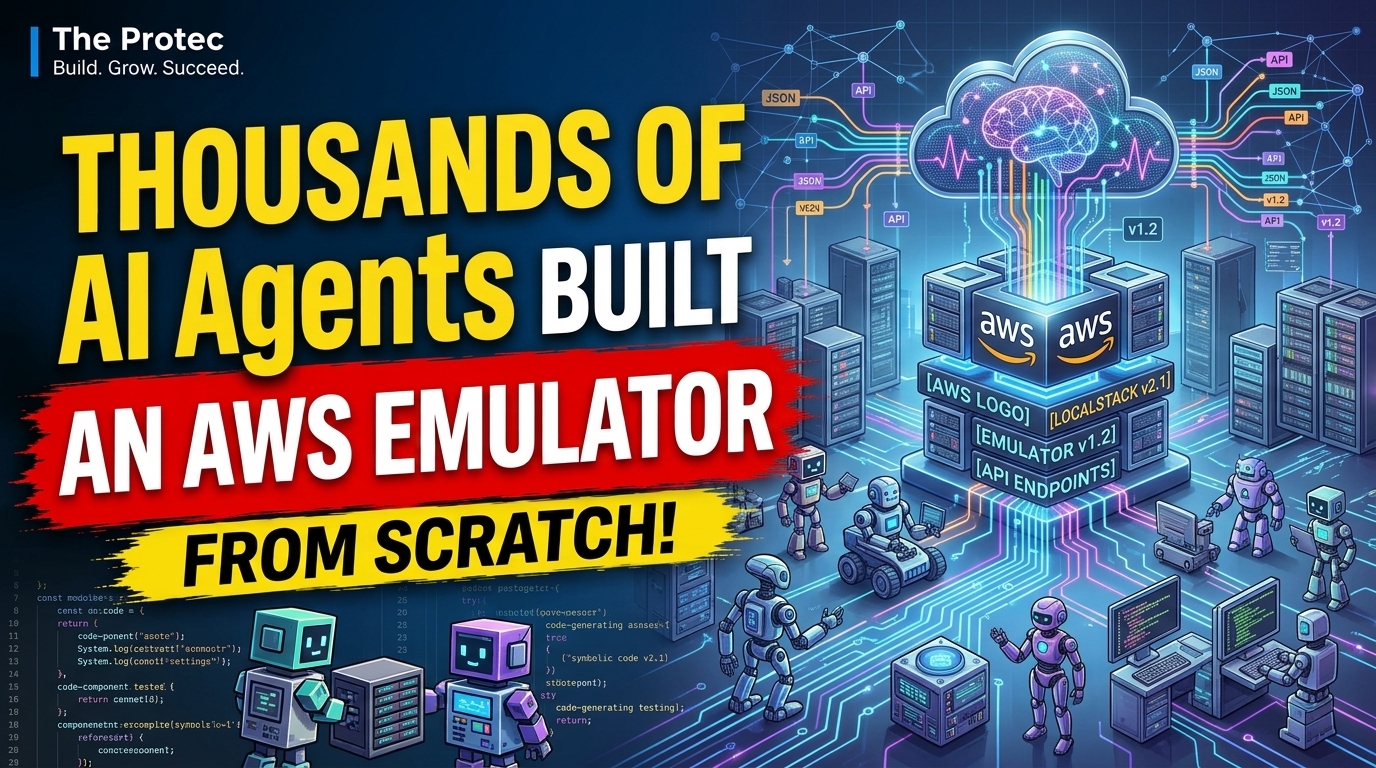
For developers building on Amazon Web Services, a small code change can trigger a surprisingly slow loop: provision cloud resources, deploy, test, inspect the result, and tear everything down. The AWS Emulator, released on November 11, 2026, is designed to shorten that loop by running a broad approximation of AWS on a local machine. The bigger surprise is how it was created: AWS says thousands of autonomous AI agents wrote every line of its code.
The free environment supports more than 200 AWS services across 438 API models, allowing applications, command-line tools, SDKs, and automated tests to send many familiar AWS requests to a local endpoint. It is not a complete copy of the production cloud, however, and AWS is unusually explicit about unfinished behavior. That combination makes the project both a practical AWS local development tool and an ambitious experiment in autonomous AI software development.
What Is the AWS Emulator?
The AWS Emulator is a locally runnable implementation of AWS service APIs. Instead of provisioning a real queue, function, database, bucket, or event rule for every development task, a developer can start the emulator and redirect supported requests to it. Existing AWS CLI commands and SDK clients can generally be configured with a custom endpoint, enabling an application to exercise cloud-dependent code without sending each request to AWS infrastructure.
AWS released the project through its public GitHub repository under CC0, a public-domain dedication that places minimal restrictions on using, modifying, or redistributing the code. The repository also exposes a public backlog showing which services and operations work, which are incomplete, and where behavioral gaps remain.
This transparency matters because service count alone does not establish production fidelity. A service may recognize an API operation while implementing only part of its validation, state transitions, error handling, or interaction with other services. The backlog gives teams a better basis for deciding whether a particular test belongs locally or must run against AWS.
How Thousands of AI Agents Built It
According to AWS’s account of the project, thousands of autonomous agents generated every line of the emulator. The engineering team did not write or review the submitted code. Human engineers instead designed the system around specifications, repeatable evaluation, automated controls, and strict merge gates.
The development process divides responsibility among three main groups of agents. Together, they create a continuous feedback loop rather than asking one general-purpose model to understand and reproduce the entire AWS platform.
1. Fidelity agents create tests against real AWS
The first group calls actual AWS services and records observable behavior. These agents create fidelity tests covering successful responses, invalid parameters, error types, resource state changes, pagination, and other externally visible details. Real AWS is therefore the reference implementation rather than an engineer’s memory of how a service should behave.
This is essential because matching an API involves much more than accepting the correct fields. Applications can depend on exact error conditions, generated identifiers, default values, response shapes, or the order in which a resource changes state.
2. Gap-finding agents compare local and cloud behavior
A second group runs those tests against the local implementation and identifies differences. If an operation succeeds in the cloud but fails locally, returns a different structure, or applies different validation, the discrepancy becomes a concrete task.
That structure turns a vague instruction such as “implement this AWS service” into a series of measurable defects. It also gives the system a way to revisit earlier work when a new test exposes an interaction or edge case that existing checks missed.
3. Coding agents fix issues behind automated gates
The third group changes the emulator to close identified gaps. Proposed fixes must pass automated builds, security scanning, coding-standard checks, existing regression tests, and the relevant fidelity tests before they can be merged. Failed changes return to the agent workflow for another attempt.
No human code review does not mean no quality control. In this model, control moves from line-by-line inspection to executable specifications and enforced acceptance criteria. The approach also connects with the broader agentic development model associated with AWS Kiro: agents are most useful when they have persistent tasks, clear evidence of success, and limited paths for introducing unverified changes.
How 438 API Models Become a Local Cloud
The agents use AWS API Models as machine-readable specifications. These models describe service operations, request and response structures, data types, and documented errors. They provide a consistent blueprint from which agents can generate handlers, validation logic, data structures, and tests.
API models do not fully describe a service’s semantics. They may define the shape of a Create operation without capturing every lifecycle transition, authorization decision, timing characteristic, or cross-service side effect. That is why tests against real AWS are central to the process. The specification tells agents what interface to build; fidelity testing reveals how the interface behaves.
At launch, AWS reports coverage spanning more than 200 services and 438 API models. That breadth makes the project relevant beyond a narrow serverless stack, but coverage should still be checked operation by operation. The GitHub backlog is a more meaningful guide than assuming every modeled API is complete.
Using AWS Services Locally
The basic workflow is familiar to anyone who has used an AWS local emulator. After starting the environment, developers point AWS CLI or SDK requests at its local endpoint instead of the default regional AWS endpoint. Application code can usually select the endpoint through configuration, an environment variable, a test fixture, or an SDK client option.
- Start the emulator on a development machine or CI runner.
- Configure the application, AWS CLI, or SDK with the local endpoint.
- Create the required local resources and seed test data.
- Run unit, component, or integration-style tests.
- Repeat quickly, then run selected tests in a real AWS account before release.
Teams should keep endpoint configuration separate from production settings. Tests must also avoid assuming that a successful local result proves identical IAM, networking, scaling, encryption, or regional behavior in the cloud.
Where the AWS Emulator Can Help
- Faster developer feedback: Applications can test cloud-facing code without waiting for repeated deployments or infrastructure provisioning.
- More predictable CI pipelines: A local environment can reduce dependence on shared test accounts, network availability, temporary credentials, and cloud resource cleanup.
- Serverless application testing: Functions, event-driven workflows, queues, storage operations, and API integrations can be exercised earlier in the development cycle when the required behavior is supported.
- Lower-risk experimentation: Developers can explore APIs and destructive test cases without modifying real cloud resources or generating the same volume of usage charges.
- Better tools for coding agents: AI coding agents can run commands, create resources, inspect responses, and rerun tests inside a disposable environment. That makes AWS testing tools available within an automated coding loop without giving every agent broad cloud access.
The value is not simply that local execution is cheaper. It can make cloud behavior available earlier, when defects are easier to isolate and fix.
A New LocalStack Alternative, but Not a Drop-In Verdict
LocalStack has long provided a popular way to emulate AWS services for local development and CI. The AWS Emulator enters the same broad category, so comparisons are unavoidable. Both aim to let AWS-oriented applications interact with local endpoints, and both can reduce the number of real-cloud deployments needed during development.
The new project stands out because it comes from AWS, uses AWS API Models, publishes an agent-generated implementation under CC0, and maintains a visible backlog of fidelity work. Its unusual production method may also allow agents to add or repair API behavior continuously.
That does not automatically make it a universal LocalStack replacement. Teams should compare the exact services, operations, integrations, tooling, performance, persistence, and support arrangements they need. A mature workflow built around LocalStack may cover behavior that the AWS project has not finished, while the AWS Emulator may support APIs that are useful to another team. Repository status and application-specific tests should decide the choice, not service totals alone.
Important Limitations: Local Is Not Production
AWS does not present the emulator as a complete replacement for its cloud. Known gaps include unsupported operations, partially implemented behavior, and responses that can differ from production. An API may work for a common path while missing a rare validation rule, eventual-consistency effect, quota, event ordering detail, or interaction with another service.
Some production conditions are inherently difficult to reproduce on a laptop. Real deployments involve AWS identity policies, organization controls, managed encryption boundaries, VPC networking, regional dependencies, service quotas, concurrency, latency, failure modes, and distributed infrastructure. A local process cannot be assumed to reproduce all of them accurately.
The AI-generated origin also deserves a measured response. Automated security and fidelity gates can reject many defects, but tests only verify behavior they cover. If the reference suite overlooks an edge case, agents may produce code that passes every gate while remaining incomplete. Public source and a public backlog make those limitations easier to inspect; they do not eliminate them.
A sound testing strategy therefore uses layers:
- Run fast unit and component tests without cloud dependencies where possible.
- Use the emulator for supported AWS API flows and local integration tests.
- Test critical paths against real AWS services in an isolated account.
- Perform production-representative IAM, networking, security, resilience, performance, and deployment validation.
Local success should be treated as evidence that an application is ready for cloud testing, not proof that it is ready for production.
What This Means for Autonomous Software Development
The most consequential part of the project may be its development system rather than the emulator itself. AWS gave agents a large but structured problem: public API specifications, access to a reference implementation, repeatable tests, narrow tasks, and non-negotiable merge gates. Those conditions reduce ambiguity and make progress measurable.
This suggests that AI agents writing code may become particularly effective on software with formal interfaces and observable outputs. Compatibility layers, protocol implementations, SDKs, database drivers, and test infrastructure could all fit that pattern. Agents can probe behavior, identify a mismatch, propose a patch, and verify the result many times in parallel.
The lesson is not that engineering teams are unnecessary. Humans still choose architecture, define acceptable risk, design evaluation systems, manage credentials and costs, and decide what should be released. The AWS experiment shifts engineering effort toward specifications, test quality, security policy, and system-level oversight. If the gates are weak, autonomous production can scale defects as efficiently as it scales fixes.
Frequently Asked Questions
Is the AWS Emulator free?
Yes. AWS released it as a free, locally runnable project and dedicated the code to the public domain under CC0. Developers should still review any separate dependencies and their licenses.
Can it replace testing in a real AWS account?
No. It can accelerate local development and CI, but production-relevant integration, IAM, networking, security, resilience, and deployment tests must still run against real AWS infrastructure.
Does it support every AWS service completely?
No. AWS reports more than 200 services and 438 API models, but individual operations and behaviors may be unfinished. The GitHub backlog documents working features and known gaps.
How do applications connect to it?
Developers configure the AWS CLI or an AWS SDK client to use the emulator’s local endpoint. The precise setting depends on the tool, language, and application architecture.
Did AWS engineers review the generated code?
AWS says the engineering team neither wrote nor reviewed the code. Instead, agent changes passed automated build, security, coding-standard, regression, and fidelity checks before merging.
A Useful Tool and a Bigger Experiment
The AWS Emulator offers developers a faster way to test many cloud-dependent applications locally, while its public backlog makes incompleteness visible. Just as importantly, it demonstrates how autonomous agents can build complex software when specifications, reference behavior, and strict automated gates are aligned. Its usefulness will depend on fidelity, but its development model is already a notable preview of how software engineering may change.