







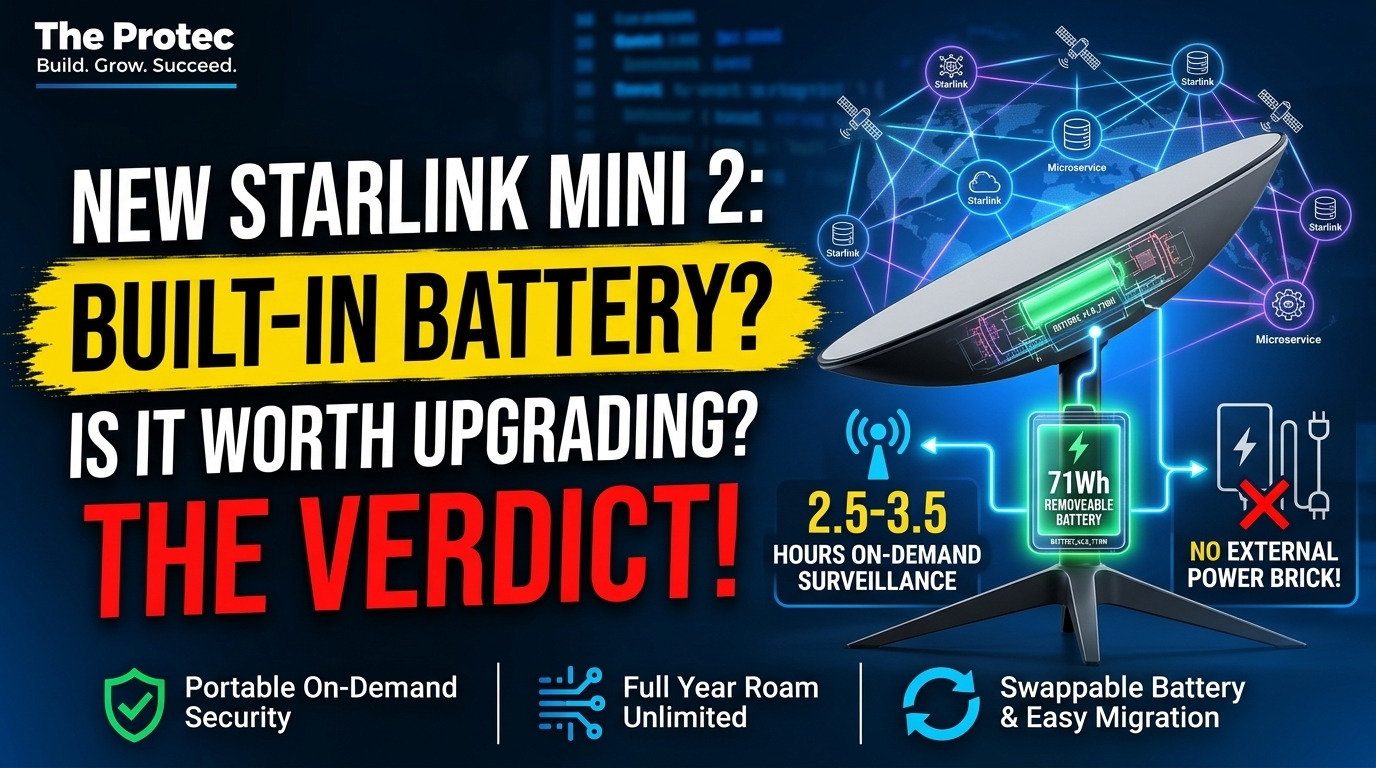
Starlink Mini 2 addresses the most obvious limitation of portable satellite internet: finding a reliable source of electricity after leaving the grid. Unveiled by SpaceX on November 10, 2026, the compact terminal incorporates a removable 71Wh battery rated for up to 4.5 hours of connectivity. That could turn Starlink from equipment that must be wired into a vehicle or power station into a more practical grab-and-go connection for camping, travel, remote work and emergencies.
The battery is the headline change, but it is not the only one. The new terminal supports 60W USB-C charging, includes Wi-Fi 6, offers advertised wireless coverage of up to 167 square meters (1,800 square feet) and has a thinner 23.1mm body. The real buying question is more nuanced: does this convenience justify replacing an original Mini that works perfectly well with portable power equipment?
Starlink Mini 2 specifications at a glance
According to information released around the unveiling, the next-generation terminal combines the satellite antenna, router and battery in one portable unit. SpaceX advertises a connection setup time of approximately 60 seconds when the terminal has a clear view of the sky.
- Battery: Integrated, removable 71Wh pack
- Advertised runtime: Up to 4.5 hours per charge
- Charging: Up to 60W through USB-C
- Wireless networking: Built-in Wi-Fi 6
- Advertised Wi-Fi coverage: Up to 167 square meters, or 1,800 square feet
- Environmental rating: IP67 dust and water protection
- Thickness: 23.1mm
- Weight: Approximately 1.6kg with the battery and kickstand
- Setup: Advertised connection in about 60 seconds with an unobstructed sky view
These are advertised specifications rather than results from long-term independent testing. Runtime, setup speed and wireless coverage can change with temperature, obstructions, network demand, connected devices and the amount of uploading being performed.
Starlink Mini 2 vs Mini: The battery changes the experience
The original Starlink Mini is already considerably easier to transport than a standard residential dish. Its main portability compromise is power: it requires an external source, such as a vehicle connection, compatible USB-C power supply or portable power station.
The Starlink Mini built-in battery removes that dependency for shorter sessions. A camper can take the terminal away from a vehicle, an emergency team can establish communications without first arranging a generator, and a remote worker can relocate to a clearer patch of sky without carrying a power station at the same time.
The removable design matters almost as much as the battery itself. A depleted pack can be exchanged for a charged spare, supporting longer use without tethering the terminal to a cable. Quick-swap support should make the process convenient, although buyers should not assume that every battery change will preserve an uninterrupted connection until retail behavior is independently verified.
Wi-Fi 6 is another useful improvement for busy temporary networks. It can manage multiple modern devices more efficiently, although it cannot increase the speed available from the satellite link itself. Likewise, the advertised 1,800-square-foot coverage figure will be easiest to achieve in an open environment. Tents, vehicles, walls, terrain and radio interference can reduce practical range.
What does 4.5 hours of Starlink Mini 2 battery life mean?
A 4.5-hour maximum is enough for a focused work session, an evening at camp or a temporary communications window. It is not all-day, always-on service. Someone planning eight to ten hours outdoors would generally need at least one additional battery and possibly a third, depending on workload and real-world efficiency.
The 71Wh capacity and 4.5-hour claim imply average system consumption of roughly 16 watts under the conditions used for the estimate. That is a useful planning figure, not a guaranteed constant draw. Searching for satellites, heavy uploads, low temperatures, battery aging and thermal controls may affect runtime.
Ways to extend off-grid use
- Carry spare batteries: Removable packs are the cleanest option when size and mobility matter most.
- Use a suitable USB-C power bank: Look for USB Power Delivery support, adequate capacity and output compatible with the terminal’s 60W charging input.
- Add a portable solar setup: Solar can replenish batteries during longer trips, but results depend on panel output, weather and daylight.
- Connect only when needed: Download maps and files in batches, complete calls, synchronize messages, then shut the terminal down.
A power bank’s advertised capacity is not fully available to the terminal because voltage conversion and charging create losses. The 60W USB-C rating also describes maximum charging capability, not continuous energy consumption. A large bank may be able to run or recharge the terminal, but buyers should confirm power-delivery profiles rather than assuming any USB-C port will work.
Why satellite internet uses more power than a mobile hotspot
A cellular hotspot communicates with a nearby terrestrial tower. A satellite terminal must maintain a high-frequency link with fast-moving satellites hundreds of kilometers overhead, electronically steer its beam and repeatedly manage handoffs across the constellation. It also powers an integrated router and may compensate for changing signal conditions.
That workload is why Starlink USB-C satellite internet cannot be evaluated like a pocket 5G hotspot. The Mini 2 is portable, but its energy needs remain closer to communications infrastructure than to an ordinary travel router.
Could the battery introduce performance compromises?
Portability creates several questions that official specifications alone cannot answer. Earlier firmware analysis reportedly indicated a reduced transmit duty cycle, which could limit how often the terminal transmits and potentially affect uploads. That finding is preliminary. It should not be treated as proof that retail units have slower uploads, especially before controlled comparisons using final hardware and software.
Independent performance tests will need to examine sustained video calls, cloud backups, large file transfers and operation under network congestion. Download speed often receives the most attention, but consistent upload capacity and latency are critical for satellite internet for remote work.
Thermal management is another unknown. A thinner enclosure containing both a satellite terminal and battery has less room to spread heat. High ambient temperatures, direct sun and sustained traffic could lead to throttling or faster battery drain. Conversely, cold weather can temporarily reduce available battery capacity. SpaceX has not established through independent tests how the new design performs across those extremes.
The IP67 rating means strong protection against dust and water under defined test conditions. It does not guarantee an unobstructed satellite signal during heavy rain, snow accumulation or severe storms. Difficult weather can still weaken the radio link, while trees, cliffs and buildings remain common causes of interruptions.
Availability and pricing require careful interpretation
The US rollout began as an invitation-only preorder rather than a universal retail launch. Broader international availability is planned, but timing, hardware terms and eligible service plans may vary by market. Prospective buyers should verify current details through the official Starlink website.
Two reported prices have caused understandable confusion. A $249 Mini 2 beta-kit listing reportedly appeared in the backend of Starlink’s website. Separately, reports describe a $999 invitation bundle that includes the terminal and one year of Starlink Roam Unlimited service.
Those figures refer to different reported offers. The backend listing may represent beta hardware pricing, while the larger amount is described as a hardware-and-service bundle. Neither should be presented as a confirmed standalone global retail price. Regional taxes, plan requirements, promotions and final public-launch pricing could all alter the total cost. Additional details about the unveiling and invitation offer were reported by Drive Tesla Canada.
Who should upgrade—and who should wait?
Upgrade if portability is more important than minimum cost
The new model makes the strongest case for people who regularly carry their terminal beyond a vehicle or fixed base. Likely beneficiaries include backpack-accessible camps, field crews, overland travelers, emergency responders and journalists who need a connection established quickly.
It may also be worthwhile in regions with unreliable electricity. A charged internal battery allows the connection to continue during a short outage without a separate uninterruptible power supply. Removable packs could provide a simple rotation system where electricity is available only at certain times.
Keep the original Mini if your power system is already solved
Existing Mini owners with a vehicle installation, solar generator or high-capacity USB-C power bank may gain relatively little. An external power station can run other equipment, may offer more total energy and avoids buying a new terminal solely for battery integration.
The original Mini may therefore remain the better value for RV users, car campers and remote workers operating from a fixed desk. A cable is less inconvenient when the dish rarely moves independently of its power source.
Wait if performance or price is your deciding factor
Buyers who depend on sustained upload speed should wait for independent retail testing. The same applies to people working in extreme heat, severe cold or persistently wet conditions. Waiting will also clarify the standalone hardware price, replacement-battery cost, international availability and whether specific Starlink Roam plans are required.
Is the Starlink Mini 2 worth it?
The integrated battery makes portable satellite internet meaningfully more convenient, but it does not automatically make the Mini 2 a better value for every owner. Its advantage is freedom from cables and external power during short deployments, not unlimited off-grid operation.
For frequent travelers, campers and emergency users, the combination of a removable battery, USB-C charging and rapid setup could justify an upgrade. For anyone who already carries a capable power station, the original Mini remains practical—and waiting for verified performance and final pricing is the sensible choice.
Frequently asked questions
How long does the Starlink Mini 2 battery last?
SpaceX advertises up to 4.5 hours from the removable 71Wh battery. Actual Starlink Mini 2 battery life will depend on traffic, temperature, signal conditions, connected devices and battery age.
Can Starlink Mini 2 run from a USB-C power bank?
It supports charging at up to 60W through USB-C. A power bank must provide a compatible USB Power Delivery output and sufficient usable capacity. Buyers should verify the required charging profile before relying on a particular bank.
Does the Mini 2 include Wi-Fi?
Yes. Starlink Wi-Fi 6 is built into the terminal, with coverage advertised at up to 167 square meters. Real range will vary with physical obstructions, interference and placement.
Is the Starlink Mini 2 price $249 or $999?
Neither figure has been established as a universal standalone retail price. The $249 amount came from a reported beta-kit backend listing. The separate $999 invitation offer reportedly bundles hardware with one year of Roam Unlimited service.
Is it better than the original Starlink Mini?
It is more self-contained and convenient away from power. However, original Mini owners who already have portable power equipment may not receive enough additional value to justify replacing their current hardware.