








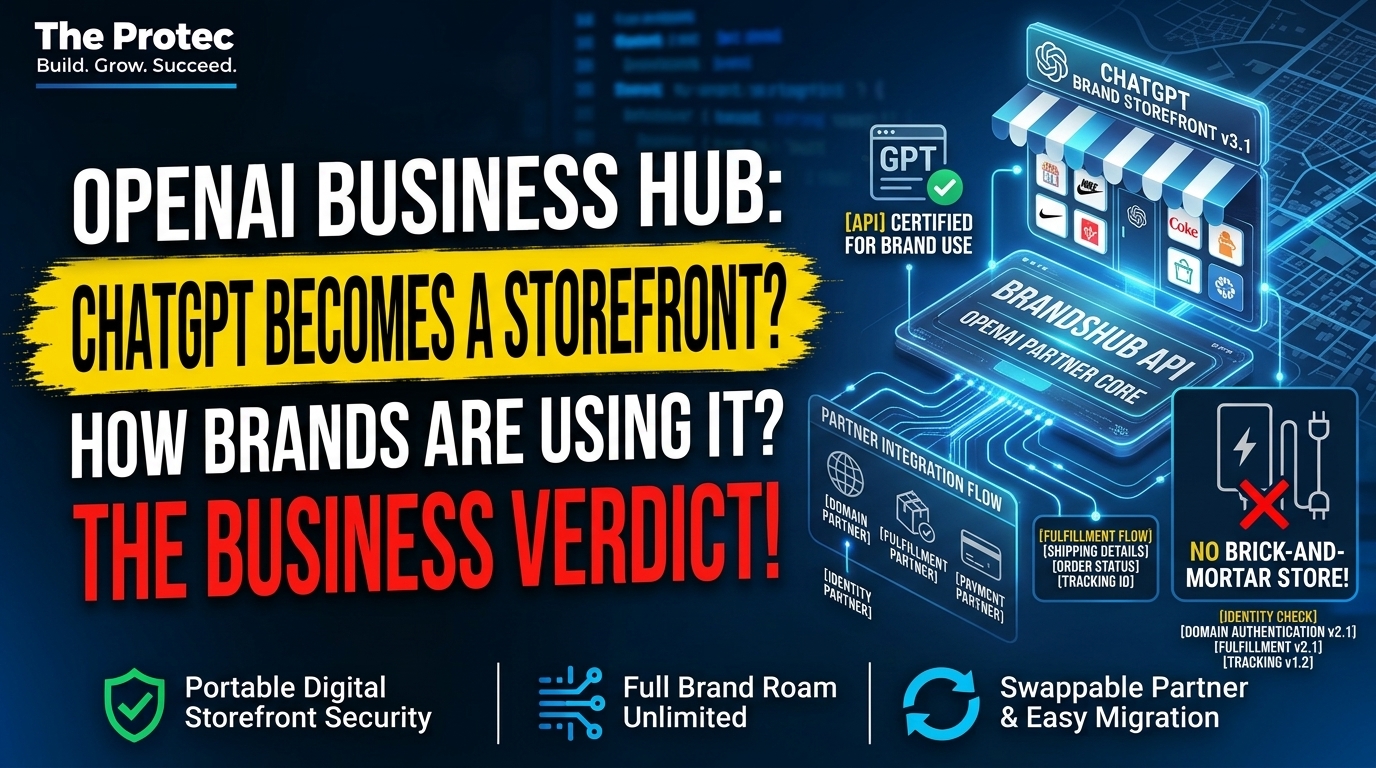
Product discovery is moving beyond lists of blue links and into conversations. With the November 10 launch of Businesses in ChatGPT, the OpenAI Business Hub gives eligible companies a way to manage how they appear in ChatGPT, while Business Agents let users start a separate conversation with an AI representative. The central question is no longer whether people will research purchases through AI, but whether ChatGPT is becoming a storefront and customer-service channel in its own right.
The beta introduces two connected but distinct products. Business Hub supports claimed profiles, business information, product data, and aggregated discovery insights. Business Agents create an interactive channel for answering questions about products, services, policies, and available options. Together, they establish a framework for businesses to participate in ChatGPT discovery without controlling ChatGPT’s independent recommendations.
What OpenAI launched on November 10
Businesses in ChatGPT is a beta platform built around verified business participation. Eligible organizations can claim an existing business profile or establish their connection to a company through Business Hub. They can then maintain information that may help ChatGPT accurately represent the business.
At launch, the platform includes several important capabilities:
- Claiming and managing eligible business profiles.
- Updating company details, policies, services, and other business information.
- Providing product feeds with current pricing and availability.
- Viewing aggregated insights about discovery topics, mentions, and website clicks.
- Connecting eligible Shopify stores and publishing Business Agents.
- Allowing users to voluntarily open a separate conversation with a company’s AI representative.
This is not simply a business directory. It connects structured company information with conversational discovery, creating a potential bridge between AI search optimization, customer support, ecommerce, and advertising.
How the OpenAI Business Hub works
The OpenAI Business Hub acts as the management layer for a company’s presence inside ChatGPT. An eligible business can claim its profile, confirm its relationship to the organization, and update information that users may encounter while researching a category or comparing options.
For a retailer, that information could include product names, descriptions, prices, and stock status. A SaaS company might maintain plan details, supported integrations, service policies, and availability. A local business could provide its address, services, operating information, and website.
Accurate feeds matter because AI-generated answers are only as useful as the information available to the system. A stale product catalog could cause ChatGPT to describe an item that is no longer available. Outdated pricing or return policies could create frustration at the moment a user is considering a purchase.
The OpenAI Business Hub beta therefore turns data maintenance into a marketing responsibility. Catalog operations, customer service, ecommerce, SEO, and brand teams may all need to contribute to one reliable source of business information.
Business Agents create a new conversational channel
ChatGPT Business Agents are AI representatives associated with participating companies. When a business appears in a ChatGPT response, a user may open its profile and choose to begin a separate conversation with the agent.
That voluntary transition is important. The agent does not silently enter an ordinary ChatGPT discussion. Instead, the user moves into a distinct business interaction where they can ask questions such as:
- Is this product available in a particular size or location?
- Which subscription plan supports a required feature?
- What is the cancellation or return policy?
- Which option fits a stated budget or use case?
- Does the company serve a specific region?
For businesses, this offers an organic conversational entry point that sits between a search result and a conventional support chat. It can help a potential customer clarify options without immediately navigating a website, searching a help center, or waiting for a human representative.
Claiming a profile is not permission to publish an agent
OpenAI makes a meaningful distinction between profile claiming and agent publication. Claiming establishes that a business manages a profile. It does not automatically grant approval to launch a Business Agent.
Agent publishing has additional eligibility requirements and is initially subject to US availability restrictions. Businesses must satisfy OpenAI’s applicable access, policy, and rollout requirements before an agent can become available. Organizations outside the initial agent market may still be able to pursue eligible profile-management features as access expands, but they should not interpret a claimed profile as confirmation of agent access.
There is also an important limit to the blue check shown on a claimed profile. It indicates that the profile has been claimed through OpenAI’s process; it is not a guarantee that every statement or submitted claim has received independent factual verification. Users still need to assess business claims, policies, and offers carefully.
Shopify ChatGPT integration and access for other businesses
Shopify merchants receive a direct path into the new ecosystem. Eligible merchants can connect their stores, make structured commerce data available, and publish agents when they meet the applicable requirements. This could reduce the technical work involved in keeping product pricing, availability, and descriptions synchronized.
Shopify is not required to claim a business profile, however. Other eligible ecommerce stores, SaaS providers, local companies, publishers, and service businesses can use profile features without operating on Shopify. The integration is a streamlined commerce route, not an exclusive gate into Businesses in ChatGPT.
Because beta terms and availability can change, companies should confirm current requirements through OpenAI’s official website and, for connected stores, Shopify’s official resources.
What this means for ChatGPT SEO and AI search optimization
Traditional SEO focuses on making pages accessible, relevant, authoritative, and useful in search results. ChatGPT SEO adds another concern: can an AI system confidently understand the business, its products, its policies, and the conditions attached to an offer?
That does not make websites or conventional search optimization obsolete. ChatGPT may still rely on public web information, and users may click through to evaluate evidence or complete an action. But businesses now have another information surface to maintain.
A practical AI search optimization strategy should prioritize:
- Entity clarity: Use consistent names, descriptions, locations, and ownership information.
- Catalog accuracy: Keep product identifiers, prices, options, and availability current.
- Policy consistency: Align shipping, returns, cancellations, privacy, and service terms across channels.
- Useful comparisons: Explain who a product serves, where it has limitations, and how plans or models differ.
- Fresh source content: Maintain accessible product pages, documentation, FAQs, and support materials.
The goal is not to manipulate an AI answer. It is to reduce ambiguity so ChatGPT can represent the company correctly when it is relevant to a user’s request.
A new measurement layer for ChatGPT business discovery
Business Hub includes aggregated insights showing how users discover and interact with a company. Available reporting can include mentions, website clicks, and topics associated with discovery. This gives marketers an early view of demand forming inside an AI assistant rather than on a conventional search results page.
These insights should not be confused with individual-level prompt analytics. Businesses cannot inspect users’ private ChatGPT conversations or read the prompts that led to every mention. The beta also does not provide a conventional share-of-voice metric showing a brand’s precise visibility against every competitor.
Even with those limitations, aggregated topic reporting could expose useful patterns. A software company might learn that users frequently encounter it while researching a specific workflow. A retailer might see discovery around a product use case that receives little organic search traffic. Website clicks could then show whether those appearances generate measurable interest.
Business Agents, ads, and AI-powered customer acquisition
Business Agents have both organic and paid commercial implications. A company can appear through a relevant ChatGPT response, after which a user may voluntarily open its profile and speak with its agent. Companies can also sponsor agents as destinations for ChatGPT Ads, creating a paid route into the same conversational environment.
This could produce a new competitive intersection among search advertising, SEO, ecommerce platforms, and AI agent marketing. Instead of paying only for a click to a landing page, an advertiser may promote an AI-powered customer service experience capable of answering detailed questions before the user visits the site.
However, neither claiming a profile nor publishing an agent guarantees prominent placement, traffic, or sales. OpenAI says ChatGPT continues to make independent recommendations and comparisons. A business profile supplies information and enables interaction; it does not buy control over the assistant’s conclusions.
Practical implications across industries
Ecommerce stores
Retailers should treat feed freshness as a conversion issue. Accurate variants, prices, stock levels, fulfillment terms, and return policies will determine whether an agent can give useful answers. Shopify merchants may have a faster integration path, while other stores may need a more deliberate catalog workflow.
SaaS companies
SaaS teams should maintain plan limits, integrations, security documentation, trial terms, and cancellation policies. An agent can help prospects narrow their choices, but inaccurate feature claims could damage trust or create avoidable support work.
Local businesses
Local companies should focus on service areas, opening information, appointment requirements, pricing conditions, and current contact details. For these businesses, ChatGPT business discovery may become another route by which high-intent customers decide whom to contact.
Publishers and digital marketers
Publishers should watch how AI discovery affects referral traffic and brand attribution. Digital marketers will need reporting that combines Business Hub insights with analytics, conversions, paid media, and customer-service outcomes rather than treating mentions as a standalone success metric.
Privacy, disclosure, and trust
The business opportunity depends on users understanding when they are talking to ChatGPT and when they have entered a company-operated experience. Business Agent conversations are separate from ordinary ChatGPT conversations. Businesses do not receive access to a user’s private chats merely because the company was mentioned in an answer.
Agents must identify themselves as AI representatives. They should not present themselves as independent advisers, neutral experts, or human employees. Sponsored placements must also be labeled so users can distinguish paid promotion from organic discovery.
Companies should apply the same care to agent interactions that they apply to websites and support systems. Answers should avoid unsupported claims, disclose meaningful limitations, and provide a route to human assistance when the issue involves sensitive information, complex disputes, or commitments an automated system should not make.
What businesses should do now
- Check whether the organization is eligible to claim its profile.
- Assign ownership across marketing, commerce, support, legal, and data teams.
- Audit business descriptions, product feeds, prices, inventory, and policies.
- Separate profile-claiming plans from Business Agent launch plans.
- Define escalation rules for questions the agent should not answer alone.
- Track aggregated discovery topics and clicks alongside qualified leads and sales.
- Review sponsored-agent opportunities without assuming paid access improves organic recommendations.
Businesses should view the current release as a beta, not a finished replacement for search, websites, social platforms, or human support. Broader availability and deeper commerce workflows are possible future directions, but they should not be treated as confirmed launch features until OpenAI announces them.
Frequently asked questions
What is the OpenAI Business Hub?
It is the management component of Businesses in ChatGPT. Eligible companies can claim profiles, update business information, submit product data, and review aggregated insights related to mentions, discovery topics, and website clicks.
Does a claimed profile automatically get a Business Agent?
No. Profile claiming and agent publishing are separate. A business must meet additional eligibility and rollout requirements to publish an agent, and Business Agents have initial US availability restrictions.
Do businesses see what users privately ask ChatGPT?
No. Businesses do not gain access to private, ordinary ChatGPT conversations. A user must voluntarily open a separate Business Agent conversation to interact with a company’s AI representative.
Does the blue check guarantee that every business claim is verified?
No. The check indicates that a business profile has been claimed through the platform. It does not guarantee that every submitted statement has been independently verified or endorsed by OpenAI.
Will claiming a profile improve ChatGPT rankings?
OpenAI does not guarantee higher placement, recommendations, traffic, or sales. ChatGPT continues to make independent comparisons and recommendations. Accurate data may help the system represent a business correctly, but it is not a ranking guarantee.
Is ChatGPT becoming the next storefront?
Businesses in ChatGPT does not replace the open web, search engines, ecommerce sites, or support teams. It does, however, create a new place where discovery, evaluation, customer service, and paid acquisition can converge. Companies that maintain accurate information and earn user trust will be better prepared if conversational AI becomes a routine stop on the path to purchase.