








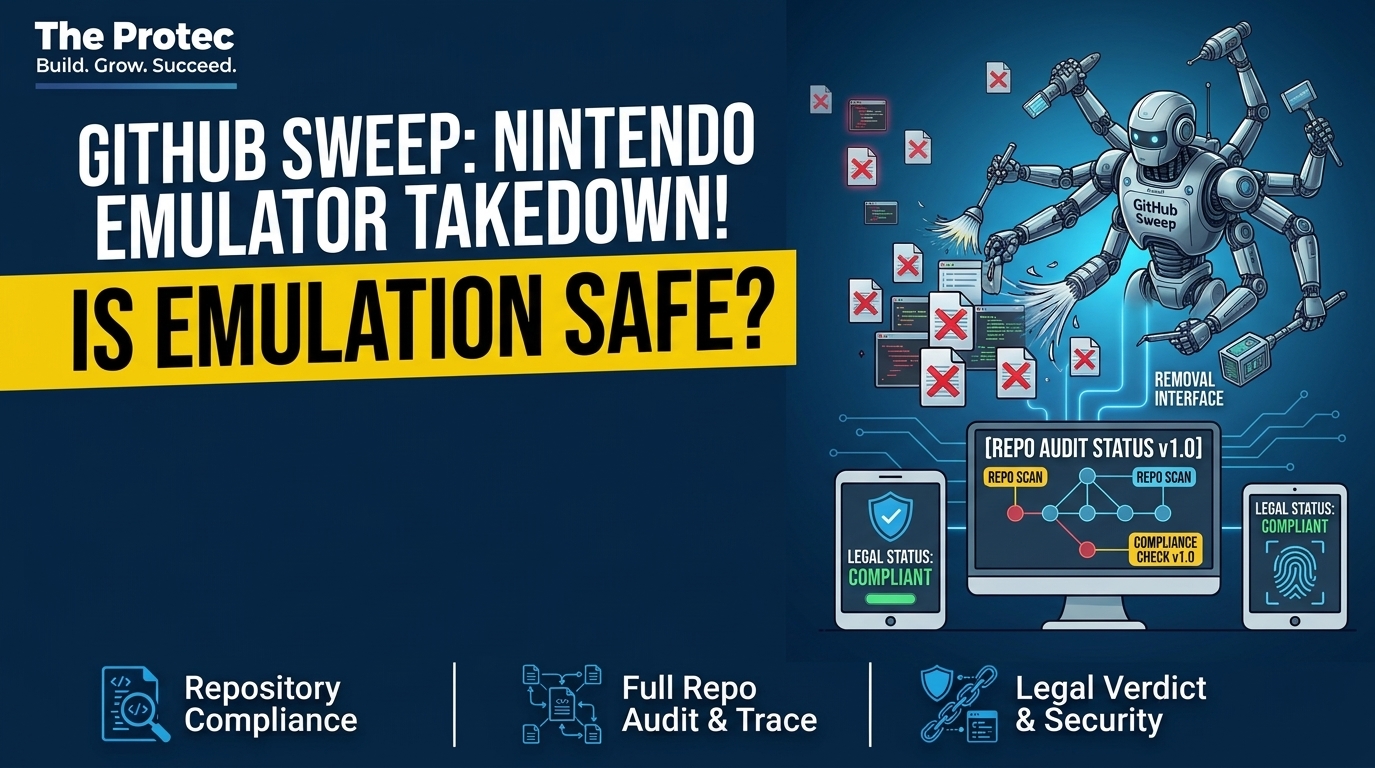
Nintendo has escalated its campaign against software associated with Switch emulation and console modification. The latest Nintendo Switch emulator takedown sweep uses the Digital Millennium Copyright Act to target emulator projects, modchip firmware, and connected repositories hosted on GitHub. Four notices reportedly cover Yuzu-related code, the Citron Neo emulator, and Picofly firmware, with 144 repositories removed from one Picofly fork network alone.
The immediate effect is straightforward: the named code is no longer available from the affected GitHub locations. The legal and practical consequences are more complicated. Nintendo alleges that the projects circumvent technological protection measures used by the Switch, but a DMCA notice is a copyright claim, not a court judgment. The dispute also raises broader questions about lawful emulation, homebrew software, preservation, and the vulnerability of open-source projects hosted on centralized platforms.
What did Nintendo remove from GitHub?
According to public GitHub DMCA records summarized by IGN’s report on the enforcement campaign, Nintendo submitted four takedown notices aimed at Switch-related projects. The targets included repositories associated with the Yuzu emulator, Citron Neo, and Nintendo Switch modchip firmware.
The largest part of the sweep involved Picofly firmware and its fork network. GitHub disabled 144 repositories connected through that network. A fork is a copy of a repository that preserves its development history and allows another developer to modify the project independently. Consequently, one notice can affect far more than the original repository if GitHub determines that numerous forks contain the same disputed material.
This GitHub repository takedown does not mean every project received a separate legal analysis or court ruling. GitHub generally evaluates whether a notice satisfies the DMCA’s formal requirements and identifies allegedly infringing content. It may then disable the reported material while preserving a route for affected owners to respond.
Why were 144 Picofly repositories taken down?
Picofly is associated with microcontroller-based Nintendo Switch modchips. Its firmware controls how compatible hardware interacts with the console during startup. Nintendo’s position is that this combination can interfere with the Switch’s boot protections and enable unauthorized software, including copied games, to run.
The number 144 reflects GitHub’s fork-network structure rather than 144 fundamentally different products. When a parent repository is forked, copies may retain substantially identical files. If a complaint identifies allegedly infringing or circumvention-related material in the parent and its forks, GitHub can process the network together.
That approach is efficient for rights holders, but it can create collateral effects. Some forks may be abandoned mirrors, while others may contain original changes, documentation, or code intended for research. Repository owners can also remove disputed files or demonstrate meaningful differences, depending on the circumstances and GitHub’s review.
Nintendo’s notice reportedly characterizes Picofly firmware as part of a system for defeating access controls. That is an allegation under the DMCA, not a finding that every owner of a Picofly-related repository committed infringement. The distinction matters because code can have multiple applications, and liability may depend on its design, distribution, marketing, and actual use.
Why are Yuzu and Citron Neo being targeted?
Nintendo Switch emulators reproduce enough of the console’s hardware and operating environment for Switch software to run on another device. An emulator is not necessarily a copy of a console’s entire system. Developers may independently implement functions such as graphics processing, memory management, controller input, and CPU behavior.
The central dispute is often not emulation by itself, but how protected games become readable and executable. Commercial Switch titles are encrypted, and the console uses cryptographic keys and a verified boot process to control access. Nintendo alleges that targeted emulators and related tools bypass those technological protection measures, bringing them within the DMCA’s anti-circumvention provisions.
Yuzu has been under particular scrutiny since Nintendo sued its original developer, Tropic Haze. That earlier case ended in a settlement, monetary payment, and permanent injunction rather than a trial establishing that all console emulation is illegal. Copies and derivatives of Yuzu code have continued to appear online, prompting further Nintendo emulator takedown requests.
Citron Neo is being targeted on similar grounds: Nintendo identifies it as software capable of running protected Switch games through alleged circumvention. Repository removal establishes that GitHub acted on the notice; it does not independently prove every allegation about the project.
How do modchips, firmware, keys, and emulators fit together?
The Switch uses several overlapping security controls. During boot, the console checks whether system software has been authorized and cryptographically signed. Game content is encrypted, while device and software keys help the legitimate system decrypt and execute it.
A modchip is an added hardware component that changes or interferes with part of the startup process. Its firmware supplies the logic that makes the chip operate. Some modifications can create a path for custom software, alternative operating environments, recovery utilities, or unauthorized game copies. This article intentionally does not provide installation, key-extraction, or protection-bypass instructions.
An emulator operates on a separate computer or device and recreates the environment expected by a game. Emulator code may be independently written, but running encrypted commercial software can require additional data obtained from a console. Nintendo argues that the relevant tools facilitate unlawful access by defeating encryption and verification measures. Emulator advocates respond that users may have lawful reasons to study hardware behavior, run homebrew, or preserve software they legitimately possess.
Are Nintendo Switch emulators illegal?
No blanket rule makes every emulator illegal. Courts have previously recognized that independently created emulation technology can have legitimate uses. Copyright problems can arise when a project distributes copyrighted console code, proprietary keys, unauthorized game files, or other protected material.
DMCA Section 1201 adds a separate issue. It generally prohibits circumventing technological measures that effectively control access to copyrighted works and can also restrict trafficking in tools primarily designed for circumvention. That claim can exist even when the dispute is not simply about copying source code.
There are statutory and periodically adopted exemptions for certain activities, but they are narrow and fact-specific. They do not provide a universal right to bypass every console security system or distribute circumvention tools. Whether a particular emulator or modification is lawful depends on what it contains, how it works, how it is promoted, and the applicable jurisdiction.
It is therefore inaccurate to say that the GitHub sweep proves all Switch emulation illegal. It is equally inaccurate to assume that owning a game automatically authorizes every method of decrypting, copying, or running it. Nintendo’s notices assert specific claims against specific repositories; only a court could conclusively resolve a contested claim.
Does this affect existing modded Switch consoles?
A GitHub removal does not remotely uninstall firmware, disable an emulator already downloaded, or reverse modifications made to an existing console. The direct action is against files hosted at named repository locations.
Existing setups may nevertheless face indirect effects. Updates, documentation, issue tracking, source history, and future firmware development can disappear or move elsewhere. Users may also encounter incompatible console updates, security risks from unofficial mirrors, or enforcement through Nintendo’s separate account and online-service policies.
The sweep should not be interpreted as proof that a particular console has been detected. GitHub takedowns and Nintendo’s technical or account-level enforcement are distinct processes.
Can developers challenge a GitHub DMCA takedown?
Yes, although responding has legal consequences. Under GitHub’s DMCA takedown policy, an affected repository owner may sometimes revise the project to remove identified material. If the owner believes content was disabled because of mistake or misidentification, the owner can submit a formal counter-notice.
A valid counter-notice generally requires identification of the removed content, a statement under penalty of perjury, consent to the jurisdiction of an appropriate federal court, and the submitter’s contact information and signature. GitHub forwards a compliant counter-notice to the complainant.
The complainant then normally has 10 to 14 business days to notify GitHub that it has filed a legal action seeking to restrain the challenged activity. If GitHub receives no such notice, it may restore the content. Restoration is not guaranteed when other policy violations or unresolved issues apply.
Developers should not treat a counter-notice as a casual support ticket. It can reveal personal information and may invite litigation. Before responding, repository owners can consider these steps:
- Preserve private development records and evidence of original authorship.
- Compare the notice’s claims with the exact files and functions identified.
- Determine whether disputed code can be removed without destroying lawful portions of the project.
- Avoid reposting the same material through replacement accounts or mirrors.
- Seek advice from a qualified copyright attorney before filing a counter-notice.
What does this mean for homebrew and game preservation?
Switch homebrew includes independently created games, media tools, accessibility projects, diagnostics, and experimental software. Console modification also supports hardware research and education. Those uses are not identical to downloading unauthorized commercial games, even when some underlying tools overlap.
Preservation introduces another concern. Digital storefront closures, server dependencies, hardware failure, and scarce physical media can make older software difficult to study. Emulators can help museums, researchers, and preservation groups document games after original hardware becomes unreliable. However, preservation goals do not automatically override copyright or anti-circumvention law, particularly for a commercially active platform.
The Nintendo piracy crackdown demonstrates how easily mixed-use projects can vanish when repositories share code or belong to one fork network. Open-source developers may respond by separating clean-room emulator code from copyrighted data, documenting provenance, refusing proprietary keys and game files, and maintaining clearer policies against piracy.
Centralized hosting remains another pressure point. GitHub provides collaboration, issue tracking, and distribution at enormous scale, but it must respond to legally sufficient notices. When a major fork network disappears, lawful research and development history can be lost alongside disputed material.
The broader impact of Nintendo’s GitHub DMCA campaign
Nintendo’s strategy reflects a shift from pursuing only prominent projects to disrupting the surrounding distribution ecosystem. Targeting firmware, emulator repositories, and large fork networks reduces easy access while signaling that renamed or copied projects may also receive notices.
Still, a takedown is not the final word on emulation law. The crucial questions remain whether code contains protected material, whether it circumvents an effective access control, and whether its developers can establish lawful independent purposes. Future disputes may shape how platforms distinguish an emulator’s general functionality from features allegedly designed around unauthorized games.
For players, the practical takeaway is narrower: repositories have been removed, but existing hardware has not been remotely changed. For developers, the campaign highlights the importance of clean-room practices, careful documentation, and informed legal review. For preservation advocates, it reinforces the need for lawful, institutionally supported methods that do not depend on vulnerable public repositories.
Frequently asked questions
Did GitHub decide that Yuzu, Citron Neo, or Picofly is illegal?
No. GitHub disabled reported content under its DMCA process. That action does not carry the same legal authority as a court judgment and does not independently confirm every allegation in Nintendo’s notices.
Can removed Nintendo Switch repositories reappear?
They may be restored after a successful counter-notice, revised to remove disputed material, or republished elsewhere. Reposting identical content does not resolve the underlying claim and may lead to additional notices or legal action.
Is it illegal to own a modded Nintendo Switch?
Ownership alone does not answer the legal question. Laws vary, and relevant conduct can include circumvention, distribution of tools, copying games, or infringement of copyrighted code. Nintendo may also apply warranty, account, or online-service restrictions separately from copyright law.
Does owning a Switch game make emulation automatically legal?
No. Ownership may support a legitimate-use argument, but it does not automatically authorize copying protected files, obtaining encryption keys, bypassing access controls, or downloading someone else’s game image. The method and jurisdiction matter.
Why is the Nintendo GitHub DMCA sweep important beyond Switch users?
It shows how one notice can remove a large open-source fork network and affect projects with varying purposes. The result may influence how emulator developers, preservation groups, and hosting platforms manage mixed-use code in the future.