








For much of the modern AI boom, the cloud was the default destination for inference. A device captured a prompt, image, or audio clip; transmitted it to a distant data center; and waited for a large model to return an answer. That architecture made sense when capable processors were concentrated in server racks and leading models demanded enormous amounts of memory and power.
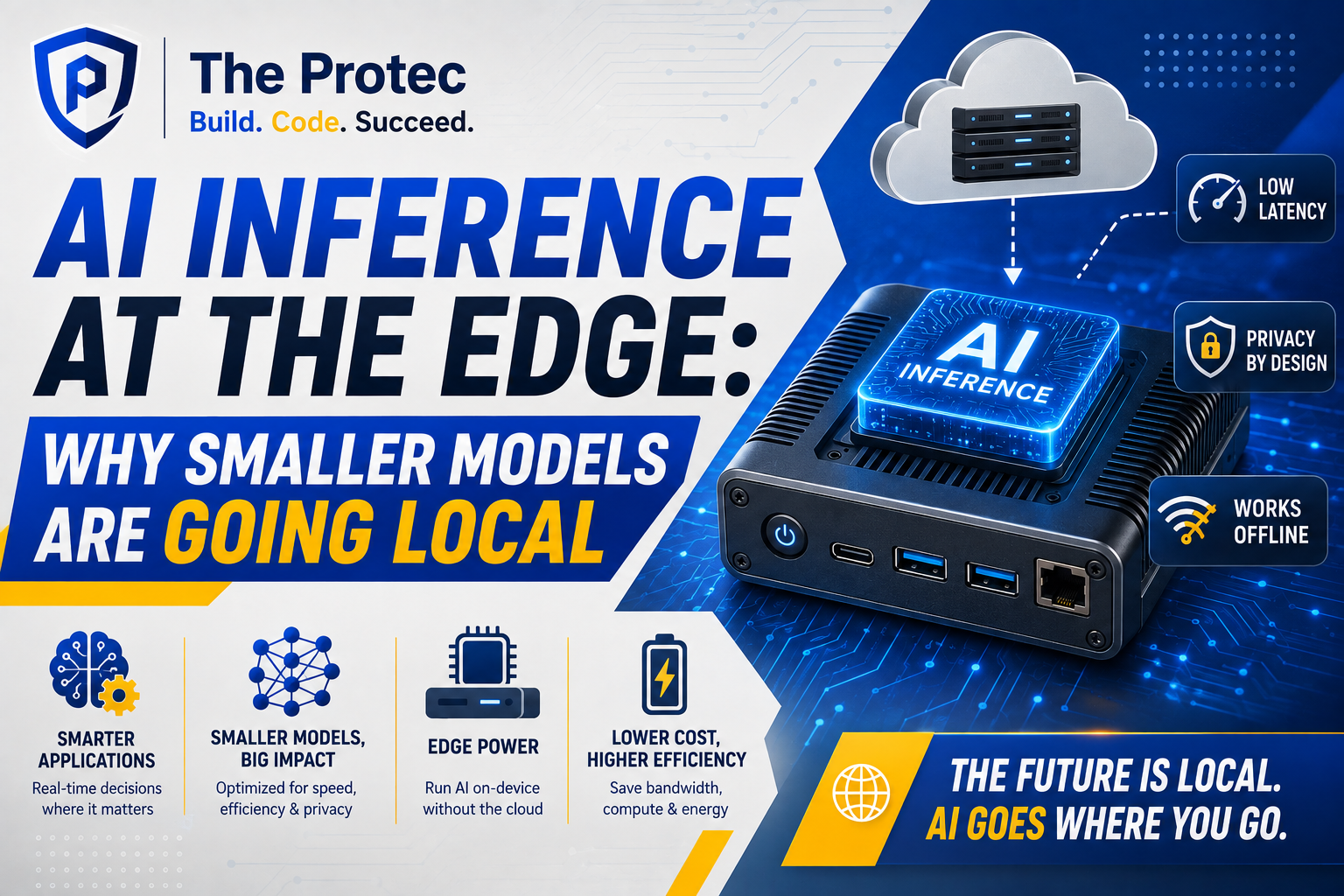
That balance is changing. Phones, laptops, vehicles, cameras, industrial systems, and other connected products increasingly contain neural processing units designed specifically for machine learning. At the same time, model compression, quantization, distillation, and more efficient architectures are making useful models dramatically smaller. The result is a steady expansion of AI inference at the edge: running a trained model close to the person, sensor, or system generating the data.
As of August 2026, this shift is no longer limited to basic voice commands or image filters. Small AI models can summarize documents, interpret screens, transcribe speech, analyze sensor streams, generate text, and support multimodal assistants directly on consumer and enterprise hardware. Cloud-scale models remain essential, but local inference is becoming a core part of how practical AI systems are designed.
What Edge AI Inference Actually Means
Inference is the stage at which a trained AI model uses new data to produce a prediction or response. Training may require large clusters of accelerators, but inference can happen almost anywhere if the model fits within the device’s limits for memory, compute, power, and heat.
Edge AI inference moves that execution away from a centralized cloud and closer to where data originates. The edge may be a smartphone, AI PC, router, retail terminal, factory gateway, vehicle, security camera, wearable, or small server located at a business site. It does not necessarily mean that a device works alone or stays permanently offline. Many deployments combine local processing with cloud services.
The important distinction is architectural: data does not always need to make a round trip to a remote data center before the product can act. That changes application responsiveness, economics, privacy, and reliability.
Why AI Inference Is Moving Beyond the Cloud
Lower Latency Creates More Natural Experiences
Network calls introduce delay. Even with a fast connection, an application must package data, transmit it, enter a processing queue, run the model, and receive the result. Congestion, weak wireless coverage, and physical distance can make the delay unpredictable.
Local inference removes much of that round trip. This matters for real-time translation, voice interfaces, accessibility tools, gaming, robotics, driver assistance, and industrial control. A response arriving in tens of milliseconds can feel immediate, while a pause of several seconds can break a conversation or make an automated system unsafe. Predictable latency is often as valuable as raw speed.
Privacy Improves When Sensitive Data Stays Local
Many AI features depend on highly personal or confidential information: messages, photos, voice recordings, health signals, business documents, camera feeds, and location data. Processing that information on the originating device can reduce how much raw data leaves a user’s control.
Local execution does not make an application automatically private or secure. Developers still need encryption, access controls, secure model storage, careful logging, and transparent retention policies. However, data minimization becomes easier when an application can extract an intent, detect an event, or create a summary without uploading the source material. For regulated organizations, that can also simplify data residency and compliance decisions.
Bandwidth and Cloud Inference Costs Add Up
Sending occasional text requests to a cloud API may be inexpensive. Continuously uploading video, audio, telemetry, or high-resolution sensor data is different. It consumes network capacity and can create substantial storage, transfer, and inference charges at scale.
AI inference at the edge allows devices to filter information before transmission. A camera can report a detected safety event instead of streaming every frame. A factory sensor can send an anomaly score rather than its complete high-frequency history. A laptop can summarize a local file without uploading it. Cloud resources can then be reserved for requests that genuinely require larger models or broader context.
Offline Operation Makes AI More Resilient
Cloud-only products depend on network availability and service uptime. That dependency is unsuitable for remote work sites, aircraft, vehicles, disaster zones, rural areas, and mobile users moving through inconsistent coverage.
A local model can preserve core functionality when a connection disappears. It can also provide a fallback during cloud outages or periods of heavy demand. This resilience is especially important when AI supports navigation, equipment monitoring, accessibility, security, or operational decisions rather than optional entertainment.
Why Small AI Models Are Becoming Capable Enough
The edge transition is not happening simply because device processors are faster. Model design has also improved. Developers increasingly optimize for useful performance per watt, byte, and millisecond instead of pursuing parameter count alone.
- Quantization reduces the precision used to represent model weights and activations. Moving from 16-bit values to 8-bit or 4-bit formats can sharply reduce memory use and accelerate inference on supported hardware.
- Knowledge distillation trains a compact student model to reproduce important behaviors from a larger teacher model, retaining much of its practical ability at a smaller size.
- Pruning and sparsity remove or skip less important model components, lowering computational requirements when runtimes and processors can exploit the resulting structure.
- Task-specific tuning lets a smaller model outperform a general-purpose model within a narrow domain, such as document classification, command recognition, code completion, or equipment diagnostics.
- Efficient runtimes improve operator fusion, memory management, caching, and hardware acceleration. Frameworks such as ONNX Runtime help applications target different processors without rebuilding every inference pipeline from scratch.
Small AI models do not need to match the broad knowledge of the largest cloud systems to be valuable. A model embedded in a product usually has a defined job, access to relevant local context, and a constrained output format. In those conditions, speed and consistency can matter more than encyclopedic range.
Device Hardware Is Catching Up With the Models
Modern devices increasingly combine CPUs, GPUs, and dedicated NPUs. Each processor serves a different role: CPUs handle flexible application logic, GPUs provide parallel throughput, and NPUs execute common neural-network operations with greater energy efficiency. Unified or tightly integrated memory systems can also reduce the cost of moving model data between processors.
This hardware matters because edge deployment is governed by sustained performance, not a brief benchmark peak. A model that drains a phone battery, overheats a laptop, or competes with critical vehicle software is not production-ready. Newer NPUs and low-precision data formats make continuous or frequently invoked inference more practical within realistic power envelopes.
Software support is improving as well. Operating systems can route workloads to available accelerators, while hardware-aware compilers adapt models to different chip architectures. Benchmark projects such as MLPerf Tiny also encourage more consistent evaluation of machine learning on resource-constrained systems.
The Rise of Hybrid Edge and Cloud AI
The future is not a simple contest between local and cloud inference. In many products, the strongest architecture is hybrid. A small model handles frequent, private, or latency-sensitive work on the device, while a larger cloud model receives requests that demand deeper reasoning, current external knowledge, or extensive context.
A local assistant might detect a wake phrase, transcribe speech, identify the user’s intent, and retrieve information from private files. It could answer routine questions itself, then escalate a complex research task to a cloud model with the user’s permission. The device may send only a compact representation or selected context instead of the full original data.
Routing can account for network quality, battery level, thermal state, model confidence, privacy settings, cost limits, and request complexity. This makes inference placement dynamic rather than fixed. It also helps services remain responsive during traffic spikes because not every interaction competes for centralized accelerator capacity.
Where Edge AI Inference Is Having the Greatest Impact
- Phones and wearables: Local models support transcription, translation, photo organization, notification summaries, health-signal interpretation, and personalized assistance.
- AI laptops: NPUs can run meeting tools, document features, local search, coding assistance, image processing, and security detection without occupying the CPU or relying on constant connectivity.
- Vehicles: Edge inference interprets cameras, radar, driver behavior, cabin activity, and voice commands where immediate responses are essential.
- Industrial devices: Factories use local models for predictive maintenance, visual inspection, worker safety, and anomaly detection close to production equipment.
- Retail and smart spaces: Edge systems can analyze occupancy, inventory, checkout activity, and equipment status while limiting the movement of identifiable video.
These use cases share a common trait: the data is generated continuously or is too sensitive, expensive, or time-critical to send to the cloud by default.
Challenges That Still Limit On-Device AI
Edge deployment introduces constraints that cloud teams can often avoid. Devices vary widely in memory, processors, operating systems, and accelerator support. A model that runs smoothly on a flagship laptop may not fit an older phone or low-cost gateway. Teams must test across a realistic hardware fleet rather than relying on one reference device.
Model updates also require discipline. Developers need secure delivery, version control, rollback mechanisms, and compatibility checks. Models can become intellectual property targets, while maliciously modified inputs may attempt to manipulate outputs. Local data stores and retrieval indexes require the same security attention as the model itself.
Quality is another trade-off. Aggressive compression can weaken reasoning, accuracy, multilingual performance, or instruction following. Edge models may also lack current information unless an application supplies trusted local or online retrieval. Evaluation should therefore cover task success, latency, energy consumption, memory, thermal behavior, and safety—not just model size.
How Organizations Should Plan an Edge AI Strategy
Teams should begin with the product requirement rather than a fashionable model. Identify which interactions must be immediate, what data should remain local, how often the feature will run, and what happens when connectivity fails. These answers define whether inference belongs on the device, in a nearby edge server, in the cloud, or across all three.
- Set measurable targets for accuracy, response time, memory use, battery impact, and cost per interaction.
- Choose the smallest model that reliably completes the defined task instead of compressing an oversized model without a clear objective.
- Design graceful escalation so uncertain or complex requests can move to a stronger model when policy and connectivity allow.
- Test with representative devices, real environmental conditions, and production-length sessions to expose heat or memory problems.
- Monitor failures and model drift without collecting more personal data than the service genuinely needs.
What Comes Next for AI Inference at the Edge
Small AI models will continue gaining stronger language, vision, audio, and tool-use capabilities, while device accelerators become more efficient. Local multimodal assistants will increasingly understand what users see, hear, write, and do across authorized applications. Personalization can also remain on the device, reducing the need to centralize sensitive behavioral data.
The cloud will still train frontier models and answer the hardest requests. Its role, however, is becoming more selective. The emerging pattern is a distributed AI stack in which each workload runs where it delivers the best combination of speed, privacy, cost, reliability, and capability. Edge AI inference is becoming less of a special feature and more of a standard systems-design decision.
Frequently Asked Questions
What is the difference between edge AI and cloud AI?
Edge AI runs models on or near the device producing the data, while cloud AI sends data to centralized infrastructure for processing. Edge inference usually offers lower latency, stronger offline support, and greater data control. Cloud inference provides more compute, easier centralized updates, and access to larger models.
Are small AI models accurate enough for real applications?
Yes, when the task is well defined. Small AI models can perform transcription, classification, summarization, visual detection, command handling, and domain-specific assistance effectively. They may be less capable on broad or highly complex reasoning tasks, which is why hybrid routing is increasingly common.
Does on-device inference eliminate privacy risks?
No. Keeping raw data local reduces exposure, but applications can still store information insecurely, create excessive logs, leak outputs, or use vulnerable model packages. Privacy requires secure storage, permission controls, data minimization, and clear policies in addition to local inference.
Will edge AI replace cloud-based inference?
Not entirely. Edge and cloud systems solve different problems. Local models are ideal for frequent, private, time-sensitive, and offline tasks. Cloud models remain useful for computationally demanding requests, large context windows, shared enterprise knowledge, and access to rapidly updated information.