







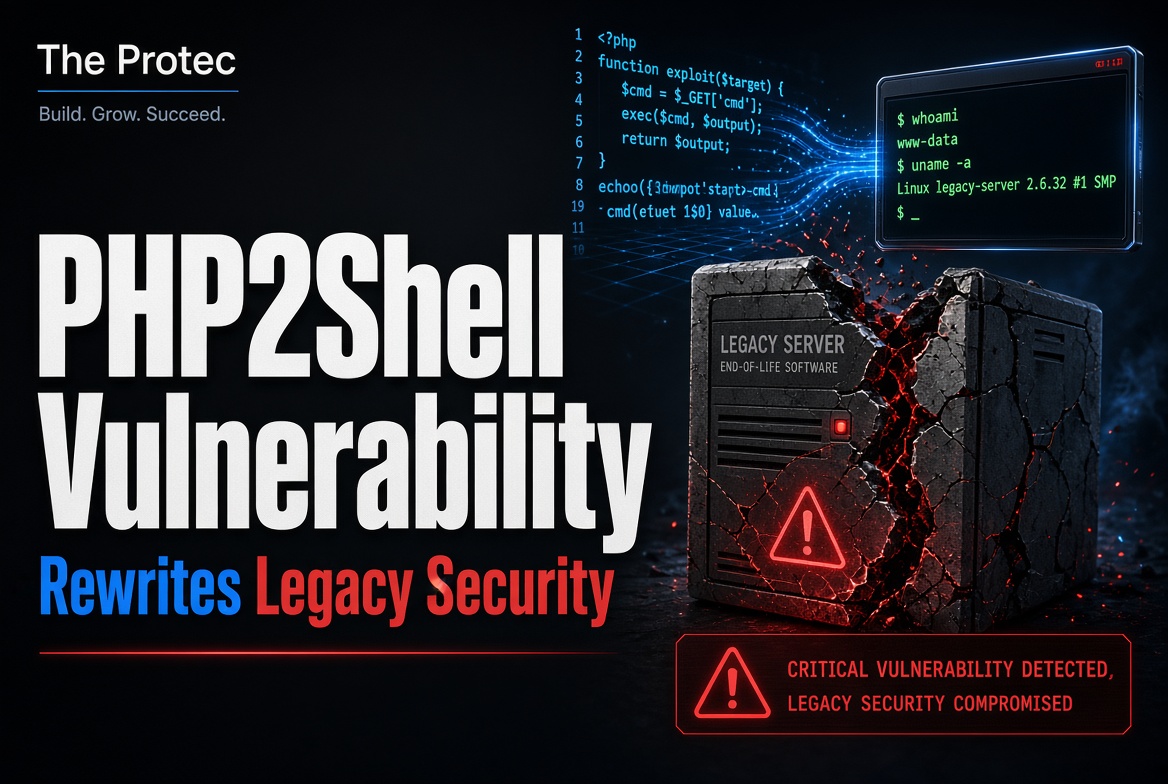
A crash in mature software rarely looks like the beginning of a critical security story. Yet the PHP2Shell vulnerability reportedly began as an out-of-memory failure submitted to the PHP Foundation in 2024, then evolved into evidence that an attacker could execute arbitrary code on a server. The difference was AI-assisted analysis: researchers at Calif used artificial intelligence to explore behavior beyond the original crash report, exposing a much more consequential failure in one of the web’s most widely deployed software platforms.
The case offers an important warning for security teams. AI vulnerability discovery can revisit old assumptions, trace obscure code paths, and test failure states at a speed human researchers cannot easily match. But faster discovery does not automatically produce faster safety. Maintainers still need to reproduce the issue, determine affected versions, design a compatible fix, test for regressions, coordinate disclosure, and give users time to update.
What happened in the PHP2Shell case?
The public chronology begins with an out-of-memory bug reported to the PHP Foundation in 2024. A report framed as a denial-of-service or reliability problem can receive a different priority from one demonstrating memory corruption or remote code execution. That distinction matters in a project with a large issue queue and limited maintenance resources.
According to Calif’s published account, its researchers applied AI-assisted security analysis during work connected to a broader PHP security review. The system helped investigators examine what happened before, during, and after the apparent memory-exhaustion condition. Rather than accepting the process termination as the final outcome, the researchers looked for violated assumptions in PHP’s internal state and cleanup behavior.
Calif reported that the crash could be developed into a path to arbitrary code execution. In practical terms, that changed the issue from a service-availability concern into a potential PHP remote code execution vulnerability. The finding did not mean every PHP application was immediately exploitable: exposure depended on application behavior, attacker-controlled data reaching the relevant code path, configuration, and hosting conditions. Nevertheless, code execution in the interpreter’s server-side context made the underlying flaw security-critical.
Wiz subsequently provided independent validation, according to the coordinated disclosure accounts. That second review was significant because reproducing a complex failure independently helps distinguish a promising research result from a reliable security finding. It also gives maintainers more evidence about exploitability without requiring publication of operational exploit details.
The role of the OpenAI-sponsored PHP security audit
PHP2Shell was not described as an isolated prompt sent to a general-purpose chatbot. It emerged from a structured security effort in which AI-supported research was combined with source-code review, controlled testing, and experienced human judgment.
The PHP Foundation stated that OpenAI sponsored a security audit of PHP. Calif’s researchers used AI-assisted techniques as part of that work, while human specialists evaluated the generated leads and established their security impact. This distinction is essential. AI can propose suspicious relationships, produce test cases, and explore unusual execution states, but a model’s output is not a verified vulnerability.
The audit also illustrates why external funding matters for open-source security. PHP is foundational infrastructure, yet the burden of maintaining it does not scale automatically with the number of websites and businesses that depend on it. Sponsored audits provide time for deep investigation that routine maintenance may not allow.
Why an out-of-memory bug could become code execution
Out-of-memory conditions are often treated as operational failures. An application consumes its permitted memory, the runtime stops the request, and administrators investigate capacity or input size. Security researchers ask a different question: does the program remain internally consistent while it fails?
Interpreters such as PHP manage complex networks of allocations, objects, references, extension state, and cleanup operations. Error handling may execute code that is rarely reached during ordinary requests. If an allocation fails at exactly the wrong time, later logic may rely on data that was only partially initialized, already released, or left in an unexpected state.
Calif’s reported breakthrough was recognizing that the original crash was not necessarily the end of execution. AI-assisted analysis helped researchers investigate the surrounding states and identify a route from memory exhaustion to control over server-side execution. For safety, the operational sequence, payload construction, and exploit-enabling conditions should remain outside a general defensive article.
The broader technical lesson is clear: crashes are security signals, especially when they involve memory management, parser state, deserialization, object lifetimes, or error-recovery logic. A bug’s initial label reflects the evidence available at triage time, not the maximum impact that later research may uncover.
Affected versions, severity, and patch status
The PHP2Shell name is a researcher-assigned label rather than a version identifier. Calif characterized the issue as critical because its research demonstrated arbitrary code execution under relevant conditions. Administrators should not assume that the nickname, by itself, establishes whether a particular application is reachable or exploitable.
The coordinated remediation was reported across the then-supported PHP 8 branches. The publicly reported fixed baselines were PHP 8.1.33, 8.2.29, 8.3.23, and 8.4.10. Systems on earlier releases in those branches should be upgraded beyond the applicable baseline. Unsupported PHP branches should not be treated as safe merely because they lack a corresponding maintenance release; they should be migrated to a currently supported branch.
Calif’s account attributes the repair to four PHP engineers working for roughly two months. That figure should be understood as a report about the coordinated engineering effort, not a universal estimate for fixing interpreter vulnerabilities. The time was needed to understand the root cause, evaluate compatibility concerns, build a durable patch, test multiple branches, and avoid replacing one failure with another.
As of November 4, 2026, organizations should rely on their branch’s latest supported release rather than stopping at the first fixed version. The authoritative source for release status and security-related changes is the official PHP 8 changelog. Distribution maintainers may backport patches without adopting the upstream version number, so teams using vendor packages should also verify the vendor’s advisory and package revision.
Why decades-old software hides modern security risk
The age of a codebase does not prove that it is insecure. Mature projects often benefit from extensive testing and years of production exposure. However, age creates technical debt cybersecurity teams cannot ignore.
Overlooked code paths
Rare combinations of allocation failure, error handling, extension behavior, and application-controlled input may not appear in conventional tests. Code can run successfully billions of times while still containing a dangerous edge case that requires an unusual sequence of events.
Outdated assumptions
Older code may have been written when deployment models, memory limits, attacker capabilities, or surrounding APIs were different. A harmless assumption in an early version can become dangerous after years of feature growth and refactoring.
Limited maintenance resources
Popular open-source projects may support enormous ecosystems with relatively small security teams. Maintainers must balance new releases, compatibility, bug reports, security triage, and community support. A report described only as a crash can reasonably receive less attention than a reproducible code-execution issue.
Familiarity can conceal risk
Widely reviewed code is not necessarily fully understood. Reviewers tend to focus on changed lines and common workflows. Stable, low-level code may escape renewed scrutiny precisely because it has existed for years.
How AI vulnerability discovery changes the economics
Traditional vulnerability research is constrained by expert time. Researchers must select targets, understand unfamiliar code, form hypotheses, build tests, and eliminate false positives. AI systems can accelerate several parts of that process.
- They can summarize relationships across large repositories and highlight unusual data flows.
- They can generate focused test cases for uncommon failure conditions.
- They can compare similar functions and identify inconsistent validation or cleanup.
- They can help researchers reason across issue reports, patches, tests, and historical changes.
- They can repeatedly explore leads that would be too time-consuming to investigate manually.
PHP2Shell demonstrates the potential value of this approach. A known crash acquired a different meaning when analysis extended beyond the observable failure. That is a strong use case for AI cybersecurity: not replacing researchers, but increasing the number and depth of hypotheses they can test.
The same acceleration creates a capacity problem. If AI systems produce credible findings faster than vendors can validate them, security queues may fill with complex reports requiring scarce specialists. Poorly prioritized output could consume the very engineering time needed to fix genuine critical flaws.
Defenders need AI-assisted remediation, not discovery alone
Security programs must increase the speed and quality of remediation alongside discovery. Otherwise, AI may expand the backlog without reducing risk.
AI-assisted patch development
Models can suggest safer error handling, identify similar patterns elsewhere, and propose candidate changes. Engineers must still verify that a patch addresses the root cause rather than merely blocking one known trigger.
Automated testing and regression analysis
Generated tests can exercise allocation failures, malformed inputs, boundary conditions, and cleanup paths. Differential testing can compare patched and unpatched behavior, while fuzzing can search for related failures. Production compatibility remains vital for a language ecosystem as broad as PHP.
Code review and variant analysis
Once a dangerous pattern is known, AI tools can search for related implementations across the codebase. Human reviewers should evaluate each result because superficial similarity does not prove equivalent impact.
Formal verification for critical components
Formal methods can provide stronger assurance for narrowly defined properties, such as object-state transitions or memory-safety invariants. They are not a practical replacement for all testing, but they can help protect particularly sensitive interpreter components.
None of these controls eliminates the need for human validation. Generated patches can introduce subtle regressions, break extensions, alter application behavior, or hide the visible symptom without fixing the underlying state violation. Careful review, multi-branch testing, and staged deployment remain mandatory.
What security teams should do now
- Inventory PHP runtimes. Include command-line installations, containers, development images, appliances, and vendor-bundled copies—not only public web servers.
- Upgrade supported branches. Move past the reported fixed baseline and install the latest security-supported release available from PHP or the operating-system vendor.
- Retire unsupported versions. Lack of a new advisory is not evidence that an end-of-life branch is unaffected.
- Review crash telemetry. Repeated memory-exhaustion and abnormal worker exits deserve security analysis, particularly when external input can influence the failing request.
- Test before broad deployment. Exercise extensions, frameworks, queues, scheduled tasks, and application-specific workloads in a representative staging environment.
- Prepare for faster disclosure cycles. Define ownership for reproducing AI-discovered findings, assigning severity, coordinating fixes, and communicating upgrade requirements.
Frequently asked questions
What is the PHP2Shell vulnerability?
PHP2Shell is the name given to a PHP security flaw that began as a 2024 out-of-memory crash report. Calif later reported using AI-assisted analysis to identify a path to arbitrary server-side code execution, with Wiz providing independent validation.
Does PHP2Shell affect every PHP website?
No. A vulnerable runtime does not mean every application exposes the conditions needed to reach the flaw. Risk depends on the PHP version, application behavior, configuration, attacker-controlled input, and deployment environment. Upgrading is still the correct response because reachability can be difficult to rule out conclusively.
Can a firewall or memory-limit change prevent exploitation?
Those measures may reduce exposure in a particular environment, but they are not substitutes for a vendor patch. Application firewalls cannot reliably recognize every interpreter-level trigger, and changing memory limits does not repair unsafe failure handling.
Did AI discover the flaw without human involvement?
No. AI-assisted tools helped Calif researchers analyze the original issue and investigate uncommon execution states. Human experts validated the behavior, established security impact, coordinated disclosure, and developed and tested the patch.
What is the main lesson for legacy software security?
Old, familiar code can still contain high-impact vulnerabilities in rarely examined paths. AI can make those paths easier to find, but organizations must invest equally in triage, maintainer capacity, patch engineering, testing, and timely deployment.
A wake-up call for software maintenance
The lasting significance of PHP2Shell is not simply that AI helped find a serious PHP security vulnerability. It is that a seemingly ordinary crash in mature code became a critical security issue once researchers could investigate it more deeply and efficiently.
AI-assisted research will make overlooked flaws easier to uncover across interpreters, libraries, operating systems, and business applications. The defensive opportunity is substantial, but only if remediation capacity keeps pace. Discovery can be accelerated by machines; accountability for safe fixes, careful validation, and resilient software still belongs to people.