







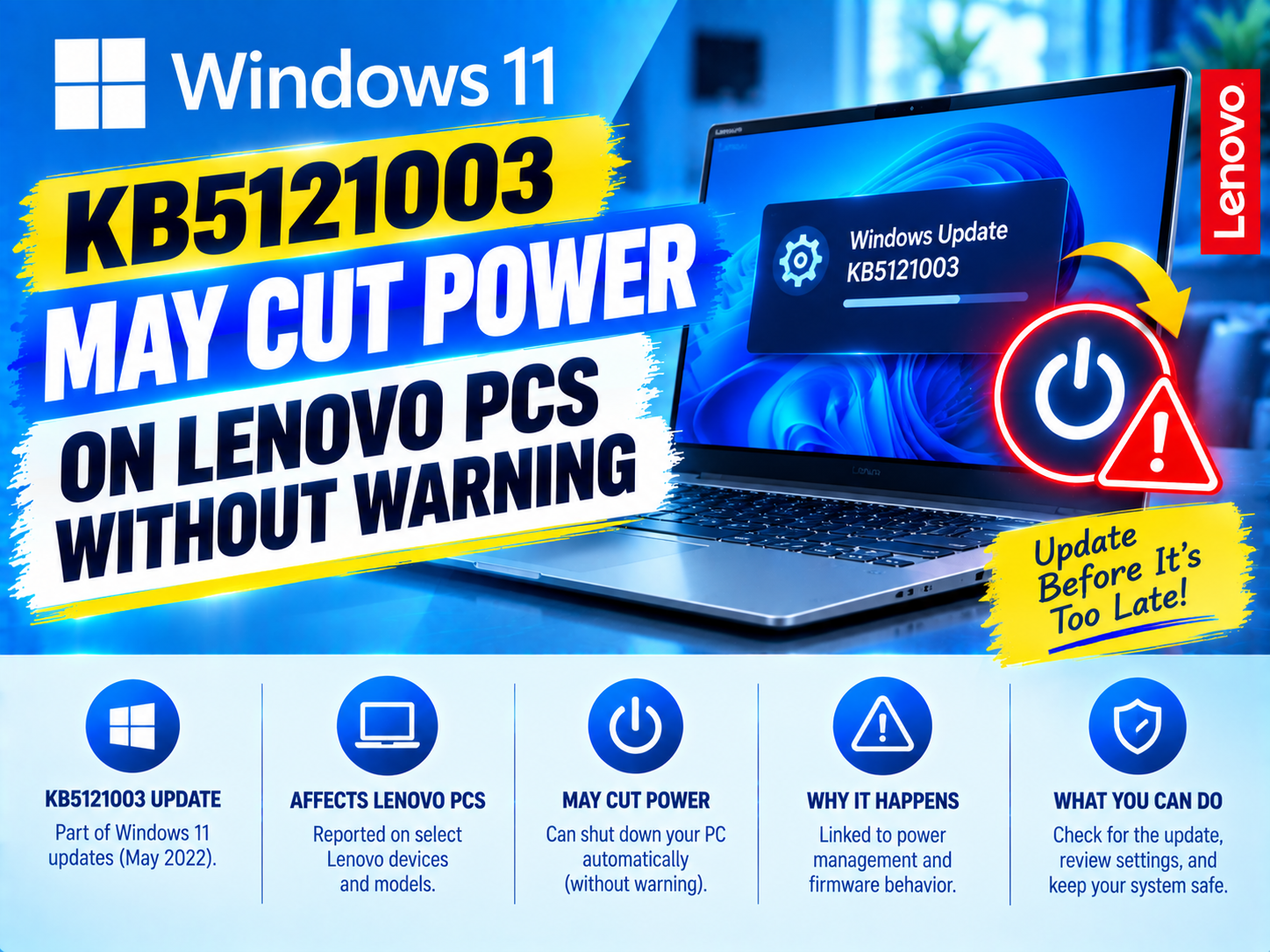
A Windows update should not make a computer behave as though someone pulled the power cord. Yet some Lenovo users investigating abrupt shutdowns are focusing on Windows 11 KB5121003, a September Windows 11 update that may coincide with PCs cutting power, restarting, or becoming unresponsive during sleep and wake transitions.
The important word is may. As of September 14, 2026, scattered reports do not establish that KB5121003 contains a universal shutdown bug, and there is no defensible reason to assume every Lenovo computer is at risk. Sudden power loss can also result from a BIOS problem, a firmware or driver update delivered alongside the cumulative update, overheating, a failing battery, an inadequate power adapter, or unrelated hardware trouble.
That distinction matters. Removing a security update without confirming the connection can expose a PC while leaving the actual fault untouched. This guide examines the Windows 11 KB5121003 problems being discussed, the systems most likely to be affected, and the safest ways to determine whether the update is responsible.
What Is Windows 11 KB5121003?
KB5121003 is associated with the September 2026 Windows 11 update cycle. Like other Microsoft Windows 11 update packages, it can include security fixes, reliability improvements, servicing-stack components, and changes that interact with drivers or low-level Windows services.
A cumulative Windows 11 update does not normally control a Lenovo PC’s electrical power directly. It can, however, change how Windows communicates with the system firmware. Windows relies on the Advanced Configuration and Power Interface, or ACPI, to coordinate sleep states, processor power, battery charging, thermal limits, lid behavior, and shutdown requests with the BIOS or UEFI firmware.
Windows Update may also install a separate Lenovo firmware capsule or driver during the same maintenance window. That creates a common diagnostic trap: KB5121003 appears in update history immediately before the failure, but an accompanying BIOS, chipset, power-management, graphics, or Intel Management Engine update may be the component that changed system behavior.
Users can verify whether the package is available for their Windows version through the Microsoft Update Catalog. The catalog entry and the update history shown on the PC should be checked instead of relying on screenshots or social-media posts, where KB numbers are sometimes mistyped.
What the Reported Lenovo PC Power Issue Looks Like
The alleged Windows 11 KB5121003 Lenovo issue is not always described consistently. Reported symptoms can fall into several categories:
- The Lenovo PC automatically shuts down shortly after signing in.
- The machine loses power during restart, sleep, hibernation, or wake.
- A laptop switches off when unplugged even though Windows shows remaining battery capacity.
- The screen goes black and the system requires a long press of the power button.
- Windows restarts and records an unexpected shutdown after installing the update.
- The computer shuts off under load, which can resemble a Windows 11 forced shutdown but may indicate thermal or electrical protection.
These symptoms do not all point to the same cause. A normal software-requested shutdown usually allows Windows to close programs and record the initiating process. An instantaneous power cut leaves no time for that sequence. Windows may record Kernel-Power Event ID 41 after the next boot, but that event only confirms the previous session ended unexpectedly; it does not prove that KB5121003 caused the outage.
Which Lenovo Windows 11 PCs May Be Affected?
There is no reliable basis for claiming that all Windows 11 Lenovo PCs share this problem. Unless Microsoft or Lenovo publishes a model-specific advisory, a definitive affected-device list should be treated with caution.
The more plausible risk group consists of machines that share a particular BIOS revision, motherboard platform, power-management driver, or firmware component. Two laptops carrying the same consumer-facing family name can use different system boards and firmware depending on their machine type, processor generation, or region.
Potentially relevant systems include Lenovo laptops using Modern Standby, devices that received a BIOS or firmware update at the same time as KB5121003, and computers already exhibiting battery, charging, sleep, or thermal abnormalities. Managed business devices may also have different exposure because administrators can control driver and firmware deployment separately from Windows quality updates.
Owners should identify the exact product name, machine type and model, serial number, Windows edition, OS build, and BIOS version. Lenovo Vantage, System Information, or the BIOS setup screen can provide these details. Entering the machine serial number at Lenovo Support is safer than applying a BIOS package intended for a similar-looking model.
Why a Windows Update Could Trigger a Lenovo PC Shutdown
ACPI and firmware compatibility
Windows sends power-state requests through ACPI tables supplied by the firmware. If a Windows 11 update changes timing, validation, or handling of those requests, an older BIOS defect can become visible. The update may not create the firmware flaw, but it can expose a compatibility problem that previous Windows builds did not trigger.
Modern Standby and sleep transitions
Modern Standby keeps parts of a laptop active in a low-power state. Graphics, Wi-Fi, storage, security hardware, and firmware must enter and leave that state in the correct order. A driver that fails during the transition can cause a hang, watchdog reset, or apparent Windows 11 power issue.
A companion firmware or driver update
Windows Update can deliver OEM drivers and signed firmware independently of a cumulative package. If the Windows 11 KB5121003 update and a Lenovo firmware update were installed in one restart, the dates alone cannot identify the culprit. Users should inspect the Driver updates and Other updates sections of Windows Update history.
Thermal or electrical protection
Firmware can immediately remove power when temperature, current, or voltage crosses a safety threshold. A post-update workload—such as indexing, antivirus scanning, or update cleanup—may increase CPU activity and reveal clogged cooling, a weak adapter, or a degraded battery. In that case, KB5121003 is a trigger in time rather than the root defect.
Security and virtualization changes
Updates can modify kernel protections, virtualization-based security, Secure Boot handling, or driver enforcement. An incompatible low-level utility may then crash or behave unpredictably. Lenovo power, docking, battery, and system-management utilities should therefore be checked alongside Windows itself.
How to Determine Whether KB5121003 Is Responsible
Begin by documenting the timeline. Open Settings, select Windows Update, choose Update history, and confirm the installation date for KB5121003. Record any driver, definition, optional, or firmware updates installed on the same day.
Next, search Reliability Monitor for a critical event at the time of the shutdown. Event Viewer can provide additional context. Event ID 1074 generally identifies a process that requested an orderly shutdown or restart. Event ID 6008 records an unexpected shutdown, while Kernel-Power 41 indicates that Windows did not shut down cleanly. None of these events independently proves a KB5121003 bug.
Use the following checks to narrow the cause safely:
- Disconnect nonessential docks, USB devices, external graphics hardware, and third-party chargers.
- Test on AC power and battery separately, but stop if the battery is swollen, unusually hot, or physically damaged.
- Note whether the failure occurs only during sleep, wake, restart, gaming, charging, or idle operation.
- Run Lenovo’s built-in hardware diagnostics and review battery and thermal results.
- Check whether the PC remains stable in Safe Mode, where many third-party drivers and utilities are not loaded.
- Perform a clean boot if Safe Mode is stable and a background service is suspected.
- Compare the BIOS version with the version approved for the exact machine type.
A strong software correlation exists when the shutdown began immediately after KB5121003, no firmware or driver changed alongside it, hardware diagnostics pass, and the problem stops after a controlled rollback. Even then, the evidence applies to that configuration rather than every Lenovo PC.
Safe Rollback and Recovery Options
Before removing an update, save open work, back up important files, and confirm that the BitLocker recovery key is available. Firmware or boot-setting changes can prompt BitLocker recovery even when storage is healthy.
If Windows remains usable, go to Settings, Windows Update, Update history, and Uninstall updates. Select KB5121003 only if it appears as removable, then restart normally. Windows recovery options may also allow removal of the latest quality update when the computer cannot boot reliably.
Do not force the computer off while a BIOS or firmware installation is actively progressing. Interrupting firmware flashing can make the system unbootable. If shutdowns are frequent enough to threaten a firmware update, contact Lenovo support rather than attempting repeated updates.
After a successful rollback, pause updates briefly to prevent immediate reinstallation while checking for a revised package, safeguard hold, BIOS fix, or official advisory. Pausing should be temporary because KB5121003 may contain security corrections. On business PCs, administrators should use their normal update-management platform to create a limited exclusion instead of disabling Windows Update services.
If the Windows 11 shutdown issue continues after rollback, reinstalling the update is reasonable once hardware safety has been assessed. Persistence after removal makes a battery, adapter, cooling, firmware, storage, or driver problem more likely.
What Microsoft and Lenovo Recommend
Without a model-specific confirmed known-issue notice, the safest official approach is standard supported troubleshooting: install updates intended for the exact Windows release, keep OEM firmware and drivers current, use built-in recovery tools, and report reproducible failures with system details.
Lenovo users should obtain BIOS and power-management packages only through Lenovo Vantage, Commercial Vantage, or the support page for the exact serial number. Microsoft update packages should come through Windows Update or the Microsoft Update Catalog. Third-party driver sites and unofficial modified BIOS files create unnecessary risk.
If opening a support case, include the machine type, BIOS version, Windows build, KB5121003 installation time, failure time, power source, connected devices, and relevant Reliability Monitor or Event Viewer records. Clear reproduction steps are far more useful than simply reporting that Windows 11 automatically shuts down.
Confirmed Facts Versus Unverified Claims
It is confirmed when a PC’s local update history shows that KB5121003 was installed. Logs can also confirm whether Windows completed an orderly shutdown or recovered from an unexpected power loss. A successful rollback can demonstrate a meaningful correlation on one machine.
What should not be presented as confirmed without an official notice is that KB5121003 damages Lenovo hardware, affects every Lenovo model, or deliberately cuts power. Claims that the update “kills” motherboards or batteries also require evidence beyond a sudden shutdown after installation.
The most accurate conclusion is that certain configurations may experience a compatibility problem after the Windows 11 September 2026 update, while the responsible layer could be Windows, an accompanying driver, Lenovo firmware, or pre-existing hardware trouble. Careful isolation is essential.
Frequently Asked Questions
Does KB5121003 make every Lenovo PC automatically shut down?
No. There is no sound evidence that every Lenovo PC is affected. Reports appear configuration-specific, and sudden shutdowns have many possible causes. Check the exact machine type, BIOS revision, update history, and event logs before attributing the problem to KB5121003.
Should I uninstall Windows 11 KB5121003 immediately?
Not if the PC is stable. Removing a security update unnecessarily can increase risk. Consider rollback when shutdowns began directly after installation, hardware safety checks are clean, and Microsoft or Lenovo support guidance allows it. Back up data and secure the BitLocker recovery key first.
Can a cumulative Windows update really cut electrical power?
Windows usually requests a shutdown rather than physically switching power by itself. Firmware and the embedded controller perform low-level power actions. An update can expose an ACPI, driver, BIOS, thermal, or power-management compatibility issue that ultimately causes a reset or power cut.
How can I tell a Windows shutdown from a hardware power loss?
An orderly shutdown often displays a shutdown screen and records Event ID 1074. An abrupt black screen followed by Kernel-Power 41 or Event ID 6008 suggests an unexpected loss, although those events do not identify the cause. Thermal, battery, adapter, and motherboard checks may still be necessary.
What should I do if the Lenovo PC will not stay on?
Disconnect nonessential accessories, use the correct Lenovo power adapter, and stop using the machine if there is swelling, smoke, odor, liquid damage, or extreme heat. If Windows Recovery is accessible, try removing the latest quality update. Otherwise, contact Lenovo support and avoid repeated forced boots or unsafe firmware flashing.