








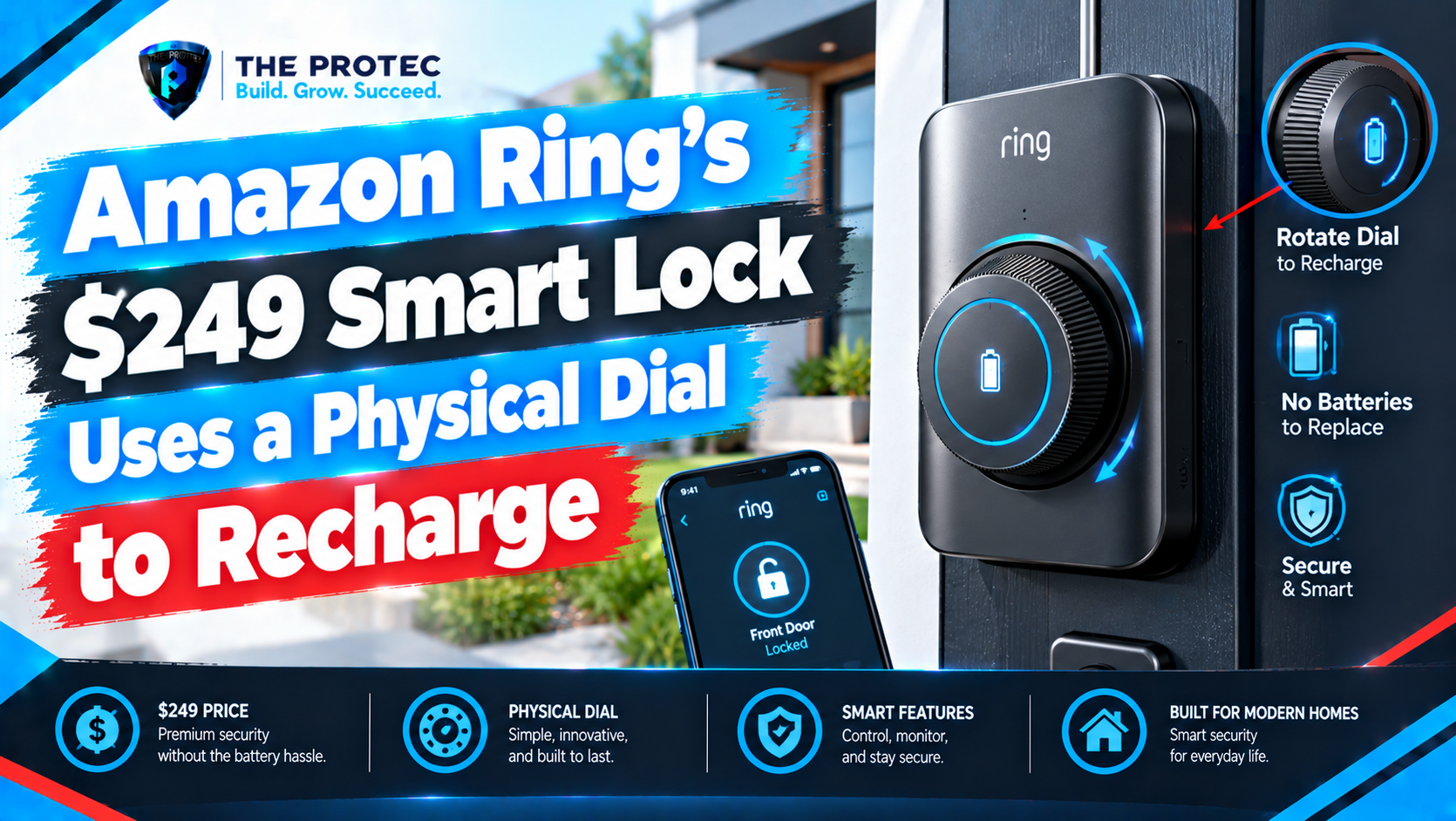
Smart locks promise to make the front door more convenient, connected and secure, but they also introduce a problem traditional locks never had: a battery that can run out. Amazon Ring’s unusual approach to that weakness with a newly unveiled smart door lock priced at $249. Instead of depending entirely on replaceable cells, a removable battery pack or an emergency power cable, the lock includes a physical dial that can be turned to recharge its internal battery.
The idea gives a familiar mechanical action a new purpose. If the battery is too low for normal electronic operation, users can generate power at the door rather than searching for fresh batteries or waiting for a battery pack to charge elsewhere. It is a notable development for Amazon home security because battery management remains one of the least elegant aspects of connected locks.
The announced $249 price places the product in the premium smart-lock market. Its real appeal, however, will depend on more than price or novelty. Buyers will want to know how much useful power the dial can generate, how clearly the lock reports its battery status and how well it works with other Ring smart home devices. Those questions will ultimately require independent testing and final retail documentation. For now, the physical recharging mechanism offers a compelling attempt to keep a battery powered smart lock operational when conventional charging is inconvenient.
How the Ring Smart Lock Physical Dial Works
The defining feature is a manually operated dial connected to a small internal power-generation system. Turning the control converts mechanical motion into electrical energy, which is then stored in the lock’s rechargeable battery. The broad principle is similar to hand-crank emergency radios and other compact devices that use human motion to produce limited amounts of electricity.
This does not mean the Ring smart lock physical dial creates unlimited power or eliminates charging considerations. Small manual generators typically provide emergency or supplemental energy rather than the output of a wall charger. Amazon Ring has not established a long-term, independently verified performance record for the new design, so buyers should avoid assuming that a few turns will support weeks or months of operation. The number of rotations required, the amount of energy generated and performance under different temperatures and usage patterns are all important details to assess when the product reaches consumers.
Even with those limitations, the mechanism could solve an immediate problem: getting enough power to authenticate a user, operate the motor or restore connected functions when the battery is nearly depleted. A resident arriving home would have a recovery option built into the lock itself. That is more convenient than locating a specific battery, connecting an external power source or gaining entry through another door.
Why Battery Management Is a Persistent Smart-Lock Problem
Every keyless entry smart lock must power several components. Depending on its design, those may include a wireless radio, processor, sensors, keypad, authentication hardware and the motor that moves the locking mechanism. Wireless communication and frequent motor use can increase energy consumption, while cold weather may reduce available battery capacity.
Manufacturers normally manage this problem with low-battery notifications and energy-saving modes. Alerts are useful, but only when users see and act on them. A warning can be missed, dismissed or delivered while the homeowner is traveling. Batteries may also decline faster than expected because of door alignment, connectivity conditions or high usage.
The Ring smart lock rechargeable battery and physical dial provide an on-device fallback. Rather than treating low power solely as a maintenance failure, the design gives the person at the door a way to intervene. It does not remove the need to monitor battery health, but it may reduce the consequences of forgetting.
This approach also reflects a broader trend in smart lock battery technology: manufacturers are looking beyond simple disposable cells. Rechargeable packs, USB emergency ports, solar assistance and lower-power wireless standards have all been explored across the market. Ring’s dial stands out because it makes manual interaction part of the power system.
Confirmed Details Versus Questions That Need Testing
The headline facts are straightforward: Amazon Ring has unveiled a connected smart lock with a $249 announced price, a rechargeable battery and a physical dial intended to generate power manually. It is positioned as part of Ring’s connected-home security offering.
The announced price should not be confused with a guaranteed final cost in every market. Taxes, professional installation, regional availability, optional services and promotional pricing may change what a customer pays. Prospective buyers should consult the official Ring website for current availability and final product specifications.
Claims about real-world endurance deserve similar care. Battery life can vary substantially according to entry frequency, wireless signal quality, temperature, door fit and enabled features. Until the Ring smart lock $249 model receives sustained independent testing, it is not possible to conclude how often owners will need the dial or whether manual charging can replace occasional conventional charging.
Other practical questions include how the dial feels under repeated use, whether it can be operated comfortably by people with limited hand strength and how the generator affects the lock’s size. Weather resistance, installation requirements and compatibility with different deadbolts will also matter. The unusual mechanism is promising, but its reliability should be judged from verified specifications and real-world evidence rather than the concept alone.
Security and Ring Connected Home Features
A successful Amazon Ring smart lock needs to do more than recharge itself. Its value comes from combining physical access control with the broader Ring home security experience. In a connected setup, the lock can complement video doorbells, security cameras, alarms and app-based event awareness. The practical goal is to help homeowners understand not only whether a door is locked, but also what is happening around the entrance.
Potential buyers should examine the final product listing for supported functions such as remote lock control, lock-status reporting, access alerts, activity history and temporary or recurring guest access. These are common smart-lock capabilities, but exact availability can depend on the model, account configuration, region and software support. Subscription requirements should also be checked rather than assumed.
Compatibility with Ring security products could make arrival and departure routines easier to manage. For example, coordinated devices may allow a homeowner to review a door event alongside camera footage or manage entry from the same connected environment. The strength of that experience will depend on how deeply the lock integrates with Ring’s app, alarm products and Amazon smart home technology.
Alexa support may also be relevant to households already using Amazon’s connected-home platform. Voice control involving a door lock should always include appropriate authentication and conservative default settings. Consumers can review Amazon’s current ecosystem information through its Alexa smart home portal, while checking the lock’s final documentation for specifically supported commands.
How the Dial Compares With Conventional Smart-Lock Power
Replaceable Batteries
Many smart locks use standard alkaline or lithium batteries. They are widely available and can be replaced quickly, but owners must keep spares nearby and dispose of depleted cells. Repeated replacement also adds cost and waste. Battery life varies, so a projected lifespan should never be treated as a guarantee.
Removable Rechargeable Packs
A rechargeable smart lock may use a proprietary battery pack that can be removed and charged through USB. This reduces disposable-battery use, but the lock can be unavailable while the pack is charging unless the owner has a spare. Proprietary packs may also be more expensive to replace as they age.
Emergency External Power
Some locks include external contacts or a USB port for temporary power. This can restore access, but it requires the user to have a compatible battery or cable. The solution works well when prepared for in advance and poorly when the required accessory is somewhere inside the locked home.
Wired Power
Hardwired locks can avoid routine battery changes, but residential installation is more complex. Running power to a door may require modifications that are impractical for renters or finished homes. Backup power may still be necessary during an outage.
Manual Dial Charging
A smart lock with physical dial charging keeps its emergency energy source attached to the product. There is no separate cable, spare cell or battery bank to locate. The trade-off is effort: users must turn the dial, and the amount of power produced may be limited. Moving components can also introduce durability questions that only long-term testing will answer.
Advantages of Ring’s Manual Recharging Approach
Built-in emergency recovery: The charging control is available at the door when the battery is low.
Less dependence on disposable batteries: A rechargeable design may reduce how often standard cells need to be purchased and discarded.
No loose emergency accessory: Users do not have to carry a power bank, cable or special battery solely for lock access.
Visible physical interaction: Turning a dial gives the user direct control during a low-power event instead of relying only on software.
Connected-security potential: Integration with Ring home security could bring access events, cameras and alerts into a more unified experience.
Trade-Offs Homeowners Should Consider
The physical dial is not automatically better for every household. Manual charging could be inconvenient for a user with arthritis, reduced grip strength or another mobility limitation. Amazon Ring will need to make the control accessible and provide clear feedback showing when sufficient energy has been generated.
There is also a difference between emergency power and routine power. If the dial is intended mainly as a backup, owners may still need to charge the battery normally. If it is intended for frequent use, the mechanism’s durability becomes especially important. Neither conclusion should be made without final guidance from Ring.
Security-conscious buyers should evaluate the complete lock rather than focusing exclusively on battery technology. Encryption, account protection, software updates, physical resistance, access-code management and fallback entry options all contribute to security. A reliable mechanical installation and properly aligned door are equally important because a struggling motor may use more energy and fail to lock correctly.
Finally, the $249 announced price puts the lock above many basic keypad models. That premium may make sense for households invested in Ring connected home products or those that place a high value on built-in low-battery recovery. Buyers who only need local keypad access may find a simpler lock more economical.
Could the Physical Dial Make Smart Locks More Practical?
The most persuasive aspect of the Ring smart lock 2026 announcement is not that it eliminates battery maintenance. It is that the design acknowledges a predictable failure point and gives users a direct response. Connected locks become harder to trust when their most important functions depend on remembering another charging schedule. A manual generator can serve as a bridge between traditional mechanical dependability and modern connected convenience.
Whether that bridge works well will depend on execution. The dial must generate useful power without excessive effort, survive repeated operation and communicate its status clearly. The rechargeable battery must also remain serviceable over time. Those factors cannot be confirmed from an unveiling alone.
Still, the concept is meaningful. Ring is treating energy resilience as a core product feature rather than an afterthought hidden behind an emergency port. If the final device performs reliably, the physical dial could make smart home security devices more approachable for people who want app-based control without feeling that a forgotten battery notification could leave them stranded.
Frequently Asked Questions
How much does the new Amazon Ring smart lock cost?
Amazon Ring announced the smart lock at $249. That is the announced price, not a guarantee of the final checkout cost in every region. Taxes, installation, promotions and optional services may affect the total.
Does the physical dial fully charge the lock?
The dial is designed to convert manual motion into electrical energy for the rechargeable battery. Ring’s final instructions should clarify whether it is intended primarily for emergency operation, supplemental charging or broader routine use. No assumptions should be made about charging speed or endurance without verified testing.
Will the Ring smart lock work when its battery is low?
Addressing low-battery access is the central purpose of the physical dial. By turning it, a user can generate power at the lock. Exactly how much turning is required and which functions become available will depend on the final product specifications and real-world conditions.
Does it work with other Ring smart home devices?
The lock is positioned within the Ring ecosystem, making compatibility with Ring home security a key part of its appeal. Buyers should verify the exact support for cameras, video doorbells, alarms, Alexa features and app automations when final documentation is available.
Is a manually rechargeable smart lock more reliable?
It offers an additional way to recover from a low battery, but that does not by itself prove greater long-term reliability. Battery aging, mechanical durability, installation quality, software support and environmental conditions all affect performance. Independent testing will be needed to determine how the lock holds up over time.