








AI companies are selling a compelling vision: tell an assistant what you need, and it will compare products, sign in to websites, book a flight, or complete a purchase on your behalf. The difficult part is that many of the businesses behind those websites never agreed to participate.
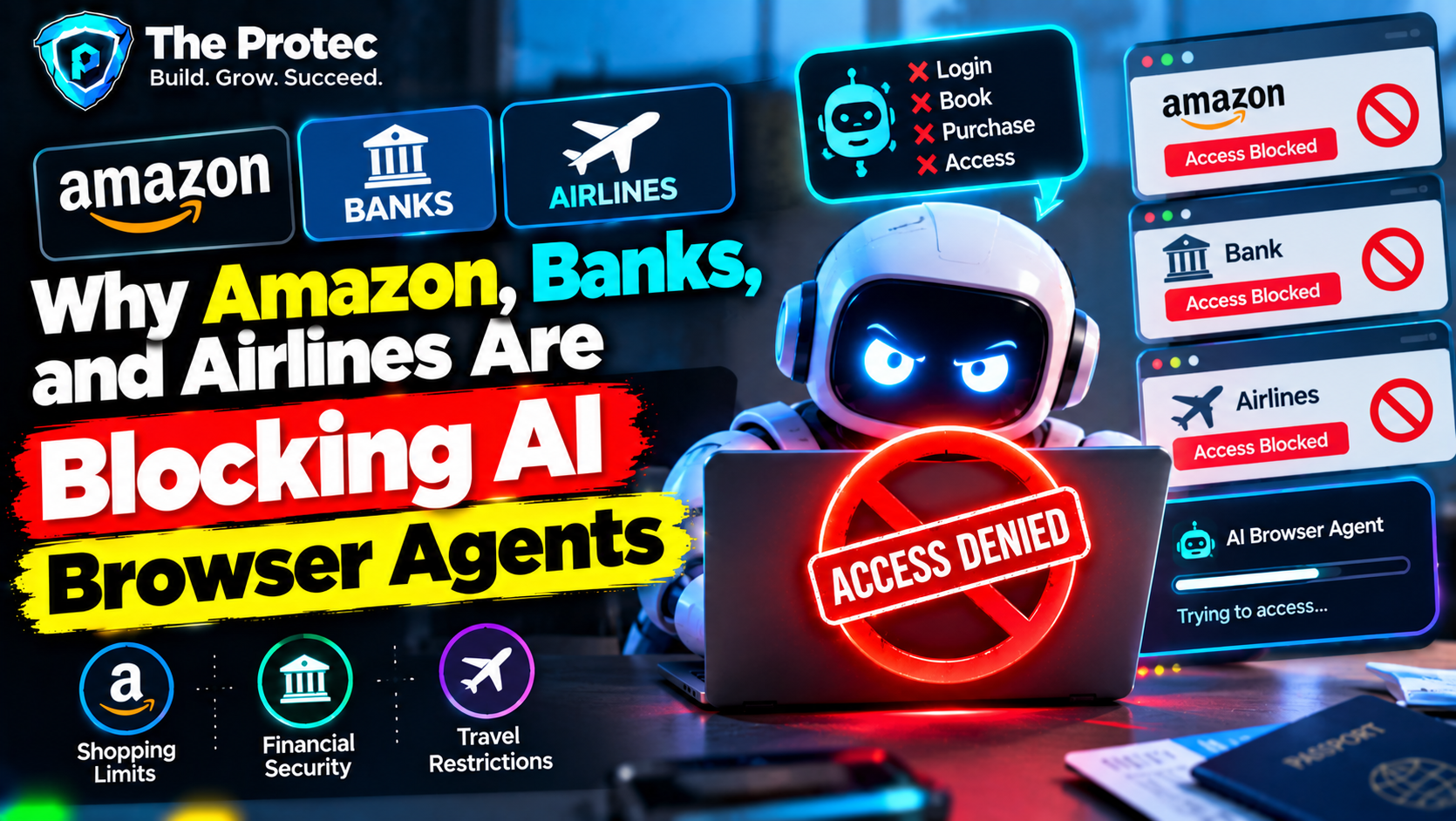
That conflict moved into sharper focus with The Verge’s October 17, 2026 reporting on the resistance AI browser agents can encounter when attempting to use popular online services. Amazon, banks, airlines, and other transaction-heavy businesses have particularly strong reasons to control automated activity. Their concerns range from fraud and privacy to customer ownership, contractual terms, system reliability, and legal responsibility when an agent makes a costly mistake.
This does not mean every company blocks every agent. Restrictions vary by website, account type, action, traffic pattern, and whether the automation uses an approved integration. Nevertheless, websites blocking AI agents are exposing a fundamental problem for the future of agentic AI: an assistant’s technical ability to click a button is not the same as having permission to do so.
Why Websites Block AI Agents
Websites have managed automated traffic for decades. Search crawlers, price scrapers, credential-stuffing tools, inventory bots, and denial-of-service networks can all generate requests without a person manually browsing. Companies use rate limits, behavioral analysis, device fingerprinting, CAPTCHAs, and contractual restrictions to decide which activity they will accept.
AI browser agents complicate that system. Unlike a traditional scraper that downloads pages in a predictable pattern, an agent may open a browser, interpret visual elements, type into forms, and follow a workflow much like a human. It may also pause, change its plan, or retry an action after encountering an error. From the website’s perspective, those behaviors can resemble either a real customer or a sophisticated attack.
There are several reasons a business may restrict AI agent web access:
- Security: An agent can become another route into a logged-in account.
- Fraud prevention: Automated purchases and bookings can be used with stolen credentials or payment details.
- Privacy: Pages may expose addresses, messages, financial records, loyalty data, or health-related purchases.
- Commercial control: Businesses may not want third parties mediating customer relationships or extracting product data.
- Reliability: A visual website can change without warning, causing an agent to misread prices, dates, or conditions.
- Licensing and terms: Website terms often limit scraping, resale of data, or access through unapproved automated systems.
These concerns explain why AI agents blocked by websites should not automatically be treated as victims of anti-competitive behavior. Some restrictions protect legitimate interests. Others may preserve a platform’s market power. Often, both motives exist at the same time.
Why Amazon May Restrict Third-Party Shopping Agents
The phrase “Amazon blocks AI shopping agents” can overstate a more nuanced reality. Amazon maintains rules governing automated access, scraping, account use, and commercial reuse of its content. Enforcement can differ depending on the agent, its behavior, the information requested, and whether it uses an authorized service. That is not the same as a blanket ban on all AI-assisted shopping.
Still, Amazon has clear incentives to impose AI shopping restrictions on third-party agents. A shopping agent may compare Amazon’s offers with competing retailers, bypass sponsored placements, summarize reviews, or recommend a cheaper substitute. That can reduce the value of Amazon’s advertising inventory and weaken its control over product discovery.
Agentic commerce also raises operational questions. If an agent selects the wrong size, overlooks a subscription, misunderstands a delivery promise, or purchases from an unfamiliar marketplace seller, who is responsible? Amazon can show disclosures to the agent, but it cannot assume the consumer actually saw or understood them.
Inventory manipulation is another concern. AI agents shopping online could check availability or prices at enormous scale. Even when each request appears harmless, coordinated automation may increase infrastructure costs, distort demand signals, or help resellers acquire limited products faster than ordinary customers.
Amazon can support automation where it chooses through official APIs, affiliate programs, seller tools, or negotiated integrations. The central dispute is therefore not whether software may ever interact with Amazon. It is whether an outside agent should be allowed to operate a consumer’s browser without Amazon’s approval.
Why Banks Treat AI Agents as a Security Boundary
AI agents banking security is an even more sensitive issue because bank accounts contain both money and extensive personal information. Giving an agent access to a logged-in banking session could expose balances, account numbers, transaction histories, tax documents, addresses, and security messages.
An assistant might be asked to download a statement or identify duplicate charges. It could also be manipulated into adding a payee, transferring funds, or disclosing data to another service. If malicious instructions are hidden in a webpage, email, or document the agent reads, a prompt-injection attack could redirect its behavior without the user realizing it.
Banks already operate under strict authentication, privacy, anti-money-laundering, recordkeeping, and fraud-management obligations. AI agents accessing online accounts can disrupt established controls when they reuse browser cookies, store credentials, or obscure who initiated a transaction. A bank may know that a request came from a recognized device, yet remain unable to tell whether the customer, an authorized agent, or an attacker controlled the session.
Official open-banking connections offer a safer model because customers grant defined permissions, such as read-only access to balances. Tokens can be revoked, access can expire, and transaction limits can be enforced. Browser automation, by contrast, may inherit nearly everything the customer can do.
Airline Bookings Combine Complexity With Irreversible Actions
AI agents booking flights face a different but equally difficult set of constraints. Airfares change rapidly, and a ticket’s real value depends on baggage allowances, refund rules, seat availability, connection times, visa requirements, and loyalty benefits. An agent that optimizes only for the displayed price may make an expensive mistake.
Airlines also fight automated inventory searches, loyalty-account takeovers, payment fraud, and speculative reservations. Aggressive automation can place heavy loads on availability systems or temporarily hold seats without producing genuine sales. That gives airlines a reason to distinguish approved distribution partners from arbitrary browser agents.
A completed airline booking may be hard or costly to reverse. A misunderstood date, passenger name, airport, or fare restriction can trigger change fees or invalidate the trip. International itineraries can require passport data and other sensitive information that consumers should not casually expose to a general-purpose agent.
Airlines do distribute fares through global distribution systems, travel agencies, and direct integrations. Once again, the issue is controlled delegation. AI automation website restrictions are more likely when an agent imitates human clicks than when it uses an authenticated channel with contractual responsibilities.
Why Cloudflare and Other Anti-Bot Systems Catch AI Agents
Many cases of AI agents blocked by anti-bot protection may not reflect a deliberate policy against a specific AI company. Security platforms evaluate signals such as IP reputation, request frequency, browser consistency, JavaScript execution, cookies, navigation patterns, and prior abuse.
Cloudflare bot detection can assign automated traffic a likelihood score and allow the website operator to challenge, rate-limit, or block it. Cloudflare’s bot-management documentation explains that detection combines multiple signals rather than relying on a single label.
Legitimate AI browser agents can trigger those defenses because they may run in data centers, create short-lived browser sessions, navigate unusually quickly, or operate across many users. An agent that repeatedly fails a form and starts over can resemble credential abuse. CAPTCHA challenges present another obstacle because allowing software to solve them automatically would undermine their purpose.
Website owners configure these systems differently, so Cloudflare AI bot blocking is not one universal Cloudflare decision. One merchant may permit a verified agent, another may issue a challenge, and a bank may reject all unfamiliar automation on authenticated pages.
The Risk of Giving an Agent Your Logged-In Browser
The most consequential agent tasks require context. To buy the right item or change a reservation, the assistant may need access to account history, stored cards, addresses, loyalty numbers, and private messages. That creates a broad concentration of sensitive data.
Three practical risks stand out:
- Excessive authority: The agent receives more access than it needs because websites offer no granular permission system.
- Instruction attacks: Untrusted page content can attempt to override the user’s request or extract secrets.
- Irreversible execution: A purchase, transfer, cancellation, or booking may occur before a person reviews the final details.
Safer agents need spending caps, domain restrictions, confirmation screens, audit logs, short-lived credentials, and clear separation between reading information and taking action. High-risk tasks should require fresh human approval rather than relying on a general instruction given earlier.
Browser Automation vs. APIs and Dedicated Agent Integrations
Browser automation is attractive because it can work with almost any visual website. Businesses do not have to build a new interface, and the agent can theoretically perform the same task as a person. Its weaknesses are fragility, ambiguous authorization, limited observability, and exposure to hostile page content.
Official APIs are more predictable. They provide structured data, documented operations, authentication scopes, and rate limits. However, APIs can be expensive to build, may exclude smaller developers, and often expose only the capabilities a business wants intermediaries to use.
Dedicated agent integrations attempt to combine broad automation with explicit delegation. Standardized AI agent protocols could let a business advertise available actions, request required fields, define payment rules, and return machine-readable results without asking an agent to inspect pixels or simulate clicks.
Several standards are relevant but should not be conflated. Anthropic’s Model Context Protocol connects models to tools and data sources; it is not itself a payment authorization system. Google’s Agent2Agent protocol supports communication and task coordination between agents; it does not automatically grant access to consumer accounts. Google’s Agent Payments Protocol focuses on verifiable user mandates for transactions. OpenAI and Stripe’s Agentic Commerce Protocol supports structured product discovery and checkout in participating commerce environments. Google’s Universal Commerce Protocol, developed with commerce and payments participants, similarly targets interoperable shopping journeys.
Adoption remains uneven. Support announcements, technical specifications, pilots, and production deployment are different milestones. None of these protocols gives an agent universal permission to transact across the web.
What About Meta’s Industry Work?
Meta has developed business-facing AI experiences across services such as WhatsApp and Messenger and has worked with industry partners on conversational commerce and customer service. Those products can connect consumers with participating businesses, but they should not be described as a universal Meta protocol for accessing arbitrary websites.
As of October 18, Meta’s publicly described business-agent initiatives do not establish a broadly adopted, open standard that grants third-party agents general access to Amazon, bank, or airline accounts. Nor should Meta automatically be listed as a participant in MCP, Agent2Agent, Agent Payments Protocol, Agentic Commerce Protocol, or Universal Commerce Protocol unless a current specification or official announcement names it. Partner programs and platform integrations are meaningful, but their capabilities and permissions remain bounded by the companies involved.
What the Agentic Web Means for Businesses and Consumers
The future of web browsing with AI may produce two parallel interfaces. Humans will continue using visual pages, while authorized agents interact through structured endpoints with explicit permissions. Websites built for AI agents could publish supported actions, identity requirements, prices, cancellation rules, and confirmation steps in machine-readable form.
For website owners, becoming AI-friendly does not mean allowing unrestricted crawling or account control. It may mean offering verified-agent access, scoped tokens, clear rate limits, signed transaction records, and separate policies for discovery, comparison, and execution.
Consumers could gain faster research and more competition among sellers, but convenience will depend on meaningful control. People need to know which agent is acting, what information it can see, how it is paid, and whether its recommendations are influenced by commissions.
The agentic web is therefore likely to evolve through negotiation, not by agents simply learning to click every website. Businesses will permit automation when they can authenticate the actor, limit its authority, manage liability, and preserve reliable customer experiences.
Frequently Asked Questions
Why do websites block AI agents?
Websites may block them to prevent fraud, protect personal data, enforce licensing terms, manage infrastructure costs, or retain control over transactions. A block may also come from general anti-bot protection rather than a policy targeting AI.
Does Amazon block all AI shopping agents?
No universal conclusion should be drawn. Amazon controls automated access under its terms and technical policies, but treatment can vary by agent, feature, account, and approved integration. Reported restrictions on particular tools do not prove that every form of AI-assisted shopping is prohibited.
Are AI browser agents safe for banking and travel?
They can introduce serious risk when given unrestricted access to authenticated sessions, payment methods, or personal records. Consumers should prefer narrowly scoped official integrations and require confirmation before transfers, purchases, cancellations, or bookings.
Will standardized protocols stop websites from blocking agents?
Protocols can make authorized access safer, but they cannot force participation. Businesses will still decide which agents, actions, and customers they support. The likely outcome is a permissioned agentic web rather than unlimited automated access.