







eSIM vs Physical SIM: Which Is Better for Travelers, Privacy, and Everyday Use?
Choosing between an eSIM and a physical SIM card used to be a simple hardware decision. Today, it affects how you travel, how quickly you can switch carriers, how private your phone setup is, and how easily you recover service when something goes wrong. As more phones ship without a SIM tray in some regions and more carriers support digital activation, the eSIM vs physical SIM debate has become a practical question for everyday users, frequent travelers, and privacy-conscious consumers alike.
If you have ever landed in another country and wanted data immediately, worried about losing a tiny SIM card, or tried to keep your personal number separate from your travel data, this comparison matters. The best choice is not the same for everyone. The right option depends on how you use your phone, where you travel, and how much control you want over your mobile identity.
In this guide, we will break down the real eSIM benefits, where physical SIM cards still make sense, how both options compare on security and privacy, and what travelers should consider before switching. We will also look at carrier support and everyday usability so you can decide which setup fits your life best.
What Is an eSIM and How Is It Different from a Physical SIM?
An eSIM, or embedded SIM, is a digital SIM built into your device. Instead of inserting a plastic card, you activate a cellular plan by scanning a QR code, using an app, or entering carrier details manually. A physical SIM is the traditional removable card that stores your carrier information and connects your phone to the network.
The core difference is not just convenience. It changes how your phone is provisioned and how quickly you can change carriers or plans. With an eSIM, you can often add a new line without visiting a store or waiting for a card to arrive by mail. With a physical SIM, you still need the card itself, which can be helpful in some situations but less flexible when you are on the move.
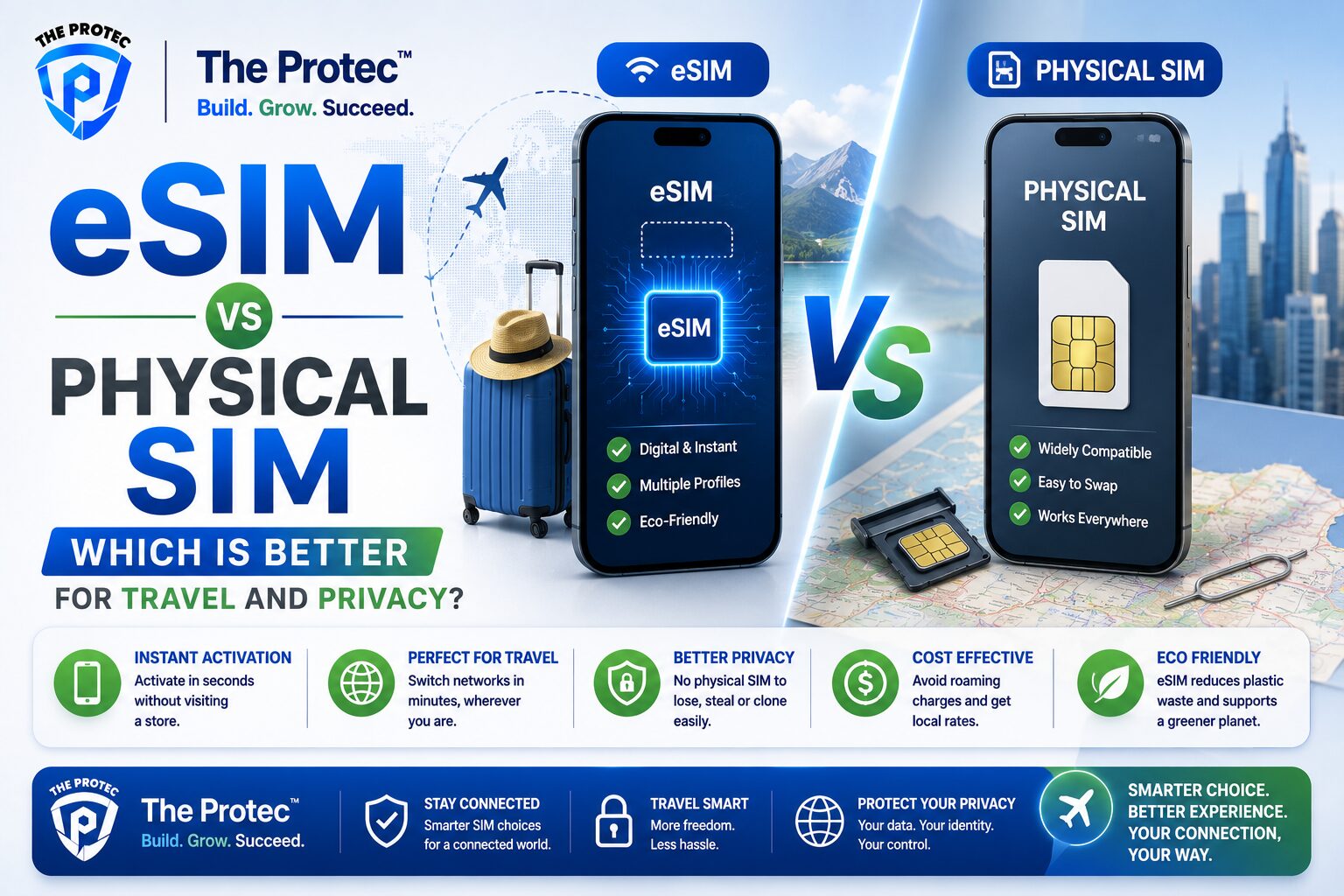
Modern phones often support multiple eSIM profiles, allowing users to keep personal and work numbers, or a home plan and travel plan, on the same device. That flexibility is one of the biggest eSIM benefits and one reason the technology has become so popular among international travelers.
eSIM Benefits for Travelers
For travel, eSIM has become the preferred option for many people because it removes the friction of finding local connectivity after landing. In many destinations, you can buy a travel data plan before you leave, activate it in minutes, and avoid hunting for airport kiosks or local SIM vendors.
- Instant activation: Many travel eSIMs can be installed before departure and turned on as soon as you arrive.
- Keep your home number active: Dual SIM support lets you use a travel data plan while still receiving calls or messages on your primary line, depending on carrier settings.
- No physical swapping: You do not need to remove your primary SIM card, which reduces the risk of losing it.
- Better for multi-country trips: Some eSIM plans cover multiple countries or regions, which is useful for longer itineraries.
- Less hassle at borders: Travelers can switch plans digitally without opening the SIM tray or handling tiny cards in transit.
For people who travel often, these eSIM benefits can save time and reduce stress. A strong travel eSIM also helps avoid roaming surprises, especially when your home carrier charges high international rates. If your device supports it, eSIM often feels like the best eSIM solution for convenience and speed.
That said, not every destination or carrier makes eSIM equally easy. In places where local support is limited, physical SIM cards may still be easier to find or cheaper to purchase in person. The best choice depends on your route and the level of support available where you are going.
Physical SIM Advantages That Still Matter
Although eSIM adoption is expanding, physical SIM cards are far from obsolete. They still offer a few practical advantages that matter to some users, especially in areas with uneven carrier support or when using older devices.
- Universal familiarity: Most people know how to insert or swap a physical SIM, and many repair shops and stores can help immediately.
- Device portability: If you change phones often or use multiple unlocked devices, moving a physical SIM can be quick.
- Works on more devices: Some budget phones, older models, tablets, and hotspots still rely on physical SIM slots.
- Useful in carrier edge cases: In certain markets, some prepaid or local plans remain easier to activate with a physical card.
Another reason some users prefer a physical SIM is control. If you want to remove cellular access entirely from a device, taking out the card is an immediate, visible action. That simplicity can feel reassuring for people who like tangible hardware. In comparison, an eSIM profile is digital and requires navigating the device settings to disable or delete it.
Physical SIMs also remain helpful when troubleshooting. If you travel with a backup phone, inserting a card can be faster than dealing with activation steps, QR codes, or carrier account verification. For some people, the old system still works best because it is predictable and widely understood.
Security: Is eSIM Safer Than a Physical SIM?
When it comes to security, eSIM and physical SIM cards each have different strengths. An eSIM cannot be physically removed by someone who steals your phone, which can make it harder for a thief to immediately disconnect your number and intercept messages. That is a meaningful advantage in theft scenarios.
At the same time, eSIM security depends on account protection. If your carrier account or email is compromised, a bad actor might attempt a SIM swap or reactivation through digital channels. This is not unique to eSIM, but it means your overall security posture matters more than the SIM type alone. Strong passwords, carrier PINs, and two-factor authentication are critical.
Physical SIM cards are vulnerable in a different way. If someone obtains your card, they can move it into another device. However, removing a physical SIM generally requires access to the phone, and the act itself is obvious. For some users, that tangible barrier is useful. Still, if someone has your unlocked phone and SIM, the risk is immediate.
From a practical standpoint, eSIM can be safer against physical theft, while physical SIM can be easier to manage if you want a simple backup method. Neither option eliminates the need for good account hygiene. The most secure setup is usually a combination of device passcodes, carrier protections, and careful number recovery settings.
Privacy: Which Option Gives You More Control?
Privacy is one of the most overlooked parts of the eSIM vs physical SIM discussion. Many people assume a SIM card is just for connectivity, but it also affects how your identity is tied to a mobile profile. eSIM can improve some privacy habits because it lets you create more separation between lines, especially on phones that support multiple profiles.
For example, you can keep a primary number for personal use and activate a travel or secondary data plan separately. This makes it easier to limit how much exposure your main number has while abroad. If you are using a travel eSIM for maps, rides, and messaging apps, you may not need to share your permanent number with local vendors or short-term services.
That said, eSIM is not inherently anonymous. Carriers still identify customers, and many plans require registration or payment details. Privacy depends more on how you use the line than on whether it is embedded or removable. If you want stronger separation, consider using a dedicated travel line, minimizing app permissions, and reviewing how your phone routes calls and data across multiple SIM profiles.
Physical SIM cards can also support privacy if you buy a local prepaid plan in person, but that varies by country and local regulations. In some regions, registration requirements are strict. In others, a prepaid SIM can offer a simple, temporary identity layer for travel use. The key question is not which SIM is magically private, but which one gives you better control over your number, contacts, and data usage.
Carrier Support and Compatibility: The Biggest Deciding Factor
Carrier support is where the eSIM vs physical SIM question becomes very practical. A phone may support eSIM, but if your carrier or destination network does not, the feature may not help you. Before choosing, it is worth checking whether your current carrier supports eSIM transfers, dual SIM use, and international activation.
Support has improved significantly across major networks, especially for postpaid plans and newer smartphones. Many carriers now allow users to convert a physical SIM to eSIM or move an eSIM to a new device through an app or online account tools. This makes switching easier than it used to be, but the experience still varies by provider.
Travelers should also pay attention to destination compatibility. The best eSIM for one country may not work well in another if the local network bands or roaming agreements are limited. Some travel eSIM providers offer broad coverage, while others focus on specific regions. In contrast, buying a local physical SIM can sometimes deliver faster speeds or lower prices if you are staying somewhere for a while.
If you change phones frequently, compatibility matters even more. Not every device handles eSIM transfer the same way, and some older models may not support it at all. A physical SIM remains the most universal fallback, especially for secondary devices, backup phones, and gadgets that lack built-in eSIM support.
Everyday Use: Which Is Easier to Live With?
For day-to-day use, eSIM usually wins on convenience. You can add or switch plans without waiting for shipping, and many phones make it easy to label lines, choose a default data line, and manage calls separately from data. This is especially useful if you want a personal line and a work line on the same device.
eSIM also reduces small but annoying risks: lost cards, damaged trays, dust issues, and the need to carry a SIM ejector tool. Once set up, the experience is mostly invisible. For many users, that is the point. Your phone just works.
Physical SIMs, however, still appeal to people who want a simpler mental model. If you only use one line and rarely travel, the removable card may be all you need. It can also be easier to troubleshoot if you are helping family members or setting up a secondary device quickly.
In everyday life, the best choice often comes down to how much you value flexibility. If you regularly switch plans, use multiple numbers, or want to activate service without visiting a store, eSIM is usually more convenient. If you prefer a universally familiar format and want the ability to move a card between devices immediately, physical SIM remains strong.
When a Physical SIM May Be the Better Choice
Even with the rise of eSIM, there are still clear cases where physical SIM is the better choice. You may want a physical card if you use an older phone, travel to destinations where eSIM support is limited, or rely on a carrier that still has a smoother physical SIM activation process.
It can also be the better option if you need the simplest possible backup. For example, if you carry a spare unlocked phone, moving a physical SIM between devices can be faster than logging into carrier portals or waiting for digital transfer approvals. People who prefer visible, tangible control often find this reassuring.
Another reason to stick with a physical SIM is cost consistency. In some markets, local prepaid SIM cards are still cheaper than comparable travel eSIM plans, especially for long stays or heavy data use. If your trip lasts weeks or months, the economics may favor physical local service.
How to Decide Between eSIM and Physical SIM
The right answer depends on your priorities. Here is a simple way to think about it:
- Choose eSIM if: you travel frequently, want quick activation, use dual lines, or prefer a cleaner phone setup.
- Choose physical SIM if: you use an older device, want maximum simplicity, or need broad compatibility with local providers.
- Use both if possible: many modern phones support one physical SIM and one or more eSIM profiles, giving you the best of both worlds.
If your phone supports dual SIM functionality, combining a physical SIM and an eSIM can be ideal. You might keep your home number on one line and use a travel eSIM for data. This setup is especially useful for travelers who want to remain reachable without paying excessive roaming fees.
When comparing the best eSIM options, look beyond price. Check activation speed, regional coverage, hotspot support, refill options, customer service, and whether the provider works reliably in the countries you visit most often. The cheapest plan is not always the best if it drops coverage or makes activation difficult.
FAQ: eSIM vs Physical SIM
Is eSIM better than a physical SIM for international travel?
In most cases, yes. eSIM is often better for international travel because it can be activated before departure, works without swapping cards, and lets you keep your main number active on supported devices. However, if your destination has weak eSIM support or you need a local prepaid deal, a physical SIM may still be better.
Can a stolen phone with an eSIM be easier or harder to exploit?
An eSIM can be harder for a thief to remove quickly because it is built into the device. That can help protect your number from immediate physical extraction. But your carrier account, device passcode, and recovery settings still matter a lot. Good security practices are essential either way.
What is the biggest eSIM benefit for everyday use?
The biggest eSIM benefit is flexibility. You can add lines digitally, switch carriers more easily, and manage multiple numbers without handling tiny cards. For many people, this makes the phone easier to use at home and while traveling.
Are physical SIM cards going away?
Not entirely. Physical SIM cards are still widely supported and will remain useful for many devices and markets. But eSIM adoption is growing quickly, especially in newer phones and travel-focused mobile plans. The future is likely to be mixed for some time.
What should I check before buying the best eSIM for travel?
Check device compatibility, country coverage, data limits, hotspot support, activation method, and how easy it is to top up or switch plans. Also confirm whether the provider offers reliable support if activation fails after you arrive.
Final Verdict: eSIM vs Physical SIM
For most travelers and many everyday users, eSIM is becoming the smarter default. It offers fast setup, easier switching, better dual-line flexibility, and fewer physical hassles. Those eSIM benefits are especially valuable if you cross borders often or want to keep your travel data separate from your main number.
Still, physical SIM cards are not outdated. They remain useful for broader compatibility, older devices, and situations where a tangible backup is preferable. If your carrier support is uneven or you travel to places where eSIM options are limited, a physical SIM may be the safer practical choice.
The best answer is not always one or the other. For many people, the ideal setup is a phone that supports both. That gives you the freedom to use eSIM for convenience and travel, while keeping a physical SIM as a backup or primary line when needed. In a world where mobile connectivity is part of how we work, travel, and protect our privacy, having options is the real advantage.
Whether you choose the best eSIM for your next trip or stick with a physical SIM for simplicity, the key is to match the technology to your habits. If you do that, you will get a setup that is faster, safer, and easier to live with.