








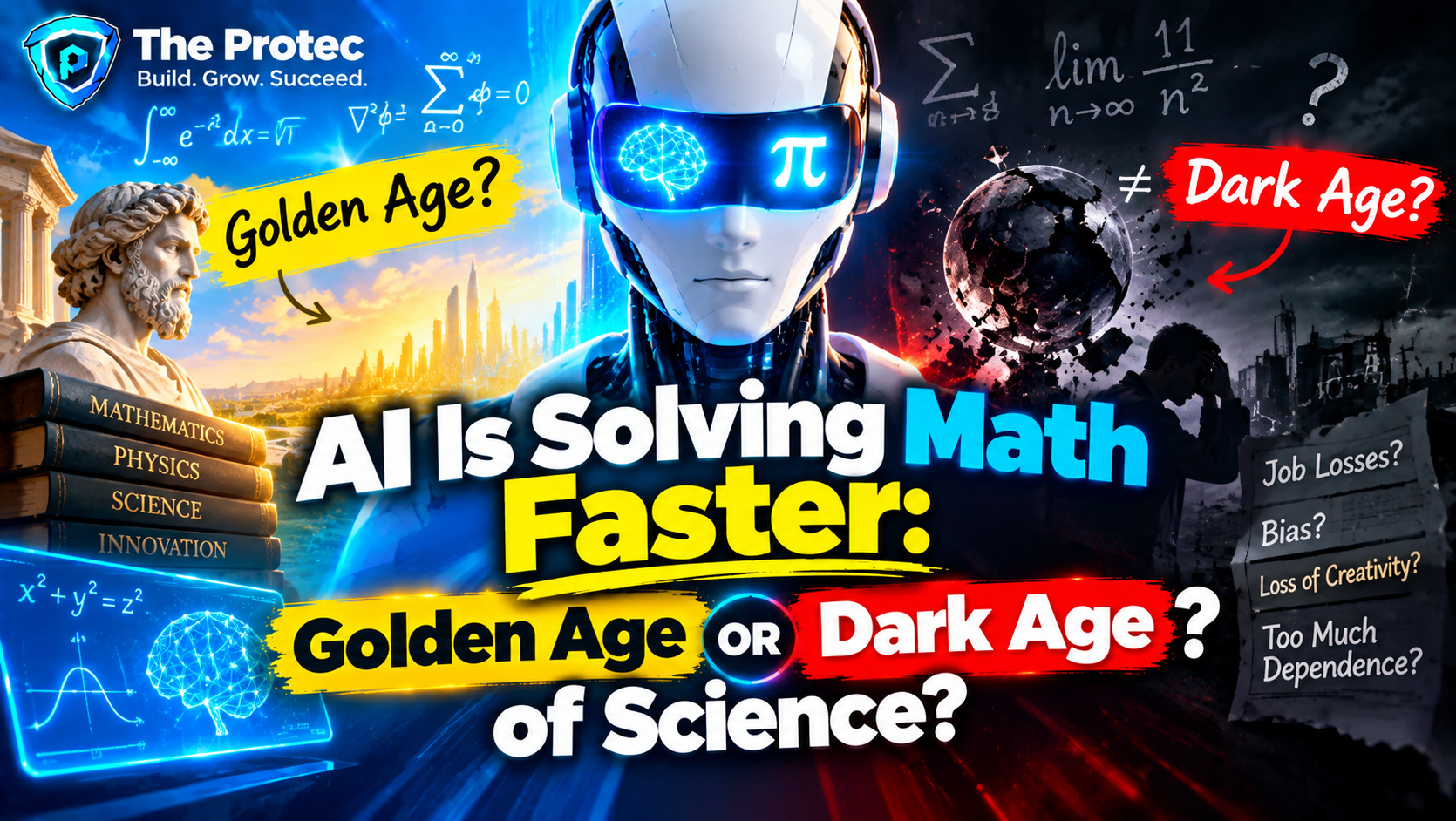
Artificial intelligence is no longer merely calculating answers to familiar exercises. Increasingly capable systems can suggest conjectures, identify patterns, retrieve relevant literature, translate informal arguments into formal language, and help construct mathematical proofs. These advances raise an extraordinary possibility: AI could compress years of scientific work into weeks, opening a golden age of discovery.
But speed is not the same as understanding. If AI-generated mathematical proofs, papers, and experimental claims multiply faster than researchers can verify them, science could accumulate an impressive-looking body of results that few people understand and fewer can reproduce. The same technology that expands human knowledge could weaken the processes that make knowledge trustworthy.
This tension is central to an October 18, 2026, guest essay by mathematician Francesco Maggi published on Terence Tao’s blog. The essay presents contrasting possibilities for AI and the future of science: one in which machines amplify human reasoning, and another in which automated output overwhelms human judgment. It is important to attribute that framing to Maggi rather than treating it as a Terence Tao AI warning or implying that Tao personally endorses every claim. It is also a debate about possible futures—not a prediction that either outcome is inevitable.
Why AI Mathematics Breakthroughs Matter
Mathematics is an unusually revealing test case for artificial intelligence in scientific research. Mathematical claims are expected to follow from explicit definitions and logical steps, giving AI systems clearer targets than they encounter in many empirical fields. A proof can, at least in principle, be checked line by line or encoded in a formal system.
AI-assisted mathematical research already spans several practical tasks. Models can search large collections of papers, summarize competing approaches, propose intermediate lemmas, generate examples and counterexamples, write code for symbolic or numerical experiments, and translate proof sketches into forms suitable for theorem provers. Pattern-finding systems can also explore large combinatorial spaces that would be tedious for humans to inspect manually.
These are demonstrated categories of assistance, although reliability varies significantly by system, problem, and evaluation method. More ambitious claims—such as broadly autonomous machines producing major scientific theories without meaningful human guidance—remain speculative. Reports of AI scientific breakthroughs in 2026 therefore require careful distinctions among a tool that assists experts, a system that solves a tightly defined benchmark, and an autonomous scientific agent capable of generating durable understanding.
The Golden-Age Case for AI and Scientific Innovation
In the optimistic scenario, AI becomes an intellectual instrument comparable in importance to the telescope, computer, or gene sequencer. It does not eliminate researchers; it expands the range of questions they can investigate.
- Conjecture generation: AI can inspect large datasets or families of mathematical objects and suggest relationships that deserve investigation.
- Literature discovery: Researchers can locate relevant results across disciplines, languages, and decades of publications instead of rediscovering known ideas.
- Proof assistance: Models can propose lemmas, expose missing steps, translate notation, and interact with formal proof environments.
- Simulation and experimentation: AI can help design computational experiments, compare parameter ranges, and identify anomalous outcomes.
- Hypothesis testing: Systems can rapidly evaluate candidate explanations against available data, helping scientists decide where scarce laboratory or research time should go.
The future of mathematics with AI could be especially productive when machines handle exhaustive search while people provide abstraction, interpretation, and strategic direction. A mathematician might define the right problem, use AI to explore thousands of cases, recognize a deeper structure in the output, and then build a transparent proof. Here, faster computation strengthens rather than displaces human intelligence.
Why a Plausible AI-Generated Proof Is Not Automatically True
A mathematical argument can sound sophisticated while containing a fatal gap. Generative models are optimized to produce likely sequences of language or formal tokens; they are not inherently guaranteed to preserve truth. They may cite a theorem whose assumptions do not apply, reverse an implication, hide an invalid step behind phrases such as “it follows,” or invent a reference that resembles a real paper.
Expert review remains essential, but informal inspection alone may not scale if AI solving complex math problems generates thousands of lengthy proofs. Formal verification offers a stronger safeguard. In systems such as the Lean theorem prover, definitions and proof steps are represented precisely and checked by a small trusted kernel. A machine-checked proof greatly reduces the chance of an unnoticed logical error.
Formal verification is not magic, however. Researchers must still confirm that the formal statement accurately represents the intended theorem, that definitions capture the relevant concept, and that imported assumptions are appropriate. A perfectly verified proof of the wrong formulation does not establish the claim scientists care about. Trust therefore depends on both mechanical checking and human interpretation.
The Dark-Age Scenario: More Output, Less Understanding
Maggi’s darker scenario begins with a mismatch: research output grows far faster than the community’s ability to assess it. AI-generated scientific papers could flood journals and preprint servers with polished claims, elaborate derivations, synthetic data, and citations. Even if many papers are correct, the volume alone could make independent scrutiny impractical.
This creates a dangerous substitute for knowledge: plausible results that circulate without enough replication, comprehension, or follow-up. A discovery has limited scientific value if no independent team can reproduce it, no researcher can explain why it works, and nobody can extend it to answer new questions. Citation counts and publication volume might rise while the shared body of reliable understanding becomes harder to identify.
The risks of AI in academia are therefore not limited to outright fabrication. They include verification debt—the accumulating burden of checking machine-generated claims. Peer review, already constrained by time and incentives, could become the bottleneck of AI scientific discovery.
Could Scientific Knowledge Become Concentrated?
Advanced research systems require models, specialized data, engineering talent, and expensive computing infrastructure. If the strongest tools remain proprietary, a small number of AI companies could gain disproportionate influence over which scientific questions are explored and who can explore them.
Researchers may receive answers through an interface without access to training data, system logs, model weights, or complete computational traces. That makes it harder to diagnose errors, evaluate hidden biases, preserve workflows, or reproduce a result after a model changes. Scientific claims should not depend on an inaccessible service behaving the same way indefinitely.
Unequal access could also create a two-tier research system. Wealthy institutions and corporate laboratories would operate powerful AI research tools, while smaller universities and independent scholars would struggle to compete. The question of AI replacing scientists may be less immediate than another possibility: scientists with privileged AI access displacing equally capable researchers who lack it.
Effects on Universities, Students, and Early-Career Researchers
Scientific training depends on doing difficult work, not merely obtaining correct outputs. Students learn by attempting proofs, debugging failed arguments, reading primary sources, and developing intuition about which approaches are promising. If AI supplies polished solutions too early, learners may advance without acquiring the foundational reasoning needed to recognize when the machine is wrong.
Early-career researchers face a related incentive problem. Hiring, promotion, and funding systems often reward publication speed. When AI-assisted output becomes cheap, researchers may feel pressure to produce more papers rather than undertake slow verification, replication, or conceptual work. Those who carefully audit results could appear less productive than those who generate claims at scale.
Universities will need assessment methods that distinguish tool use from genuine understanding. Oral examinations, reproducible projects, proof explanation, error analysis, and documented research decisions may become more valuable than take-home work whose authorship is impossible to determine.
AI Should Support Human Reasoning, Not Hide It
The strongest case for AI-assisted mathematical research is not that machines should replace scientists. It is that they can remove friction while keeping humans responsible for meaning and evidence. A model can map a literature field, but a scholar should evaluate the sources. It can suggest a hypothesis, but researchers should design the test. It can construct proof steps, but the final argument should be inspectable and independently checked.
Human intelligence vs artificial intelligence is therefore a misleading choice. Scientific progress can emerge from a division of labor: machines provide speed, search, memory, and large-scale pattern recognition, while people contribute judgment, causal interpretation, ethical responsibility, and the ability to reformulate the question. The decisive issue is whether research institutions preserve those human capabilities instead of allowing convenient outputs to erode them.
Safeguards for a Trustworthy Future of Mathematical Discovery
A golden age is possible, but it requires deliberate standards rather than blind confidence in technical progress.
- Researchers should disclose AI use. Papers should identify the systems used, their role, relevant prompts or configurations, and which claims received human or formal verification.
- Research workflows should be reproducible. Authors should preserve code, data, model versions, proof files, logs, and computational environments whenever legal and ethical constraints permit.
- Universities should teach AI literacy and fundamentals together. Students need experience using research tools, testing outputs, detecting hallucinations, and reasoning without automated assistance.
- Journals should strengthen verification. Editorial policies should reward replication, require accessible research artifacts, and apply additional scrutiny to machine-generated proofs or data.
- AI developers should improve transparency. Clear documentation, capability evaluations, failure analysis, version records, and disclosure of known limitations are essential for research use.
- Access should be broadened. Public infrastructure, academic partnerships, open tools, and equitable compute programs can prevent scientific capacity from becoming concentrated in a few companies.
The central challenge is not whether AI can produce answers faster. It is whether science can preserve verification, understanding, and shared access while taking advantage of that speed. If those norms remain strong, AI and scientific innovation can reinforce each other. If output becomes the goal and trustworthy knowledge an afterthought, the apparent boom in discovery may conceal intellectual decline.
Frequently Asked Questions
Can AI replace human mathematicians and scientists?
Current systems can automate or accelerate specific research tasks, including literature searches, code generation, pattern discovery, and parts of theorem proving. That does not demonstrate the broad judgment, conceptual understanding, accountability, or independent reliability required to replace scientists. Future automation may expand, but claims of complete replacement remain speculative.
Are AI-generated mathematical proofs reliable?
Not automatically. An AI-generated proof can contain subtle logical errors, misuse assumptions, or prove a statement different from the intended theorem. Reliability improves through expert review, formal theorem proving, transparent assumptions, and independent verification.
What is the main risk of AI-generated scientific papers?
The central risk is that production becomes cheaper than evaluation. A large volume of plausible papers can overwhelm peer review, conceal errors, encourage citation of unverified claims, and divert attention from replication and deeper understanding.
Did Terence Tao write the golden-age-versus-dark-age argument?
The central framing discussed here comes from Francesco Maggi’s October 18, 2026, guest essay hosted on Tao’s blog. Tao’s publication of a guest essay should not be presented as proof that he authored or endorses every argument in it.