







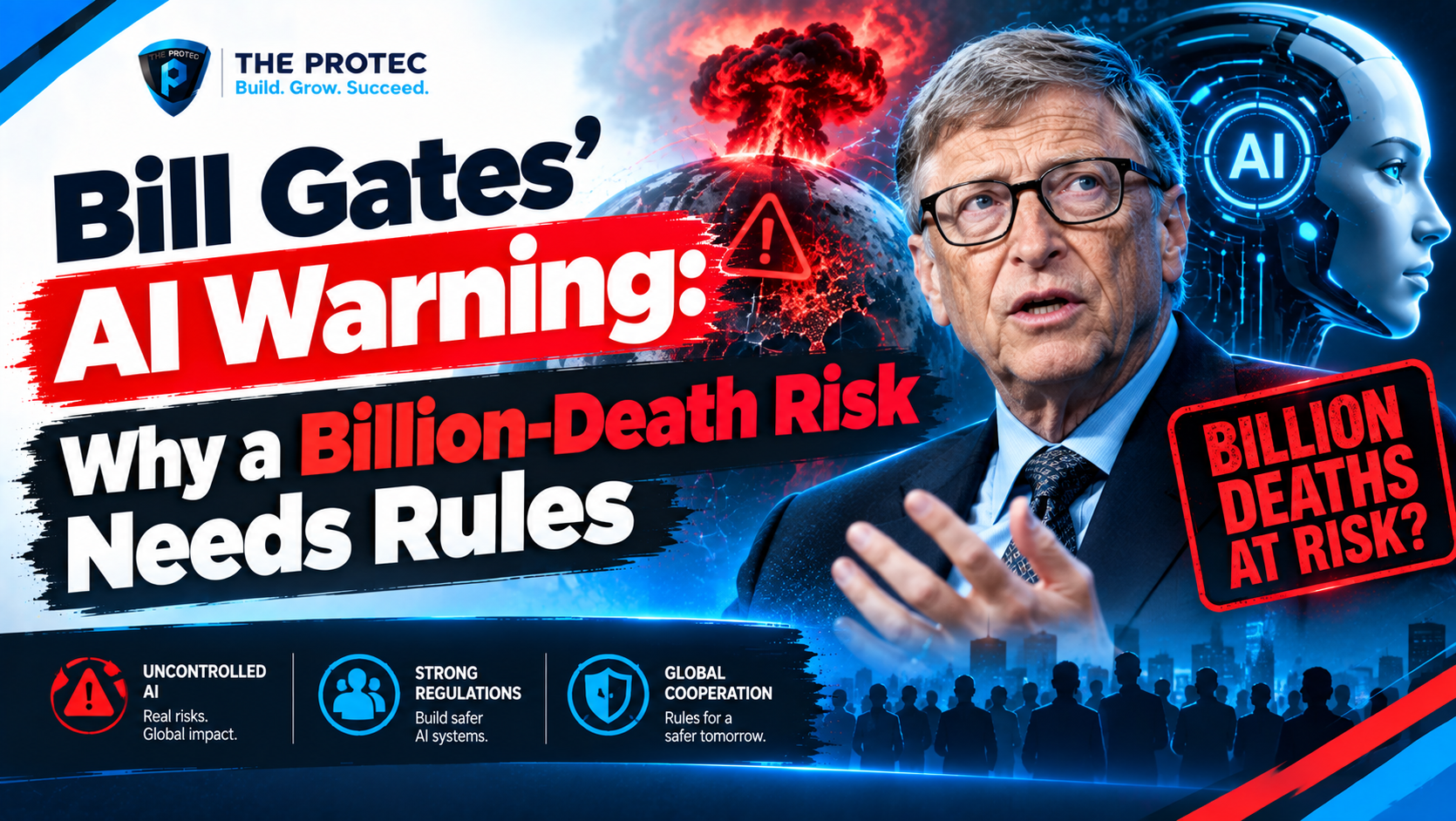
Bill Gates has issued one of his starkest warnings yet about artificial intelligence: sufficiently advanced AI, if deliberately misused, could help malicious actors set events in motion that kill as many as a billion people.
The statement is alarming, but it is important to understand precisely what Gates meant. In a September 2026 interview with NBC News, he did not predict that AI will inevitably cause a billion deaths. He described an extreme but plausible misuse scenario—a measure of how destructive the technology could become when paired with human intent, dangerous capabilities, and inadequate safeguards.
The Bill Gates AI warning also carried a clear policy message. Gates argued that voluntary commitments by technology companies are not enough to manage advanced AI risks. Lawmakers, law enforcement agencies, technical experts, and other public institutions must help establish rules, monitoring systems, and accountability before frontier AI becomes even more capable.
What Bill Gates Actually Said About AI and a Billion Deaths
Gates’ warning centered on the potential power of artificial intelligence in the hands of malicious people. His concern was not that a chatbot might independently decide to destroy humanity. It was that advanced systems could give an individual, criminal organization, or hostile group access to expertise and operational assistance that was once available only to well-resourced governments or specialized laboratories.
The phrase “a billion deaths” described the possible scale of a catastrophic event enabled by AI. Gates pointed to areas such as biological threats, where a system might eventually help a bad actor understand pathogens, optimize harmful processes, or overcome technical barriers. Advanced AI could also amplify cyberattacks against critical infrastructure and other systems on which large populations depend.
This distinction matters. The Bill Gates AI billion deaths scenario is a warning about capability and misuse, not a numerical forecast. Gates was not assigning a probability or claiming that such an event is imminent. He was arguing that when a technology has even the potential to contribute to destruction on that scale, society cannot rely entirely on the companies developing it to decide what protections are adequate.
A Catastrophic Risk Is Not the Same as a Prediction
Headlines can easily make Gates’ comments sound like a prophecy. They are better understood as a risk-management argument. Governments already prepare for rare but devastating events—including pandemics, nuclear accidents, infrastructure failures, and large-scale cyberattacks—without asserting that those events are certain to occur.
AI existential risk and AI catastrophic risk are also related but different concepts. Existential risk generally refers to a threat that could permanently destroy humanity or severely curtail its future. A catastrophe causing hundreds of millions or a billion deaths would be historically unprecedented, but it would not automatically mean human extinction.
Gates’ warning belongs primarily in the catastrophic-risk category. His point is that low-frequency, high-impact scenarios deserve preparation before all the technical details or probabilities are known. Waiting for definitive proof may be unacceptable when the first clear evidence could arrive only after irreversible harm has occurred.
Why Gates Says AI Self-Regulation Is Insufficient
Technology companies have introduced model evaluations, red-team testing, usage policies, access controls, and internal safety teams. These measures are valuable, and developers often understand their systems better than outside institutions. Gates’ argument, however, is that AI self regulation cannot be the only line of defense.
Companies face competitive pressure to release more capable models quickly. Safety practices also vary among developers, while voluntary promises may be changed, narrowly interpreted, or abandoned. A company can test a model thoroughly and still miss dangerous behaviors, especially when users combine AI with external tools, private data, laboratory equipment, or stolen credentials.
There is also a basic accountability problem. Decisions involving national security, public health, criminal activity, and risks to millions of people carry consequences far beyond a company’s customers or shareholders. Gates’ call for AI government regulation reflects the principle that public institutions must have a role when private products create society-wide risks.
That does not mean governments should design models or approve every software update. It means enforceable AI safety standards should exist for the most powerful systems, with independent oversight and consequences when organizations ignore clear obligations.
The Biological Risks Behind the Bill Gates AI Warning
AI biological risks are among the most serious concerns in the frontier AI debate. Current systems can already summarize scientific literature, explain technical concepts, and help researchers analyze complex data. Those capabilities can accelerate beneficial work on medicines, vaccines, diagnostics, and pandemic preparedness.
The same knowledge can be dual-use. As models improve, policymakers are asking whether they could meaningfully help untrained or moderately trained actors design harmful biological agents, identify methods that increase transmissibility, evade known countermeasures, or troubleshoot dangerous experiments.
AI alone cannot create a pandemic. A malicious actor would still need materials, facilities, equipment, tacit knowledge, and an ability to avoid detection. Those barriers remain significant. The concern is that frontier AI could lower enough of them to make an attack feasible for more people.
Effective safeguards could include specialized biological evaluations before deployment, tighter access to high-risk capabilities, monitoring for suspicious patterns, secure handling of model weights, and clear procedures for escalating credible threats to law enforcement or public-health authorities. These controls should focus on dangerous capability without blocking legitimate research.
AI Cybersecurity Risks Could Scale Faster
Cybersecurity presents a more immediate illustration of AI misuse. Models can assist defenders by finding vulnerabilities, reviewing code, detecting anomalies, and responding to incidents. Attackers can use similar tools to write phishing messages, search for exploitable systems, generate malicious code, or automate parts of an intrusion.
The greatest concern is not merely a higher volume of spam. Advanced AI risks could include highly adaptive attacks on hospitals, energy grids, communications networks, financial systems, water facilities, and government services. An AI-assisted campaign might identify weaknesses, change tactics when blocked, and coordinate attacks across many targets.
Critical infrastructure failures can produce physical consequences. Disruptions to healthcare, power, food distribution, transportation, or emergency communications could magnify a biological crisis or conventional conflict. This is why Gates’ warning is about systems of risk rather than one hypothetical superintelligence. Biological, cyber, geopolitical, and informational threats can compound one another.
What Meaningful AI Regulation Could Include
Gates’ call for regulation emphasizes participation by lawmakers, law enforcement, and other institutions rather than reliance on corporate promises. A credible framework for frontier AI would likely combine several layers of protection:
- Capability-based rules: Requirements should focus on what a model can do, especially in biology, cybersecurity, autonomous operation, persuasion, and weapons-related domains.
- Pre-deployment evaluations: Independent or government-approved testing should assess whether a frontier model materially increases the ability of users to cause severe harm.
- Incident reporting: Developers should promptly report major security breaches, model theft, safeguard failures, and credible evidence of dangerous misuse.
- Secure model development: Companies training advanced systems should meet cybersecurity standards designed to protect model weights, research data, and critical infrastructure.
- Controlled access: The most dangerous capabilities may require identity verification, usage limits, enhanced monitoring, or restricted interfaces rather than unrestricted public release.
- Law-enforcement coordination: Clear legal processes are needed so credible threats can be investigated without turning routine AI use into indiscriminate surveillance.
- Emergency authority and review: Governments may need narrowly defined powers to respond to an imminent threat, paired with judicial oversight, transparency, and expiration provisions.
Technical guidance such as the NIST AI Risk Management Framework can help organizations identify and manage risk. Gates’ argument goes further: voluntary frameworks must be reinforced by enforceable obligations when models cross high-risk capability thresholds.
Monitoring Must Be Effective Without Becoming Mass Surveillance
AI monitoring is one of the most difficult elements of this discussion. Providers need enough visibility to detect attempts to obtain pathogen instructions, compromise critical infrastructure, or bypass safeguards. Yet broad monitoring could expose private information, chill legitimate research, or be abused by governments and companies.
Good AI policy should therefore require proportionality. Monitoring can prioritize high-risk models and suspicious behavior rather than collecting every conversation. Data retention can be limited, access can be logged, and escalation can require defined evidence. Independent audits and legal oversight should verify that safety systems do not quietly become permanent surveillance mechanisms.
This balance is central to AI safety regulation: reducing catastrophic danger while preserving privacy, scientific inquiry, competition, and civil liberties.
The Wider Frontier AI Regulation Debate
The AI regulation 2026 debate increasingly revolves around frontier AI—the most capable general-purpose models, particularly those that may exceed existing systems in scientific reasoning, autonomous task completion, cyber operations, or biological knowledge.
One side warns that premature rules could entrench dominant companies, slow innovation, and regulate hypothetical dangers while overlooking present harms. The other argues that waiting until dangerous capabilities are widely available would make prevention far harder. Once model weights are stolen or openly distributed, restrictions may be nearly impossible to enforce.
A risk-tiered approach offers a practical middle ground. Everyday, low-risk AI applications should not face the same obligations as systems with exceptional capabilities. Requirements can become stronger as training scale, autonomy, access, and demonstrated risk increase. Regulation should also be updated as evidence changes rather than freezing today’s assumptions into permanent law.
What Gates’ Warning Means for the AI Industry
The central message is not that advanced AI should be stopped. Gates has repeatedly emphasized artificial intelligence’s potential to improve healthcare, education, productivity, and scientific discovery. The warning is that beneficial potential does not erase the need to plan for deliberate abuse.
Developers should treat AI safeguards as core infrastructure, not optional product features. Governments need technical expertise, international cooperation, and laws that target real capabilities. Researchers and civil society should be able to test safety claims independently. The public, meanwhile, deserves clear explanations of both the risks and the limits of current systems.
Frequently Asked Questions
Did Bill Gates predict that AI will kill a billion people?
No. Gates described a scenario in which advanced AI could be powerful enough, when used by malicious actors, to contribute to events causing a billion deaths. He did not say this outcome is certain, imminent, or statistically likely.
Why is Bill Gates calling for AI regulation?
Bill Gates’ AI regulation argument is that companies cannot manage society-wide threats alone. Competitive pressures, inconsistent safety practices, and the public consequences of biological or cyber misuse make government standards, law enforcement involvement, monitoring, and accountability necessary.
What are the main AI risks Gates is concerned about?
The warning focuses on malicious use of advanced AI, particularly biological threats and large-scale cyberattacks. More broadly, frontier systems could lower technical barriers, automate harmful tasks, and increase the speed or reach of attacks against critical systems.
Can regulation eliminate catastrophic AI risk?
No regulation can remove all risk. Effective rules can make misuse more difficult, improve detection, establish minimum AI safety standards, protect powerful models from theft, and create coordinated responses when credible threats appear.
The Bottom Line
The Bill Gates artificial intelligence warning is intentionally severe because the potential consequences are severe. It should not be misrepresented as a prediction of inevitable mass death. It is a call to govern advanced AI before dangerous capabilities become cheap, widely available, and difficult to control.
Industry expertise will remain essential, but self-regulation alone cannot resolve risks that cross corporate and national boundaries. Gates’ message is that lawmakers, law enforcement, developers, scientists, and the public must build practical AI safeguards now—while there is still time to shape how the most powerful systems are deployed.