






Why Enterprise AI Is Moving Beyond General-Purpose Models
For the past few years, general-purpose large language models have captured most of the attention in artificial intelligence. They are flexible, impressive, and useful across many tasks. But as enterprise AI matures, a clear pattern is emerging: businesses are increasingly adopting domain-specific AI models instead of relying solely on broad, general-purpose systems.
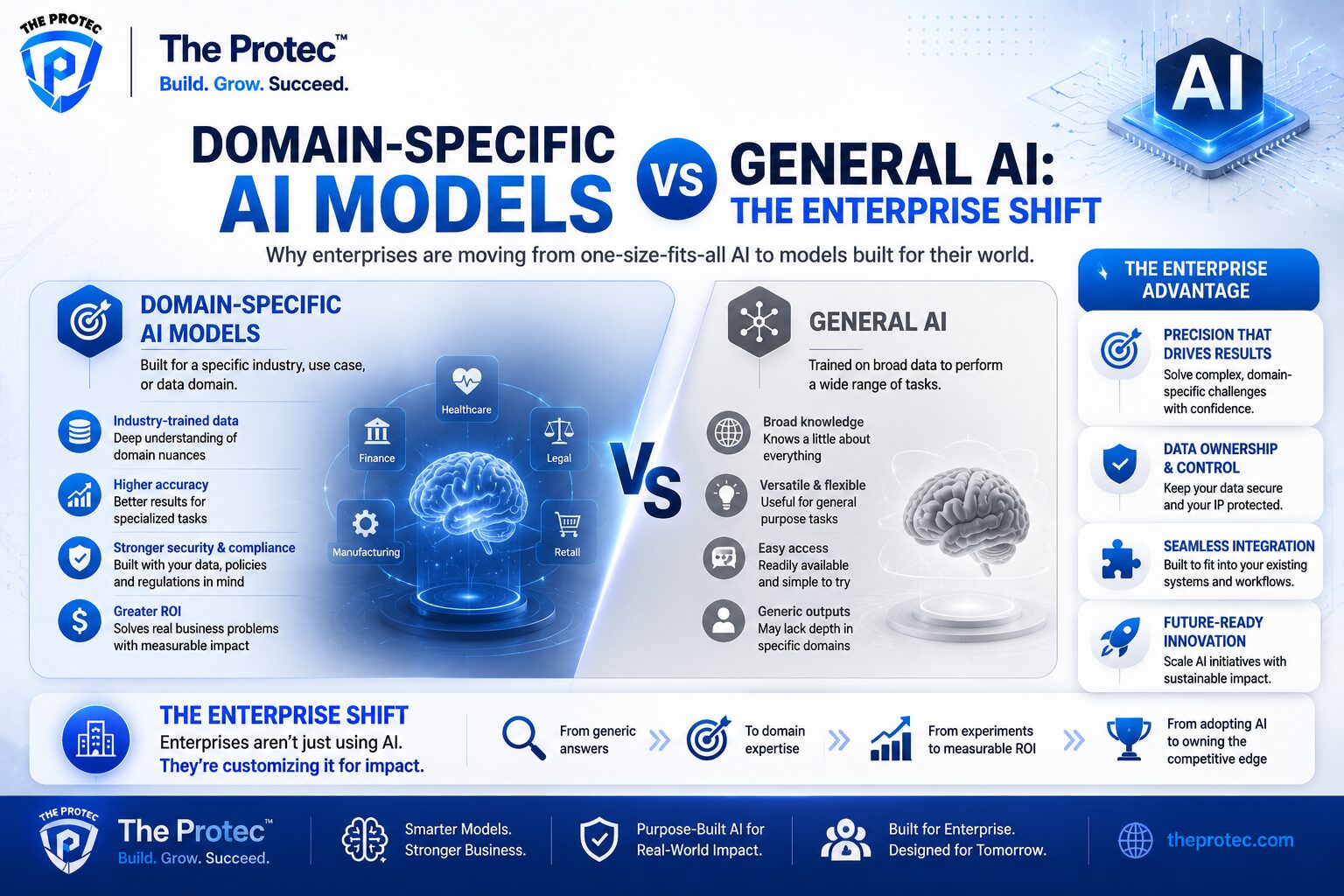
This shift is not about replacing general AI completely. It is about matching the right model to the right business problem. In regulated, high-stakes environments, a model that understands industry language, workflows, compliance requirements, and domain-specific risks can outperform a more generic system in ways that matter commercially. That is why domain specific AI models are becoming one of the most important enterprise AI trends.
Healthcare organizations want safer clinical support. Financial institutions need precise fraud detection and regulatory awareness. Legal teams require document analysis that respects nuance and confidentiality. Software teams are looking for coding assistants that understand architecture, security, and codebase conventions. Across all of these sectors, industry AI models are proving that specialization can deliver better accuracy, lower risk, and faster return on investment.
Recent progress in model customization, retrieval-augmented generation, smaller high-performance models, and enterprise-grade orchestration has accelerated this movement. Enterprises no longer need to choose between a huge general model and rigid legacy software. They can now deploy specialized AI systems tuned to their own data, rules, and operating environment.
What Are Domain-Specific AI Models?
Domain-specific AI models are artificial intelligence systems trained, fine-tuned, or adapted for a particular industry, function, or workflow. Unlike general-purpose models that are designed to handle a wide range of topics, these systems are optimized for specialized knowledge and task performance within a narrower scope.
Examples include:
- Clinical AI models trained on medical terminology, care pathways, and clinical documentation
- Financial AI models designed for fraud detection, underwriting, risk scoring, and compliance monitoring
- Legal AI models built to interpret contracts, summarize case law, and support discovery workflows
- Software engineering AI models tuned for code completion, debugging, testing, and architecture guidance
These models may be built in several ways. Some are fine-tuned versions of foundation models. Others combine a general model with enterprise data through retrieval systems and policy constraints. In more advanced deployments, organizations use smaller domain-specific models for core tasks and reserve larger models for broader reasoning or natural language interaction.
The key difference is focus. General AI aims for breadth. Industry AI models aim for depth.
Why General AI Models Are Not Enough for Enterprise Use
General-purpose LLMs are incredibly useful for brainstorming, drafting, summarizing, and answering broad questions. However, enterprises operate under stricter requirements than consumer use cases. They need accuracy, auditability, data governance, and consistency. A model that sounds confident is not enough if it cannot reliably follow industry rules or interpret specialized context.
There are several reasons why general models often fall short in enterprise settings:
- Limited domain precision: General models may misunderstand specialized terminology or confuse similar concepts.
- Hallucination risk: In regulated environments, even a small factual error can create legal, financial, or clinical consequences.
- Compliance gaps: General models do not inherently know industry-specific regulations or organizational policies.
- Workflow mismatch: Enterprise work depends on structured processes, approvals, and traceability that generic systems may not support well.
- Data sensitivity: Many organizations cannot freely send proprietary or regulated data to external general models without controls.
That is why enterprise AI leaders are moving toward hybrid architectures. They use general models where broad language capability is useful, but they layer in domain-specific AI models for higher-risk tasks and business-critical operations. This gives them both flexibility and control.
The Enterprise Case for Specialized AI
Specialized AI is not just a technical upgrade. It is a business strategy. Companies are adopting domain specific AI models because specialization translates into measurable enterprise outcomes.
1. Higher Accuracy in Real Workflows
In enterprise settings, model accuracy is not abstract. It affects claims decisions, clinical coding, contract interpretation, defect detection, and customer trust. A specialized model trained on relevant data and terminology can produce better results than a general model that lacks context.
2. Better Compliance and Governance
Industry AI models can be designed with policies, guardrails, and review loops aligned to regulatory requirements. That matters in healthcare, finance, legal services, and any environment where oversight is essential. Specialized AI can be paired with approval workflows, logging, access controls, and explainability tools to support governance.
3. Improved Cost Efficiency
Not every enterprise task requires the largest available model. Many organizations are realizing that smaller specialized models can be faster, cheaper to run, and easier to deploy at scale. For repetitive or narrow tasks, this often improves total cost of ownership.
4. Faster Time to Value
When a model already understands the domain, teams spend less time correcting output and more time integrating AI into production workflows. Specialized AI can reduce pilot fatigue and make it easier to move from experimentation to operational use.
5. Stronger Competitive Advantage
Enterprises that encode their proprietary knowledge into AI systems create a defensible edge. A model trained on internal processes, expert feedback, and industry data can become a strategic asset rather than just another software tool.
Healthcare: Where Precision Can Affect Patient Outcomes
Healthcare is one of the clearest examples of why domain-specific AI models matter. Clinical environments are rich with specialized terminology, complex documentation, and high stakes. General AI can assist with drafting and summarization, but it is often not sufficient for tasks that require clinical accuracy, safety, and regulatory awareness.
Healthcare-focused industry AI models are being used for:
- Clinical note summarization
- Medical coding assistance
- Prior authorization support
- Patient triage and care navigation
- Administrative workflow automation
The value comes from context. A healthcare AI model can be tuned to understand symptoms, procedures, medications, and the vocabulary used in medical records. It can also be paired with retrieval systems that pull from approved clinical references or institutional policies.
That said, healthcare organizations are cautious for good reason. They need human oversight, traceability, and validation. The goal is not to automate clinical judgment blindly. It is to reduce administrative burden, improve operational efficiency, and support clinicians with better tools.
As healthcare systems continue adopting AI for documentation and back-office operations, specialized models are becoming the preferred path because they reduce the risk of confusing generic language generation with domain expertise.
Finance: Accuracy, Auditability, and Risk Control
In finance, the margin for error is tiny. A slightly incorrect answer can impact a loan decision, trigger a compliance issue, or create reputational damage. This is why enterprise AI in financial services is increasingly centered on specialized models rather than broad public chat systems.
Finance teams are using industry AI models for:
- Fraud detection and anomaly spotting
- Transaction monitoring
- Customer support with compliance-aware responses
- Document classification and KYC workflows
- Risk analysis and reporting assistance
Specialized financial AI can be aligned with internal controls, regulatory language, and institution-specific risk policies. It can be connected to approved data sources and monitored for explainability. This is especially important as financial organizations continue to modernize customer service and operations without sacrificing governance.
General models may generate a plausible explanation, but specialized systems can be optimized for precision and consistency. That is a critical difference in finance, where trust is built on control, not just convenience.
For a deeper look at responsible AI governance in regulated environments, see the guidance from the NIST AI Risk Management Framework.
Legal: Deep Context Matters More Than Broad Fluency
The legal industry has rapidly embraced AI, but it has also become one of the strongest advocates for specialization. Legal work depends on jurisdiction, precedent, precise wording, and context. A general AI model may produce polished summaries, but polish is not the same as legal reliability.
Legal domain-specific AI models support:
- Contract review and clause extraction
- Discovery document analysis
- Case law summarization
- Litigation support and issue spotting
- Policy and compliance document drafting
The legal sector values AI that can handle citations, maintain document structure, and respect confidentiality. Industry AI models can be trained or constrained to follow firm-specific templates and approved sources. This reduces the likelihood of unsupported claims or missed nuances.
Because legal work is heavily interpretive, enterprises are also investing in human-in-the-loop review and audit trails. Specialized AI is not replacing lawyers; it is helping them work faster with greater consistency. The result is a more practical and defensible AI deployment than relying on a general-purpose model alone.
Software Development: From Generic Coding Help to Codebase Intelligence
Software development is another area where specialized AI is gaining traction quickly. General AI coding assistants can be helpful for snippets, explanations, and basic debugging. But enterprise engineering teams often need much more: awareness of architecture, code conventions, security rules, dependency constraints, and private repositories.
That is why many engineering organizations are moving toward software-specific AI tools and codebase-aware models. These systems can support:
- Repository-aware code suggestions
- Automated test generation
- Refactoring support
- Security vulnerability detection
- Documentation generation
Specialized software AI can be connected to internal code, ticketing systems, and development standards. This enables better suggestions than a generic model that only sees the prompt in isolation. It also helps teams reduce context switching and accelerate delivery without compromising quality.
As enterprises adopt AI-assisted development at scale, the winners are likely to be the organizations that treat code generation as part of a broader engineering system, not just as a chatbot feature. Domain-specific AI models fit that reality better.
Why Domain-Specific AI Is Becoming the Next Enterprise Trend
The move toward specialized AI is being driven by several converging trends. First, enterprises have learned that broad capability alone does not guarantee business value. Second, the infrastructure for custom and semi-custom AI has matured. Third, leaders want more control over cost, privacy, and performance.
Several technology shifts are accelerating adoption:
- Retrieval-augmented generation: Models can answer using enterprise-approved knowledge sources instead of relying only on static training.
- Smaller, more efficient models: Many specialized use cases do not need the largest model available.
- Model routing and orchestration: Enterprises can direct tasks to different models based on risk, domain, or complexity.
- Private deployment options: More organizations want on-premise, virtual private cloud, or controlled SaaS deployments.
- Enterprise fine-tuning and evaluation tools: Teams can now benchmark AI more rigorously against business-specific criteria.
This is changing the AI buying model. Enterprises are no longer asking only, “Which general model is the smartest?” They are asking, “Which model performs best for this workflow, with our data, under our controls?” That question naturally favors domain-specific AI models.
General AI vs Domain-Specific AI: The Real Difference
The most useful way to compare general AI and specialized AI is not by asking which is better overall, but by asking which is better for the task.
- General AI models are ideal for broad ideation, writing assistance, general Q&A, and versatile interaction.
- Domain-specific AI models are ideal for specialized business workflows, regulated tasks, and high-precision decision support.
In practice, many enterprises will use both. A general model may draft a first version of a response, while a specialized model validates the content against internal rules. A broad model may serve as a conversational interface, while a domain model handles the underlying intelligence. This layered approach is becoming the standard for mature enterprise AI programs.
Organizations that expect one general model to do everything often encounter quality problems, governance issues, and hidden costs. Organizations that match specialized AI to specific use cases are more likely to see sustainable value.
How Enterprises Should Approach Adoption
Businesses exploring industry AI models should start with high-value, repeatable tasks where domain knowledge matters. That often means identifying workflows with clear inputs, measurable outputs, and meaningful risk if errors occur.
A practical adoption approach includes:
- Prioritizing use cases with strong data availability
- Defining accuracy and compliance benchmarks early
- Choosing deployment options that fit data governance requirements
- Combining domain-specific models with human review for sensitive decisions
- Continuously evaluating model performance against real business outcomes
Enterprises should also think in terms of systems, not just models. The best results come from integrating specialized AI into existing workflows, permissions, and review processes. That is how AI becomes operational rather than experimental.
What the Future Looks Like
The future of enterprise AI is unlikely to be dominated by a single universal model. Instead, it will likely be a portfolio of models: some general, some specialized, and some tuned to the specific knowledge base of a company or industry.
We are already seeing a rise in AI stacks that combine foundation models, domain experts, retrieval layers, policy controls, and evaluation systems. In this environment, specialization is not a niche strategy. It is a competitive necessity.
For enterprises, the lesson is clear. General AI is useful, but specialized AI is becoming essential where accuracy, compliance, and domain context matter. The organizations that move early will not just automate tasks more efficiently. They will build AI systems that understand their business as well as their teams do.
To explore broader AI governance principles, the OECD AI Principles offer a useful external reference on trustworthy AI adoption.
FAQ
What are domain-specific AI models?
Domain-specific AI models are AI systems trained or adapted for a particular industry, function, or workflow. They are designed to perform better on specialized tasks than general-purpose models.
Why are enterprises choosing specialized AI over general AI?
Enterprises choose specialized AI because it can deliver better accuracy, stronger compliance, lower operational risk, and more relevant outputs for industry-specific workflows.
Can general AI models still be useful in enterprise environments?
Yes. General AI models are useful for brainstorming, drafting, summarization, and broad knowledge tasks. However, many businesses pair them with industry AI models for critical or regulated use cases.
Which industries benefit most from domain-specific AI models?
Healthcare, finance, legal, and software development benefit significantly because they involve specialized language, high stakes, and strict governance requirements.
Are specialized AI models harder to deploy?
Not necessarily. With modern retrieval systems, orchestration tools, and private deployment options, many organizations can deploy specialized AI efficiently. The main challenge is aligning the model with data, workflow, and governance requirements.