








Most satellites are launched with a built-in expiration date. Their fuel eventually runs low, components degrade, and hardware becomes obsolete even when the spacecraft itself remains valuable. Until recently, operators had little choice but to retire the asset and launch a replacement.
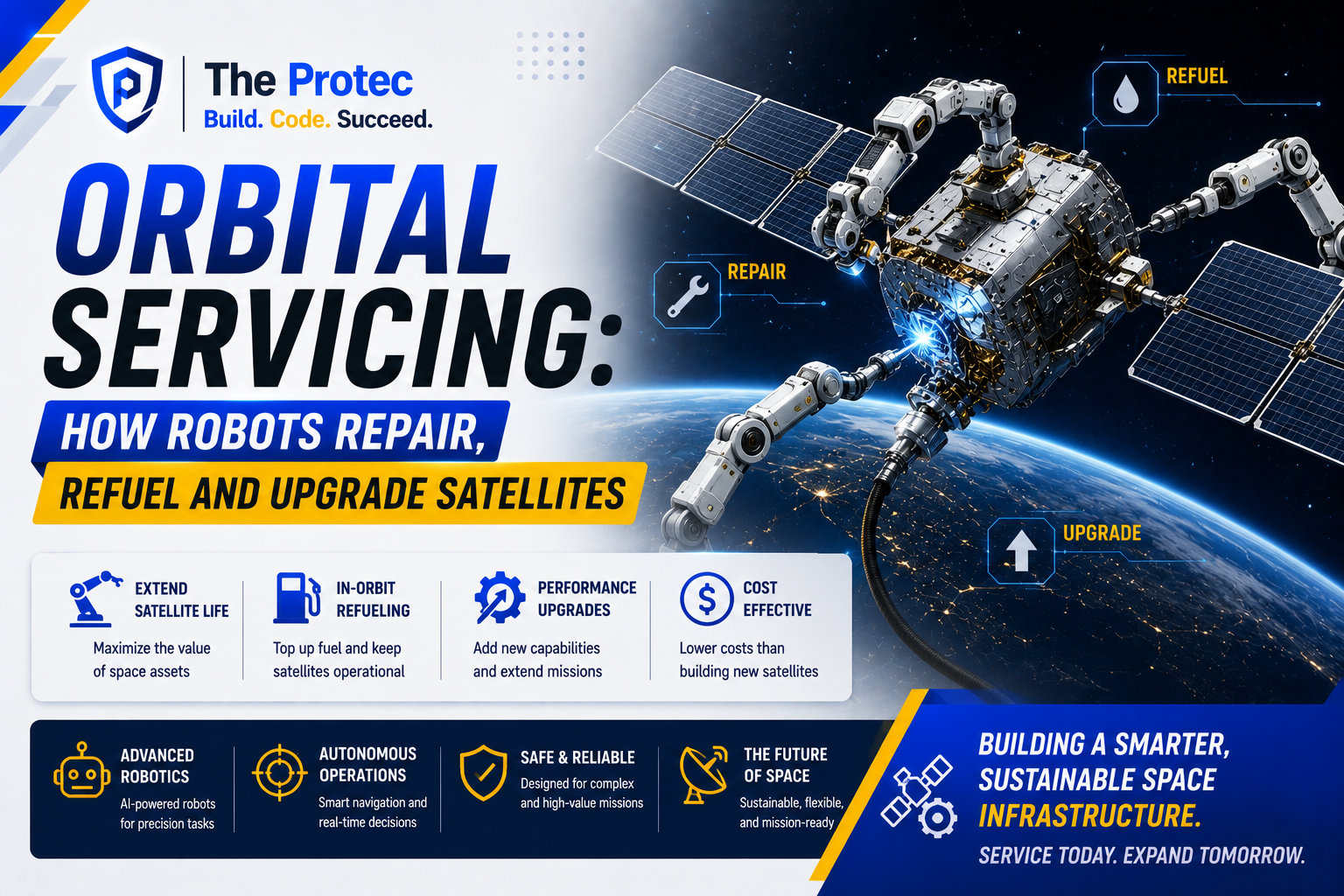
Orbital servicing could change that model. Instead of treating every satellite as disposable, operators could send robotic spacecraft to inspect damage, provide propulsion, transfer fuel, perform repairs or install new equipment. These satellite servicing robots would function as mobile mechanics, tow trucks and upgrade platforms hundreds or thousands of kilometers above Earth.
The concept is moving from theory toward an emerging market. Mission-extension vehicles have already docked with commercial satellites, while rendezvous demonstrations have shown increasingly precise approaches to unprepared objects. As of August 2026, however, routine repair and satellite refueling remain harder than simple life extension. Success depends on sophisticated space robotics, autonomous navigation, reliable docking hardware and a business case strong enough to justify each mission.
What Is Orbital Servicing?
Orbital servicing covers activities performed by one spacecraft to maintain, modify or support another object in space. A servicing vehicle may visit a single client or move between several satellites, depending on its fuel supply, tools and orbit.
Servicing is different from conventional ground support because physical intervention happens after launch. It is also broader than debris removal. A debris mission generally disposes of an uncontrolled object, while orbital servicing seeks to preserve or improve a useful asset.
Potential services include:
- Close-range inspection and diagnosis
- Attitude control and orbital repositioning
- Propellant transfer and tank replenishment
- Repair or replacement of failed components
- Installation of propulsion, computing or payload modules
- Safe relocation to a disposal orbit at end of life
These missions form part of the wider field known as in-space servicing, assembly and manufacturing, or ISAM. The NASA ISAM initiative describes technologies that could make spacecraft more maintainable and enable structures that are too large or complex to launch fully assembled.
What Satellite Servicing Robots Could Actually Do
Inspect Spacecraft at Close Range
Inspection is one of the most achievable near-term services. A robotic spacecraft can photograph solar arrays, antennas, thermal blankets, thrusters and other exterior hardware from angles unavailable to ground controllers. Infrared cameras may reveal abnormal heat, while lidar can generate a three-dimensional model of the client.
Such information helps operators determine whether an anomaly comes from impact damage, a deployment failure, surface degradation or another cause. Inspection can therefore deliver value without physical contact, but the servicer must still navigate safely around a client that may not have been designed for close approaches.
Reposition and Extend the Life of Satellites
A servicer can dock with a satellite and take over propulsion and attitude-control duties. This is especially attractive in geostationary orbit, where a communications satellite may still have functioning payloads but insufficient fuel for station-keeping.
Northrop Grumman’s Mission Extension Vehicles established an important commercial precedent. MEV-1 docked with Intelsat 901 in 2020, followed by MEV-2 servicing Intelsat 10-02 in 2021. Rather than opening fuel lines, each vehicle attached mechanically and acted as an external propulsion system. That avoided the plumbing risks of refueling an unprepared satellite while adding years of useful service.
Refuel Satellites in Space
True satellite refueling requires a secure fluid connection, leak-free transfer and precise management of pressure, temperature and propellant motion. The difficulty varies by fuel. Hydrazine is toxic and chemically hazardous, xenon is stored under high pressure, and cryogenic propellants can boil away unless tanks and lines are carefully controlled.
Older satellites lack standardized fuel ports accessible to robots. A servicer may need to cut insulation, remove caps and manipulate valves never intended for use after launch. Future spacecraft can simplify the task by incorporating robotic refueling interfaces from the start. Standard ports would let multiple providers serve compatible clients and could eventually support orbital fuel depots.
Repair Failed Hardware
Repair is more challenging because satellites are compact, delicate and highly customized. A robotic arm must work near flexible solar arrays, exposed wiring and thermal materials without generating debris or applying excessive force. Even a familiar action such as turning a bolt is difficult when the robot and client can both move in microgravity.
Early repair services are likely to focus on accessible problems: releasing a stuck mechanism, reconnecting a cable, patching insulation or replacing a modular unit. Deep internal repairs will remain rare unless manufacturers design spacecraft with standardized fasteners, tool paths and robot-accessible components.
Upgrade Payloads and Computing Systems
Upgrading may ultimately provide more value than fixing failures. A long-lived satellite could receive a new processor, sensor, communications package or propulsion module as technology improves. Operators would no longer need to replace an entire spacecraft merely because one payload became outdated.
This vision requires modular satellites with defined electrical, mechanical, thermal and data interfaces. It also raises cybersecurity questions: an installed module must be authenticated and integrated without creating a pathway for unauthorized control.
The Space Robotics Behind an Orbital Service Mission
Successful orbital servicing depends on several technologies working as one system. A capable robotic arm is not enough if the spacecraft cannot reach its client safely or determine exactly where to grasp it.
At long range, a servicer can use ground tracking, satellite navigation signals and radio measurements. As it closes in, optical cameras, lidar and sometimes radar estimate the client’s distance, orientation and motion. Navigation software combines these measurements into a continuously updated relative position.
The hardest target is a noncooperative spacecraft. It may have no navigation beacon or docking marker, and it could be tumbling. Sun glare, darkness, reflective surfaces and uncertain geometry can confuse sensors. Autonomous systems must recognize the object, predict its rotation and select a safe trajectory while obeying predefined keep-out zones.
Astroscale’s ADRAS-J demonstration around a discarded Japanese rocket stage illustrated the progress of this technology. Its close approaches and observation operations provided experience relevant to inspection, debris removal and future servicing of unprepared objects.
Docking, Capture and Stabilization
Cooperative satellites can carry docking plates or refueling ports. Unprepared satellites may instead be captured at a launch-adapter ring, engine nozzle or another structurally suitable feature. Robotic arms, grippers and compliant mechanisms help absorb small alignment errors at contact.
After capture, the combined vehicle must be stabilized. Controllers need to account for the client’s mass, fuel movement and flexible appendages before performing maneuvers. A poor estimate could cause oscillation, structural damage or loss of control.
Robotic Manipulation and Supervision
Communications delays make direct joystick control impractical for many fine tasks. Robots therefore need partial autonomy for grasping, tool alignment, collision avoidance and force control. Human operators remain important, but they supervise operations through planned steps, hold points and verified commands.
Digital twins can rehearse a procedure before execution. During the mission, force sensors and machine vision compare actual behavior with the simulation. If readings exceed safe limits, the robot can pause or retreat rather than continue blindly.
Why Orbital Servicing Is Economically Difficult
The technical case is compelling, but the financial case varies by satellite. A servicing mission must cost less than the value it preserves or creates. High-capacity geostationary communications satellites are attractive initial clients because they are expensive, generate revenue and occupy carefully managed orbital slots. Extending one asset’s life can defer the cost and risk of replacement.
Economics are less favorable for a small, inexpensive satellite in low Earth orbit. Unless one servicer can assist many clients, the rendezvous and mission-management costs may exceed the satellite’s value. Constellation operators may find servicing worthwhile when spacecraft share standardized interfaces and orbital planes, allowing repeatable operations at scale.
Providers must also solve a utilization problem. A robot that completes one mission and then sits idle is difficult to finance. Reusable servicers, replaceable fuel modules and multi-client routes could spread development and launch costs across more contracts.
Safety, Standards and Regulatory Challenges
Close-proximity operations carry consequences beyond the two spacecraft involved. A collision can create debris, interrupt commercial service or affect nearby orbital traffic. Servicers therefore need transparent operating procedures, dependable abort modes and coordination with satellite owners and tracking organizations.
Standardization is equally important. Common docking targets, fluid connectors and communication protocols would reduce custom engineering, but manufacturers and governments must agree on specifications without preventing competition. Industry groups such as the Consortium for Execution of Rendezvous and Servicing Operations develop recommended practices for responsible rendezvous and proximity operations.
Other unresolved issues include licensing, liability, insurance and export controls. The same spacecraft that can approach and move a disabled satellite could potentially interfere with one. That dual-use nature makes operator identity, consent, cybersecurity and verifiable behavior central to international trust.
What Comes Next for Satellite Servicing Robots?
The near-term market is likely to expand in stages. Inspection and propulsion assistance require fewer invasive actions, so they can mature before complex repair. Refueling should become more practical as compatible interfaces reach orbit, while modular upgrades will depend on spacecraft designed around servicing from the beginning.
Another important trend is the shift from one-off demonstrations to service infrastructure. Fuel depots, standardized ports, reusable tugs and replaceable mission-extension modules could create an orbital logistics network. In that environment, satellites would be maintained as long-lived platforms rather than sealed products abandoned after a single fuel load.
Frequently Asked Questions
Are satellites currently being serviced in orbit?
Yes, but the available services are limited. Commercial mission-extension vehicles have docked with geostationary satellites and supplied propulsion. Inspection and rendezvous demonstrations have also advanced rapidly. Routine robotic repair, open-market refueling and payload replacement are not yet broadly available.
Can any satellite be refueled?
No. Many existing satellites were not designed with accessible fuel interfaces, and their valves may be hidden beneath insulation or protective caps. Refueling an unprepared spacecraft requires specialized tools and carries additional risk. Satellites built with standardized ports will be much easier to serve.
Do orbital servicing robots operate autonomously?
They use a combination of autonomy and human supervision. Autonomous navigation handles rapid sensor updates, collision avoidance and precise relative motion. Ground teams approve major steps, monitor safety limits and intervene when conditions differ from the plan.
Which satellites benefit most from orbital servicing?
High-value satellites with healthy payloads, limited fuel and significant replacement costs are the strongest candidates. Geostationary communications spacecraft fit this profile. In low Earth orbit, servicing becomes more attractive when standardized fleets allow one robot to support multiple satellites efficiently.
Could servicing robots make space more sustainable?
Yes, if they extend useful life, prevent premature disposal and move failed spacecraft to safer orbits. However, servicers also add traffic and maneuvering activity. Sustainability depends on reliable systems, responsible operating practices and clear coordination among operators.
From Disposable Spacecraft to Maintainable Infrastructure
Orbital servicing represents a fundamental change in spacecraft design and operation. The first generation of services is proving that robots can approach, inspect, capture and reposition valuable assets. Refueling, repair and upgrades demand greater standardization and autonomy, but each successful mission lowers the barrier. As servicing-friendly satellites enter orbit, space robotics could transform satellites from disposable machines into maintainable infrastructure.