







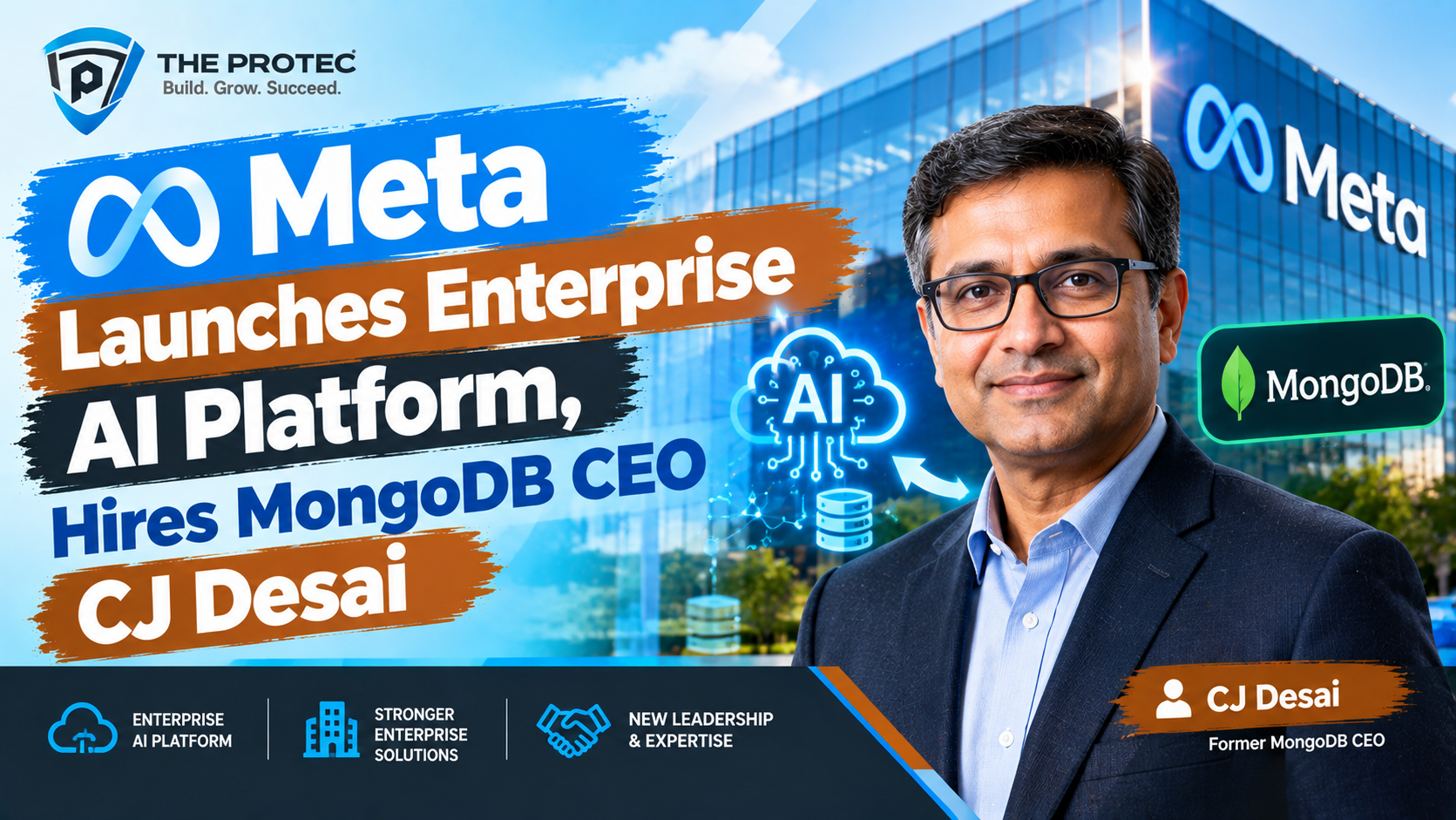
Meta is making a direct play for the enterprise AI market. The company has launched the Meta Enterprise Platform and recruited Chirantan “CJ” Desai, the MongoDB CEO known for scaling complex software businesses, to lead the initiative as Chief Enterprise Platform Officer. Desai will report directly to Mark Zuckerberg, highlighting how strategically important business AI has become to Meta.
The move brings several previously distinct technologies—including Muse, Meta Business Agent, Muse API and Muse Code—under a broader commercial strategy. Rather than offering isolated models or experimental features, Meta wants to give companies and developers a platform for building, deploying and managing AI agents across customer service, marketing, software development and internal operations.
Meta enterprise AI is therefore about more than adding chatbots to Facebook, Instagram or WhatsApp. It is an effort to convert Meta’s models, data infrastructure and agent technology into secure products that businesses can adopt at scale.
What Is the Meta Enterprise Platform?
The Meta Enterprise Platform is designed as the business-facing layer of Meta’s expanding AI stack. It combines models, agent capabilities, APIs, developer tools and administrative controls in a unified environment for organizations. The goal is to help enterprises move from limited AI experiments to applications that can operate reliably across real workflows.
That distinction matters. Businesses rarely buy a model alone. They need identity management, access policies, observability, data controls, integrations, deployment tooling and predictable support. The Meta AI platform is intended to package those requirements around the company’s core AI capabilities.
The platform also gives Meta a clearer way to serve customers beyond its advertising business. Meta AI for businesses can extend into customer engagement, developer productivity, commerce automation and specialized agents connected to enterprise systems. Updates published through the Meta Newsroom will be closely watched as the company defines availability, pricing and ecosystem partnerships.
How Muse and Meta Business Agent Fit the Strategy
Meta’s enterprise portfolio is built around several complementary products. Together, they cover content generation, customer interaction, software development and the creation of customized agents.
Meta Muse Enterprise
Meta Muse enterprise capabilities give organizations a foundation for producing and adapting multimodal content. Muse can help teams generate campaign assets, personalize creative variations, support product experiences and automate parts of content production. For global brands, that could mean creating localized material at a speed that traditional design workflows cannot match.
The enterprise opportunity depends on governance as much as generation quality. Companies need controls over approved data, brand standards, user permissions and generated outputs. Bringing Muse into the Meta Enterprise Platform allows Meta to surround the model with the management features required by legal, security and marketing teams.
Meta Business Agent
Meta Business Agent is the customer-facing component of the strategy. It enables businesses to deploy AI agents that can answer questions, recommend products, assist with transactions and support customers through conversational channels.
Meta has a natural distribution advantage here. Businesses already communicate with consumers through WhatsApp, Messenger and Instagram. A Meta Business Agent could connect those interactions with catalogs, support systems, order data and company knowledge, reducing the need to move customers into separate applications.
The larger ambition is to make agents useful beyond simple question-and-answer exchanges. Enterprise agents must understand context, call approved tools, complete multistep tasks and know when to transfer an interaction to a human employee. Those requirements make platform design and operational controls especially important.
Muse API and Muse Code
The Muse API gives developers programmable access to Meta’s AI capabilities. Instead of being restricted to a finished Meta application, companies can integrate models and agents into their own websites, internal tools, mobile apps and business processes.
Muse Code extends the platform into software engineering. Its potential use cases include code generation, documentation, testing, debugging, modernization and assistance with large codebases. Enterprise buyers will expect it to work within existing repositories and development environments while respecting source-code permissions and organizational policies.
Together, Muse API and Muse Code position Meta to compete for developer adoption. The strategy recognizes that enterprise AI platforms gain value when developers can customize them, connect them to proprietary systems and build reusable applications on top.
Why Meta Recruited MongoDB CEO CJ Desai
The appointment of CJ Desai signals that Meta understands the difference between advanced AI research and enterprise software execution. Building powerful models is only one part of winning business customers. Selling to large organizations requires dependable products, structured customer support, partner networks, security reviews and long-term account relationships.
As MongoDB CEO, Desai led a company whose database technology sits behind modern applications and AI workloads. That experience is relevant because successful AI agents depend on access to current, well-governed business data. His understanding of developers, cloud infrastructure and enterprise buying processes should help Meta turn technical assets into products that companies can deploy.
Desai also brings experience from Cloudflare and ServiceNow. At Cloudflare, his work was connected to globally distributed infrastructure, security and developer services. At ServiceNow, he helped scale a cloud software business built around enterprise workflows. Those roles exposed him to the operational expectations of chief information officers, technology leaders and security teams.
The official MongoDB company site illustrates the type of developer-led enterprise ecosystem Desai has helped shape. For Meta, his combination of product, infrastructure and go-to-market expertise fills a gap that cannot be addressed by AI researchers alone.
Security and Privacy Will Determine Enterprise Adoption
Meta’s consumer reach gives it enormous scale, but enterprise customers will evaluate the new platform through a different lens. Security, privacy, compliance and data ownership will be central to every serious purchasing decision.
Organizations will want clear answers about whether their prompts, files, code and agent interactions are used for model training. They will also expect encryption, role-based access, audit logs, retention settings and options for isolating sensitive workloads. Regulated industries may require regional data processing, formal certifications and contractual guarantees.
AI agents introduce additional risk because they can take actions rather than merely generate text. A poorly governed agent might retrieve restricted information, call the wrong system or complete a transaction without sufficient authorization. The Meta enterprise AI platform must therefore support granular permissions, tool-level policies and human approval for consequential tasks.
- Administrators need centralized identity, access and policy controls.
- Security teams need logs showing what an agent accessed and changed.
- Developers need evaluation tools for accuracy, safety and reliability.
- Legal teams need transparent policies covering customer data and model use.
- Business owners need controls for escalation, approvals and human oversight.
Meta’s ability to meet these expectations will determine whether the platform becomes core enterprise infrastructure or remains limited to lower-risk marketing and engagement use cases.
Meta’s Enterprise AI Strategy Expands the Competitive Field
The launch places Meta more directly against OpenAI, Anthropic, Google, Microsoft, Amazon and other providers building enterprise AI platforms. The Meta OpenAI Anthropic competition is no longer limited to benchmark performance. It now covers agent frameworks, developer ecosystems, cloud distribution, security, pricing and access to business users.
Meta has several advantages. It operates global communication platforms, maintains large-scale AI infrastructure and has promoted a more open model ecosystem than some competitors. Its products also connect businesses with billions of consumers, creating opportunities to deploy AI where commercial conversations already happen.
However, competitors have meaningful strengths. Microsoft and Amazon have deep cloud relationships with enterprises. Google combines cloud services with productivity software and AI research. OpenAI has strong developer recognition, while Anthropic has built credibility around enterprise use and model safety.
Meta’s response is to unite consumer distribution, models, agents and development tools under a dedicated enterprise organization. Reporting directly to Zuckerberg may also help Desai coordinate teams across Meta that previously developed AI capabilities for different products.
What the Platform Means for Businesses and Developers
For businesses, the immediate value of the Meta Enterprise Platform may be its ability to connect customer engagement with generative AI. A retailer could deploy an agent across WhatsApp and Instagram, use approved inventory data to answer product questions, and hand complex cases to human staff. A marketing organization could use Muse to create variations while enforcing brand rules and approval workflows.
Developers gain another major platform for building agent-based applications. The Muse API could support custom workflows, while Muse Code may accelerate engineering tasks. If Meta provides strong documentation, stable APIs and broad integration options, its ecosystem could grow quickly.
Companies should still begin with focused use cases. The best candidates have measurable outcomes, reliable source data and clearly defined boundaries. Customer support triage, product discovery, internal knowledge retrieval and developer assistance are more practical starting points than giving autonomous agents unrestricted access to critical systems.
Execution Is Meta’s Biggest Test
Meta has the technical resources to become a major enterprise AI provider, but execution will decide the outcome. Enterprise customers expect product road maps, service commitments, migration support and consistent account management. They also expect platforms to remain stable while underlying models evolve rapidly.
Desai’s challenge is to create that enterprise discipline without slowing Meta’s pace of AI development. He must also establish trust among companies that may know Meta primarily as a consumer social media and advertising business.
If the company delivers strong governance, dependable integrations and useful AI agents, Meta AI business products could become an important new growth engine. More broadly, the launch shows that the next phase of enterprise AI will be shaped not only by who builds the strongest models, but by who turns those models into secure, manageable systems that businesses can use every day.
Frequently Asked Questions
What is the Meta Enterprise Platform?
The Meta Enterprise Platform is Meta’s unified environment for delivering AI models, agents, APIs, coding tools and administrative controls to businesses and developers. It includes technologies such as Muse, Meta Business Agent, Muse API and Muse Code.
Who is leading Meta’s enterprise AI platform?
Chirantan “CJ” Desai is leading the organization as Chief Enterprise Platform Officer and reports directly to Mark Zuckerberg. The CJ Desai Meta Enterprise Platform appointment brings experience from MongoDB, Cloudflare and ServiceNow into Meta’s enterprise AI strategy.
Why did Meta hire MongoDB CEO CJ Desai?
Meta hired Desai for his experience scaling developer platforms, cloud infrastructure and enterprise software. His background can help Meta add security, governance, integrations, customer support and go-to-market capabilities around its AI technology.
How does Meta plan to compete with OpenAI and Anthropic?
Meta plans to compete through an integrated stack combining models, multimodal generation, business agents, developer APIs and access to widely used communication platforms. Its success will depend on product reliability, data protection, enterprise partnerships and the usefulness of its agents in real business workflows.