








Contents
- 1 Why Quantum Computing Is Back on Investors’ Radar
- 2 What Makes Quantum Computing an Investment Theme
- 3 Quantum Computing Stocks Investors Are Watching Closely
- 4 Quantum Startups Investors Should Know
- 5 How Investors Evaluate Quantum Computing Stocks
- 6 The Biggest Trends Shaping Future Technology Investments
- 7 Risks Investors Should Not Ignore
- 8 How to Build a Smarter Quantum Investment View
- 9 FAQ: Quantum Computing Stocks and Startups
- 10 Conclusion
Why Quantum Computing Is Back on Investors’ Radar
Quantum computing has spent years in the “promising but premature” category, but the conversation has changed. As of May 2026, investors are no longer asking whether quantum systems will matter eventually. They are asking which companies are building the most defensible position now, which approaches are most likely to scale, and where early commercial demand may appear first. That shift has made quantum computing stocks and quantum startups a serious topic for anyone tracking future technology investments.
The appeal is straightforward: if quantum machines can solve certain classes of problems faster or more efficiently than classical computers, the market opportunity could be enormous. Applications in materials science, drug discovery, logistics, cybersecurity, finance, and optimization all carry multibillion-dollar potential. But the path from scientific achievement to revenue is uneven, and that is exactly what makes this area both exciting and risky.
For investors, the challenge is not simply identifying the next breakthrough. It is distinguishing between companies with real technical progress, sustainable funding, and an addressable market versus those benefiting mainly from hype. The most closely watched names today tend to fall into three groups: public quantum computing stocks, private quantum startups with unique architectures, and larger technology companies building quantum capabilities as part of broader platforms.
What Makes Quantum Computing an Investment Theme
Quantum computing is not just another hardware cycle. It is a new computational paradigm. Classical computers use bits, which are either 0 or 1. Quantum computers use qubits, which can represent combinations of states and can be linked through entanglement. In theory, this creates a path to solving specific problems that are intractable for conventional systems.
That theoretical advantage is why investors care. The upside is not incremental improvement; it is potential category creation. If even a few use cases cross the threshold into practical advantage, the companies controlling the underlying hardware, software, error correction, and cloud access layers could become foundational technology providers.
Still, quantum investing is not the same as buying into a mature semiconductor or software market. Many companies are still pre-scale, revenue is often modest compared with valuations, and milestones can be highly technical rather than financial. That means investors should focus on signals such as qubit quality, error correction progress, engineering talent, partnerships, government contracts, and the strength of a company’s roadmap.
Quantum Computing Stocks Investors Are Watching Closely
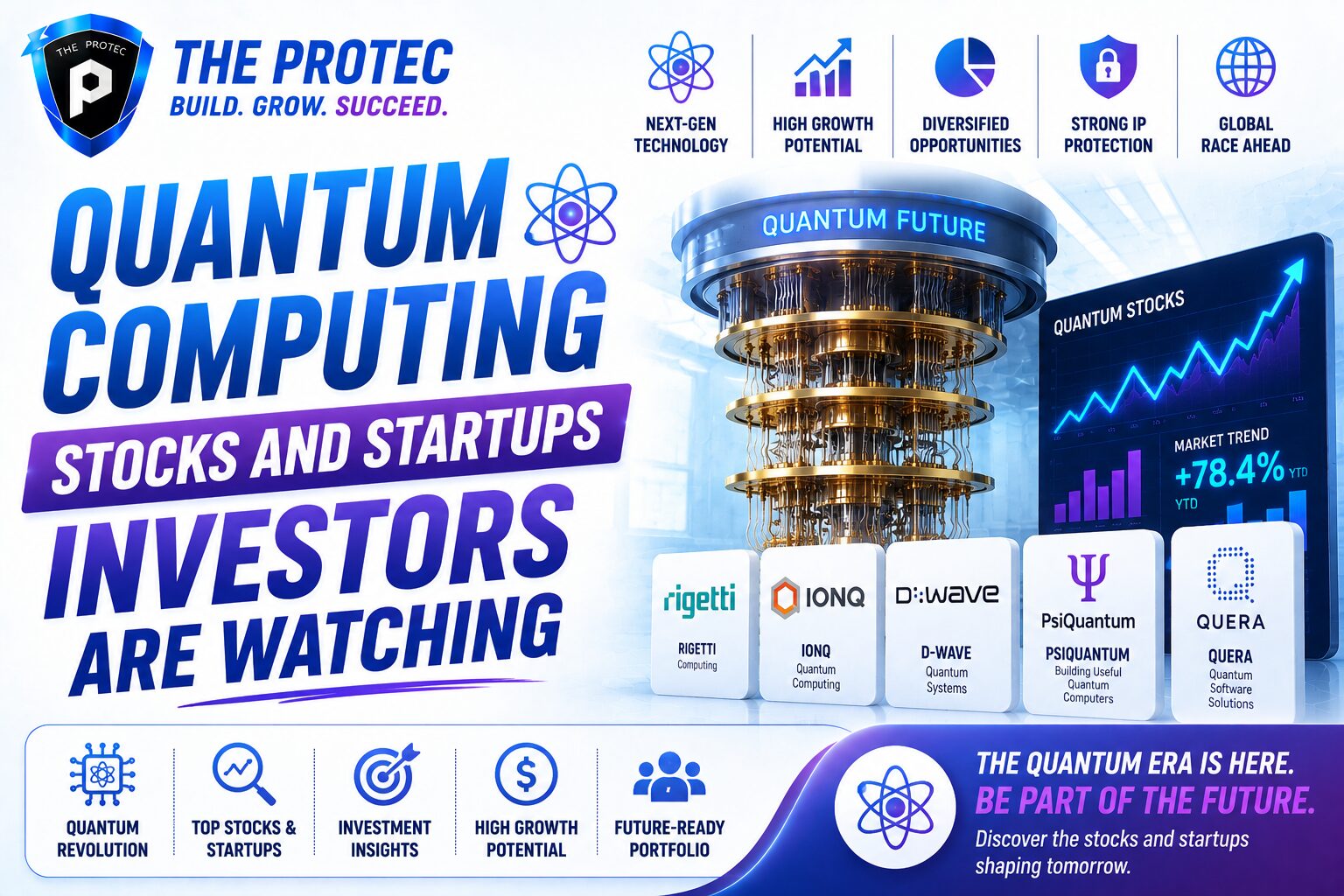
Publicly traded quantum computing stocks remain a small universe, but they are closely followed because they offer direct exposure to the sector. These names are often volatile, yet they serve as the clearest way for public market investors to express a view on the future of quantum computing.
1. IonQ
IonQ remains one of the best-known pure-play quantum computing stocks. The company is associated with trapped-ion quantum computing, a method that has attracted attention because of its high-fidelity operations and strong coherence properties. Investors like IonQ because it has managed to build a recognizable brand, secure cloud availability through major platforms, and maintain visibility in enterprise and government circles.
What keeps IonQ on watchlists is not just the hardware story. It is the company’s push to position itself as a full-stack quantum provider, with software, networking, and access models layered on top of its systems. That broader approach matters because monetization in quantum may come from a mix of access, services, and eventual application development rather than hardware alone.
2. Rigetti Computing
Rigetti is another pure-play name that investors track for its superconducting quantum computing approach. Superconducting qubits are widely studied in the field, and Rigetti has focused on building a modular architecture that could improve scalability over time. The company tends to attract investor attention when it announces hardware milestones, performance improvements, or strategic partnerships.
Rigetti’s appeal is that it sits in the middle of the quantum race: not as large as the tech giants, but with enough technical ambition to remain a credible contender. Investors often view Rigetti as a higher-risk, higher-reward way to participate in the sector.
3. D-Wave Quantum
D-Wave occupies a unique position because it has long emphasized quantum annealing, a different approach from gate-based quantum computing. While some investors debate how broadly useful annealing will be compared with universal quantum systems, D-Wave has continued to generate attention through commercial deployments, optimization use cases, and software offerings.
For investors, D-Wave matters because it brings an important question to the front: does the market reward practical near-term quantum applications even if the technology path differs from the most discussed long-term architectures? The answer could shape how future technology investments are allocated across the sector.
4. IBM
IBM is not a pure-play quantum stock, but it remains one of the most consequential public companies in the field. Its quantum computing program has been important for years, and its role in offering cloud-accessible quantum systems, software tools, and research leadership keeps it highly relevant.
Large-cap exposure like IBM offers a different investment profile. Instead of betting on quantum as the company’s main business, investors gain exposure to quantum as part of a diversified technology platform. This can reduce some of the binary risk associated with smaller quantum startups while still preserving upside from the sector’s long-term growth.
5. Alphabet and Microsoft
Alphabet and Microsoft are watched closely because they are deeply involved in the broader quantum ecosystem. Their quantum efforts are paired with cloud infrastructure, AI, and enterprise software ecosystems, which gives them multiple routes to monetize quantum advancements over time. Both companies also benefit from the option value of participating in a potentially transformative technology without depending on it for near-term earnings.
For many investors, these names are attractive because they offer indirect quantum exposure through diversified balance sheets. If quantum computing matures more slowly than expected, the downside impact on these companies is limited. If it accelerates, they are well positioned to capture demand through cloud platforms, developer tooling, and enterprise integration.
Quantum Startups Investors Should Know
While public stocks get most of the headlines, many of the most interesting developments are happening in private quantum startups. These companies are often experimenting with specialized qubit designs, control systems, error correction, or software layers that may become crucial as the market evolves.
PsiQuantum
PsiQuantum is one of the most closely watched quantum startups because of its ambitious approach to building a fault-tolerant machine using photonic qubits and semiconductor manufacturing principles. That combination appeals to investors who believe scalability will depend on manufacturing discipline as much as physics breakthroughs.
The company’s strategy is notable because it aims at a much larger endgame than many early-stage rivals. Rather than focusing only on demonstrating a few useful qubits, PsiQuantum has long emphasized the architecture required for industrial-scale systems. If its technical assumptions hold, it could become one of the most important names in future technology investments tied to quantum.
Quantinuum
Quantinuum is widely followed because it combines advanced trapped-ion technology with software, applications, and enterprise-oriented capabilities. Its integrated approach gives investors a clearer path to commercialization than companies that focus solely on hardware. It also benefits from the broader credibility of its parent ecosystem and strategic partnerships.
Quantinuum’s significance lies in the way it bridges research and business. Investors watching quantum computing stocks often look for signs that a startup can turn technical depth into software tools, cloud access, cryptography solutions, or application-specific services. Quantinuum is one of the clearest examples of that model.
Xanadu
Xanadu has gained attention for photonic quantum computing and for building a robust software stack that supports both research and developer engagement. Its PennyLane platform is especially important because software ecosystems can become powerful multipliers in emerging technologies. In markets like quantum, the company that wins developer mindshare can become a crucial layer in the value chain.
Investors track Xanadu not only for its hardware progress but also for its ability to shape how quantum algorithms are developed and tested. That makes it an important startup to watch if you believe the software layer may be just as valuable as the hardware layer over time.
Atom Computing
Atom Computing has drawn strong interest for its neutral-atom approach, which many believe could offer a promising route to scalability. Neutral-atom systems are compelling because they may support large qubit counts and flexible system design. In a field where scaling is the central challenge, that is a major reason investors pay attention.
The company is also part of a broader trend: quantum startups are increasingly judged by whether they can show not just scientific novelty, but a credible path toward larger, more useful systems. Atom Computing’s progress has made it one of the key names in that conversation.
QuEra Computing
QuEra is another neutral-atom startup that has become a favorite among quantum watchers. Its work sits at the intersection of advanced hardware and practical experimentation, and it has been associated with high-profile research demonstrations that help validate the neutral-atom pathway.
For investors, QuEra matters because it represents a class of startups focused on a potentially scalable architecture without losing sight of immediate scientific relevance. That balance is valuable in a market where technical credibility is often the strongest indicator of future commercial potential.
How Investors Evaluate Quantum Computing Stocks
Because the sector is still early, traditional valuation metrics only tell part of the story. Investors need a framework that blends technical assessment with market analysis. The following factors are often more important than near-term revenue when evaluating quantum computing stocks and startups.
- Qubit quality and coherence: Better physical performance can reduce errors and improve the usefulness of the system.
- Error correction progress: Fault tolerance remains one of the largest barriers to commercialization.
- Scalability of the architecture: A system that works in the lab but cannot scale is unlikely to become a winner.
- Enterprise and government partnerships: These can validate demand and support funding.
- Cloud accessibility: Easier access for developers and customers can expand adoption.
- Patent portfolio and IP depth: In a frontier market, intellectual property can become a major moat.
- Balance sheet strength: Many startups will need significant capital before commercialization.
Investors should also pay attention to whether a company is focused on a single path or building a platform. Pure hardware plays may offer more upside if they crack scaling, but platform companies may have better chances of creating early revenue through software, cloud access, and enterprise services.
The Biggest Trends Shaping Future Technology Investments
Several trends are shaping how the market thinks about quantum computing stocks and quantum startups right now. First, there is a growing focus on hybrid workflows that combine classical and quantum systems. In many real-world use cases, quantum machines are expected to augment rather than replace classical infrastructure. That means cloud providers, software companies, and systems integrators could all capture value.
Second, interest in quantum-safe security continues to rise. Even before large-scale fault-tolerant quantum computers arrive, organizations are preparing for cryptographic risk. This has created a parallel market for post-quantum encryption and migration tools, which can indirectly benefit the quantum ecosystem.
Third, government support remains a major catalyst. Public funding, national quantum initiatives, and defense-related research continue to accelerate development. The companies best positioned to win contracts, research collaborations, or strategic funding often gain credibility well beyond what their current revenue would suggest.
Finally, AI and quantum are increasingly discussed together. Investors are beginning to ask whether quantum systems might eventually accelerate machine learning, optimization, or simulation tasks that are hard for AI infrastructure today. While that overlap is still early, it reinforces the idea that quantum may become part of a broader next-generation computing stack.
Risks Investors Should Not Ignore
Despite the excitement, quantum investing remains highly speculative. The first risk is technical delay. Progress can be real without being commercially useful, and timelines can stretch much longer than expected. The second risk is capital intensity. Building advanced quantum hardware is expensive, and companies may need repeated fundraising before they reach meaningful scale.
There is also a valuation risk. Some names in the sector can trade on momentum and headlines rather than fundamentals, which makes them vulnerable to sharp corrections. Competition is another concern, especially because larger companies have the resources to absorb talent, buy startups, or outspend smaller rivals.
Investors should also remember that not every quantum architecture will prove equally useful. Some approaches may dominate particular applications while others fade. That uncertainty makes diversification especially important in this segment of future technology investments.
How to Build a Smarter Quantum Investment View
A practical approach is to treat quantum as a basket theme rather than a single-stock thesis. Public investors may want a mix of pure-play exposure and diversified technology leaders. That way, they can participate in upside from sector breakthroughs while limiting the damage if one technical route falls behind.
It also helps to follow milestones rather than headlines. A new prototype, a partnership announcement, or a government contract matters most when it meaningfully advances scalability, reliability, or commercialization. If an update does not change the company’s technical or business trajectory, it may be less important than it appears.
For long-term investors, patience matters. Quantum computing is likely to be a multi-phase buildout, with early value captured in cloud access, software, consulting, and security before truly transformative hardware becomes mainstream. The investors who understand that progression are better positioned to separate genuine opportunity from short-term noise.
FAQ: Quantum Computing Stocks and Startups
Are quantum computing stocks a good long-term investment?
They can be, but only for investors who understand the risks. Quantum computing stocks offer exposure to a potentially transformative technology, but most companies in the space are still early, volatile, and far from mature profitability.
Which quantum startups are investors watching most closely?
Among the most watched names are PsiQuantum, Quantinuum, Xanadu, Atom Computing, and QuEra Computing. Each brings a different technical approach, which is why investors monitor them for both scientific progress and commercialization potential.
What should I look for before investing in quantum computing stocks?
Look for evidence of technical progress, scalability, partnerships, funding strength, and a credible commercialization path. For public companies, watch how much of the business is actually tied to quantum versus broader operations.
Will quantum computing replace classical computing?
No. Quantum computing is expected to complement classical computing, not replace it. The most likely outcome is a hybrid environment where quantum systems handle specialized tasks while classical systems remain dominant for general-purpose computing.
Conclusion
Quantum computing is still an emerging field, but it has matured enough to become a serious investment category. The most closely watched quantum computing stocks and quantum startups are no longer just science projects; they are companies building hardware, software, and access models that could shape the next era of computing. For investors, the opportunity is real, but so is the uncertainty.
The smartest approach is to focus on fundamentals that matter in frontier technology: architecture, scalability, partnerships, and capital discipline. Whether you prefer pure-play quantum computing stocks or diversified leaders with quantum exposure, this is one of the most compelling future technology investments to monitor closely.
As the sector advances, the winners may not be the companies making the loudest claims. They may be the ones quietly solving the hardest engineering problems and building ecosystems that can survive the long road to practical quantum advantage.