







Introduction
The race to deliver faster, more reliable internet is shaping the way people and businesses connect globally. Two dominant technologies, 5G and satellite internet, are at the forefront of this transformation. While both promise to revolutionize connectivity, they come with distinct features, advantages, and challenges. Understanding the nuances between 5G vs satellite internet especially innovations like Starlink internet is essential for anticipating which technology will power the future internet landscape.
Understanding 5G and Satellite Internet
What is 5G?
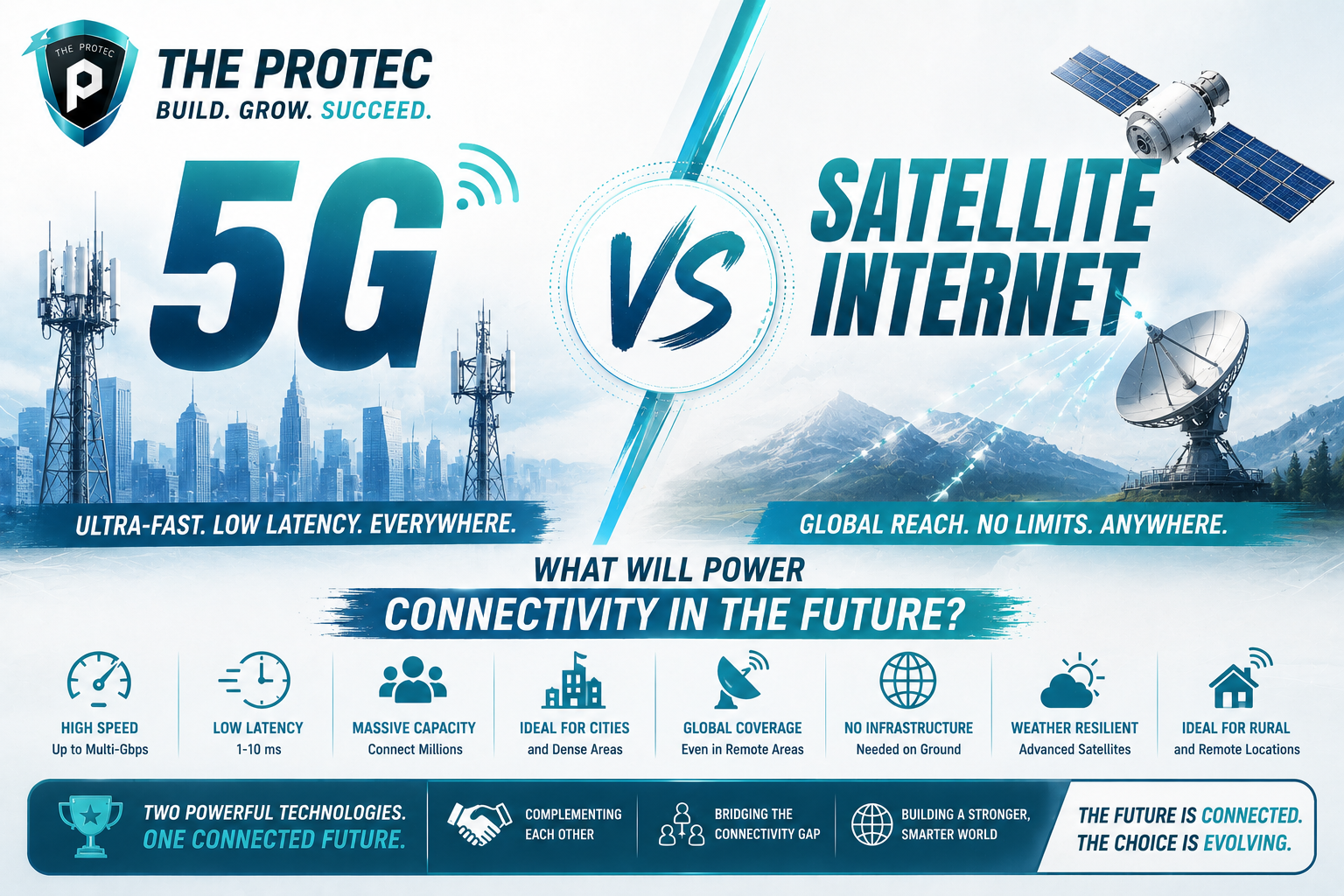
5G, or fifth-generation cellular network technology, builds on advances made by its predecessors to deliver ultra-fast data rates, minimal latency, and massive device connectivity. Unlike earlier networks, 5G employs millimeter waves, small cells, and advanced antenna technology to offer multi-gigabit speeds, even in densely populated areas.
What is Satellite Internet?
Satellite internet transmits data between ground stations and satellites orbiting the Earth. Recent advancements, such as low Earth orbit (LEO) satellite constellations exemplified by Starlink internet have drastically reduced latency and increased bandwidth, making satellite internet a viable alternative to traditional broadband, especially in remote regions.
Speed: How Fast Can They Go?
Speed is often the decisive factor in choosing an internet service. 5G offers blistering speeds ranging from 100 Mbps up to 10 Gbps under optimal conditions. This capability supports applications like augmented reality, virtual reality, and 4K streaming with ease.
Starlink and other LEO satellite services have pushed satellite internet speeds beyond expectations. Starlink typically provides download speeds between 150 Mbps to 250 Mbps, with uplink speeds around 20-40 Mbps. Though impressive for satellite services, these speeds generally don’t match the highest 5G capabilities but remain adequate for many applications.
Traditional geostationary satellites lag behind both but are less relevant given recent LEO innovations.
Availability and Coverage: Where Do They Work Best?
5G Availability
5G networks require dense infrastructure due to their reliance on high-frequency bands that have shorter range and limited building penetration. Urban and suburban areas generally experience extensive 5G coverage. However, rural and remote regions often lack 5G service due to cost and logistical challenges of installing many small cells.
Satellite Internet Coverage
Satellite internet inherently bypasses terrestrial infrastructure limitations. Constantly orbiting satellite constellations can deliver connectivity virtually anywhere on Earth, including isolated rural areas, ships at sea, and aircraft in flight. For populations underserved by fiber and 5G networks, satellite internet serves as a critical lifeline.
Long-Term Scalability: Supporting Future Demands
Scalability refers to a technology’s ability to evolve and expand capacity to meet growing demand. 5G networks are designed to be scalable by leveraging network slicing, edge computing, and dynamic spectrum sharing. This positions 5G to support a booming ecosystem of Internet of Things (IoT) devices, smart cities, and autonomous vehicles, requiring ultra-low latency and high reliability.
Satellite internet scalability is tied closely to satellite deployment pace and ground station infrastructure. Starlink’s continual satellite launches increase capacity and global bandwidth, but limitations persist, such as orbital congestion and signal interference. Furthermore, the lifespan of satellites necessitates periodic replacement and network upgrades, which are complex and costly.
Key Advantages and Challenges
- 5G Advantages: Extremely high speeds, low latency, excellent for urban centers, supports dense device ecosystems.
- 5G Challenges: Limited rural reach, costly infrastructure upgrades, and challenges penetrating buildings.
- Satellite Internet Advantages: Global and remote coverage, rapidly improving speeds with LEO constellations, less reliance on ground infrastructure.
- Satellite Internet Challenges: Higher latency than 5G, weather susceptibility, expensive user terminals, orbital debris concerns.
Which Technology Will Dominate the Future?
Rather than viewing 5G vs satellite internet as an either-or proposition, the future connectivity landscape will likely rely on a synergistic blend of both technologies. Urban and suburban regions will benefit from the ultra-fast and reliable 5G infrastructures, supporting a proliferation of smart and connected devices.
Meanwhile, satellite internet, especially through initiatives like Starlink, will fill the digital divide by bringing dependable internet to rural, remote, and underserved populations. Additionally, satellite connectivity is poised to become indispensable for mobility scenarios such as maritime, aviation, and emergency response where traditional coverage is unattainable.
Emerging Trends Shaping the Connectivity Horizon
Several developments are accelerating evolution in both arenas:
- Integration of 5G and Satellite Networks: Hybrid models are in development where satellite systems backhaul data to 5G networks, enhancing coverage and resilience.
- Advances in Satellite Technology: Next-gen satellites promise reduced latency, increased bandwidth, and AI-driven network management.
- Regulatory Support: Governments worldwide are allocating spectrum and investing in infrastructure to foster competitive, high-quality internet services.
Frequently Asked Questions
Is 5G faster than satellite internet?
Generally, 5G offers faster peak speeds and lower latency compared to satellite internet. However, advanced LEO satellite constellations like Starlink offer speeds competitive with some 5G deployments, especially where 5G infrastructure is limited.
Can satellite internet replace 5G?
Satellite internet complements rather than replaces 5G. It is ideal for delivering internet where 5G infrastructure is impractical. For dense urban environments requiring ultra-low latency and high throughput, 5G remains superior.
What is Starlink internet and how does it impact the future?
Starlink internet is a satellite service developed by SpaceX utilizing thousands of LEO satellites to provide high-speed broadband worldwide. It has significantly reduced satellite internet latency and increased speeds, helping close connectivity gaps and influencing satellite internet’s role in future internet technology.
Conclusion
The future of internet connectivity rests on a dynamic interplay between 5G and satellite internet technologies. Speed, availability, and scalability criteria reveal that neither solution is universally superior. Instead, each excels in different contexts.
As 5G networks continue to expand and satellite constellations mature, consumers and industries will enjoy unprecedented connectivity choices. Ultimately, understanding the strengths and limitations of 5G vs satellite internet equips us to navigate and harness the future internet technology landscape effectively.