








Why Edge Computing Is Growing Faster Than Traditional Cloud Services
For more than a decade, cloud computing has been the default answer to digital transformation. It gave businesses elastic infrastructure, lower upfront costs, and access to powerful services without owning large data centers. But as applications have become more interactive, more distributed, and more dependent on real-time decisions, a new model has been rising quickly: edge computing.
The reason is simple. Many modern workloads cannot afford the round trip to a distant cloud region. Whether it is a smart factory, a retail checkout system, a connected vehicle, an AI camera, or an online game, businesses increasingly need computation closer to users and devices. That shift is driving demand for low latency infrastructure and pushing edge computing ahead of traditional cloud services in several high-growth sectors.
This does not mean cloud computing is fading. It remains essential for storage, orchestration, analytics, and long-term scalability. But the center of gravity is changing. Organizations are discovering that the best architecture is no longer “cloud first” in every case. Instead, it is often “edge where it matters, cloud where it helps.”
What Edge Computing Actually Changes
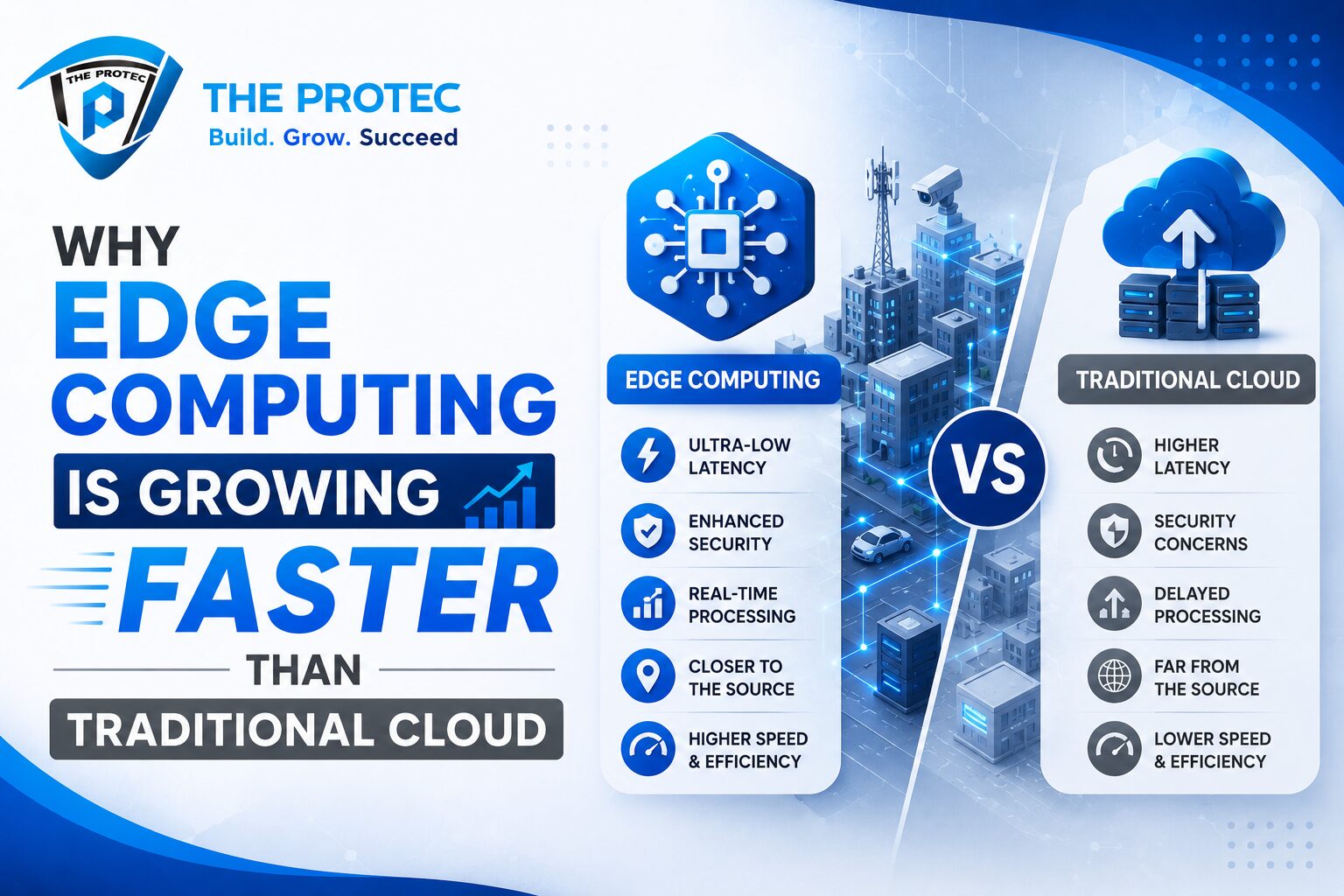
Edge computing moves data processing away from centralized cloud regions and closer to the point where data is created or consumed. That edge can be a device, a gateway, a local server, a micro data center, or a nearby regional node. The goal is to reduce the distance between user action and system response.
Traditional cloud computing works well when latency is not critical. A user uploads a file, an application runs in a remote region, and the result returns a moment later. Edge computing is different because it supports immediate interaction. It can analyze sensor data locally, trigger automation in milliseconds, or make AI decisions without sending every packet across long network paths.
This is especially important as enterprises adopt more Internet of Things systems, computer vision, augmented reality, industrial automation, and AI-powered services. These workloads produce enormous volumes of data, and not all of it should travel to the cloud. Processing locally reduces congestion, improves speed, and often lowers cost.
The Main Reasons Edge Computing Is Growing Faster
1. Low latency has become a business requirement
Customers now expect instant experiences. A delay of even a few hundred milliseconds can affect shopping conversions, game performance, telemedicine interactions, or machine control. In industries like manufacturing and autonomous systems, latency is not just a performance issue; it can affect safety and reliability. Low latency infrastructure is therefore becoming a competitive necessity rather than a technical luxury.
Edge computing solves this by keeping processing near the source of activity. The closer the compute is to the user or device, the faster the response. This is one of the biggest reasons edge deployments are expanding faster than many traditional cloud-only strategies.
2. Data volumes are exploding
Modern organizations are generating far more data than they can efficiently move to a central cloud. High-resolution cameras, industrial sensors, point-of-sale systems, wearable devices, and machine telemetry all create constant streams of information. Sending everything to the cloud increases bandwidth costs, creates bottlenecks, and can slow down decision-making.
Edge computing allows businesses to filter, compress, classify, or act on data locally. Instead of transmitting every raw data point, only the most relevant insights are sent to the cloud for long-term storage or deeper analytics. That model is more scalable and more economical.
3. AI workloads are moving closer to where data is generated
One of the strongest accelerators for edge adoption is the rise of real-time AI inference. While training large models usually still happens in the cloud or specialized data centers, inference increasingly happens at the edge. This is especially true for computer vision, speech recognition, anomaly detection, and predictive maintenance.
Businesses want AI that can react immediately, even when connectivity is limited or inconsistent. Edge AI reduces dependence on the cloud and supports use cases such as on-device personalization, retail analytics, smart logistics, and industrial inspection. As AI becomes embedded into more products and workflows, edge computing becomes the natural delivery model for many of those decisions.
4. Network costs and bandwidth efficiency matter more than ever
Cloud services are powerful, but transporting large amounts of data to and from the cloud is not free. For companies with distributed operations, bandwidth can become a major operating expense. This is particularly true for video-heavy applications, sensor networks, and global consumer platforms.
By processing data at the edge, organizations can reduce unnecessary data transfer and keep network usage under control. That is one reason edge architectures are becoming attractive not only for performance, but also for total cost optimization. In many cases, the financial argument is as compelling as the technical one.
5. Reliability improves when systems can operate locally
Not every business can assume continuous high-quality connectivity. Remote facilities, shipping routes, stores with intermittent links, and industrial sites can all experience network instability. If an application depends entirely on a remote cloud service, even a brief outage can cause disruption.
Edge computing provides a local layer of resilience. Critical operations can continue even if the cloud connection drops temporarily. Data can be buffered, rules can be executed locally, and systems can sync later. For industries where uptime matters, this reliability advantage is a major reason edge adoption is gaining momentum.
How Businesses Are Bringing Computation Closer to Users
Across industries, companies are redesigning their infrastructure so that computation happens at the point of need rather than far away in a centralized region. This shift is visible in several practical patterns.
- Retail: Stores use edge nodes for self-checkout, inventory monitoring, loss prevention, and localized customer analytics.
- Manufacturing: Plants process sensor and machine data on-site to detect defects, predict maintenance needs, and keep production lines running.
- Healthcare: Hospitals and clinics use low latency infrastructure for imaging, device coordination, and time-sensitive monitoring.
- Transportation: Fleets and logistics platforms analyze location and sensor data closer to vehicles and hubs for faster routing decisions.
- Media and gaming: Edge delivery supports low-delay streaming, immersive experiences, and smoother multiplayer interactions.
- Smart cities: Local processing helps traffic systems, public safety tools, and environmental sensors respond in real time.
These deployments show a common pattern: the more immediate the decision, the more valuable edge computing becomes. Businesses are not replacing cloud computing. They are shifting the right tasks to the right layer.
Why Traditional Cloud Services Still Matter
It is important to be clear that cloud computing is not becoming obsolete. In fact, edge and cloud are increasingly complementary. The cloud remains the best place for large-scale storage, centralized policy management, data warehousing, model training, and cross-organization analytics. It also provides the tooling and orchestration needed to manage distributed systems at scale.
What is changing is the balance of responsibility. The cloud is evolving into a control plane and intelligence hub, while the edge handles latency-sensitive, bandwidth-heavy, or locality-specific tasks. This hybrid architecture gives organizations the flexibility to optimize each workload for its real-world requirements.
In other words, edge computing is growing faster not because cloud is failing, but because cloud alone is no longer enough for the most demanding modern applications.
The Role of 5G, Wi-Fi 7, and Modern Connectivity
Connectivity improvements are also accelerating edge adoption. Faster wireless standards and improved private network technologies make it easier to deploy distributed systems without sacrificing performance. For example, private 5G and newer Wi-Fi environments can support dense device populations and reliable local communication, which is ideal for factories, campuses, and large retail sites.
At the same time, better orchestration tools and container platforms have made it much easier to manage workloads across many edge locations. Businesses can now deploy software consistently across hundreds or thousands of sites, update it centrally, and monitor performance from a unified dashboard. That operational maturity is removing one of the biggest historical barriers to edge adoption.
Security and Compliance Are Pushing Workloads to the Edge
Data sovereignty, privacy regulations, and industry-specific compliance rules are becoming more complex. For some organizations, moving all raw data to a central cloud is not ideal or even permissible. Edge computing can help by keeping sensitive information local and transmitting only the minimum necessary data to centralized systems.
This is particularly relevant for sectors such as healthcare, finance, government, and critical infrastructure. Local processing can reduce exposure, simplify compliance workflows, and limit the amount of sensitive data traveling across networks. When combined with strong encryption, identity controls, and zero trust practices, edge architectures can improve both governance and responsiveness.
For a broader perspective on distributed systems and cloud-edge architectures, resources from Cloudflare and Cisco offer useful overviews of how edge computing works in practice.
Why Edge Computing Is Winning in AI, IoT, and Real-Time Apps
Three areas in particular are fueling the rapid rise of edge computing: AI, IoT, and real-time applications.
AI: Businesses increasingly need inference close to the user to support personalization, automation, vision systems, and decision support. Edge deployment makes AI faster, cheaper, and often more private.
IoT: Sensors and connected devices generate constant streams of data. Processing that data locally reduces traffic and enables instant action when thresholds are crossed.
Real-time apps: From collaboration tools to industrial dashboards, applications that depend on immediate feedback benefit from low latency infrastructure. Even small delays can hurt the user experience or operational efficiency.
These workloads are not niche anymore. They are becoming mainstream, which is why edge computing is gaining adoption across industries that traditionally relied almost exclusively on cloud computing.
Operational Challenges Are Real, But Solvable
Edge computing is not a magic switch. It introduces new operational complexity because organizations must manage distributed hardware, local software updates, monitoring, security, and lifecycle maintenance across many sites. That can be challenging for teams used to centralized cloud environments.
Still, the tooling ecosystem has improved quickly. Modern observability platforms, Kubernetes-based orchestration, remote device management, and policy-driven deployment pipelines are making edge operations more practical. As a result, businesses are now able to scale edge deployments with much less friction than before.
The key is to design architecture intentionally. The most successful deployments do not try to push everything to the edge. They define which workloads need immediate local processing and which should remain in the cloud for aggregation and long-term analysis.
What the Future Looks Like: Distributed by Default
The future of enterprise infrastructure is increasingly distributed. Rather than placing all compute in one place, organizations are creating a layered model where devices, edge nodes, regional services, and cloud platforms each play a role. This architecture is more flexible and better aligned with how modern applications actually behave.
We are also seeing more hardware designed specifically for edge use cases, including compact AI accelerators, ruggedized servers, and specialized networking gear. At the software level, more platforms are being built to support portable workloads that can move between cloud and edge environments without major rework.
For businesses, the strategic advantage is clear: faster response times, lower bandwidth pressure, stronger local resilience, and better support for real-time decision-making. That is why edge computing is growing faster than traditional cloud services in many sectors. It is not a replacement for the cloud; it is the next evolution of distributed computing.
Conclusion
Edge computing is gaining momentum because it solves problems that traditional cloud services were never designed to handle alone. As applications demand more speed, more local intelligence, and more efficient data handling, companies are moving computation closer to users and devices. The result is a more responsive, resilient, and cost-effective digital architecture.
Cloud computing will remain central to modern IT, but edge computing is now the layer where many of the most valuable real-time experiences are being delivered. For businesses building the next generation of connected services, low latency infrastructure is no longer optional. It is becoming the foundation of competitive advantage.
FAQ
What is the main difference between edge computing and cloud computing?
Cloud computing processes data in centralized remote data centers, while edge computing processes data closer to the source, such as on devices, gateways, or local servers. The main advantage of edge is lower latency and reduced bandwidth use.
Why is edge computing better for low latency applications?
Because data does not need to travel as far, edge computing reduces response time. That makes it ideal for applications like industrial automation, gaming, video analytics, and real-time AI inference.
Will edge computing replace cloud computing?
No. Edge computing and cloud computing work best together. The edge handles immediate processing, while the cloud remains valuable for storage, analytics, orchestration, and model training.
Which industries benefit most from edge computing?
Industries with real-time or data-heavy workloads benefit the most, including manufacturing, healthcare, retail, logistics, transportation, smart cities, and media.
Is edge computing secure?
It can be secure when implemented correctly. Strong authentication, encryption, device management, and zero trust controls are essential because distributed environments create more endpoints to protect.