






AI Testing Tools Are Changing Software Quality Assurance Forever
Software quality assurance is undergoing one of the most important shifts in its history. What used to be a heavily manual, time-consuming process is now being accelerated by AI testing tools that can generate test cases, detect anomalies, prioritize risks, and adapt to frequent product changes. For QA teams, this is not just a productivity upgrade. It is a fundamental change in how software testing automation is planned, executed, and maintained.
The pressure on modern engineering teams is intense. Products ship faster, user expectations are higher, and systems are more complex than ever. Applications now depend on microservices, third-party APIs, cloud-native infrastructure, and continuous deployment pipelines. In that environment, traditional testing methods struggle to keep up. This is where AI QA tools are becoming essential. They help teams identify defects earlier, reduce test maintenance, and improve release confidence without adding unsustainable manual effort.
AI is not replacing testers. It is changing what testers can focus on. Instead of spending hours on repetitive checks, QA professionals can spend more time on strategy, exploratory testing, risk analysis, and customer impact. The result is a smarter quality assurance model that supports faster delivery without sacrificing reliability.
What Makes AI Testing Tools Different
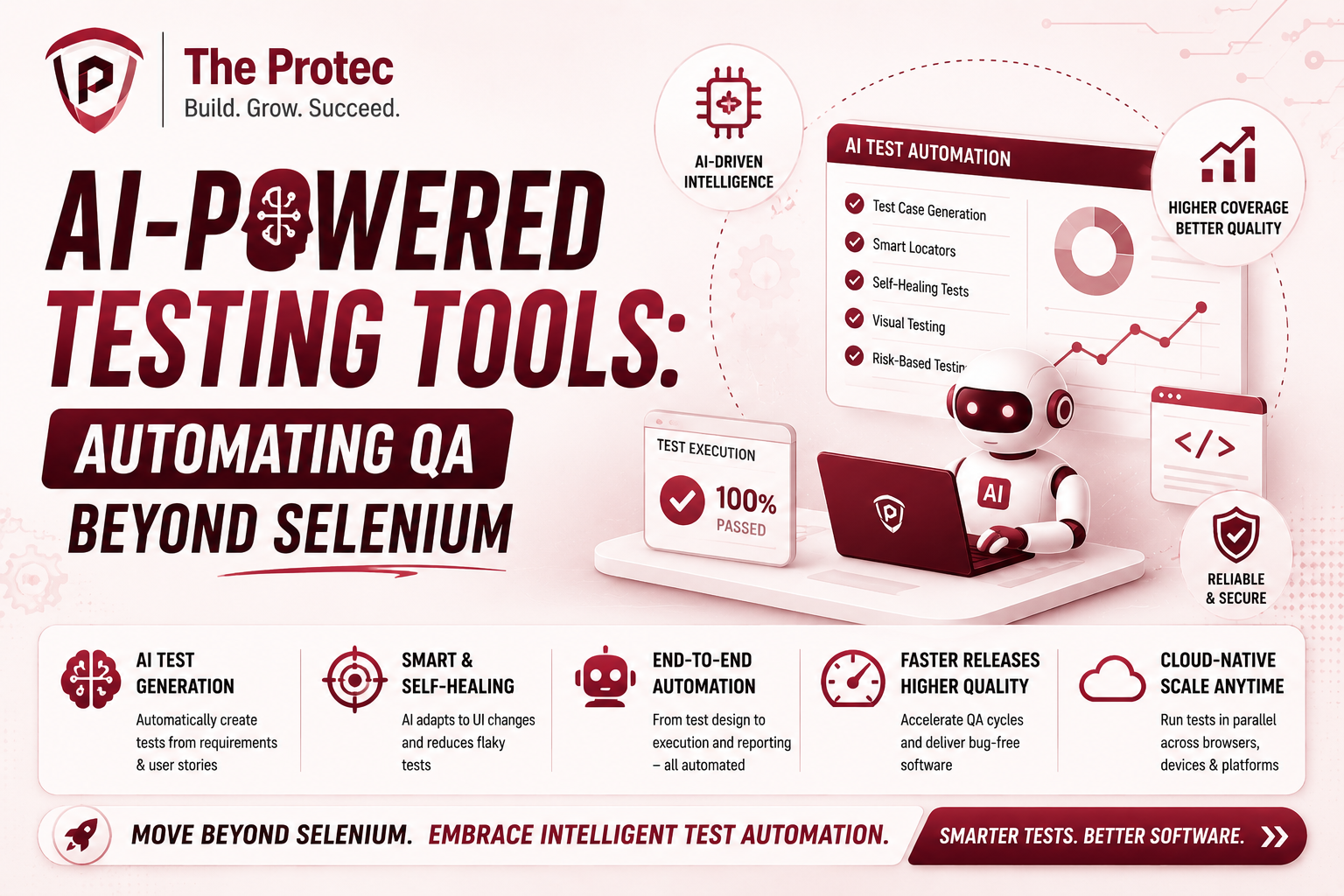
Conventional test automation follows instructions. A script runs the same steps every time and fails when the application changes in ways the script does not expect. That approach works well until interfaces shift, selectors break, data changes, or workflows become more dynamic. AI testing tools take a different approach by using machine learning, computer vision, natural language processing, and pattern recognition to make testing more adaptive.
Instead of relying only on static rules, these tools can learn from historical test runs, user behavior, and application changes. They can identify where defects are most likely to appear, suggest better test coverage, and even adjust locators when the UI changes. In practice, this means less time spent fixing brittle scripts and more time validating meaningful product behavior.
Modern AI QA tools are especially effective in environments with frequent releases. They help teams maintain confidence in fast-moving codebases by reducing the manual burden of regression testing and by highlighting the most critical areas to test first. This shift is one reason AI is now central to software testing automation strategies across enterprise, SaaS, fintech, healthcare, and consumer products.
How AI Is Transforming Software Testing Automation
Automation has always been about speed and consistency. AI adds intelligence to that equation. The most impactful use cases go beyond basic script execution and into decision-making support.
1. Test creation is becoming faster and smarter
One of the biggest bottlenecks in QA has always been test authoring. Writing stable test cases takes time, and keeping them updated takes even more. AI testing tools can now generate test scenarios from user stories, requirements, code changes, or recorded user behavior. Some tools can even convert plain-language prompts into executable test steps, which lowers the barrier for teams that want to expand automation coverage quickly.
This does not eliminate the need for human review. Instead, it gives QA engineers a strong starting point. The team can validate the logic, refine the assertions, and adapt the generated test to align with business goals. That combination of automation and human oversight leads to better coverage with less effort.
2. Test maintenance is less painful
Test maintenance has long been one of the least efficient parts of software testing automation. A minor UI change can break dozens of scripts. AI QA tools reduce this pain by using resilient locators, self-healing capabilities, and visual recognition to identify interface elements even when layouts shift.
When a button moves, a label changes, or a component is restructured, the tool can often recover automatically or recommend a fix. That means fewer false failures and less time spent chasing broken tests that are not actually related to product quality. For teams with large regression suites, the time savings can be significant.
3. Execution can be prioritized by risk
Not every test deserves the same urgency. AI testing tools can analyze historical defects, code churn, usage patterns, and recent changes to determine which areas are most likely to fail. That makes test execution smarter. Instead of running everything with equal weight, teams can prioritize the most risky components first.
This is especially valuable in continuous integration and continuous delivery environments where feedback speed matters. If the highest-risk tests fail early, developers can respond faster and prevent defects from moving deeper into the pipeline.
AI QA Tools Are Improving Bug Detection
Bug detection is one of the clearest areas where AI is changing quality assurance forever. Traditional automated tests are good at confirming expected behavior, but they often miss subtle issues that do not produce obvious failures. AI QA tools are better at spotting irregularities, patterns, and anomalies that may indicate underlying defects.
1. Anomaly detection catches issues earlier
AI-powered systems can learn what normal behavior looks like across builds, environments, and user flows. When a new release behaves differently, the tool can flag the deviation even if the application does not technically crash. This is useful for detecting slow performance degradation, broken integrations, unusual API responses, and partial workflow failures.
In complex systems, the earliest signs of a defect are not always visible to a human tester. AI can surface those weak signals quickly, helping teams investigate before customers experience the issue.
2. Visual testing is getting more precise
Visual regression testing has become a major strength of AI testing tools. Instead of comparing screenshots pixel by pixel in a brittle way, modern systems can understand layouts, component relationships, and visual intent. This allows them to distinguish between acceptable rendering changes and true defects.
That matters for applications with responsive design, dynamic content, and frequent UI updates. A button shifting by a few pixels might be harmless, while a misaligned form field or hidden call-to-action might be a serious usability issue. AI QA tools are increasingly able to tell the difference.
3. Root-cause analysis is becoming faster
Finding a bug is only part of the job. Understanding why it happened is often the harder part. AI tools can correlate failures with recent commits, dependency updates, environment changes, and earlier warning signs. That makes triage faster and more accurate.
For QA and engineering teams, this means fewer long debugging sessions and faster handoffs. When the tool can point to a likely cause or cluster related failures, teams can spend less time searching and more time fixing.
Why Release Cycles Are Getting Shorter
Release speed has become a competitive advantage, but only if quality keeps pace. AI testing tools are helping teams shorten release cycles because they reduce three major sources of delay: test authoring, maintenance, and triage.
With smarter software testing automation, teams can build broader regression coverage in less time. They can run the right tests sooner, focus on the most critical risk areas, and identify problems earlier in the development process. That means fewer late-stage surprises and less need to pause releases for manual validation.
AI also supports continuous testing practices. As code changes move through the pipeline, AI QA tools can assess impact, recommend test selection, and detect patterns that suggest a release is safe or risky. In mature environments, this creates a feedback loop where quality signals are available much earlier than in traditional QA models.
The result is not reckless speed. It is controlled speed. Teams can ship more often because they have stronger evidence that the release is stable. That confidence is what makes modern delivery pipelines sustainable.
Key Benefits of AI Testing Tools for QA Teams
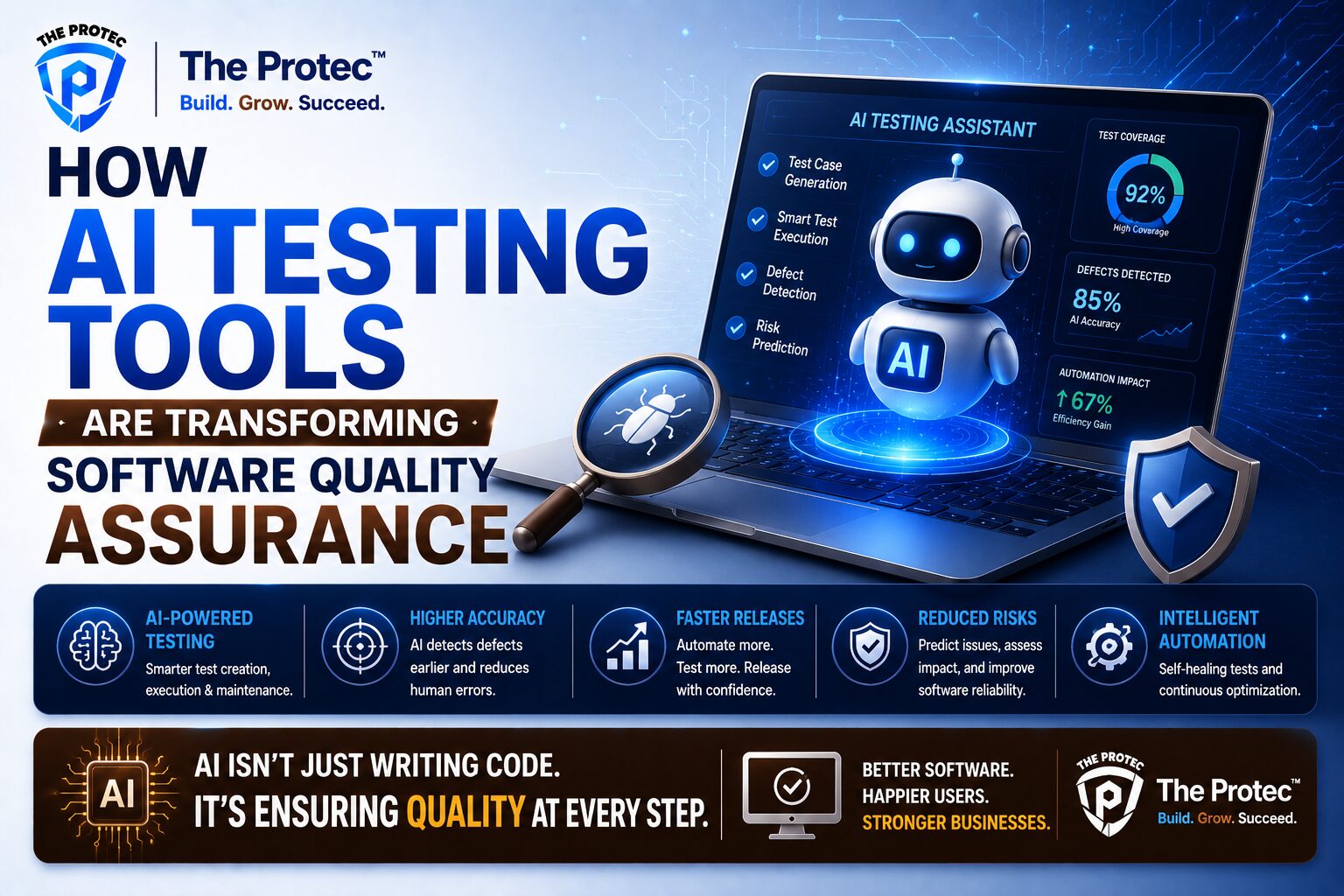
Organizations adopting AI testing tools usually see benefits across both productivity and product quality. The strongest advantages include:
Faster test creation: Teams can generate tests from requirements, user flows, or existing behavior patterns.
Lower maintenance overhead: Self-healing capabilities reduce the cost of brittle scripts.
Better defect detection: AI can identify anomalies, visual issues, and hidden regressions earlier.
Smarter prioritization: Risk-based execution focuses effort where failures are most likely.
Shorter release cycles: Faster feedback helps teams ship with more confidence.
Improved coverage: AI can reveal gaps in test suites and suggest missing scenarios.
These benefits are especially important for teams managing large products or distributed systems. The larger the application, the more valuable intelligent automation becomes.
The Limits of AI in Software Testing Automation
Despite the excitement, AI QA tools are not magic. They work best when used as part of a thoughtful testing strategy, not as a replacement for sound engineering judgment. AI can accelerate testing, but it still needs governance, context, and oversight.
One limitation is that AI models may struggle with highly unique business logic if they are not given enough relevant data. Another challenge is trust. If the tool cannot explain why it flagged a failure or modified a test, teams may hesitate to rely on it for critical releases. There is also the risk of over-automation, where teams automate everything without considering whether a test is truly valuable.
Human expertise remains essential. Testers still need to define quality goals, design meaningful scenarios, interpret unusual results, and challenge assumptions. AI should amplify that expertise, not replace it.
Security and compliance also matter. Teams evaluating AI testing tools should review how data is stored, how models learn from project information, and whether the platform meets organizational requirements for privacy and auditability. For highly regulated industries, these details are not optional.
What to Look for in Modern AI QA Tools
Not all AI testing tools are equally useful. When evaluating options, QA leaders should focus on practical capabilities rather than marketing claims.
Self-healing tests: Can the tool recover from UI changes without constant manual edits?
Risk-based test selection: Does it help prioritize the most important tests for each build?
Visual validation: Can it detect layout and rendering problems accurately?
Integration support: Does it fit into CI/CD, issue tracking, and observability workflows?
Explainability: Can the tool show why a failure occurred or why a test was selected?
Scalability: Will it support growing suites, multiple environments, and frequent releases?
A good platform should make the QA workflow simpler, not more complicated. If the tool creates more noise than value, it is not delivering on the promise of software testing automation.
How QA Teams Can Prepare for AI-Driven Testing
The teams that benefit most from AI testing tools are the ones that prepare deliberately. The best starting point is to clean up the existing test suite. If the current automation is full of duplicated cases, unreliable scripts, and unclear ownership, AI will not solve those problems automatically. It will simply make them more visible.
Next, teams should define what success looks like. Is the goal faster regression testing, better bug detection, reduced maintenance, or higher release confidence? Clear goals make it easier to choose the right AI QA tools and measure their impact.
It also helps to start small. A pilot project focused on one product area or one release pipeline can show where AI adds value and where human intervention is still necessary. From there, teams can expand gradually and build internal confidence.
Finally, QA leaders should invest in upskilling. As AI takes over repetitive tasks, testers need stronger analytical skills, better domain understanding, and the ability to work with intelligent tooling. The future of QA is not less skilled. It is differently skilled.
The Future of Software Quality Assurance
AI testing tools are changing software quality assurance in ways that will keep expanding. Over time, software testing automation will become more predictive, more adaptive, and more connected to product telemetry. QA systems will increasingly use production signals, user behavior, and code intelligence to decide what to test and when to test it.
This evolution will not make quality assurance effortless. Software is still too complex for that. But it will make quality more manageable. Teams will spend less time reacting to broken scripts and more time preventing issues before they escape into production. That is a major shift in responsibility and in value.
For organizations that release software frequently, adopt modern development practices, or operate at scale, AI QA tools are becoming a strategic necessity. They help teams move faster without losing control, which is exactly what modern software delivery demands.
FAQ
What are AI testing tools?
AI testing tools are software quality assurance platforms that use machine learning, pattern recognition, computer vision, or natural language processing to improve testing. They can help generate tests, detect anomalies, reduce maintenance, and prioritize risk.
How do AI QA tools improve software testing automation?
They make automation more intelligent and adaptive. Instead of relying only on static scripts, AI QA tools can self-heal broken tests, identify likely defect areas, optimize test selection, and speed up bug detection across the release pipeline.
Can AI testing tools replace manual testers?
No. AI testing tools are best used to support manual testers, not replace them. Human testers still play a critical role in exploratory testing, risk assessment, usability analysis, and validating business logic.
Are AI testing tools worth it for smaller teams?
Yes, especially if the team releases often or struggles with test maintenance. Smaller teams can use AI QA tools to save time, improve coverage, and reduce the burden of repetitive regression testing.
What is the biggest benefit of using AI in software quality assurance?
The biggest benefit is faster, more reliable feedback. AI helps teams detect bugs earlier, maintain tests more easily, and shorten release cycles while improving confidence in the final product.
Conclusion
AI testing tools are not a passing trend. They are redefining how software quality assurance works by making software testing automation more intelligent, efficient, and scalable. From smarter test creation to better bug detection and shorter release cycles, AI QA tools are helping teams deliver better software with less friction.
As applications become more complex and release timelines continue to shrink, the teams that embrace AI-assisted testing will have a clear advantage. They will be able to move faster, catch more issues, and maintain higher confidence in every deployment. That is why AI is changing software quality assurance forever.
For teams ready to modernize QA, the next step is not to automate everything. It is to automate strategically, use AI where it adds real value, and keep human expertise at the center of quality.