








Contents
- 1 Why Local AI Models Are Becoming a Big Deal in Mobile Phones
- 2 What Local AI Models Actually Do on a Phone
- 3 Why Manufacturers Are Putting AI on the Device
- 4 The Hardware Powering AI Phones
- 5 How Software Is Making On-Device AI Practical
- 6 What Offline AI Smartphones Mean for Privacy
- 7 Where Local AI Models Are Improving the Most
- 8 The Limits of On-Device AI Today
- 9 What Users Should Look for in an AI Phone
- 10 The Future of Local AI Models in Mobile Devices
- 11 FAQ
Why Local AI Models Are Becoming a Big Deal in Mobile Phones
Mobile phones are entering a new phase of intelligence. For years, the most advanced AI features depended on the cloud: a photo was uploaded to a server, a voice command was processed remotely, and a text prompt was sent out for inference before a result came back. That model worked, but it came with trade-offs in speed, privacy, reliability, and cost. Today, manufacturers are moving in a different direction. Instead of sending everything to the cloud, they are integrating local AI models directly into the phone itself.
This shift is reshaping what users expect from AI phones. The latest wave of devices is designed to handle many tasks on-device, from live translation and transcription to image generation, smart search, contextual summaries, and personal assistants that can respond instantly. In practical terms, offline AI smartphones are becoming more useful because they can keep working even when connectivity is weak or unavailable.
The change is not just a marketing update. It reflects major improvements in mobile chips, memory systems, and software frameworks that make on-device inference realistic at scale. As of mid-2026, local AI models are no longer limited to experimental demos or ultra-premium handsets. They are becoming a standard feature across flagship and upper-midrange phones, and that trend is likely to spread further.
What Local AI Models Actually Do on a Phone
Local AI models are machine learning models stored and executed directly on the device instead of in a remote data center. In mobile phones, that usually means running compact language models, vision models, speech models, or multimodal systems through dedicated hardware such as a neural processing unit, GPU, or specialized AI accelerator.
These models are smaller than the giant cloud models used by major AI platforms, but they are increasingly optimized for mobile use. That optimization matters. A phone has limited battery capacity, thermal headroom, and memory compared with a laptop or server. To work well, local models must be efficient enough to deliver meaningful intelligence without draining the device or making it uncomfortably warm.
In real-world use, local AI models can power a wide range of features:
- On-device voice assistants that answer simple requests immediately
- Real-time transcription and live captioning during calls or meetings
- Offline translation for travel and communication
- Photo cleanup, object removal, and content-aware editing
- Context-aware message drafting and smart reply suggestions
- Personalized search across apps, files, and device data
- Summaries of notifications, documents, or long threads
The key difference is that the phone can act on the data locally, often without needing to send sensitive information elsewhere. That makes the experience feel faster and, for many users, more trustworthy.
Why Manufacturers Are Putting AI on the Device
Phone makers are embracing on-device AI for several reasons, and the strongest one is user experience. Cloud-based AI introduces delays. Even a short wait can make a feature feel less natural, especially for tasks like live translation or voice interaction. Local AI models reduce that delay dramatically by processing data right where it is created.
Privacy is another major reason. Many consumers are now more aware of how their data is collected, stored, and analyzed. By keeping more processing on-device, manufacturers can reduce the amount of personal data that needs to leave the phone. That does not eliminate every privacy concern, but it meaningfully lowers exposure for sensitive tasks such as message analysis, photo indexing, or voice commands.
Reliability also matters. Offline AI smartphones can continue delivering useful features in airplane mode, during international travel, in rural areas, or in buildings with weak signal. That resilience is especially valuable for tools people rely on every day. If an assistant can still summarize notes, translate a menu, or transcribe a conversation without internet access, it becomes much more practical.
There is also a strategic reason. As AI becomes a core part of the smartphone experience, manufacturers want to differentiate themselves. Hardware makers, chip designers, and operating system teams are all racing to prove that their devices can deliver smarter experiences with less dependence on the cloud. In other words, AI phones are becoming a battleground for both performance and product identity.
The Hardware Powering AI Phones
Local AI models would not be possible at this scale without major hardware upgrades. The modern smartphone chip is no longer just a CPU and GPU bundle. It is a highly integrated platform with dedicated AI acceleration, higher memory bandwidth, better power management, and improved thermal control.
At the center of this shift is the neural engine or NPU, which is designed specifically for matrix operations and other workloads common in machine learning. These units are far more efficient than general-purpose processing for many AI tasks. They can process inference quickly while using less energy than trying to force the CPU to do the same job.
Memory is just as important. Larger on-device models need more RAM and faster memory access. That is why high-end phones increasingly ship with more memory than they used to, especially in AI-focused models. The goal is not only to run a model, but to keep it responsive while other apps are open in the background.
Thermals also matter. AI workloads can be sustained and compute-heavy, so manufacturers are improving internal cooling systems, using vapor chambers, graphite layers, and smarter power allocation. The best AI phones are those that can maintain performance without making the device uncomfortable to hold or causing rapid battery drain.
As chipmakers continue to refine mobile silicon, local AI models will keep getting larger, faster, and more capable. That hardware progress is a big reason offline AI smartphones are moving from niche premium features to broader mainstream adoption.
How Software Is Making On-Device AI Practical
Hardware alone is not enough. The software layer is what makes local AI models usable for everyday people. Mobile operating systems are now being redesigned around AI-aware workflows, with system-level access to context, app data, and user actions. That allows features such as smart summarization, semantic search, and proactive suggestions to feel integrated rather than bolted on.
Developers are also using smaller, more efficient model formats and optimized runtime frameworks that can run on mobile hardware. Quantization, pruning, and distillation have become important techniques for reducing model size while preserving useful performance. In practical terms, that means a model can be compressed enough to run locally without losing the quality needed for consumer features.
Another crucial development is hybrid AI. Many phones now use a combination of local and cloud processing. Simple or sensitive tasks stay on-device, while more complex requests can be escalated to the cloud when needed. This approach gives manufacturers flexibility and helps preserve battery life while still offering advanced capabilities.
That hybrid approach is likely to remain common because it offers the best of both worlds. Users get fast, offline-first behavior for everyday tasks, and they still have access to larger AI systems when required. The result is a more balanced AI phone experience that can scale across different use cases and network conditions.
What Offline AI Smartphones Mean for Privacy
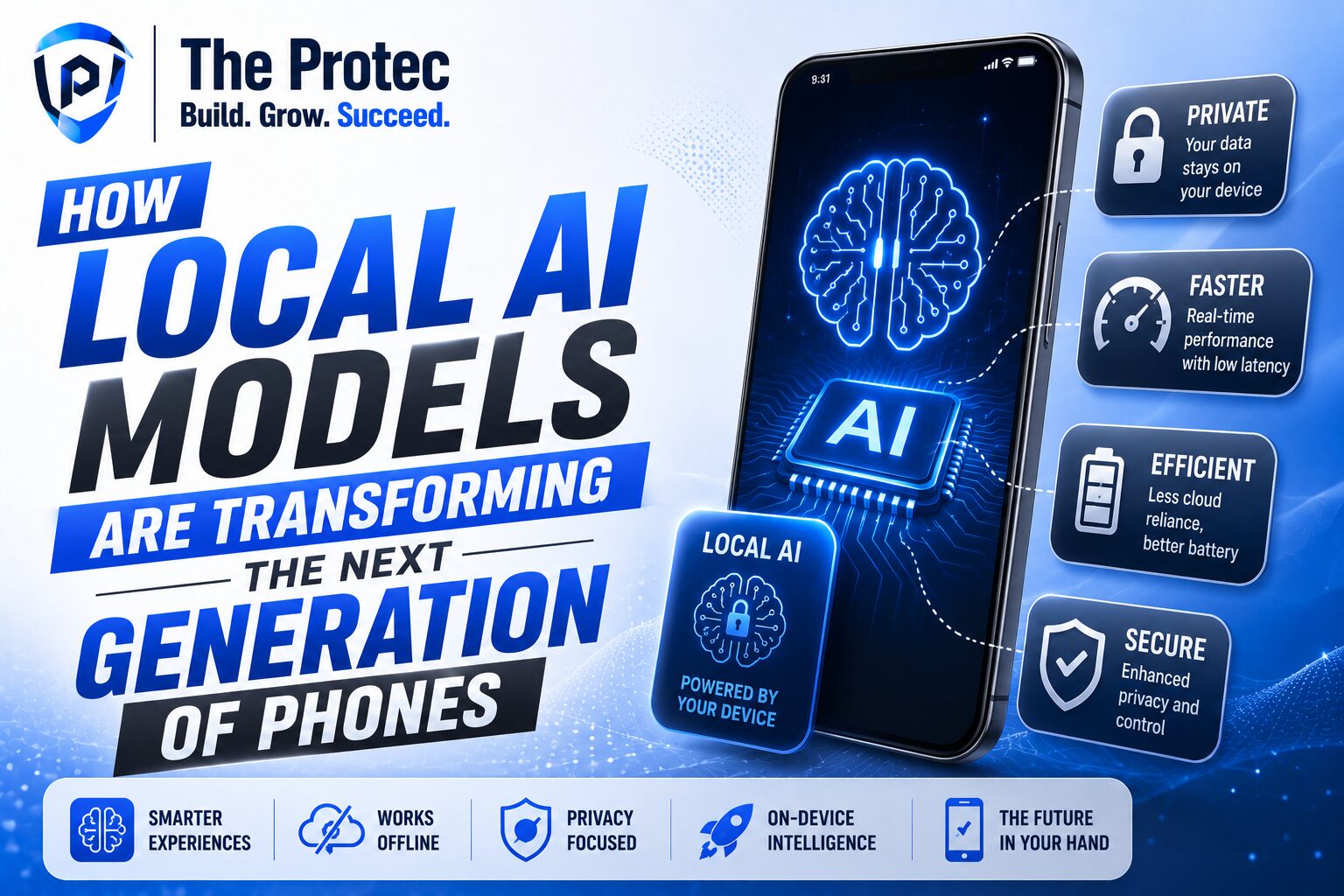
Privacy is one of the strongest arguments for local AI models. When a phone can handle tasks locally, the data does not need to leave the device just to produce a useful result. That matters for messages, photos, voice recordings, location-based notes, and other sensitive information.
For example, if a phone can transcribe a voice memo on-device, the audio does not necessarily need to be uploaded for processing. If it can identify objects in a photo locally, the image may remain on the phone. If it can summarize a document locally, the content does not have to be sent to a remote server. Each of these cases reduces the risk of exposure.
That said, privacy is not automatic. Users still need to understand what is processed locally, what is sent to the cloud, and how the manufacturer handles data logs, model updates, and personalization. The best offline AI smartphones are transparent about these choices and give users control over them.
For a broader technical overview of on-device AI and edge inference, NVIDIA offers a helpful explanation of edge AI concepts at NVIDIA Edge AI. For privacy and mobile data handling guidance, Google’s Android documentation is also useful at Android Privacy.
Where Local AI Models Are Improving the Most
The first wave of local AI features focused on small, high-value tasks. That remains true, but the quality and ambition of those features are rising quickly. The most visible improvements are happening in areas where speed, context, and repeated interaction matter most.
Voice and conversation
On-device voice processing is becoming much more natural. Phones can now handle wake-word detection, short commands, transcription, and conversational follow-ups with less delay. This makes assistants feel more responsive and less dependent on network quality.
Writing and summarization
Local AI models can help rewrite messages, shorten long text, summarize meeting notes, and extract key points from documents. These tasks are ideal for on-device processing because they often involve personal content that users do not want uploaded unnecessarily.
Camera and image editing
Smart photo tools are one of the most compelling parts of AI phones. Local models can support scene recognition, object removal, portrait enhancements, background edits, and generative touch-ups right in the camera app or gallery.
Search and organization
Phones are becoming better at understanding user intent across files, apps, screenshots, and notes. Instead of searching only by exact keywords, local AI models can interpret context and help users find what they meant to locate.
Accessibility
Live captions, speech-to-text, translation, and reading assistance are powerful examples of AI that directly improve daily life. When these functions run locally, they can be faster, more dependable, and more inclusive.
The Limits of On-Device AI Today
Even with rapid progress, local AI models still have limits. Mobile devices cannot yet match the scale of the largest cloud models. That means some deeply complex reasoning tasks, very long context windows, and heavyweight generation workloads still perform better in the cloud.
Battery life is another concern. While dedicated AI hardware is efficient, sustained inference still uses power. If a model is active for long periods, especially alongside camera processing, gaming, or multitasking, battery drain can become noticeable.
Model updates are also more complicated on-device. A cloud AI system can be updated centrally, but local AI models need to be distributed to millions of devices and remain compatible with different hardware capabilities. Manufacturers must balance rapid innovation with device storage limits and regional rollout constraints.
There are also quality trade-offs. Smaller models can be very useful, but they may produce less nuanced outputs than larger cloud systems. That is why most AI phones will probably continue using a hybrid model rather than relying entirely on offline processing.
What Users Should Look for in an AI Phone
Not every phone that advertises AI is equally capable. If you are evaluating AI phones, it helps to look beyond the headline features and examine how much actually runs locally.
- Dedicated AI hardware: Look for a strong NPU or AI accelerator designed for on-device inference.
- Memory capacity: More RAM usually means better support for larger local AI models and smoother multitasking.
- Offline functionality: Check whether translation, transcription, search, and editing still work without a connection.
- Privacy controls: Review settings for data sharing, cloud fallback, and personalization.
- Battery optimization: AI features should not dramatically shorten daily battery life.
- Software support: Long-term updates matter because local AI features will evolve over time.
A phone that genuinely supports offline AI smartphones should feel intelligent even in low-connectivity situations. The best devices make AI feel like part of the operating system, not an app you need to open separately.
The Future of Local AI Models in Mobile Devices
The next stage of smartphone AI will likely be defined by better model efficiency, more personalization, and closer integration with everyday workflows. As local AI models get smaller and smarter, phones will be able to handle more tasks privately and instantly.
One likely development is more personal context understanding. Instead of just responding to commands, AI phones will increasingly anticipate needs based on calendar events, messages, travel plans, and usage patterns. The challenge will be doing that responsibly, with strong user controls and clear privacy boundaries.
Another major direction is multimodal AI. Phones already see, hear, and track user input through touch, text, photos, and voice. The next generation of offline AI smartphones will combine those signals more naturally, allowing users to interact in whatever way is most convenient at the moment.
We will also see more developer tools that let app makers tap into local AI capabilities without building every system from scratch. That will open the door to smarter note apps, productivity tools, camera apps, health features, and accessibility tools that run directly on the device.
Ultimately, the mobile industry is moving toward a world where AI is not a separate feature. It is becoming part of the phone’s foundation. The devices that succeed will be the ones that make local intelligence useful, private, and effortless.
FAQ
What are local AI models in mobile phones?
Local AI models are machine learning models that run directly on the phone instead of a remote server. They enable on-device features such as transcription, translation, summarization, and image editing with less dependence on the internet.
Are offline AI smartphones better for privacy?
They can be. Because more processing happens on the device, less sensitive data needs to be sent to the cloud. However, privacy still depends on how the phone maker handles logging, syncing, and model updates.
Do AI phones still need the cloud?
Yes, many do. Most current devices use a hybrid approach, where smaller tasks run locally and larger or more complex tasks use the cloud when needed. This gives users speed and flexibility.
Will local AI models drain battery faster?
They can, depending on the task. Modern AI chips are efficient, but sustained inference still consumes power. Manufacturers are improving this with dedicated hardware, better cooling, and smarter scheduling.
What should I look for in an AI phone?
Look for strong on-device AI hardware, enough memory, useful offline features, good privacy controls, and long software support. The best AI phones make local AI feel fast and practical in everyday use.