




Contents
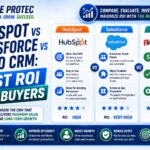
- 1 HubSpot vs Salesforce vs Zoho CRM: Which CRM Delivers the Best ROI?
- 2 What ROI Really Means in a CRM Purchase
- 3 HubSpot vs Salesforce: Ease of Use vs Enterprise Depth
- 4 Zoho CRM Comparison: Budget-Friendly Value with Broad Capability
- 5 Feature-by-Feature ROI Comparison
- 6 Where Each CRM Delivers the Best ROI
- 7 How AI and Automation Trends Affect CRM ROI
- 8 Total Cost of Ownership: The Hidden ROI Factor
- 9 Decision Framework: Which CRM Should You Choose?
- 10 Final Verdict: Which CRM Delivers the Best ROI?
- 11 FAQ
HubSpot vs Salesforce vs Zoho CRM: Which CRM Delivers the Best ROI?
Choosing a CRM is no longer just about storing contacts and tracking deals. In 2026, the best CRM platforms are revenue engines that unify marketing, sales, service, automation, analytics, and AI-assisted workflows. That is why buyers researching HubSpot vs Salesforce or a Zoho CRM comparison need more than feature checklists. They need a realistic view of total cost, adoption friction, implementation effort, and long-term return on investment.
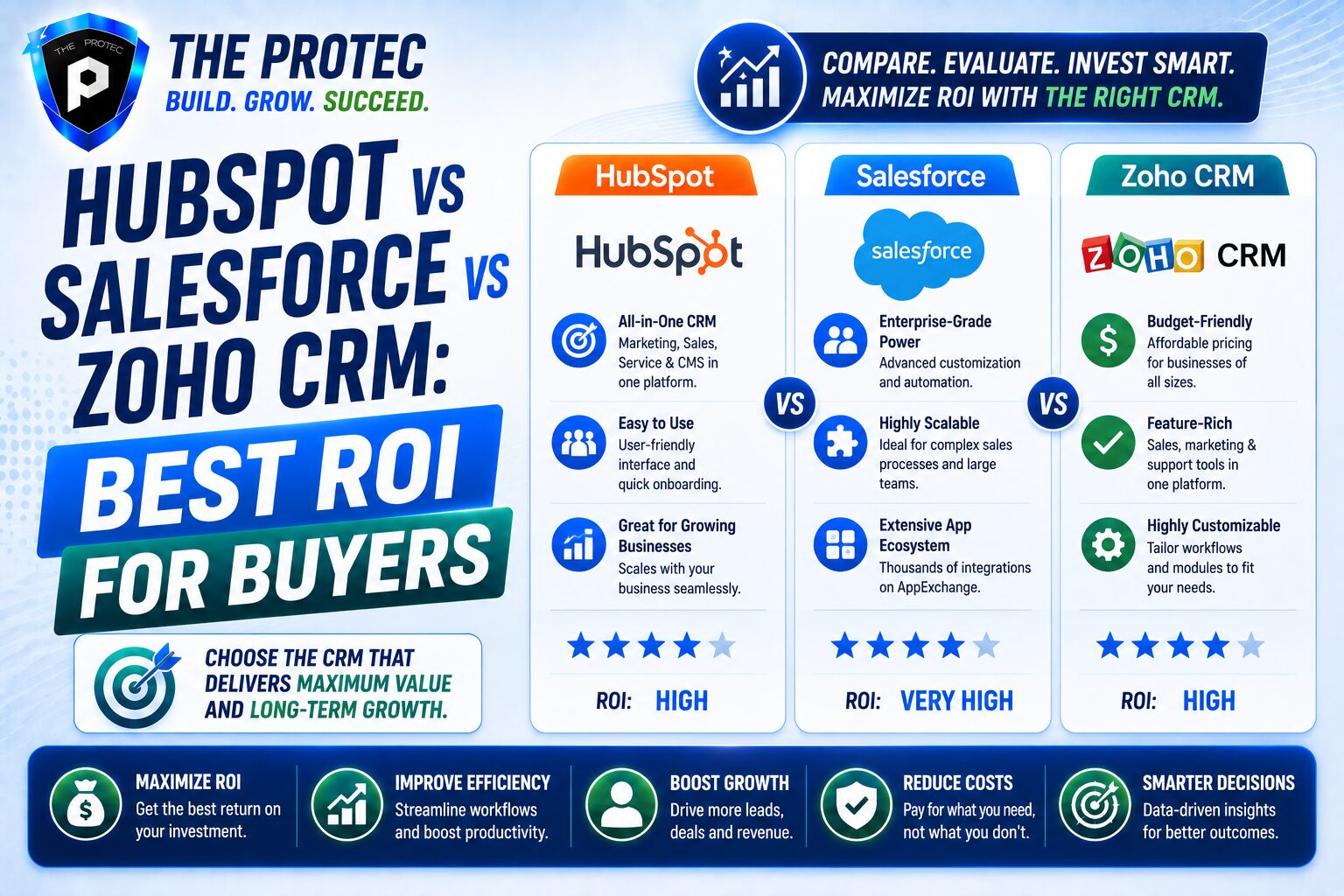
For most organizations, CRM ROI comes down to a simple question: which platform helps teams move faster, sell more consistently, and reduce operational overhead without creating a software burden? HubSpot, Salesforce, and Zoho all deliver strong value, but they do so in very different ways. HubSpot is known for ease of use and fast adoption. Salesforce remains the enterprise powerhouse for complex processes and deep customization. Zoho CRM competes on affordability and broad functionality, making it a serious contender for cost-conscious teams.
This comparison breaks down the strengths, trade-offs, and hidden costs of each platform so you can decide which CRM delivers the best ROI for your business model, growth stage, and technical resources.
What ROI Really Means in a CRM Purchase
CRM ROI is not just license price. A low monthly fee can still become expensive if adoption is poor, integrations are fragile, or teams need constant admin support. The best CRM ROI usually comes from a platform that reduces friction across the customer lifecycle and measurably improves revenue operations.
When evaluating CRM value, buyers should consider these factors:
- Time to value: How quickly can the team start using the platform effectively?
- Adoption rate: Will sales, marketing, and service teams actually use it?
- Automation impact: How much manual work can be eliminated?
- Scalability: Can the system grow without forcing a replatform?
- Total cost of ownership: Licenses, onboarding, consultants, integrations, and admin time.
- Revenue impact: Better conversion rates, shorter sales cycles, improved retention, and more accurate forecasting.
In practice, the best CRM ROI is rarely the cheapest one. It is the one that produces the highest net value after implementation, training, and ongoing management.
HubSpot vs Salesforce: Ease of Use vs Enterprise Depth
The HubSpot vs Salesforce debate is often framed as simplicity versus power, and that remains true. HubSpot is designed to reduce operational complexity. Salesforce is built to handle nearly any business process, but that flexibility can increase setup time, internal dependency, and administrative overhead.
HubSpot ROI profile
HubSpot is often the strongest ROI choice for small and mid-sized businesses that want quick deployment and high adoption. Its interface is intuitive, and its combined marketing, sales, and service tools help teams centralize activity without stitching together too many systems. In many cases, companies get value quickly because the platform encourages consistent usage rather than forcing heavy technical configuration.
HubSpot’s biggest ROI advantage is speed. If your team can go live quickly, automate lead routing, launch email sequences, track attribution, and manage pipelines with minimal friction, your payback period shortens. The platform also benefits companies that depend on content marketing, inbound lead generation, and visible cross-functional collaboration.
That said, HubSpot’s cost can rise sharply as contacts, features, and teams grow. Buyers sometimes underestimate how quickly pricing scales when they need advanced automation, custom reporting, or multiple hubs. So while HubSpot can deliver excellent ROI, it is strongest when businesses value time savings and adoption more than deep customization.
Salesforce ROI profile
Salesforce is the most flexible and mature platform in this comparison. It is often the best fit for organizations with complex sales processes, multi-region operations, strict data governance needs, or highly customized workflows. For larger teams, Salesforce can produce strong ROI by consolidating many systems into one highly adaptable environment.
The challenge is that Salesforce usually requires more implementation effort. Many organizations need consultants, admins, and ongoing optimization to unlock its full value. That means the upfront investment is higher, and the time to value is often longer. However, when deployed well, Salesforce can deliver exceptional ROI through robust forecasting, advanced automation, richer analytics, and deep integration across the revenue stack.
Salesforce tends to win when revenue complexity is high and process control matters more than ease of use. If the business needs advanced permission structures, sophisticated account hierarchies, or custom objects that support unique operations, Salesforce may justify its premium by preventing future replatforming costs.
Zoho CRM Comparison: Budget-Friendly Value with Broad Capability
In any serious Zoho CRM comparison, one theme stands out: value. Zoho CRM offers a broad feature set at a price point that is typically much lower than HubSpot or Salesforce. For startups, SMBs, and growing businesses with tight budgets, that makes Zoho especially attractive.
Zoho CRM ROI profile
Zoho CRM can deliver excellent ROI when the goal is to maximize core CRM capability without premium pricing. It includes sales automation, workflow tools, analytics, AI-assisted features, and ecosystem integrations that cover many business needs. For organizations that want breadth without enterprise-level cost, it is a compelling option.
Zoho’s ROI strength is not just affordability. It can also be a strong operational fit for businesses that want to customize processes without paying for heavyweight enterprise software. The platform’s ecosystem is wide, and for companies already using other Zoho applications, the combined value can be substantial.
The trade-off is that Zoho can feel less polished than HubSpot and less expansive than Salesforce in highly complex environments. While it has improved significantly, some teams may need more internal patience during setup and optimization. Still, for many buyers, Zoho offers the best balance of cost and functionality, especially when the business is focused on practical CRM use rather than enterprise-scale complexity.
Feature-by-Feature ROI Comparison
To understand which CRM delivers the best ROI, it helps to compare the areas that most directly affect productivity and revenue.
1. User adoption
- HubSpot: Usually the easiest to adopt, especially for teams that need a clean interface and minimal training.
- Salesforce: Powerful but often the hardest to roll out without structured training and admin support.
- Zoho CRM: Accessible for many teams, though the experience can vary depending on configuration and user expectations.
ROI takeaway: HubSpot often wins on adoption, which can translate into faster ROI if the team needs quick wins.
2. Automation
- HubSpot: Strong workflow automation, especially for inbound lead management and lifecycle orchestration.
- Salesforce: Extremely powerful automation with broad customization potential.
- Zoho CRM: Solid automation for sales operations and routine process control.
ROI takeaway: Salesforce leads for advanced automation, while HubSpot and Zoho can produce excellent ROI for standard business workflows.
3. Reporting and analytics
- HubSpot: Excellent for accessible dashboards and marketing-to-revenue visibility.
- Salesforce: Strongest for deep, customizable reporting across complex revenue structures.
- Zoho CRM: Good reporting for the price, especially for core sales tracking.
ROI takeaway: Salesforce is strongest for advanced analytics; HubSpot is often best for teams that need quick clarity; Zoho provides strong value for the cost.
4. Integration ecosystem
- HubSpot: Broad app marketplace and strong native usability for marketing and sales tools.
- Salesforce: Massive ecosystem with deep enterprise integration potential.
- Zoho CRM: Good ecosystem, especially within Zoho’s own product family and common SMB tools.
ROI takeaway: Salesforce wins for enterprise breadth, but HubSpot often delivers simpler integration ROI for smaller teams.
5. Cost control
- HubSpot: Predictable at first, but costs can rise as needs become more advanced.
- Salesforce: Highest total cost in many implementations due to licensing and admin overhead.
- Zoho CRM: Usually the most cost-efficient option for direct CRM functionality.
ROI takeaway: Zoho generally offers the strongest cost-to-capability ratio, especially for budget-conscious buyers.
Where Each CRM Delivers the Best ROI
HubSpot is best for fast-growing teams that prioritize adoption
HubSpot tends to produce the best ROI for companies that want a shorter implementation timeline, a unified user experience, and a low-friction path to revenue operations maturity. It is especially effective for inbound-led businesses, SaaS teams, agencies, and mid-market companies that want marketing and sales alignment without a heavy admin layer.
If your team values simplicity, clean workflows, and faster execution, HubSpot often pays back quickly through higher usage and reduced training needs.
Salesforce is best for complex organizations that need scale
Salesforce delivers the best ROI when the company’s complexity justifies the investment. Large sales teams, multi-product businesses, and organizations with strict reporting or compliance requirements often need Salesforce’s depth. It can become the most valuable platform over time because it is so adaptable, but only if the company is prepared to support it properly.
For enterprises and sophisticated revenue organizations, Salesforce ROI usually comes from future-proofing. It may cost more upfront, but it can prevent expensive process limitations later.
Zoho CRM is best for buyers maximizing value per dollar
Zoho CRM often delivers the best ROI for SMBs and lean organizations that want strong CRM fundamentals without a premium spend. It is particularly compelling when the buyer needs a capable system for sales tracking, automation, and forecasting but does not want to pay for enterprise-level overhead.
If affordability matters and the team is comfortable with some trade-offs in polish or ecosystem depth, Zoho can be the smartest financial decision.
How AI and Automation Trends Affect CRM ROI
CRM ROI in 2026 is shaped heavily by AI-assisted selling, predictive insights, automated data capture, and revenue workflow orchestration. Buyers increasingly expect CRMs to reduce admin work, improve lead prioritization, and support more accurate decision-making with less manual effort.
HubSpot has invested heavily in user-friendly AI features that help teams draft content, summarize activity, and streamline workflows. Salesforce continues to expand advanced AI capabilities for forecasting, service, and enterprise orchestration. Zoho has also improved its AI layer, making automation and recommendations more accessible to smaller teams.
The practical implication is that the ROI gap is no longer just about features. It is about how intelligently the platform reduces labor. A CRM that saves five hours a week for fifty users can create meaningful return, even if its license cost is higher. That is why buyers should evaluate the quality of automation, not only the headline feature list.
Total Cost of Ownership: The Hidden ROI Factor
License price is only one part of CRM economics. Total cost of ownership includes onboarding, migrations, integrations, consultant fees, training, data cleanup, and ongoing system administration. This is where many CRM purchases become more expensive than expected.
- HubSpot: Lower implementation complexity can reduce launch costs, but advanced tiers may become expensive as needs expand.
- Salesforce: Often the highest TCO because of setup, customization, admin, and ongoing optimization requirements.
- Zoho CRM: Usually the lowest TCO for standard use cases, though complex customization can still add effort.
For buyers comparing best CRM ROI, this is the critical lens. A CRM that appears expensive on paper may actually be efficient if it prevents manual processes and speeds up revenue generation. Conversely, a cheaper CRM can become costly if the team cannot use it consistently.
Decision Framework: Which CRM Should You Choose?
Use this simple framework to narrow your decision:
- Choose HubSpot if you want the fastest path to adoption, strong marketing-sales alignment, and a clean user experience.
- Choose Salesforce if you need deep customization, enterprise-grade scalability, and complex reporting across multiple teams or business units.
- Choose Zoho CRM if your priority is affordability, core CRM capability, and a strong balance between cost and functionality.
If you are comparing all three strictly on ROI, the answer depends on your operating model. HubSpot often wins for speed and adoption-driven ROI. Salesforce wins for long-term strategic ROI in complex environments. Zoho frequently wins for direct financial ROI, especially when budgets are tight and core functionality is enough.
Final Verdict: Which CRM Delivers the Best ROI?
There is no universal winner, but there is a clear pattern. HubSpot delivers the best ROI for teams that need rapid adoption and operational simplicity. Salesforce delivers the best ROI for larger organizations with complex processes and the resources to support a sophisticated system. Zoho CRM delivers the best ROI for buyers who want the strongest value for money and can live with fewer premium features.
If your buying decision is based on pure financial efficiency, Zoho often has the strongest cost-to-value ratio. If your decision is based on execution speed and user adoption, HubSpot is hard to beat. If your decision is based on long-term scale and process depth, Salesforce remains the benchmark.
The best CRM ROI comes from matching platform complexity to business complexity. The wrong fit wastes money. The right fit compounds revenue efficiency over time.
FAQ
Which CRM has the best ROI for small businesses?
Zoho CRM often has the strongest ROI for small businesses because it delivers broad CRM functionality at a lower cost. HubSpot can also be a strong choice if the team values simplicity and fast adoption more than low pricing alone.
Is Salesforce worth the higher price?
Yes, but only when the business needs Salesforce’s depth. If you have complex workflows, large teams, advanced forecasting needs, or custom data structures, Salesforce can justify its cost through scalability and control. For simpler use cases, it may be more than you need.
Why do some companies choose HubSpot over Salesforce?
Many companies choose HubSpot because it is easier to implement, easier to use, and faster to adopt. That often leads to quicker ROI, especially for teams that want strong marketing and sales alignment without significant technical overhead.
Does Zoho CRM work well for growing teams?
Yes. Zoho CRM can work very well for growing teams that need flexibility and affordability. It is especially effective when the company wants to keep costs under control while still gaining automation, reporting, and sales tracking capabilities.
The biggest hidden cost is usually implementation and adoption. Even a powerful CRM can underperform if users resist it, training is insufficient, or the system requires too much manual maintenance. That is why ROI should always include people, process, and platform together.