




Contents
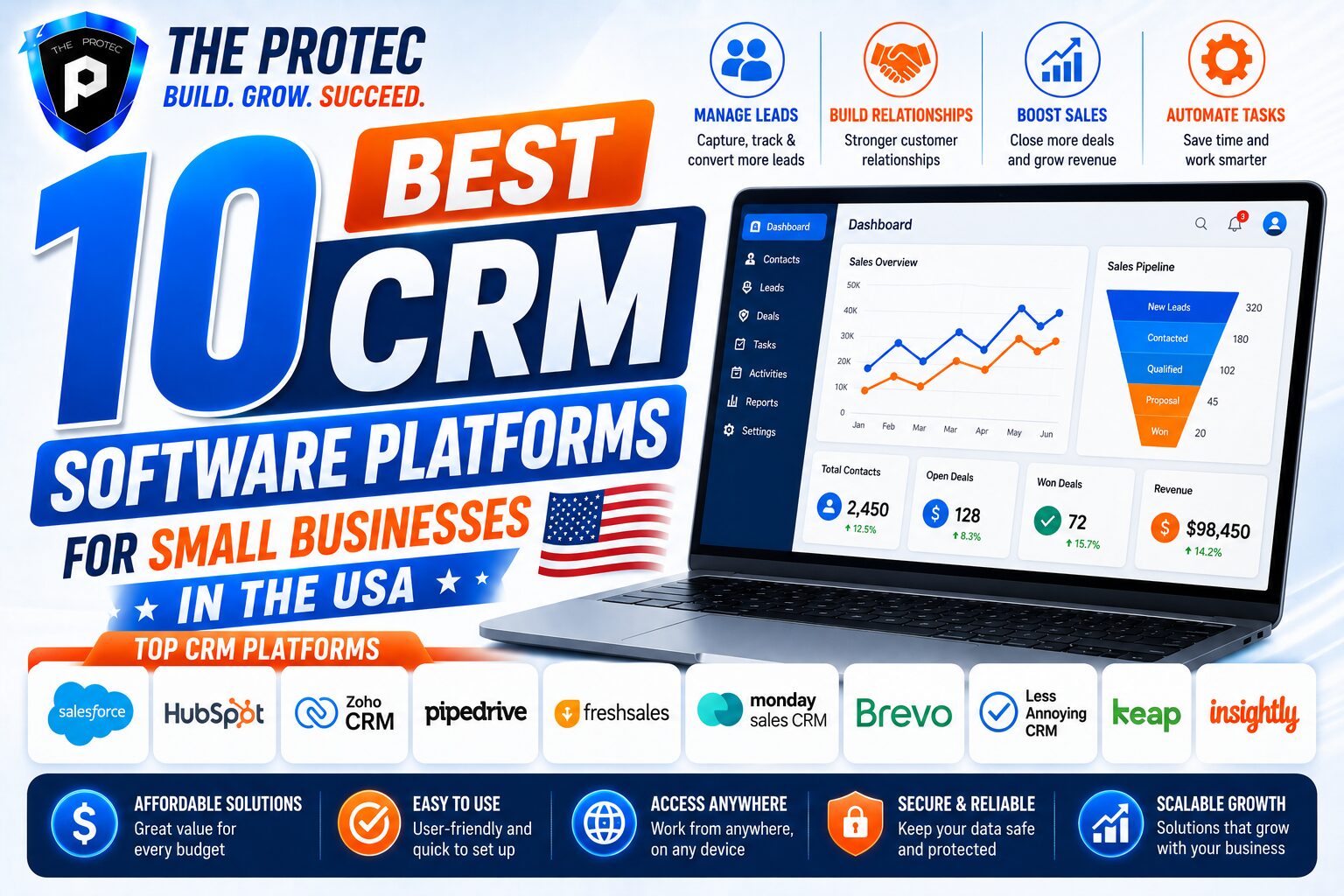
- 1 10 Best CRM Software Platforms for Small Businesses in the USA
- 2 What Small Businesses Should Look for in a CRM
- 3 Quick Comparison of the Best CRM Software USA Offers
- 4 1. HubSpot CRM
- 5 2. Zoho CRM
- 6 3. Salesforce Starter Suite
- 7 4. Pipedrive
- 8 5. Freshsales
- 9 6. Monday Sales CRM
- 10 7. Insightly
- 11 8. Keap
- 12 9. Brevo
- 13 10. Less Annoying CRM
- 14 Which CRM Is Best for Different Small Business Needs?
- 15 How AI Is Changing CRM Comparison in 2026
- 16 Pricing Tips Before You Commit
- 17 Final Verdict: Choosing the Best CRM Software USA Small Businesses Need
- 18 FAQ
10 Best CRM Software Platforms for Small Businesses in the USA
Choosing the right CRM software for small business can make the difference between a messy sales process and a repeatable growth engine. In 2026, the best CRM software USA companies rely on does more than store contacts. It helps teams automate follow-ups, track deals, score leads, forecast revenue, and use AI to move faster with less manual work.
For small businesses, the challenge is not finding a CRM. It is finding one that fits the way the business actually sells. Some teams need a simple pipeline and mobile app. Others need advanced automation, integrated marketing, or AI assistants that can summarize calls and draft emails. The best CRM comparison 2026 should therefore focus on pricing, automation depth, AI capabilities, and the best use case for each platform.
Below is a hands-on review of ten leading CRM platforms for small businesses in the USA, with practical guidance on who each one is best for.
What Small Businesses Should Look for in a CRM
Before comparing tools, it helps to define what matters most. A CRM should reduce manual work, improve follow-up speed, and give clear visibility into opportunities. For a small business, the best choice usually balances cost, ease of use, and scalability.
- Ease of setup: Small teams need a platform that can be adopted quickly without heavy admin work.
- Automation: Look for workflow automation, task creation, email sequences, and lead routing.
- AI support: Modern CRMs increasingly include AI summaries, email drafting, predictive scoring, and call insights.
- Integrations: The CRM should connect with email, calendar, accounting, forms, calling, and marketing tools.
- Pricing: Affordable entry tiers matter, but so does the cost of growth as seats and features expand.
- Reporting: Clear dashboards help owners understand pipeline health, conversion rates, and rep performance.
Quick Comparison of the Best CRM Software USA Offers
Here is a simplified CRM comparison 2026 for small businesses in the USA:
- HubSpot CRM: Best for all-in-one growth and marketing alignment
- Zoho CRM: Best value for automation-heavy teams
- Salesforce Starter Suite: Best for ambitious teams wanting a path to enterprise scale
- Pipedrive: Best for sales pipeline simplicity
- Freshsales: Best for AI-assisted selling on a budget
- Monday Sales CRM: Best for highly visual, customizable workflows
- Insightly: Best for project-driven businesses
- Keap: Best for service businesses that need sales and marketing automation
- Brevo: Best for email-first businesses and lean teams
- Less Annoying CRM: Best for very small teams that want simplicity
1. HubSpot CRM
HubSpot remains one of the strongest choices for small businesses because it combines usability, strong free tools, and a clear upgrade path. For many owners, it is the easiest way to get started without sacrificing long-term capability. It is especially attractive for businesses that want CRM, email marketing, forms, landing pages, and automation under one roof.
Pricing: HubSpot offers a free CRM with paid hubs for marketing, sales, and service. Entry pricing can be friendly, but costs rise as you add contacts and advanced automation.
Automation: Strong workflow automation, lead routing, task automation, email sequences, and deal-stage triggers.
AI capabilities: HubSpot’s AI tools help draft emails, summarize records, and support content and prospecting workflows.
Best use case: Small businesses that want a polished all-in-one platform and expect to grow into broader revenue operations.
HubSpot is often the best CRM software USA teams choose when marketing and sales need to work together closely.
2. Zoho CRM
Zoho CRM is a favorite for small businesses that want powerful customization and a strong feature set without premium pricing. It is one of the most flexible options in the market and works well for businesses that need detailed automation and custom processes.
Pricing: Zoho is usually one of the most affordable serious CRMs, with tiered plans that remain accessible for small teams.
Automation: Excellent workflow rules, assignment rules, blueprints, process management, and multichannel automation.
AI capabilities: Zia, Zoho’s AI assistant, can help with predictions, suggestions, anomaly detection, and writing support depending on the plan.
Best use case: Cost-conscious teams that need robust automation and customization.
Zoho is a smart choice when a CRM software for small business must do more than basic contact management.
3. Salesforce Starter Suite
Salesforce is still the heavyweight in CRM, and its Starter Suite gives small businesses a more approachable entry point into the ecosystem. It is not the simplest option on this list, but it offers strong credibility, advanced scalability, and a deep app ecosystem.
Pricing: Starter-level pricing is higher than some SMB competitors, but it opens the door to a powerful platform.
Automation: Basic automation is solid, and the ecosystem supports much more as needs grow.
AI capabilities: Salesforce continues to advance AI assistance across sales workflows, forecasting, and summaries.
Best use case: Small businesses planning to scale aggressively or needing a CRM that can grow into a larger operation.
For teams that expect complexity later, Salesforce can be a strategic long-term decision.
4. Pipedrive
Pipedrive is built for sales teams that want clarity and speed. Its visual pipeline is one of the cleanest in the market, and small businesses often adopt it quickly because it makes deal tracking intuitive. It is less of an all-in-one marketing suite and more of a focused sales CRM that keeps reps moving.
Pricing: Competitive entry pricing with straightforward paid plans.
Automation: Good workflow automation, activity reminders, deal updates, and follow-up triggers.
AI capabilities: Pipedrive has expanded AI tools for deal insights, email support, and sales productivity.
Best use case: Sales-driven small businesses that want a simple, visual pipeline and fast adoption.
If your team wants less complexity and more selling, Pipedrive is one of the best CRM software USA options to evaluate.
5. Freshsales

Freshsales, part of the Freshworks ecosystem, is a strong option for teams that want modern AI features without enterprise-level complexity. It combines contact management, sales automation, and communication tools in a package that feels built for speed.
Pricing: Attractive for small businesses, especially for teams looking for AI at a manageable cost.
Automation: Lead scoring, workflow automation, task creation, and pipeline management are all well covered.
AI capabilities: Freddy AI supports lead scoring, email insights, deal recommendations, and workflow assistance.
Best use case: Small sales teams that want AI-supported prioritization and simple administration.
Freshsales works well for owners who want smart automation without a steep learning curve.
6. Monday Sales CRM
Monday Sales CRM is ideal for businesses that think visually and want flexibility. Built on the Monday.com work management platform, it lets teams customize pipelines, workflows, and dashboards with a level of visual control that many small businesses appreciate.
Pricing: Typically accessible for smaller teams, though costs can increase as more advanced features are added.
Automation: Strong if you want custom triggers, notifications, and workflow-based task handling.
AI capabilities: Monday has steadily added AI functionality for summarization, content assistance, and work planning.
Best use case: Teams that want a highly visual CRM and also manage projects or operations in the same environment.
For agencies, creative firms, and service businesses, Monday can function as both CRM and workflow hub.
7. Insightly
Insightly is often a strong fit for businesses that need CRM and project coordination together. That makes it useful for service companies, consultants, and firms with longer sales cycles that continue into delivery.
Pricing: Mid-range pricing that can work well for small firms with more complex needs.
Automation: Solid workflow automation, relationship linking, and project-related coordination.
AI capabilities: Insightly has been adding more intelligent assistance, though it is generally less AI-forward than the leaders in this list.
Best use case: Businesses that sell projects or services and need visibility from lead to delivery.
It is especially appealing when customer management and project handoff must stay connected.
8. Keap
Keap is a long-standing favorite for service businesses that need more than a basic CRM. It pairs contact management with marketing automation, appointment booking, invoicing, and follow-up tools, making it particularly useful for coaches, consultants, agencies, and local service companies.
Pricing: Usually higher than entry-level CRMs, but it bundles a lot of functionality.
Automation: One of Keap’s biggest strengths, with lead capture, nurture sequences, booking, and follow-up automation.
AI capabilities: Keap’s newer AI features support productivity, but the platform is primarily known for automation breadth.
Best use case: Small service businesses that want to automate lead nurturing and client follow-up.
Keap is a strong answer when the goal is to save time on repetitive admin and response work.
9. Brevo
Brevo has become popular with lean businesses that want CRM, email marketing, and messaging tools in one place. It is particularly attractive for companies that rely heavily on email campaigns and customer communication rather than complex sales processes.
Pricing: Often competitive, with a low-cost entry point for email-centric businesses.
Automation: Good for email workflows, segmentation, and lifecycle messaging.
AI capabilities: Brevo continues to enhance intelligent assistance for messaging and campaign optimization.
Best use case: Small businesses that prioritize email marketing and straightforward customer communication.
Brevo is less of a deep enterprise CRM and more of a practical growth tool for smaller teams.
10. Less Annoying CRM
Less Annoying CRM is exactly what the name suggests: simple, affordable, and intentionally lightweight. It is designed for small teams that want to organize contacts, manage follow-ups, and track tasks without being overwhelmed by features they will never use.
Pricing: Flat, easy-to-understand pricing makes budgeting simple.
Automation: Limited compared with larger platforms, but enough for basic task reminders and process organization.
AI capabilities: Minimal relative to other platforms on this list.
Best use case: Very small businesses, solo operators, and teams that want a no-friction CRM.
If your top priority is usability, this is one of the easiest CRMs to adopt.
Which CRM Is Best for Different Small Business Needs?
The best CRM software USA businesses should choose depends on the team’s priorities, not just feature counts. A platform that is perfect for a marketing agency may be wrong for a trades company or a consulting firm.
- Best overall for growth: HubSpot CRM
- Best budget-friendly automation: Zoho CRM
- Best for sales simplicity: Pipedrive
- Best AI-assisted selling: Freshsales
- Best for future scalability: Salesforce Starter Suite
- Best for service businesses: Keap
- Best for visual workflows: Monday Sales CRM
- Best for project-based businesses: Insightly
- Best for email-first teams: Brevo
- Best for ultra-simple use: Less Annoying CRM
How AI Is Changing CRM Comparison in 2026
AI is no longer a bonus feature. In modern CRM comparison 2026 evaluations, AI affects how quickly a team responds, how accurately it prioritizes leads, and how well it maintains data hygiene. The best platforms now use AI to reduce repetitive work and surface the next best action.
Common AI features small businesses should look for include:
- Email drafting and rewriting
- Call and meeting summaries
- Lead scoring and deal prioritization
- Forecasting and pipeline risk detection
- Suggested follow-up tasks
- Data enrichment and duplicate detection
For small teams with limited admin capacity, these features can create a real productivity advantage. AI is especially valuable when one salesperson or owner handles a large volume of leads.
Pricing Tips Before You Commit
When comparing CRM software for small business use, do not focus only on the advertised monthly price. The true cost depends on contacts, seat count, automation limits, add-ons, and the number of tools you can replace.
- Check whether the plan charges per user or bundles users differently.
- Review contact and email limits if your business does a lot of outbound marketing.
- Confirm which automation features are included at the entry level.
- Look for hidden costs like onboarding, support tiers, or implementation services.
- Consider whether the CRM can replace separate tools for email, forms, calling, or scheduling.
A slightly more expensive CRM can be the better value if it eliminates several other subscriptions and saves your team hours every week.
Final Verdict: Choosing the Best CRM Software USA Small Businesses Need
The best CRM software USA small businesses choose in 2026 is the one that fits their workflow, not just their wishlist. If you want a balanced all-in-one option, HubSpot is a strong starting point. If budget and automation matter most, Zoho stands out. If simplicity is the priority, Pipedrive or Less Annoying CRM can be the easiest path. For AI-driven sales productivity, Freshsales is compelling. And for service businesses that need deep follow-up automation, Keap remains a strong contender.
The smartest approach is to shortlist two or three platforms, test them with real leads, and see which one your team actually uses consistently. A CRM only creates value when it becomes part of the daily sales habit.
FAQ
What is the best CRM software for small business owners in the USA?
For many small businesses, HubSpot CRM is the best overall starting point because it is easy to use, scalable, and offers strong free tools. However, Zoho CRM, Pipedrive, and Freshsales can be better depending on budget, sales process, and automation needs.
Which CRM has the best automation for small businesses?
Zoho CRM and Keap are among the strongest for automation. Zoho is excellent for workflow customization, while Keap is especially good for lead nurturing, appointment booking, and follow-up automation for service businesses.
Do small businesses really need AI in a CRM?
Yes, if the team wants faster follow-up, better lead prioritization, and less manual admin. AI can help draft emails, summarize meetings, score leads, and identify next steps, which is especially useful for lean teams.
Is a free CRM enough for a small business?
A free CRM can be enough for very small teams that only need basic contact tracking and deal management. Once you need automation, reporting, or multiple users, a paid plan usually provides much better long-term value.
How should I choose between two similar CRM platforms?
Test both with real workflows. Compare ease of use, setup time, automation depth, reporting, and how well each tool fits your sales process. The best CRM is usually the one your team will use consistently.
For more guidance on selecting software that supports growth, it also helps to review vendor documentation and product updates directly from the source. For example, HubSpot publishes detailed product information at https://www.hubspot.com/products/crm and Salesforce maintains current suite details at https://www.salesforce.com/.