








Contents
- 1 The Smartphone Shift: From App Launchers to Intelligent Systems
- 2 Why Apps Are Becoming Less Central
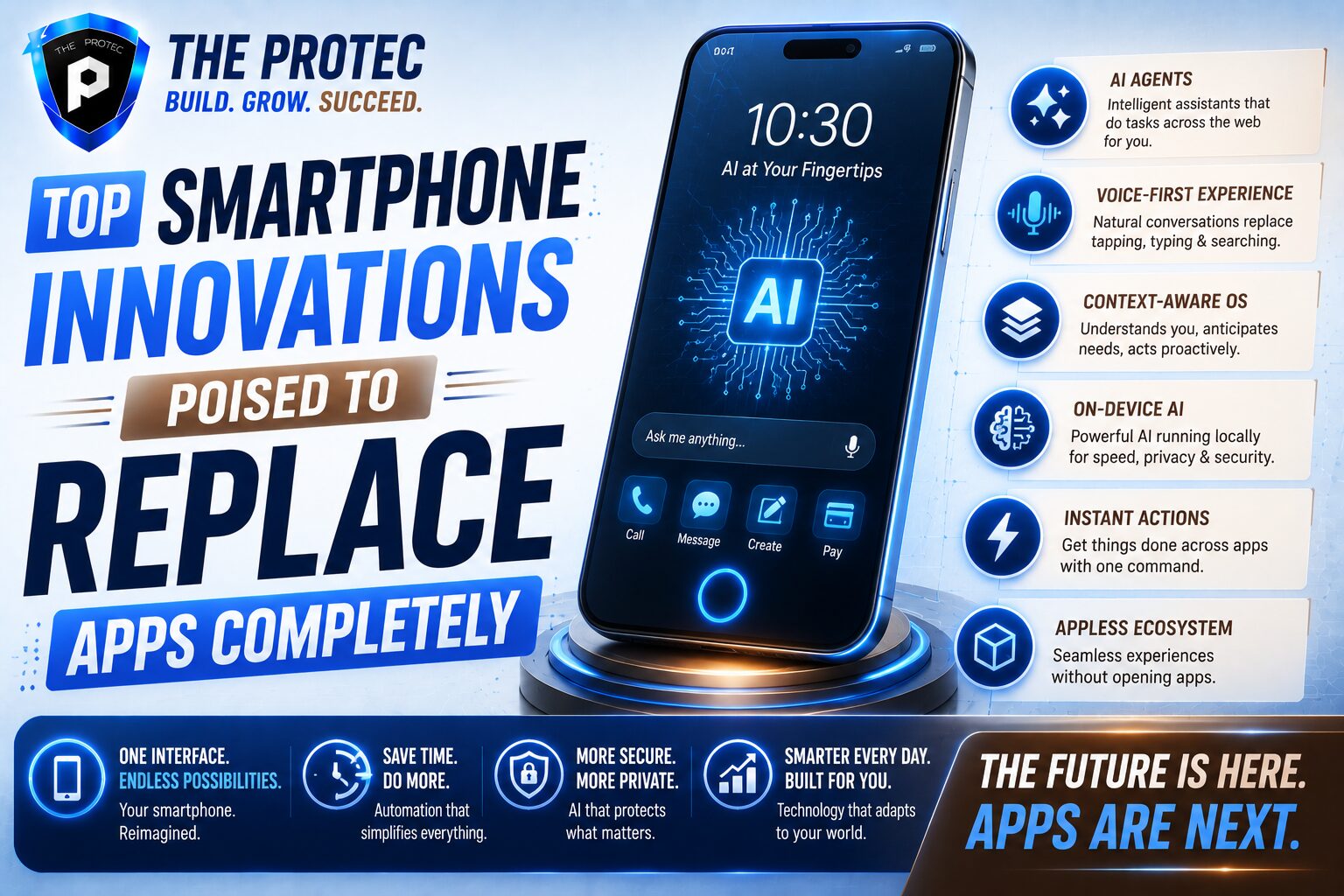
- 3 AI Assistants That Actually Complete Tasks
- 4 Contextual Computing: The Phone That Understands the Moment
- 5 On-Device AI Is Making App-Free Actions Possible
- 6 Multimodal Interfaces Will Replace Taps With Intent
- 7 Operating Systems Are Becoming Action Layers
- 8 Ambient Computing and Invisible Interfaces
- 9 What App-Less Experiences Could Look Like in Daily Life
- 10 Privacy, Trust, and the Limits of Automation
- 11 What This Means for Developers and Brands
- 12 The Future Smartphone Features That Matter Most
- 13 Conclusion: The End of the App-Centric Phone?
- 14 FAQ
The Smartphone Shift: From App Launchers to Intelligent Systems
For more than a decade, the smartphone experience has been defined by apps. Tap an icon, open a silo, complete a task, then close it and move on. That model worked brilliantly when mobile hardware was limited and software needed to be neatly packaged into separate utilities. But the center of gravity is changing. The next wave of phones is being shaped by AI mobile technology, deeper context awareness, and interfaces that can act before you even think about opening an app.
This is not a distant sci-fi concept. It is already visible in voice-first workflows, on-device AI summaries, proactive recommendations, multimodal search, and operating systems that increasingly surface actions instead of apps. The most important change is philosophical: future smartphones may stop asking you to find the right app and instead just understand what you want done.
In other words, the real competition is no longer app versus app. It is app-based computing versus app-less experiences powered by intelligent agents, ambient interfaces, and contextual computing. If this shift continues, some of the most familiar behaviors on phones could disappear entirely.
Why Apps Are Becoming Less Central
Apps still matter, but they are becoming a less visible layer of the smartphone experience. That is happening for several reasons. First, users are overloaded. Many people rely on only a small fraction of the apps installed on their devices, while the rest sit unused. Second, mobile operating systems and AI models are now capable of handling tasks directly, without forcing users to navigate through menus. Third, the rise of cloud-connected intelligence and on-device inference means phones can increasingly interpret intent, not just input.
At the same time, consumer expectations are changing. People do not necessarily want to use an app; they want to book a ride, edit a photo, summarize a message thread, compare prices, draft a reply, or start navigation. The app is just a means to an end. The most powerful future smartphone features will hide complexity behind a more natural interaction model.
This trend has accelerated as major platforms and chipmakers have invested heavily in generative AI, privacy-preserving on-device processing, and better voice and vision systems. The result is a new class of next generation phones that can act as personal operators rather than passive devices.
AI Assistants That Actually Complete Tasks
The biggest app replacement candidate is the intelligent AI assistant. Early voice assistants were useful for basic commands, but they were limited by rigid intent matching and narrow integrations. The latest wave is different. Modern assistants can understand natural language, infer context, work across apps and services, and increasingly chain multiple actions together.
Imagine saying, “Reschedule my 3 p.m. meeting, tell the team I’m delayed, and find me a coffee shop near the new location.” A traditional phone might still rely on several separate apps. A next-generation assistant can potentially manage the calendar, messaging, maps, and search layers in one flow. That turns the assistant into a task engine, not just a command parser.
What makes this especially important is that assistants are becoming multimodal. They do not just listen; they can read what is on your screen, analyze images, interpret documents, and respond based on what you are doing. This makes them far more capable of replacing app-driven navigation. Instead of opening an app to do something, you describe the outcome and let the system handle the steps.
For a deeper look at how these systems are evolving, Google’s overview of Gemini and multimodal AI is a useful reference: Google AI Blog.
Contextual Computing: The Phone That Understands the Moment
Contextual computing is the quiet engine behind app-less experiences. It means the phone can interpret location, time, behavior, calendar data, device state, motion, nearby devices, and even the content on screen to determine what to offer next. When done well, it eliminates the need to search through apps because the phone already knows what you are likely trying to do.
Think about how many times you open an app simply because your phone does not anticipate the need. A contextual smartphone could surface a boarding pass when you arrive at the airport, suggest a translation tool when you receive a message in another language, or bring up smart home controls when you enter the house. The point is not to predict everything perfectly. The point is to reduce friction enough that apps become a backup, not the first step.
This is one of the most promising future smartphone features because it turns the device into a responsive environment. Instead of a grid of icons, the phone becomes a dynamic interface that adapts to your goals. That can make tasks faster, but it also changes how we think about mobile software architecture. Apps may still exist behind the scenes, yet the user may never need to open them directly.
On-Device AI Is Making App-Free Actions Possible
Cloud AI grabbed the headlines first, but on-device AI is what makes app-less experiences practical. Phones are now shipping with neural processing units, larger memory pools, and specialized silicon designed to run models locally. That means the phone can process requests faster, reduce latency, and keep more personal data on the device.
On-device intelligence is essential for tasks like live transcription, image understanding, call screening, context-aware suggestions, and private personal assistance. It is also important for reliability. If the phone can interpret a request locally, it does not have to wait for a cloud round trip just to open another app or generate an action.
This architecture opens the door to more than convenience. It enables a new UI paradigm in which the operating system itself becomes the primary interface. Rather than launching separate apps to edit, search, send, summarize, or organize, the phone can expose these as system-level actions. The result is a smoother experience that feels less like software management and more like a conversation with the device.
Multimodal Interfaces Will Replace Taps With Intent
The future of mobile interaction is not voice alone. It is multimodal. That means the phone can understand speech, text, touch, camera input, screenshots, and surrounding context simultaneously. This matters because many real-world tasks are not easy to describe in a single command. Multimodal systems help bridge that gap.
For example, you might circle an item in a photo and ask, “Find something similar under $100.” You might point the camera at a document and ask the phone to summarize it, extract action items, and draft a reply. You might highlight a message thread and ask for the key decisions. In each case, the phone is responding to intent directly, not funneling you through a separate app workflow.
These interactions are especially powerful on next generation phones with stronger processors and better sensors. They create a more natural relationship between human and device. Over time, users may stop thinking in terms of which app to use and instead think in terms of what they want the phone to understand.
Operating Systems Are Becoming Action Layers
Another major innovation is the transformation of the operating system itself. Traditional mobile OS design centered on app launching, app switching, and notification management. The next phase is about action orchestration. The OS becomes an intelligent layer that can surface the right shortcuts, summarize information, and execute routines across services.
This evolution is already visible in system search, smart replies, automatic categorization, live notifications, and cross-app suggestions. But the deeper change comes when the operating system can coordinate a chain of actions without forcing the user to manage each step. In that model, the OS behaves more like a personal workflow engine than a launcher.
That is a major departure from the familiar app grid. It also explains why some future smartphone features will feel subtle rather than flashy. The most important improvements may be the ones that reduce the number of times you need to open anything at all.
Ambient Computing and Invisible Interfaces
Ambient computing is the idea that technology should fade into the background and respond only when needed. In smartphones, this means the device becomes aware of the environment and acts in small, helpful ways without interrupting the user. It is one of the clearest paths toward replacing apps completely, because the user experience becomes event-driven rather than app-driven.
Examples include automatic meeting mode adjustments, context-sensitive reminders, personalized lock-screen actions, and proactive travel support. As ambient intelligence improves, the phone can become less of a destination and more of a companion. That shift is especially powerful when combined with voice, glanceable displays, haptics, and wearable integration.
The key is restraint. Ambient systems work best when they offer the right action at the right time, without overwhelming the user with noise. If the experience is too aggressive, people will retreat back to manual app control. If it is subtle and accurate, it can quietly replace many everyday app interactions.
What App-Less Experiences Could Look Like in Daily Life
To understand the future, it helps to imagine the phone in practical terms. An app-less smartphone will not literally eliminate every app overnight. Instead, it will gradually absorb the most common tasks into the operating system and assistant layer.
- Messaging: The phone drafts, summarizes, translates, and routes messages without opening a separate communication app.
- Travel: It monitors flights, surfaces boarding details, suggests departure times, and handles rebooking prompts proactively.
- Shopping: It compares products, tracks prices, and recommends the best match based on budget and preferences.
- Productivity: It extracts action items from emails, updates calendars, and builds task lists automatically.
- Media: It identifies content, creates summaries, and generates highlights or recommendations from what you are watching or reading.
In each case, the user outcome matters more than the app. That is the central idea behind the app-less future. The device becomes a service layer that understands context, while apps recede into the background as infrastructure.
Privacy, Trust, and the Limits of Automation
For all its promise, app replacement raises serious questions. A phone that acts on your behalf needs access to sensitive data, permissions, and behavioral patterns. That creates privacy concerns, especially if the system relies heavily on cloud processing or opaque third-party integrations.
Trust will be the deciding factor. Users are more likely to embrace AI mobile technology when they know what the device is doing, what data is local versus remote, and how actions are approved. The best implementations will give people clear controls, transparent permissions, and easy ways to review or undo automated decisions.
There is also the issue of error handling. An AI assistant that makes one wrong assumption can create more friction than it removes. That is why the most credible next generation phones will likely use a hybrid model: strong automation for low-risk tasks, user confirmation for sensitive actions, and a clear fallback to manual control when needed.
What This Means for Developers and Brands
If apps become less visible, developers and brands will need to rethink how they reach users. The question will shift from “How do we build the best app?” to “How do we become the best action?” That means designing services that can be invoked by assistants, surfaced by contextual systems, and completed without forcing users into deep app navigation.
For brands, discoverability may move from app stores to assistant ecosystems, system recommendations, and action-based search. For developers, APIs, structured data, and interoperable workflows will matter more than glossy standalone interfaces. In many ways, this is similar to the shift from websites to mobile apps, except the new layer may be less about installing software and more about exposing capabilities.
That does not make apps obsolete. It makes them less dominant. Some experiences will still require full-featured apps, especially creative tools, advanced games, and specialized professional workflows. But for everyday tasks, the winning format may be an action, not an app.
The Future Smartphone Features That Matter Most
Among all the innovations underway, a few stand out as the strongest candidates for replacing apps completely:
- Persistent AI assistants that understand goals, not just commands.
- Contextual computing that adapts to the user’s environment and routine.
- On-device inference that makes smart actions fast and private.
- Multimodal interaction that blends voice, vision, text, and touch.
- Action-first operating systems that orchestrate outcomes across services.
- Ambient interfaces that reduce the need to open apps manually.
Together, these features point toward a phone that is less like a container of apps and more like an intelligent personal layer. That is the real shift. The device is not simply getting smarter; it is changing the way digital work is structured.
Conclusion: The End of the App-Centric Phone?
The app will not disappear overnight, and many users will continue to rely on familiar software for years. But the direction is clear. The smartest smartphones are moving toward a future where the device understands intent, predicts needs, and completes tasks through AI-driven orchestration rather than app hopping.
That future is being built on AI mobile technology, contextual computing, and the rise of truly useful assistants. As these systems improve, the smartphone experience may become more seamless, more personal, and far less dependent on icons and folders. The next generation phones will not just run apps; they will increasingly replace the need to open them.
And that may be the most important innovation of all.
FAQ
Will smartphones completely eliminate apps?
Probably not in the near term. Apps will likely remain important for complex or specialized use cases, but many everyday tasks could move to AI assistants and system-level actions that reduce direct app usage.
What are the biggest future smartphone features replacing apps?
The most important features are persistent AI assistants, contextual computing, on-device AI processing, multimodal interaction, and action-based operating systems that complete tasks without opening separate apps.
How does AI mobile technology change the phone experience?
AI mobile technology lets phones understand intent, analyze context, and automate multi-step tasks. Instead of navigating through apps, users can ask the phone to handle outcomes directly.
Are app-less experiences safer for privacy?
They can be, especially when processing happens on device. However, privacy depends on implementation. Users need clear controls, transparent permissions, and the ability to review or reverse automated actions.
Which next generation phones are most likely to lead this shift?
The phones most likely to lead are those with advanced AI chips, strong on-device inference, deep OS integration, and mature assistant ecosystems. Hardware alone is not enough; the software layer must be built for contextual action.