








Contents
- 1 Why Tech Companies Are Investing Billions Into Humanoid Robots
- 2 The Business Case Behind the Humanoid Robots Boom
- 3 Why the Robotics Industry Is Moving So Fast Now
- 4 The AI Robots Future Depends on Embodied Intelligence
- 5 Why Humanoid Robots Appeal to Big Tech and Investors
- 6 The Competitive Race Is About More Than the Robot Itself
- 7 Where Humanoid Robots Can Deliver the Fastest ROI
- 8 What Still Holds the Market Back
- 9 How the Investment Boom Could Reshape the Robotics Industry
- 10 What to Watch Next in the AI Robots Future
- 11 Conclusion
- 12 FAQ
Why Tech Companies Are Investing Billions Into Humanoid Robots
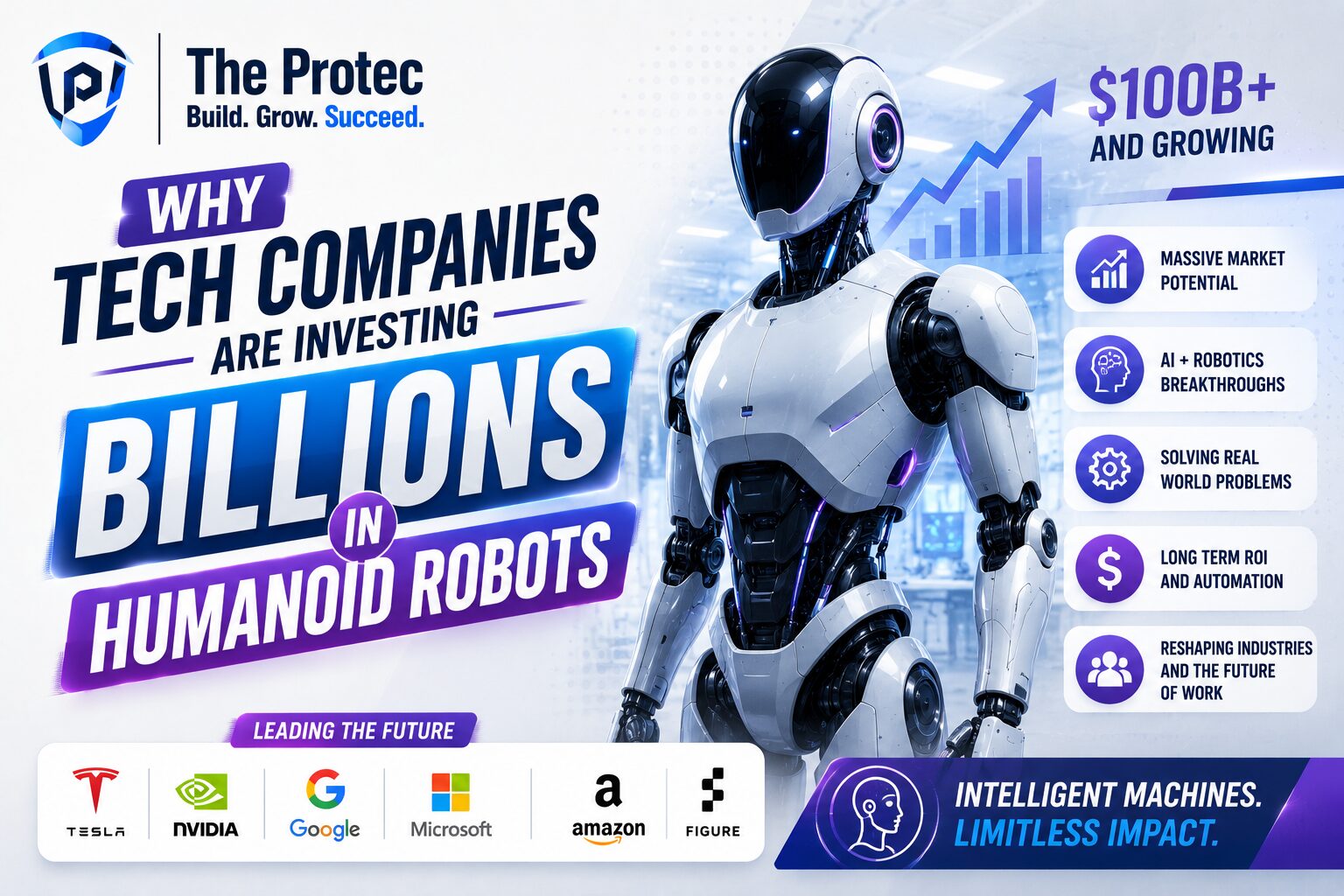
Tech companies are no longer treating humanoid robots as a futuristic side project. They are funding them as a serious business category with the potential to reshape manufacturing, logistics, elder care, retail, and even office work. The race is not just about building machines that walk and grasp like humans. It is about creating a new class of flexible labor platform that can operate in environments already designed for people, powered by rapid advances in AI, sensing, batteries, and model training.
That is why the robotics industry is seeing an extraordinary wave of investment. From major cloud and chip companies to automotive giants and startup-backed venture rounds, billions of dollars are being deployed to secure a stake in what many believe could become the next major computing platform. The logic is simple: if AI robots future systems can reliably perform useful work in the physical world, the companies that control the hardware, software, and deployment stack could capture enormous value.
But why humanoid robots specifically? Why not focus only on industrial arms, warehouse bots, or autonomous vehicles? The answer lies in versatility. A humanoid form factor is not the only path to automation, but it is one of the most adaptable. It can potentially use stairs, doors, tools, ladders, carts, and workstations built for humans. For companies seeking broad market reach, that flexibility is extremely attractive.
The Business Case Behind the Humanoid Robots Boom
At the core of the investment surge is a powerful economic argument: labor is expensive, scarce, and difficult to scale. In many regions, companies struggle to hire workers for repetitive, physically demanding, or dangerous jobs. At the same time, aging populations and shrinking labor pools are putting pressure on industries that depend on reliable human labor.
Humanoid robots promise a different cost structure. If they can be produced at scale and deployed with acceptable reliability, they may reduce labor bottlenecks and improve uptime in environments where human workers are costly or unavailable. For businesses, that means a robot is not just a piece of hardware; it is a capital asset that could generate returns through continuous operation, predictable performance, and software-driven upgrades.
This is especially compelling for sectors where tasks vary too much for a single-purpose machine. Traditional automation works best when the environment is stable and repetitive. The real world is messier. Packages fall, shelves change, parts differ, and workflows evolve. Humanoid robots are being designed to handle that variability better than fixed-purpose machines, which could unlock new levels of automation in existing facilities without requiring a complete redesign.
Why the Robotics Industry Is Moving So Fast Now
The robotics industry has existed for decades, but several recent breakthroughs have changed the pace of development. The first is artificial intelligence. Foundation models, multimodal perception, reinforcement learning, and simulation-based training have made it easier for robots to interpret scenes, understand commands, and improve behavior over time. Instead of being hard-coded for one task, modern robots can learn from demonstrations and adapt to new situations.
The second is hardware maturity. Battery density, motor efficiency, actuator control, and lightweight materials have all improved. These advances matter because humanoid robots need to balance power, mobility, safety, and runtime. Even a small improvement in each area can significantly change commercial viability.
The third is compute access. The same AI infrastructure that powers large language models is now helping drive robot perception and control. Companies already invested in GPUs, edge devices, and cloud platforms see humanoid robots as a natural extension of their core businesses. They are not just betting on machines; they are betting on the data, compute, and software layers that will support them.
For a useful overview of how robotics is moving into practical commercial use, the International Federation of Robotics provides industry data and trend coverage here: International Federation of Robotics.
The AI Robots Future Depends on Embodied Intelligence
The phrase AI robots future is more than a buzzword. It reflects a major shift in how companies think about automation. For years, AI was mostly digital: recommendation systems, chatbots, search ranking, fraud detection, and code generation. Humanoid robots bring AI into the physical world. That means perception, planning, manipulation, balance, and timing all need to work together in real time.
This is often called embodied intelligence, and it is one of the most promising frontiers in technology. A robot in a warehouse must understand what it sees, decide what to do, move safely, and recover when something unexpected happens. Unlike software running in the cloud, a robot cannot simply reload a page if it makes a mistake. Physical tasks have real-world consequences, which makes robustness a central challenge.
Tech companies are investing because embodied AI creates a long-term platform opportunity. A robot that can continuously improve through data collection, fleet learning, and simulation can become more valuable over time. The more units deployed, the more data gathered. The more data gathered, the better the models. That feedback loop is exactly what many of the biggest tech firms understand well from their experience in cloud software and consumer platforms.
Why Humanoid Robots Appeal to Big Tech and Investors
Humanoid robots attract tech companies for reasons that go beyond simple automation. They sit at the intersection of several high-growth markets: AI, semiconductors, cloud computing, industrial software, logistics, and services. That makes them strategically valuable to companies that want exposure to multiple revenue streams.
- Hardware sales: selling robots directly to businesses, factories, and service providers.
- Software subscriptions: charging for autonomy, fleet management, and task updates.
- Data services: using robot-generated data to improve models and optimize operations.
- Cloud and edge compute: processing perception and planning workloads at scale.
- Maintenance and support: recurring revenue from servicing deployed fleets.
For investors, humanoid robots represent a rare combination of hype and plausibility. The market is still early, but the use cases are concrete. Warehouse picking, machine tending, inspection, material handling, and facility support are all labor-intensive tasks with clear ROI potential. If even a portion of these jobs can be automated by humanoid robots, the addressable market could be enormous.
There is also a defensive motive. No major technology company wants to miss the platform shift if AI becomes embodied. The companies that backed mobile, cloud, and generative AI early often captured outsized gains. Many executives now believe robotics could be the next similar inflection point.
The Competitive Race Is About More Than the Robot Itself
It is tempting to think the winner will be the company with the most human-like robot. In reality, the race is broader and more strategic. Success will depend on an integrated stack that includes sensors, actuators, data pipelines, simulation environments, safety systems, and deployment software. The best robot body alone will not win if the learning system is weak or the service model is too expensive.
That is why tech companies are forming partnerships across the ecosystem. Chipmakers want to optimize inference and control at the edge. Cloud providers want to host training and fleet intelligence. Manufacturers want reliable systems that fit existing workflows. Startups want to move fast and iterate on task performance. The result is a complex competitive landscape where hardware and software are tightly linked.
There is also a strong first-mover advantage in data. A robot deployed in the real world generates motion traces, failure cases, and task outcomes that can be used to refine future models. Companies with early deployments may build a moat that becomes increasingly difficult for competitors to match. In robotics, learning from the physical world is expensive, slow, and operationally messy. That makes real-world fleet data incredibly valuable.
Where Humanoid Robots Can Deliver the Fastest ROI
Not every industry needs humanoid robots immediately. The most likely early wins are in environments where the tasks are repetitive, the surroundings are semi-structured, and labor shortages are persistent. These include warehouses, light manufacturing, automotive plants, distribution centers, and some commercial facilities.
In these settings, robots can perform straightforward but time-consuming jobs such as moving bins, unloading items, tending machines, delivering parts, scanning inventory, and inspecting equipment. Even if the robot is slower than a human in the beginning, it may still be financially attractive if it can work longer hours, reduce injuries, and fill staffing gaps.
Over time, the use cases may expand into service environments. Hotels, hospitals, airports, and retail locations all involve physical tasks that are repetitive enough to automate but varied enough to challenge single-purpose robots. Humanoid robots may be especially useful in these places because the human-built environment is already optimized for similar body proportions and movement patterns.
For companies evaluating ROI, the key metric is not whether the robot looks impressive. It is whether the robot can reduce total operating cost, improve throughput, and scale with minimal retraining or infrastructure changes.
What Still Holds the Market Back
Despite the excitement, humanoid robots are not ready to replace human labor at scale. Technical limitations remain significant. Dexterity is still hard. General-purpose manipulation is much harder than walking across a room. Safety certification is complex. Battery life remains limited. And reliability under unpredictable conditions is still a major hurdle.
There are also economic challenges. A robot that is too expensive to buy, deploy, or maintain will not achieve broad adoption. Businesses need clear payback periods, not just impressive demos. That means companies must bring down unit costs, simplify setup, and ensure that robots can operate with minimal supervision.
Another challenge is trust. In industries like healthcare, logistics, and public services, organizations will not adopt humanoid robots unless they can prove safety, consistency, and compliance. This is why many deployments begin in controlled environments before moving into more dynamic ones.
The near-term reality is that humanoid robots will likely augment human workers rather than replace them. They may handle the repetitive or physically demanding parts of a workflow while people focus on exception handling, oversight, and customer interaction.
How the Investment Boom Could Reshape the Robotics Industry
If current momentum continues, the robotics industry could undergo a major restructuring. Today, many robotics companies remain niche specialists. Tomorrow, the market could consolidate around platforms that combine robot hardware, AI models, simulation, and service delivery. This would mirror what happened in other technology categories where software ecosystems became more important than standalone devices.
One possible outcome is a layered market. A few large companies may build general-purpose humanoid platforms, while smaller firms focus on task-specific software, integration, and vertical applications. Another outcome is that the most valuable companies may not be the ones manufacturing the most robots, but the ones controlling the operating system, model layer, or deployment network.
There is also a geopolitical dimension. Countries and regions that lead in robotics will gain advantages in manufacturing productivity, supply chain resilience, and industrial competitiveness. That is one reason governments and large enterprises are paying close attention to humanoid robots now. The investment race is not only about near-term profits; it is also about long-term economic leadership.
For a broader perspective on robotics adoption and market expansion, see the McKinsey advanced electronics and robotics insights.
What to Watch Next in the AI Robots Future
The next few years will likely determine whether humanoid robots become a transformative business category or remain a limited specialty market. The most important signals to watch are deployment scale, task reliability, price compression, and software learning speed. A robot that can perform one impressive task is interesting. A fleet that can learn across sites and improve without constant engineering intervention is a breakthrough.
Key developments to monitor include:
- Commercial pilots moving into multi-site deployments
- Better manipulation and grasping in unstructured settings
- Lower-cost actuators and more efficient batteries
- Improved simulation-to-real-world transfer
- Integration with enterprise systems and workflow software
- Safety standards that support broader workplace adoption
If these trends continue, humanoid robots may become as strategically important to the next decade as cloud infrastructure was to the last one. The companies investing now are not just buying into a product category. They are positioning themselves for a future where AI does not only generate text, images, or code, but also moves through the physical world and performs useful work.
Conclusion
Tech companies are investing billions into humanoid robots because the opportunity is bigger than robotics alone. It is about labor economics, AI platform control, industrial productivity, and the future of embodied intelligence. Humanoid robots may not replace every machine or every worker, but they could become one of the most important tools in the AI robots future.
The race is already underway, and the winners will likely be the companies that combine strong hardware, intelligent software, real-world data, and a clear path to commercial deployment. In the robotics industry, that combination could define the next major technology platform.
FAQ
Why are tech companies investing so much in humanoid robots?
Because humanoid robots could automate labor in human-built environments without requiring major infrastructure changes. They also create opportunities in AI, cloud services, hardware, and industrial software.
What makes humanoid robots different from other robots?
Humanoid robots are designed to move and operate in spaces made for people. That makes them more flexible than many single-purpose robots, especially for tasks involving tools, stairs, doors, or mixed workflows.
Are humanoid robots ready for mass adoption?
Not yet. They are improving quickly, but reliability, battery life, safety, and cost still limit broad deployment. Most early adoption is happening in controlled commercial environments.
Which industries are most likely to adopt humanoid robots first?
Warehousing, manufacturing, logistics, automotive, and facility operations are likely early markets because they have repetitive tasks, labor shortages, and measurable ROI potential.
Will humanoid robots replace human workers?
In the near term, they are more likely to assist workers than replace them. Over time, they may take on more repetitive or physically demanding jobs, while humans handle supervision, exceptions, and customer-facing tasks.