








Contents
- 1 How AI Is Making Phishing Emails More Dangerous Than Ever
- 2 Why AI Has Changed the Phishing Game
- 3 How Attackers Use Generative AI to Build Better Scams
- 4 Why Email Scams AI Creates Are Harder to Detect
- 5 The Most Common AI Phishing Attack Techniques
- 6 What Makes AI Phishing Attacks So Effective
- 7 How Generative AI Helps Attackers Evade Security Controls
- 8 How Organizations Can Defend Against AI-Powered Phishing
- 9 What Employees Should Watch For Now
- 10 The Future of Phishing in an AI-Driven World
- 11 Conclusion
- 12 FAQ
- 12.1 How is AI used in phishing emails?
- 12.2 Why are AI phishing attacks more dangerous than traditional phishing?
- 12.3 Can email security tools stop email scams AI creates?
- 12.4 What is the biggest red flag in an AI-generated phishing email?
- 12.5 How can employees protect themselves from AI phishing attacks?
How AI Is Making Phishing Emails More Dangerous Than Ever
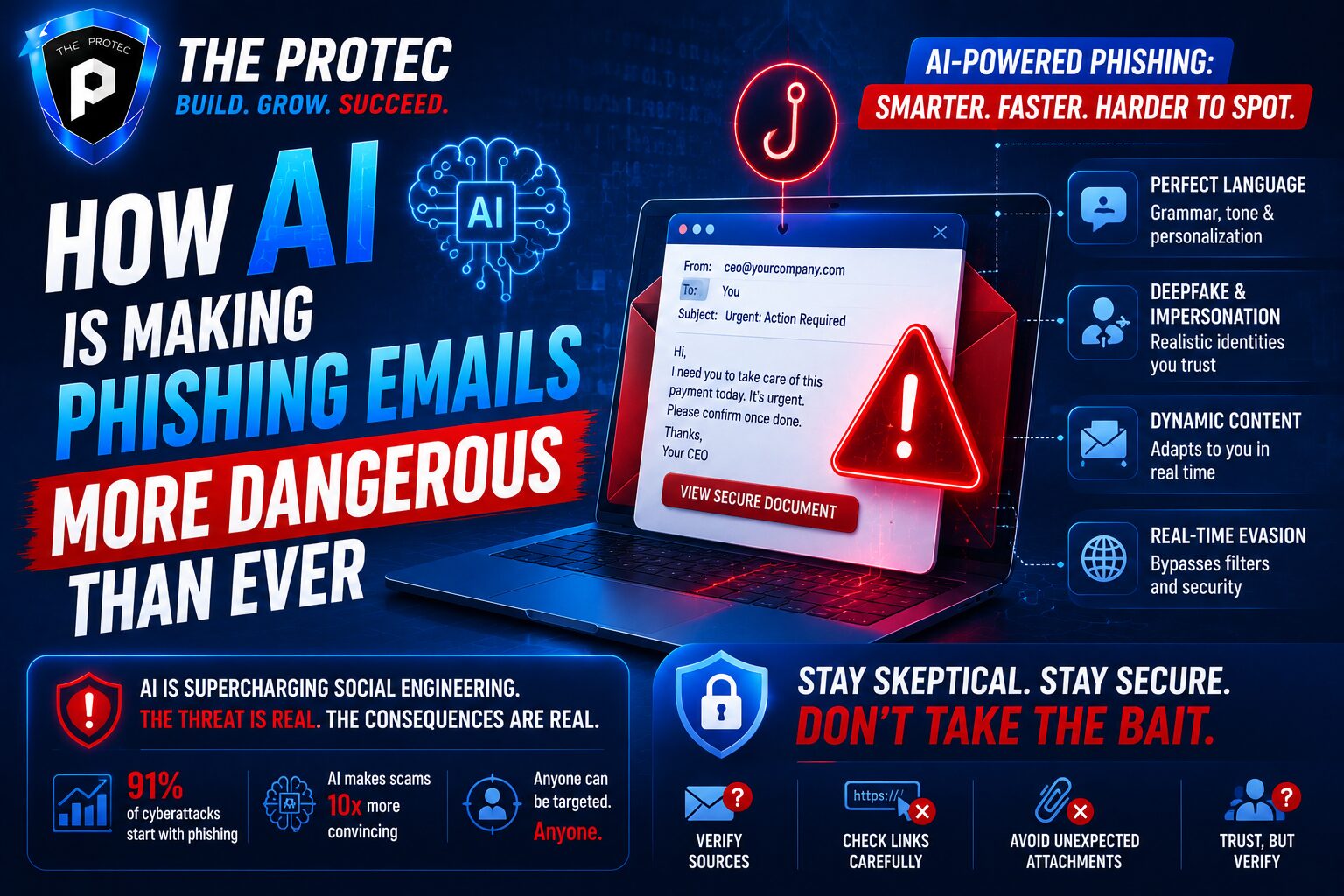
Phishing has always relied on deception, but artificial intelligence has raised the stakes dramatically. What used to be a giveaway-laden scam with awkward grammar and obvious red flags can now look polished, personalized, and alarmingly credible. Generative AI has given cybercriminals a new advantage: the ability to create persuasive email scams at scale, in multiple languages, and with far less effort than ever before.
This shift matters because phishing is still one of the most common entry points for cybercrime. The difference now is that AI phishing attacks are no longer limited to the stereotypical “broken English” message from a fake prince. Attackers can use large language models, voice cloning, scraped public data, and automation tools to craft email scams AI systems can generate in seconds. The result is a new wave of cybersecurity threats that are more adaptive, more targeted, and more difficult for employees and security tools to spot.
As organizations adopt AI across their operations, attackers are doing the same. They are using generative models to write better bait, test variations faster, and even mimic the tone of executives, vendors, and trusted partners. The old advice to “look for typos” is no longer enough. Today’s phishing defense requires understanding how AI changes the attack lifecycle from the first recon email to the final credential theft.
Why AI Has Changed the Phishing Game
Traditional phishing campaigns were often built on volume. Criminals would blast out thousands of messages hoping a small percentage of recipients would take the bait. AI has not replaced that strategy; it has made it smarter. Instead of generic spam, attackers can now produce tailored messages that speak directly to a target’s role, industry, or recent activity.
Generative AI improves phishing in several important ways:
- Speed: Attackers can draft convincing messages in seconds instead of spending hours writing and editing them manually.
- Personalization: AI can summarize public information about a target and insert relevant details that make the message feel authentic.
- Language quality: Emails are more grammatical, natural, and context-aware, reducing the warning signs people used to rely on.
- Scale: Criminals can generate hundreds of message variants to evade spam filters and A/B test the most effective wording.
- Localization: AI can produce fluent scams in many languages, expanding the reach of email scams AI enables globally.
These capabilities make phishing attacks more dangerous because they reduce the friction for attackers while increasing the likelihood that a recipient will trust the message. The barrier to producing a convincing scam has dropped sharply.
How Attackers Use Generative AI to Build Better Scams
Most AI phishing attacks start with reconnaissance. Attackers collect publicly available information from websites, social media profiles, corporate directories, press releases, conference speaker bios, and breached datasets. They then feed that material into AI tools to generate messages that feel relevant and legitimate.
For example, a cybercriminal targeting a finance team may use AI to write an email that references invoice timing, a vendor’s name, or an ongoing project. A scam aimed at HR may mention onboarding documents, payroll updates, or policy changes. A message to a busy executive may imitate a brief, urgent style that mirrors internal communication patterns.
In more advanced campaigns, attackers use AI to create entire conversation threads. They may start with a harmless-looking message, then continue the exchange with follow-up replies that answer questions, adjust tone, and build trust over time. This “conversation phishing” is particularly effective because it feels like a real interaction rather than a one-off scam.
Attackers also use AI for:
- Subject line testing: Generating many versions to see which ones get opened most often.
- Call-to-action optimization: Tweaking urgency language to improve click-through rates.
- Pretext generation: Creating believable stories around billing issues, password resets, shipping alerts, or compliance notices.
- Attachment and link baiting: Writing context that makes malicious links or files appear expected.
The key point is that AI does not need to make the scam perfect. It only needs to make it believable enough to lower suspicion and trigger action.
Why Email Scams AI Creates Are Harder to Detect
Email security tools have improved, but AI is forcing defenders to rethink what “suspicious” looks like. In the past, phishing filters could flag obvious language mistakes, strange formatting, and known malicious patterns. Today, AI-generated emails often bypass those cues because they read like professional business communication.
One of the biggest challenges is that generative AI can imitate organizational tone. A scam email may sound formal, casual, or technical depending on the intended victim. It may include the right length, formatting, and vocabulary to blend in with routine business correspondence. That makes both automated detection and human review more difficult.
AI phishing attacks are also more dynamic. Attackers can rapidly adjust the message if a campaign is blocked, if a domain is flagged, or if a recipient asks questions. Instead of abandoning the scam, they can regenerate the content and launch again with slight changes that evade detection.
Another issue is that many organizations rely on users to spot red flags manually. But if the message is clean, specific, and contextually correct, even experienced employees can be fooled. This is especially true when the email arrives during a busy workday and creates urgency around payments, account access, or executive requests.
Modern phishing is no longer just about malicious links. It can involve fake meeting invites, document-sharing requests, invoice fraud, MFA fatigue prompts, cloud storage impersonation, and business email compromise. AI makes each of these lures more believable.
The Most Common AI Phishing Attack Techniques
Although every scam is different, several attack patterns are becoming increasingly common as attackers integrate generative AI into their workflows.
1. Hyper-personalized spear phishing
This is one of the clearest examples of AI phishing attacks. Instead of mass-mailing random recipients, attackers use AI to create highly targeted messages for a specific person or small group. The email may reference recent projects, job titles, events, or internal terminology. The more relevant it feels, the more likely the target is to respond.
2. Executive impersonation
AI can help criminals mimic the tone and style of a CEO, CFO, or manager. While email alone does not create a perfect impersonation, it can make a request for an urgent payment, wire transfer, gift card purchase, or document review seem plausible. When combined with public data and organizational structure, the risk increases significantly.
3. Vendor and invoice fraud
Attackers often pose as suppliers, contractors, or service providers. AI helps them craft messages that resemble normal invoicing language and reference realistic billing cycles. These scams are effective because they exploit routine business processes rather than technical weaknesses.
4. Account verification and password reset scams
Many users are conditioned to respond quickly to account alerts. AI can generate convincing security notifications that imitate cloud platforms, payroll systems, or collaboration tools. The email may direct the user to a fake login page or a malicious file designed to harvest credentials.
5. Thread hijacking and reply spoofing
Attackers may infiltrate or imitate an existing email conversation, then use AI to continue the thread with contextually appropriate replies. Because the message appears inside a familiar exchange, recipients are much more likely to trust it.
6. Multilingual scam campaigns
One of the most powerful uses of AI in email scams is translation and localization. Attackers can create fluent phishing emails in different languages, enabling global campaigns with fewer barriers. This expands the attack surface for multinational companies and cross-border suppliers.
What Makes AI Phishing Attacks So Effective
The success of a phishing campaign depends on psychology as much as technology. AI amplifies the psychological tactics that already make phishing work: urgency, authority, curiosity, fear, and convenience.
For example, a scam email may say a payment is overdue, a file is expiring, or an executive needs a response immediately. AI can refine the wording to create just enough pressure without sounding exaggerated. It can also learn which emotional triggers are most effective by generating multiple versions of the same message.
Another reason these scams work is timing. Attackers can use AI and automation to send messages when victims are most likely to be distracted: early morning, late afternoon, during travel, or near the end of a reporting period. A convincing email arriving at the right moment can be enough to override caution.
AI also improves consistency. Older phishing emails often contained contradictions, awkward formatting, or mismatched references. Generative models can maintain a coherent narrative across a thread, attachment, and landing page. That consistency builds trust, and trust is exactly what attackers want.
As a result, email scams AI produces are not just more polished. They are more strategic.
How Generative AI Helps Attackers Evade Security Controls
Security teams are right to worry about model-driven phishing because it creates new opportunities for evasion. Spam filters and secure email gateways look for patterns, but AI-generated scams can be varied enough to avoid simple signature-based detection.
Attackers can repeatedly rewrite the same message until it no longer resembles known malicious templates. They can change sentence structure, swap synonyms, alter formatting, and vary the call to action. This rapid mutation helps campaigns stay active longer.
Some attackers also use AI to test how their messages perform against security filters before sending them broadly. If one version gets blocked, they generate another. This makes the attack lifecycle faster and more resilient.
There is also a broader ecosystem issue. Criminals increasingly combine AI-generated text with domain spoofing, lookalike domains, QR-code phishing, malicious attachments, and compromised accounts. Even if one layer is caught, another may still succeed. That is why phishing has become one of the most persistent cybersecurity threats facing businesses today.
How Organizations Can Defend Against AI-Powered Phishing
Defending against AI phishing attacks requires a layered approach. No single control will stop every scam, especially when the attacker can adapt quickly. The best strategy combines technology, process, and user awareness.
Strengthen email authentication
Implement and monitor DMARC, SPF, and DKIM to reduce domain spoofing and improve visibility into fraudulent messages. These controls do not stop every scam, but they make it harder for attackers to impersonate your brand or abuse your domain.
Use behavior-based email security
Modern email security platforms should analyze sender reputation, message intent, attachment behavior, URL reputation, and anomalous communication patterns. Behavior-based detection is more effective against email scams AI generates than simple keyword filtering.
Train employees to verify requests out of band
Employees should be taught to confirm high-risk requests through a separate channel, especially anything involving payments, account changes, or sensitive data. A quick phone call or message through a known internal channel can stop a scam before it spreads.
Reduce exposed information
Attackers rely on public data to personalize scams. Review what your organization and employees share online, including job titles, vendor relationships, organizational charts, project names, and travel details. Less exposed information means less material for attackers to weaponize.
Harden identity controls
MFA is still essential, but it should not be your only line of defense. Use phishing-resistant authentication methods where possible, monitor for unusual login behavior, and enforce least-privilege access. If a credential is stolen, strong identity controls can limit the damage.
Establish verification rules for financial workflows
Payment and vendor-change requests should require multi-step verification and documented approval. AI-driven business email compromise often succeeds because organizations allow exceptions for urgency. Tightening workflow controls can eliminate that weakness.
Run realistic simulations
Phishing awareness training should reflect the quality of modern scams. If your test messages still look obviously fake, employees will not be prepared for the polished, context-aware attacks they actually face. Simulations should include executive impersonation, invoice fraud, and credential-harvesting lures.
What Employees Should Watch For Now
Because AI-generated emails can be polished, employees need to focus less on grammar and more on behavior and context. Red flags may include unusual urgency, unexpected payment requests, slight changes in sender details, requests to bypass policy, or links that do not match the organization’s normal workflow.
It is also wise to be cautious when an email asks for secrecy, discourages verification, or pressures you to act outside normal procedures. If a message feels slightly off, even if it looks professional, treat that discomfort as a signal to pause and verify.
Employees should also watch for subtle signs of impersonation:
- Display names that look correct but email addresses that differ by one character
- Unexpected changes in tone from a known sender
- Requests that arrive at unusual times
- Attachments or links that require immediate action
- Messages that reference real projects but ask for an abnormal task
The safest habit is to verify before acting. In the age of generative AI, a convincing message is not proof of legitimacy.
The Future of Phishing in an AI-Driven World
Phishing will continue to evolve as generative AI becomes easier to use and harder to regulate. Attackers are likely to pair text generation with voice cloning, synthetic identities, automated recon, and agentic workflows that can run scams with minimal human supervision. That means future phishing campaigns may become more interactive, more believable, and more persistent.
Defenders should expect more “living” scams that adapt in real time. A message might begin as an email, continue in chat, and then escalate to a fake voice call or meeting invite. The boundaries between channels will blur, and that is exactly what makes these campaigns so effective.
At the same time, AI will also help security teams detect suspicious patterns faster, analyze message behavior, and improve response times. The challenge is that both sides are using the same technology. The organizations that stay ahead will be those that treat phishing not as a simple awareness issue, but as a dynamic risk requiring continuous controls and training.
If your team still thinks phishing is mainly about sloppy emails and obvious scams, it is time to update that assumption. AI has made phishing smarter, faster, and more scalable. The threats are more convincing, the detection problem is harder, and the consequences of a single mistake can be severe.
Conclusion
AI phishing attacks are dangerous because they combine speed, personalization, and realism in a way that older scams could not. Generative AI helps criminals write better messages, imitate trusted voices, and adapt campaigns in real time. That means email scams AI enables are not just a larger version of the same old problem; they are a more sophisticated threat class altogether.
The good news is that organizations are not helpless. Strong email authentication, behavior-based detection, identity protections, verified approval workflows, and realistic user training can significantly reduce risk. But the mindset has to change. Phishing in the AI era is no longer about spotting bad grammar. It is about recognizing manipulation, verifying requests, and building systems that are harder to fool.
As cybercriminals continue to adopt generative AI, security teams and employees alike must stay alert. The organizations that adapt fastest will be the ones best positioned to resist the next generation of cybersecurity threats.
FAQ
How is AI used in phishing emails?
Attackers use AI to write polished messages, personalize content using public data, generate multiple versions for testing, and mimic the tone of trusted contacts. This makes phishing emails more convincing and harder to detect.
Why are AI phishing attacks more dangerous than traditional phishing?
They are more dangerous because they are faster to create, easier to personalize, and more likely to bypass basic detection methods. AI also helps attackers scale campaigns and adapt quickly when defenses block them.
Can email security tools stop email scams AI creates?
Some can detect suspicious behavior, but no tool is perfect. The best protection combines advanced email security, strong authentication, user verification procedures, and employee awareness training.
What is the biggest red flag in an AI-generated phishing email?
The biggest red flag is usually not grammar anymore. It is an unusual request, unexpected urgency, or a message that pressures you to bypass normal approval steps or verify nothing through official channels.
How can employees protect themselves from AI phishing attacks?
Employees should verify unusual requests out of band, avoid clicking unexpected links, inspect sender details carefully, and report suspicious emails immediately. When in doubt, pause and confirm before taking action.