








Contents
- 1 What Are Zero Knowledge Proofs?
- 2 Why Zero Knowledge Proofs Matter in Web Security
- 3 How Zero Knowledge Proofs Work in Simple Terms
- 4 ZKP Authentication: A Better Way to Log In
- 5 Zero Knowledge Proofs vs Traditional Authentication
- 6 Where Web Security Crypto Is Heading
- 7 Benefits of Zero Knowledge Proofs for Security Teams
- 8 Common Challenges and Limitations
- 9 Practical Use Cases in Modern Web Apps
- 10 How Developers Can Start Thinking About ZKP Authentication
- 11 Best Practices for Secure ZKP Adoption
- 12 FAQ: Zero Knowledge Proofs in Web Security
- 13 Conclusion: Why ZKPs Are Important for the Future of Web Security
What Are Zero Knowledge Proofs?
Zero knowledge proofs are a cryptographic method that lets one party prove something is true without revealing the underlying information. In simple terms, you can prove you know a secret without showing the secret itself. That idea sounds almost magical, but it is one of the most practical and important innovations in modern cryptography.
For web security, this matters because authentication has always involved a tradeoff between convenience and risk. Traditional systems ask users to reveal something sensitive, such as a password, a token, or a one-time code. If that secret is stolen, intercepted, reused, or leaked from a database, attackers can often gain access. A zero knowledge proof changes the model. Instead of sending the secret, the user proves possession of the secret in a way that can be verified mathematically.
This is why zero knowledge proof technology is becoming a serious topic in web security crypto discussions. It enables privacy-preserving systems that can verify identity, eligibility, or authorization without exposing the data behind the claim. For users, this can mean safer logins and less data sharing. For businesses, it can mean reduced liability and better protection against common attack paths.
Why Zero Knowledge Proofs Matter in Web Security
Web security has long relied on secret exchange. Passwords, session cookies, API keys, and recovery codes all create possible points of failure. Even strong security programs can be weakened by phishing, credential stuffing, database breaches, or insecure third-party integrations. Zero knowledge proofs offer a different way to think about trust.
Instead of asking, “Can this user show me the secret?” a system asks, “Can this user prove they know the secret?” That distinction is powerful. If the proof is designed correctly, the verifier learns nothing about the secret itself. This can drastically reduce the amount of sensitive data moving across the web.
In today’s security landscape, the appeal is even stronger because privacy expectations are rising. Users want fewer passwords, less tracking, and better protection of personal information. Companies want to reduce the blast radius of breaches and comply with stricter privacy requirements. Zero knowledge proofs support both goals by helping systems verify facts without collecting unnecessary data.
How Zero Knowledge Proofs Work in Simple Terms
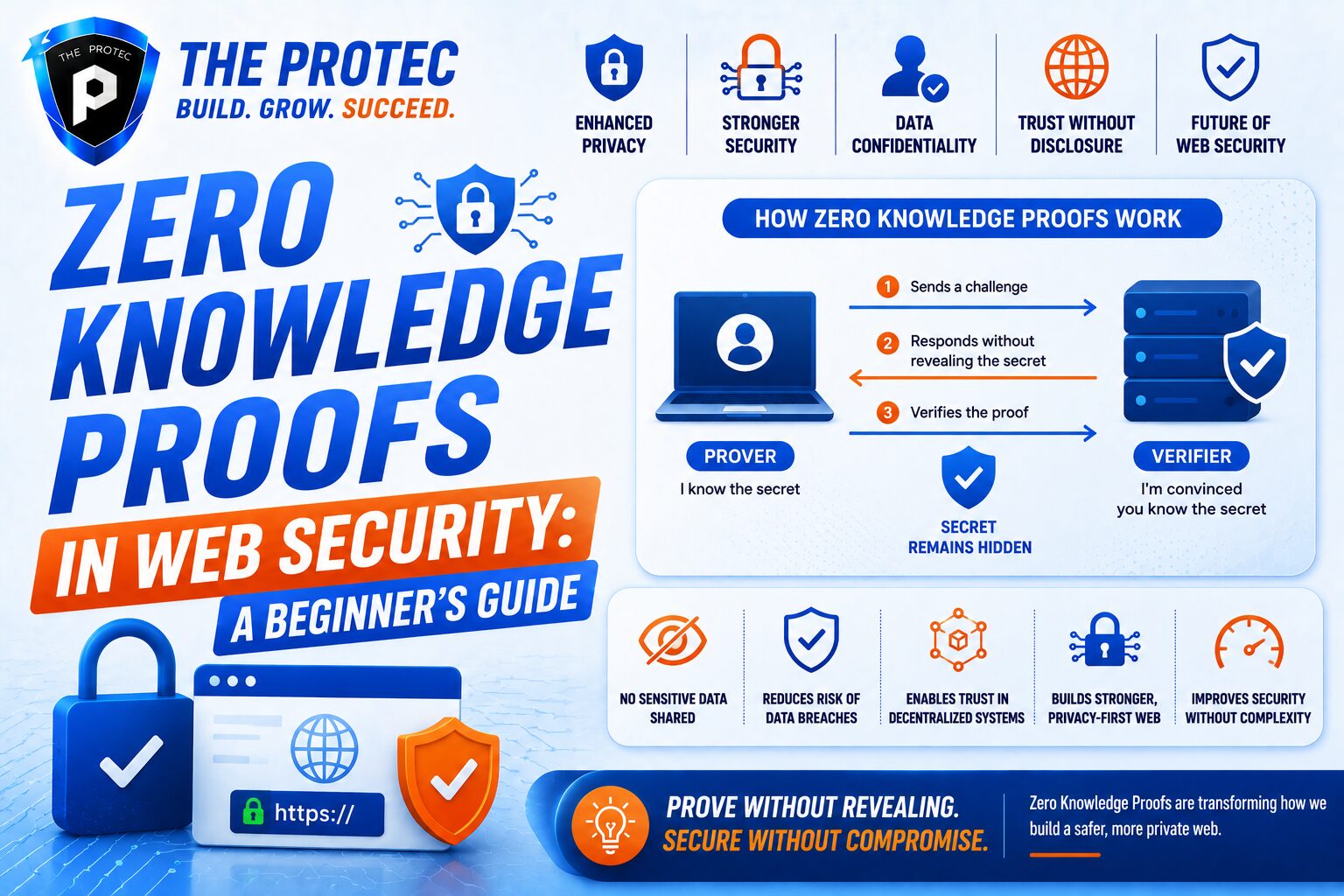
At a high level, a zero knowledge proof involves two roles: the prover and the verifier. The prover wants to demonstrate that a statement is true. The verifier checks the proof and becomes convinced the statement is valid. Crucially, the verifier does not learn the secret itself.
A classic way to understand this is with a maze or puzzle analogy. Imagine someone claims they know the hidden route through a maze. Instead of describing the path, they enter the maze and return through the correct exit repeatedly under different conditions. Each successful round increases confidence that they truly know the route. In cryptography, the process is formalized with mathematical proofs rather than physical demonstrations.
There are many types of zero knowledge proof systems, but modern web applications often use zk-SNARKs or zk-STARKs because they can be compact and efficient enough for practical use. These systems are designed to prove complex statements, such as “this user is over 18,” “this transaction is valid,” or “this identity matches the registered account,” without exposing the underlying personal data.
For developers, the important takeaway is that a proof can be generated from private inputs and then verified using public parameters. The verifier only sees the proof and the statement being checked. If the proof passes, the system accepts the claim.
ZKP Authentication: A Better Way to Log In
ZKP authentication is one of the most promising web security use cases. Instead of sending a password to a server, the user proves they know the password in a cryptographic way. The password itself never has to cross the network in readable form, and in some designs it never even needs to be stored in a recoverable form on the server.
This approach can reduce many common risks. Phishing becomes harder because there is no reusable secret to trick the user into entering on a fake site. Database breaches become less damaging because the server may not store plaintext passwords or easily exploitable equivalents. Replay attacks also become more difficult because each proof can be tied to a specific session or challenge.
ZKP authentication is not limited to passwords. It can support login flows based on device possession, membership in a group, possession of a credential, or satisfaction of a policy. That flexibility makes it useful in enterprise environments, consumer apps, fintech platforms, and decentralized applications.
A practical example is a system where a user proves they have a valid credential from an identity provider without disclosing the credential itself. Another example is proving that a user belongs to a protected group without revealing which member they are. These are not theoretical use cases. They are increasingly relevant in modern privacy-focused product design.
Zero Knowledge Proofs vs Traditional Authentication
Traditional authentication methods still dominate the web, but they come with familiar weaknesses. Passwords can be reused across sites, guessed, phished, leaked, or brute-forced. SMS-based one-time passwords improve security somewhat, but they are vulnerable to SIM swapping and interception. Even app-based MFA can be undermined by session hijacking or social engineering.
Zero knowledge proof systems aim to remove the need to reveal the secret in the first place. That means the authentication event itself leaks far less information. In a well-designed ZKP authentication flow, the server verifies a mathematical claim rather than comparing a transmitted secret against stored data.
This does not mean every traditional mechanism disappears overnight. Many organizations will use ZKPs alongside passkeys, hardware security keys, or risk-based authentication. The real value is that ZKPs can shrink the attack surface and make the overall system more resilient. They are especially attractive when the application handles highly sensitive data, must minimize data collection, or wants to improve user privacy without sacrificing security.
Where Web Security Crypto Is Heading
Web security crypto is moving toward privacy-preserving verification. This is one reason zero knowledge proof research and product adoption continue to accelerate. Developers are increasingly interested in systems that can verify identity, attributes, balances, permissions, or compliance conditions without exposing the data behind them.
A major trend is the use of ZKPs in digital identity. Instead of presenting a full identity document or a complete personal profile, users may prove only the necessary attribute. For example, they could prove age eligibility, residency status, or account ownership without sharing their exact date of birth or address.
Another important trend is selective disclosure. Businesses want to reduce the amount of personal data they handle, both to improve trust and to reduce compliance burden. Zero knowledge proofs make it possible to prove a statement while disclosing only the minimum necessary information. This aligns with modern privacy principles and supports data minimization strategies.
There is also growing interest in combining ZKPs with passkeys and WebAuthn-based authentication. Passkeys already reduce password risk by using public-key cryptography and device-bound credentials. ZKPs can extend that privacy-first direction by reducing what the server learns during login and authorization. Together, these technologies point toward a web that is less dependent on shared secrets and more reliant on verifiable cryptographic claims.
Benefits of Zero Knowledge Proofs for Security Teams
Security teams are often focused on reducing credential theft, breach impact, and compliance risk. Zero knowledge proofs can help on all three fronts.
- Less sensitive data exposure: The system can verify claims without collecting the underlying secret or attribute.
- Lower breach impact: If a database is compromised, there may be less useful information for attackers to exploit.
- Better phishing resistance: Users are not repeatedly typing secrets into websites that can be copied or spoofed.
- Reduced replay risk: Properly designed proofs can be session-specific and resistant to reuse.
- Privacy by design: Applications can verify identity or eligibility while sharing less personal data.
These benefits are especially relevant for organizations that handle financial data, health data, government records, or large identity datasets. In such environments, even a small reduction in exposed data can have a meaningful security and compliance impact.
Common Challenges and Limitations
Zero knowledge proofs are powerful, but they are not a universal fix. They introduce their own implementation and operational challenges. One issue is complexity. ZKP systems are mathematically advanced, and a flawed design can undermine the very security they are meant to provide. Proper implementation requires careful protocol selection, rigorous testing, and experienced cryptographic review.
Another challenge is performance. Some proof generation steps can be resource-intensive, especially on mobile devices or low-power hardware. Although modern proof systems have improved significantly, developers still need to consider latency, scalability, and user experience. A secure login that takes too long will be difficult to adopt.
There is also the question of trust assumptions. Some proof systems rely on setup procedures, trusted parameters, or circuit design choices that must be handled correctly. If the setup is compromised or the circuit does not accurately model the intended statement, the proof may not provide the expected guarantees.
Finally, ZKPs work best when integrated into a broader security architecture. They should complement, not replace, sound identity management, secure device handling, rate limiting, monitoring, and incident response. The strongest systems use multiple layers of defense.
Practical Use Cases in Modern Web Apps
Zero knowledge proofs are beginning to show up in real products and architecture decisions. One common use case is identity verification with minimal disclosure. A user may prove they satisfy an access policy without sending all the personal data that supports that claim.
Another use case is secure membership verification. For example, a private community or enterprise portal can allow access to approved users without revealing the full membership list. This is useful when the membership itself is sensitive.
In fintech, ZKPs can help verify transaction legitimacy or account ownership while reducing exposure of account details. In healthcare, they can support privacy-preserving credential checks, such as confirming eligibility for services without disclosing unnecessary medical information. In decentralized applications, ZKPs are widely used to preserve anonymity and validate on-chain or off-chain claims without revealing every detail to the public.
These use cases show why the topic keeps gaining traction. ZKPs are not just an abstract cryptography concept. They are becoming an enabling technology for safer, more privacy-conscious product design.
How Developers Can Start Thinking About ZKP Authentication
For beginners, the best way to approach ZKP authentication is to start with the problem, not the mathematics. Ask what sensitive information your application currently asks users to reveal. Then ask whether the application truly needs that information or only needs proof of a fact.
For example, if your system only needs to know that a user is authenticated, does it need the password itself? If it only needs to know that a user is eligible for access, does it need the full identity document? If it only needs to know that a transaction follows certain rules, does it need every private input in clear form?
From there, developers can evaluate whether a zero knowledge proof system is a good fit. The decision will depend on the use case, performance goals, regulatory requirements, and the maturity of the team. In many cases, a hybrid model is best: use ZKPs where privacy and minimization matter most, and use established controls like MFA, rate limiting, and secure session management alongside them.
Teams that want to explore further should work with trusted documentation and community resources. A good starting point for conceptual understanding is the Ethereum Foundation’s overview of zero knowledge proofs, which explains the core ideas in accessible language. For a broader cryptographic perspective, the zkProof community offers research-oriented material and ecosystem insights.
Best Practices for Secure ZKP Adoption
Adopting zero knowledge proofs successfully requires more than choosing the right library. Teams should treat ZKP systems as security-critical infrastructure.
- Define the exact statement to prove: Be precise about what the verifier should learn and what must remain hidden.
- Minimize the proof surface: Keep circuits or proof logic as small and focused as possible.
- Test against edge cases: Validate that proofs fail safely when inputs are invalid or manipulated.
- Review performance early: Measure proof generation and verification costs on target devices and workloads.
- Pair with strong authentication policies: Use device security, session controls, and monitoring as part of the design.
- Plan for key and parameter management: Treat setup material and cryptographic assets as highly sensitive.
When these practices are followed, ZKPs can become a strong part of a secure web architecture rather than an experimental add-on.
FAQ: Zero Knowledge Proofs in Web Security
What is a zero knowledge proof in simple words?
A zero knowledge proof lets someone prove they know a secret or that a statement is true without revealing the secret itself. It is a privacy-preserving way to verify information.
How does ZKP authentication improve security?
ZKP authentication improves security by reducing the need to transmit or store reusable secrets. That lowers the risk of phishing, replay attacks, and database leaks exposing credentials.
Is zero knowledge proof only used in blockchain?
No. While ZKPs are popular in blockchain and crypto systems, they are also highly relevant to web security, digital identity, access control, compliance checks, and privacy-preserving authentication.
Are zero knowledge proofs hard to implement?
They can be complex, especially for teams new to cryptography. However, modern tooling and libraries are making them more accessible. The key is to start with a clear use case and use experienced review for security-critical deployments.
Conclusion: Why ZKPs Are Important for the Future of Web Security
Zero knowledge proofs are changing how we think about trust online. Instead of handing over secrets, users can prove what matters and keep the rest private. That shift is especially important in web security, where authentication has historically depended on shared secrets that are easy to steal or misuse.
As web security crypto continues to evolve, ZKP authentication stands out as one of the most promising approaches for privacy-preserving login and authorization. It offers a path toward systems that are safer, more selective in what they reveal, and better aligned with modern privacy expectations.
For beginners, the main idea is simple: zero knowledge proof technology lets you verify truth without exposing the underlying data. For security teams and developers, that idea opens the door to stronger authentication systems, reduced breach risk, and better user trust. That is why ZKPs are no longer just a research topic. They are becoming a practical part of the future web security stack.