








Contents
- 1 How Modern SSDs Are Outpacing Some Server Networks
- 2 Why SSDs Are Suddenly Competing With Network Speeds
- 3 What Makes NVMe SSD Speed So High?
- 4 PCIe Gen5: The Game-Changer for Enterprise Storage Performance
- 5 When Storage Becomes Faster Than the Network
- 6 Enterprise Workloads That Expose the Gap
- 7 Why Fast SSD Technology Is More Than Raw Throughput
- 8 The Network Is Still Important, But the Balance Has Changed
- 9 Thermals, Power, and the Real-World Limits of Speed
- 10 What This Means for IT Teams and Infrastructure Planning
- 11 Storage Innovation Is Reshaping the Data Center
- 12 FAQ
- 13 Conclusion
How Modern SSDs Are Outpacing Some Server Networks
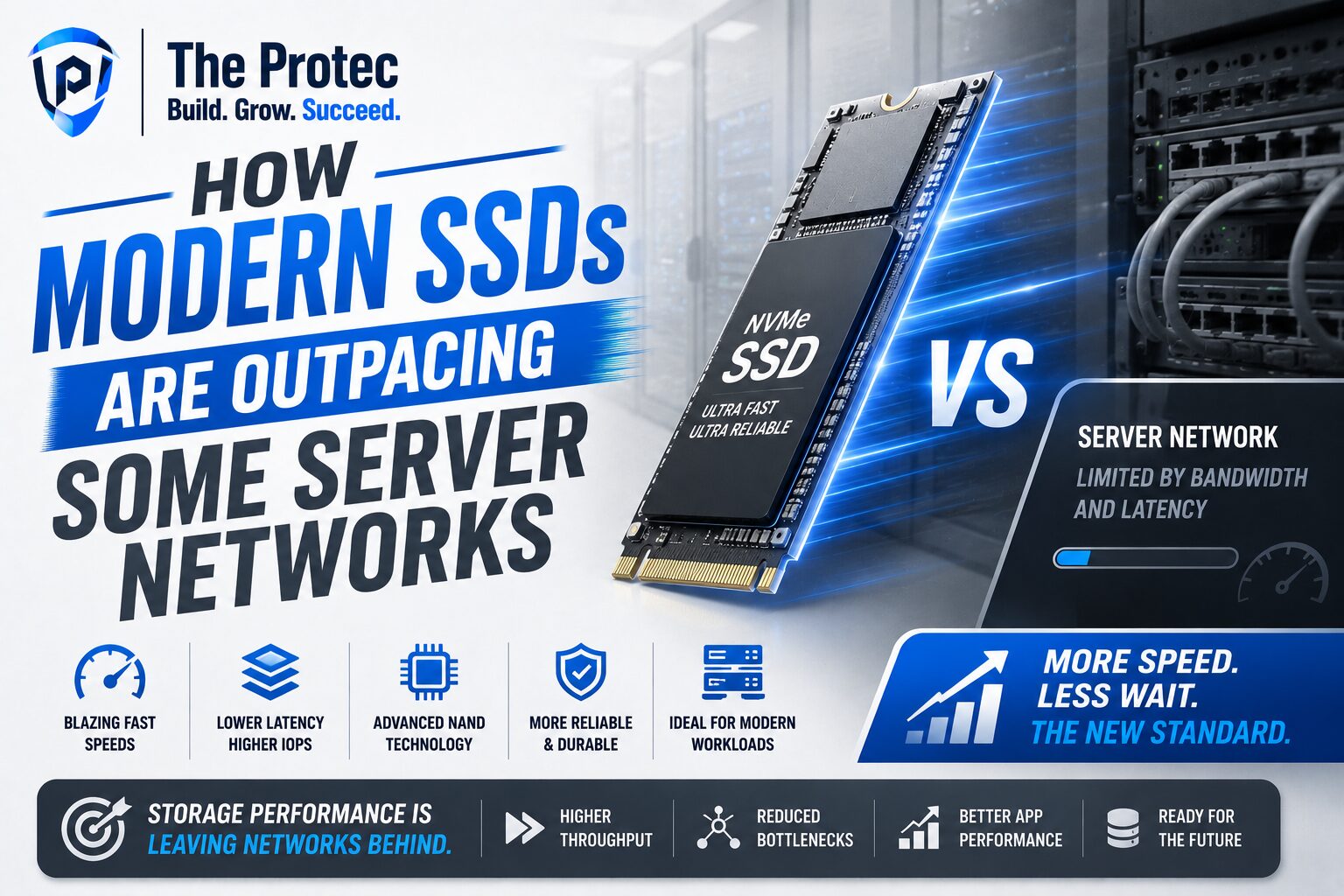
For years, the standard assumption in IT was simple: the network was faster than storage, and storage was the bottleneck. That assumption is no longer safe. Today’s high-end SSDs, especially PCIe Gen5 NVMe drives, are pushing performance so far that in some environments they can move data faster than the server network feeding them. This shift is not just a lab curiosity. It reflects a real change in how fast SSD technology, controller design, NAND flash, and enterprise infrastructure are evolving.
The result is a new performance landscape. In many modern workloads, the bottleneck is no longer raw drive speed alone. It may be the network fabric, CPU overhead, PCIe lane allocation, software stack, or storage architecture itself. Understanding this change matters for anyone responsible for application performance, database responsiveness, AI pipelines, virtualization, or high-throughput analytics. The rise of NVMe SSD speed is no longer just about faster local storage; it is about storage innovation redefining what the rest of the system must be able to keep up with.
Why SSDs Are Suddenly Competing With Network Speeds
The reason modern SSDs can rival or exceed some server networks comes down to a combination of engineering gains. NAND flash has become denser and more efficient, controllers have become more powerful, and the NVMe protocol is designed to reduce latency and increase parallelism. Meanwhile, PCIe generations have continued to expand bandwidth dramatically.
In older systems, SATA SSDs were a major improvement over hard drives, but they were still limited by the SATA interface. NVMe changed that by connecting storage directly to the PCIe bus. PCIe Gen4 expanded the ceiling, and PCIe Gen5 pushed it much further. As a result, a single enterprise SSD can now deliver read and write performance that would have been exceptional only a few years ago. In some cases, the drive is no longer waiting on the network; the network is the slower component.
This is especially visible in distributed environments where servers rely on 25GbE, 40GbE, or even 100GbE networking, but the actual network path includes switches, congestion, protocol overhead, and software layers that reduce effective throughput. A modern PCIe Gen5 SSD, by contrast, can sustain extremely high local transfer rates with very low latency, especially when paired with an optimized platform.
What Makes NVMe SSD Speed So High?
NVMe SSD speed is the product of multiple layers of innovation working together. Unlike legacy storage protocols, NVMe was built for flash memory and parallel access. That means it can issue many more commands at once, with lower overhead and much shorter command queues than older interfaces.
The most important contributors to fast SSD technology include:
- PCIe bandwidth: Each new PCIe generation doubles the available lane throughput, allowing SSDs to move more data with less interface limitation.
- NVMe command efficiency: NVMe reduces CPU overhead and supports deep parallelism, helping modern drives handle many I/O operations simultaneously.
- Advanced controllers: Enterprise-grade controllers manage flash translation, wear leveling, error correction, and queue handling more intelligently than ever.
- High-speed NAND: TLC and QLC flash have improved, while caching and firmware tuning help maintain better sustained performance.
- Better thermal design: Modern SSDs use more robust heat management to preserve performance under heavy load.
The key point is that these improvements are cumulative. Faster interfaces alone would not create this leap, and smarter firmware without bandwidth would still be constrained. The power of modern SSDs comes from combining all these advancements into a storage platform that can keep up with demanding enterprise workloads.
PCIe Gen5: The Game-Changer for Enterprise Storage Performance
PCIe Gen5 is one of the biggest reasons modern SSDs are now challenging server network performance. Compared to PCIe Gen4, Gen5 doubles the available bandwidth per lane. For x4 SSDs, that means a major jump in theoretical throughput, and enterprise-class drives are beginning to approach the limits of what a single device can practically sustain in real-world conditions.
In practice, PCIe Gen5 SSDs are not just faster on paper. They also reduce the time required to serve data to applications that depend on low latency and high concurrency. Database systems, AI training data pipelines, high-frequency analytics, and large-scale virtualization environments all benefit from this improvement. The faster the drive can deliver data, the less time compute nodes spend waiting.
This is where the phrase enterprise storage performance becomes more than marketing language. In modern environments, performance is not only measured in IOPS or sequential throughput. It is measured by how quickly the storage layer can keep up with compute, networking, and application demand. PCIe Gen5 helps close the gap between storage and processing, which is exactly why many infrastructure teams are reevaluating their architecture.
For a useful technical overview of PCIe and its bandwidth scaling, see PCI-SIG.
When Storage Becomes Faster Than the Network
It may sound surprising, but there are several common cases where an SSD can outpace the network attached to the server. This usually happens when local storage is capable of moving data at a rate higher than the server can transmit or receive it over the network fabric.
Examples include:
- Virtualization hosts: A server with multiple Gen5 SSDs may deliver local storage performance that exceeds the effective throughput of its uplink, especially under mixed workloads.
- Backup and restore operations: Fast local SSD arrays can ingest or restore data faster than the network can supply it from remote systems.
- Content creation and media workflows: Large files can be moved locally at extreme speed, while network transfer remains bounded by NIC and switch performance.
- AI and machine learning pipelines: Data staging on local SSDs can outrun the network path used to bring datasets into the server.
- High-frequency transactional systems: Applications may be limited more by network latency than by local SSD responsiveness.
In these situations, the storage device is not the weak link. Instead, the network, protocol overhead, or remote storage design becomes the slower part of the path. That is a major architectural change, and it means IT teams must think differently about balance across the stack.
Enterprise Workloads That Expose the Gap
Not every workload will notice this shift equally. The environments that benefit most from modern SSDs are the ones that combine heavy throughput, low latency, and lots of simultaneous requests. These are exactly the workloads where storage innovation creates measurable business value.
Databases are a clear example. Transaction-heavy databases need predictable latency, and faster NVMe SSD speed improves response times for writes, reads, and log operations. In real deployments, the storage layer can often serve requests faster than the network can distribute them across clustered systems or remote tiers.
Virtual desktop infrastructure is another example. Boot storms, login storms, patching, and profile loads can overwhelm older storage systems. Modern SSDs absorb these spikes much more effectively, sometimes so efficiently that the network path to remote storage becomes the next constraint.
AI and analytics workloads are now a major driver of storage modernization. Large datasets must often be staged quickly before processing begins. If the SSD can deliver data faster than the network can deliver it from remote sources, local storage becomes the performance anchor for the pipeline.
Edge and branch deployments also benefit. In many edge sites, the network is intentionally limited or inconsistent. A fast local SSD can outperform the available network path by a wide margin, improving responsiveness and resilience.
Why Fast SSD Technology Is More Than Raw Throughput
It is tempting to think the story is only about speed numbers, but fast SSD technology is really about consistency. A drive that can peak at high throughput but collapse under sustained load is not enough for enterprise use. Modern SSDs are increasingly designed to maintain performance during long write sessions, mixed workloads, and thermal pressure.
That matters because servers rarely run simple workloads. They run mixed I/O patterns, multiple VMs, background indexing, logging, checkpointing, replication, and caching. Enterprise storage performance depends on how the SSD behaves when the environment is messy, not just when the benchmark is clean.
Newer SSDs use firmware optimizations, larger overprovisioning strategies, better garbage collection, and more advanced error correction to hold up under stress. The best drives also include power-loss protection and endurance features that make them suitable for business-critical deployments. This is one reason the latest storage innovation is so important: it is improving both speed and reliability at the same time.
The Network Is Still Important, But the Balance Has Changed
None of this means the network no longer matters. It absolutely does. In fact, modern SSD performance increases the pressure on the network to be equally modern. If storage is capable of delivering more data than the network can carry, then the network becomes the obvious choke point.
That is why many organizations are pairing Gen5 storage with faster networking, better switch design, and more efficient data paths. In some cases, this means upgrading to higher-bandwidth Ethernet, reducing oversubscription, or redesigning storage access patterns so that the network is not forced to carry unnecessary traffic.
It also highlights the value of local-first architecture in certain scenarios. If applications can work from nearby fast storage rather than constantly reaching across the network, they can achieve lower latency and better stability. This is one reason edge computing and distributed compute are gaining momentum alongside storage innovation.
The most important takeaway is that the balance has changed. The storage layer is no longer a passive follower in the system. It can be a leading performance component, and in some cases, it is now faster than the network path around it.
Thermals, Power, and the Real-World Limits of Speed
As SSDs become faster, they also become more demanding. PCIe Gen5 drives, especially in dense enterprise systems, can generate significant heat under sustained load. Thermal throttling can reduce performance if the system does not have adequate airflow or heatsinking. This is why fast SSD technology must be matched with proper chassis design and server cooling.
Power delivery matters too. High-performance drives and controllers need stable power to maintain consistent operation. In enterprise settings, this is one reason storage design is no longer just a drive decision. It is a systems decision that includes board layout, server thermals, firmware behavior, and workload planning.
There is also the issue of diminishing returns. For some workloads, a drive that is theoretically twice as fast may not produce twice the user-visible improvement if the CPU, memory, or network cannot keep up. That does not reduce the value of NVMe SSD speed; it simply means the whole stack must be evaluated as a system.
What This Means for IT Teams and Infrastructure Planning
For IT teams, the rise of SSDs that can outpace some server networks changes purchasing and design priorities. Storage is no longer chosen only to satisfy capacity or baseline latency requirements. It must be assessed in relation to network throughput, CPU overhead, and workload architecture.
Practical planning considerations include:
- Matching SSD performance to network capacity so the system stays balanced.
- Evaluating sustained performance, not just peak benchmark figures.
- Considering PCIe lane availability when scaling multiple Gen5 drives.
- Testing thermal behavior under real workloads, not only synthetic tests.
- Designing storage tiers that reflect actual application access patterns.
Organizations that understand these relationships can build faster, more efficient systems. Those that ignore them may invest in cutting-edge SSDs only to discover the network or platform design prevents those drives from reaching their full potential.
Storage Innovation Is Reshaping the Data Center
The bigger story here is not just that SSDs are faster. It is that storage innovation is changing the role of storage in the data center. Once treated as the slow layer, storage is now increasingly one of the fastest components in the system. That shift affects everything from application tuning to server procurement to network strategy.
As PCIe Gen5 becomes more widespread and enterprise storage performance continues to improve, the question will no longer be whether storage can keep up. The question will be whether the rest of the infrastructure can keep up with storage. That is a profound reversal, and it is already influencing real-world architecture decisions.
For teams building modern infrastructure, the lesson is clear: fast storage is no longer a luxury. It is part of the foundation. And in some environments, modern SSDs are already moving data faster than the network paths they support.
FAQ
Can an SSD really be faster than a server network?
Yes. A modern PCIe Gen5 NVMe SSD can deliver local throughput and latency performance that exceeds what some server networks can sustain, especially when network overhead, switch congestion, or protocol inefficiencies are involved.
What is the biggest advantage of PCIe Gen5 SSDs?
The biggest advantage is bandwidth. PCIe Gen5 doubles the per-lane throughput of PCIe Gen4, allowing enterprise drives to reach much higher transfer speeds and better support demanding workloads.
Why does NVMe SSD speed matter for enterprise storage?
NVMe SSD speed matters because it reduces latency, improves parallel I/O handling, and helps applications access data faster. This is critical for databases, virtualization, analytics, and AI workloads.
Does faster SSD technology make the network less important?
No. It makes the network more important to optimize. If storage becomes faster than the network, the network can become the new bottleneck, so both layers need to be balanced.
What should businesses look for in modern SSDs?
Businesses should look for sustained performance, thermal stability, endurance, power-loss protection, and compatibility with the platform’s PCIe lane and network capabilities.
Conclusion
Modern SSDs are no longer just storage devices that sit behind the network. With PCIe Gen5, advanced controllers, improved NAND, and smarter firmware, they are becoming powerful enough to outpace some server networks in real deployments. That change is reshaping infrastructure planning and forcing teams to rethink how storage, compute, and networking should be balanced.
As NVMe SSD speed continues to rise, the winners will be organizations that treat storage as a high-performance system component rather than a passive repository. In the era of fast SSD technology and enterprise storage performance, the fastest system is not always the one with the fastest network. It is the one where every layer is designed to move at the same pace.