








Contents
- 1 Why AI Smartphones Are Becoming More Important Than Camera Upgrades
- 2 The Upgrade Mindset Is Changing
- 3 What On-Device AI Actually Changes
- 4 Why Camera Upgrades Are Losing Their Edge
- 5 Mobile AI Features That Are Changing the Experience
- 6 The Role of Dedicated AI Chips
- 7 Why Users Notice AI Improvements More Than Camera Specs
- 8 How AI Smartphones Are Reshaping Product Strategy
- 9 What This Means for Buyers
- 10 The Future of Smartphone Technology Trends
- 11 FAQ
- 12 Conclusion
Why AI Smartphones Are Becoming More Important Than Camera Upgrades
For years, smartphone upgrades followed a familiar script: a slightly better camera, a brighter display, a faster chip, and maybe a design refresh. The camera was the headline feature. It was easy to market, easy to compare, and easy for buyers to understand. But that formula is changing fast. Today, the most meaningful improvements in smartphone technology trends are happening inside the phone, not just in the lens module on the back.
AI smartphones are now redefining what a phone can do day to day. Instead of relying on hardware specs alone, modern devices are using on-device AI to summarize messages, clean up photos, translate calls in real time, organize notifications, transcribe meetings, anticipate user behavior, and simplify tasks that used to require multiple apps. In other words, mobile AI features are moving from novelty to necessity.
This shift matters because most people do not take enough photos every day to justify a camera-first upgrade cycle. But almost everyone interacts with their phone dozens or hundreds of times per day. That means the most valuable phone improvements are increasingly the ones that save time, reduce friction, and make the entire device feel smarter. Camera upgrades still matter, but they are no longer the only upgrade that changes how a phone feels in real life.
The Upgrade Mindset Is Changing
Smartphone buyers used to ask, “How much better is the camera?” That question still comes up, but it is being replaced by something more practical: “How much smarter is this phone?” This is a major shift in smartphone technology trends because it reflects how people actually use their devices. A better camera is useful, but a better smartphone experience affects everything from productivity and communication to battery life and accessibility.
AI smartphones are appealing because they improve the everyday experience in ways that are easy to notice. They can sort notifications, surface the right information at the right time, improve voice interactions, and help users complete actions faster. The benefit is not limited to one feature or one app. It extends across the whole device.
This is why many flagship launches now emphasize AI suites, assistant upgrades, and intelligent editing tools more than pure camera hardware. The camera is still part of the story, but it is no longer the whole story.
What On-Device AI Actually Changes
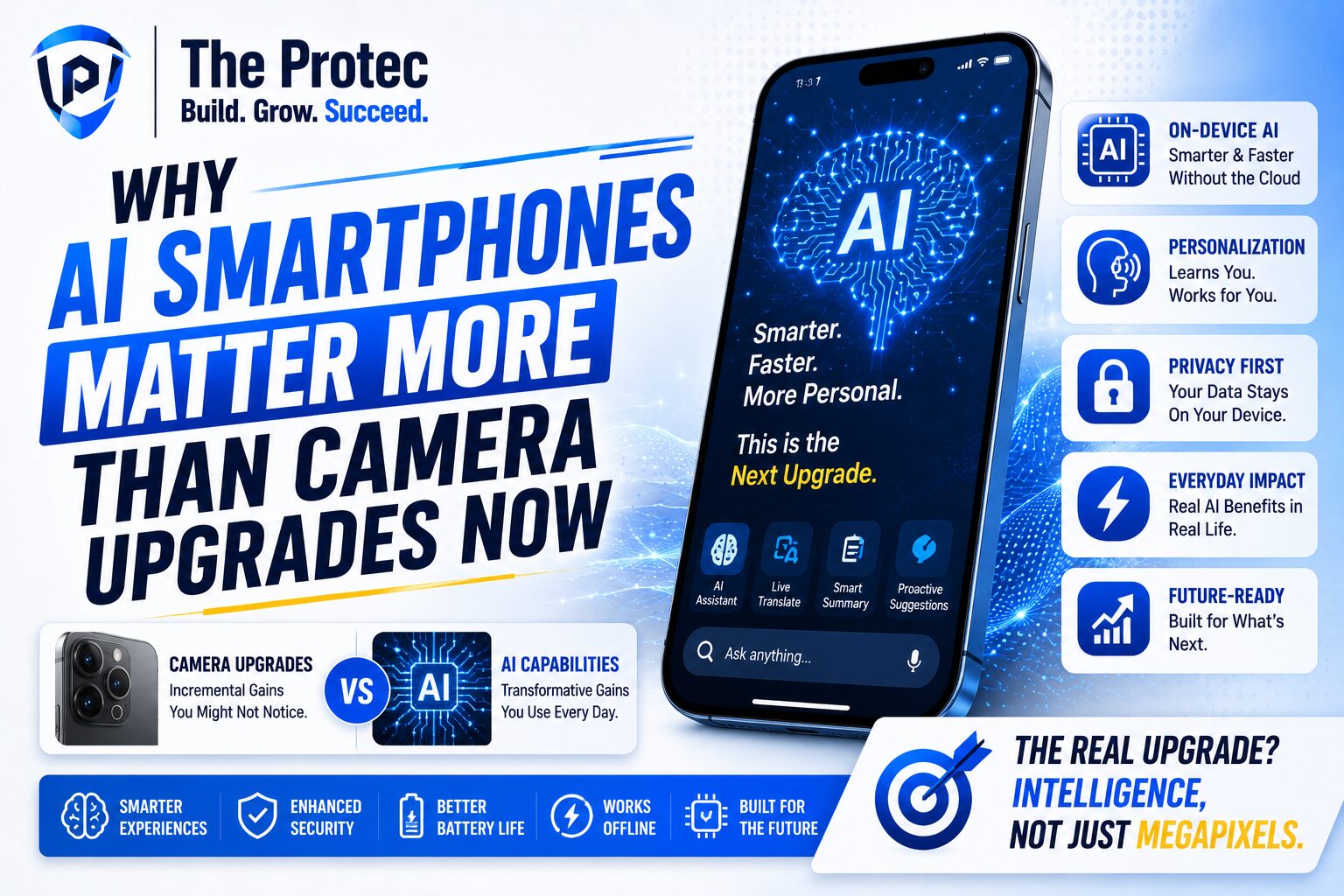
One of the most important developments in mobile AI features is the move from cloud-dependent processing to on-device AI. Instead of sending everything to remote servers, the phone can process many tasks locally using its neural engine or dedicated AI accelerator. That matters for speed, privacy, reliability, and battery efficiency.
On-device AI makes features feel immediate. When a phone can summarize a voice note, generate a quick reply, or remove background noise without waiting on a server, the user experience becomes much smoother. It also helps in places with weak connectivity, because many features continue to work even when the phone is offline or on a poor data connection.
Privacy is another major advantage. Some users are hesitant to let cloud services handle messages, photos, call transcripts, or personal documents. On-device AI reduces how often sensitive data needs to leave the phone, which makes smart features more acceptable for everyday use.
In practical terms, on-device AI has expanded what phones can do without adding much friction. That is why AI smartphones feel like a bigger leap than another small camera improvement.
Why Camera Upgrades Are Losing Their Edge
Camera improvements still matter, especially for users who care about content creation, travel photography, or social media. But the reality is that modern smartphone cameras have already reached a very high baseline. Most premium phones now produce excellent photos in good light, and even midrange devices can deliver strong results with computational photography.
Because the baseline is already so high, the difference between one generation and the next is often incremental. A slightly larger sensor, a modestly improved zoom lens, or a cleaner low-light shot may be impressive in a review, but many buyers barely notice the difference in daily use. For most people, the camera has become “good enough.”
That does not mean camera innovation is over. It means the camera is no longer the single most compelling reason to upgrade. Meanwhile, mobile AI features can improve the phone’s usefulness in dozens of small ways that add up every day. When a device saves time, reduces taps, and helps users get things done faster, the value is much easier to feel.
Mobile AI Features That Are Changing the Experience
The strongest argument for AI smartphones is not abstract innovation. It is the collection of real features that make life easier. Across current devices, the most useful mobile AI features typically fall into a few categories.
Smarter communication
Phones are increasingly able to summarize long text threads, suggest replies based on context, rewrite messages in different tones, and filter out noise. Some devices can also transcribe calls or voice notes, turning spoken information into searchable text. This is especially valuable for busy users who juggle work, family, and personal communication across multiple apps.
Real-time translation and interpretation
Live translation has become more polished and more practical. AI smartphones can translate conversations, captions, and calls faster than before, making cross-language communication easier for travel, business, and education. These features are not just convenient; they can remove real barriers in everyday life.
Photo and video intelligence
Even though this article is about why AI matters more than camera upgrades, AI still improves imaging in ways that matter beyond the sensor itself. Editing tools can remove unwanted objects, sharpen faces, adjust lighting, and generate cleaner backgrounds. Video tools can reduce wind noise, stabilize footage, and optimize scenes automatically. The point is not just taking better photos; it is making the entire capture-and-edit process easier.
Search and organization
AI-powered search is becoming one of the most underrated phone features. Users can search across messages, photos, notes, documents, and settings using natural language instead of exact keywords. This turns the phone into a much more usable personal assistant, especially when paired with better indexing and semantic understanding.
Accessibility improvements
AI is also changing how phones support users with hearing, vision, or mobility challenges. Live captions, voice control, image descriptions, and smarter dictation tools are making smartphones more inclusive. These are not flashy features, but they are some of the most important and practical examples of AI smartphones delivering real value.
The Role of Dedicated AI Chips
Modern smartphone technology trends increasingly center on specialized silicon. It is not just about faster CPUs or GPUs anymore. Chipmakers are building neural processing units and AI cores designed to handle machine learning tasks efficiently. That shift is enabling richer mobile AI features without draining the battery as quickly as older approaches.
Dedicated AI hardware helps phones run models locally, process images faster, and support more advanced assistants. It also gives manufacturers room to launch new features that would have been too slow or power-hungry a few years ago. As chip design continues to improve, the gap between “regular smartphones” and AI smartphones will become more obvious.
This trend is also helping vendors differentiate their products in a crowded market. Many phones can claim a great camera. Fewer can deliver genuinely useful AI performance that feels fast, private, and deeply integrated.
Why Users Notice AI Improvements More Than Camera Specs
Camera specs are easy to compare on a chart, but human experience is harder to quantify. That is exactly why AI smartphones are becoming more compelling. A phone that edits photos a little better or enhances low-light performance by 10% may not be dramatic. But a phone that summarizes your day, helps you find information instantly, and cuts your response time in half feels transformative.
People notice improvements most when they affect frequent tasks. That includes typing, searching, replying, organizing, navigating, and listening. Camera use, while important, is intermittent for many buyers. AI touches the phone’s core behaviors all day long.
There is also a psychological factor: AI makes a device feel more personal. When a phone learns patterns, understands intent, and adapts to context, it creates a stronger sense of usefulness than a better lens ever could. In a market where hardware differences are often small, that feeling matters.
How AI Smartphones Are Reshaping Product Strategy
Manufacturers are responding to this shift by reorganizing how they present their devices. Instead of leading with megapixels, many brands now highlight AI assistants, writing tools, generative editing, voice intelligence, and personalized automation. This is a sign that the market understands where consumer interest is moving.
We are also seeing more emphasis on software longevity. If a phone receives regular AI feature updates, it can keep feeling fresh long after purchase. That is a major advantage over hardware-centric upgrades, which are fixed the moment you buy the device. In a competitive market, long-term software value can matter more than one extra camera lens.
For consumers, this changes the buying question. Instead of comparing only the camera stack, it makes more sense to ask whether the phone will continue getting smarter over time. That is a much more relevant metric for modern use.
What This Means for Buyers
If you are choosing a new phone today, the most important question is not whether the camera is good. It is. The real question is whether the phone delivers meaningful AI that fits how you live and work. A strong camera is still a nice bonus, but it should not overshadow the value of features you will use every single day.
When evaluating AI smartphones, look for:
- Fast, reliable on-device AI features that do not feel gimmicky
- Practical tools for writing, search, transcription, and translation
- Useful photo and video editing support, not just camera marketing
- Clear privacy controls and transparent data handling
- Long-term software support and feature updates
Phones that combine these strengths are likely to feel more future-proof than devices that focus mainly on camera hardware. That is because mobile AI features evolve faster than lens systems, and they influence more of the daily experience.
The Future of Smartphone Technology Trends
The next phase of smartphone technology trends is likely to be defined by tighter integration between AI, hardware, and software. We are moving toward phones that can understand what you need before you ask, adapt interfaces in real time, and automate repetitive tasks across apps. The camera will remain important, but it will increasingly be just one part of a much larger intelligence layer.
As models become more efficient and more capable on-device, AI smartphones will continue to expand what users expect from a phone. The best devices will not merely capture moments better. They will help users manage information, communicate faster, and interact with technology more naturally.
That is why the upgrade conversation has changed. The most valuable smartphone is no longer the one with the biggest camera jump. It is the one that feels smartest, most helpful, and most responsive throughout the day.
FAQ
Are AI smartphones replacing the need for better cameras?
No. Cameras still matter, especially for users who care about photography and video. But AI smartphones are becoming more important because they improve many more everyday tasks than camera upgrades alone.
What is on-device AI in smartphones?
On-device AI means the phone processes certain tasks locally instead of sending data to the cloud. This can improve speed, privacy, battery efficiency, and offline functionality.
Which mobile AI features are most useful?
The most useful mobile AI features include message summarization, smart replies, live translation, transcription, photo editing, search across apps, and accessibility tools such as captions and voice control.
Why are smartphone technology trends shifting toward AI?
Because most users benefit more from smarter daily interactions than from small hardware upgrades. AI makes phones faster to use, easier to personalize, and more capable across communication, productivity, and creativity.
Should I prioritize AI features when buying a new phone?
If you use your phone for messaging, work, travel, note-taking, or organization, yes. AI features may provide more value than a modest camera upgrade, especially if you want a phone that feels useful for longer.
Conclusion
AI smartphones are becoming more important than camera upgrades because they change how the phone works in everyday life. A better camera may improve a few moments. Better mobile AI features can improve the entire day. As on-device AI becomes faster, smarter, and more private, it is reshaping what buyers expect from modern devices and setting the direction for smartphone technology trends going forward.
If the last generation of upgrades was about taking better pictures, the next generation is about making the whole phone smarter. And for most users, that is a much bigger leap.
For more on the broader shift toward AI-powered consumer tech, see Qualcomm’s Snapdragon mobile AI overview and Google AI.