







Contents
- 1 Why ARM-Based PCs Are Suddenly Dominating the Laptop Market
- 2 What ARM Actually Means in a Laptop
- 3 Why the Shift Away from Intel Is Happening Now
- 4 Snapdragon X Elite Changed Expectations
- 5 Battery Life Is the Killer Feature
- 6 Software Compatibility Is Finally Catching Up
- 7 AI Is Accelerating the ARM Advantage
- 8 How Apple Made ARM Feel Normal
- 9 Why Manufacturers Love ARM-Based PCs
- 10 What Intel and AMD Must Do to Compete
- 11 What This Means for the Future of Laptops
- 12 FAQ
- 13 Final Take
Why ARM-Based PCs Are Suddenly Dominating the Laptop Market
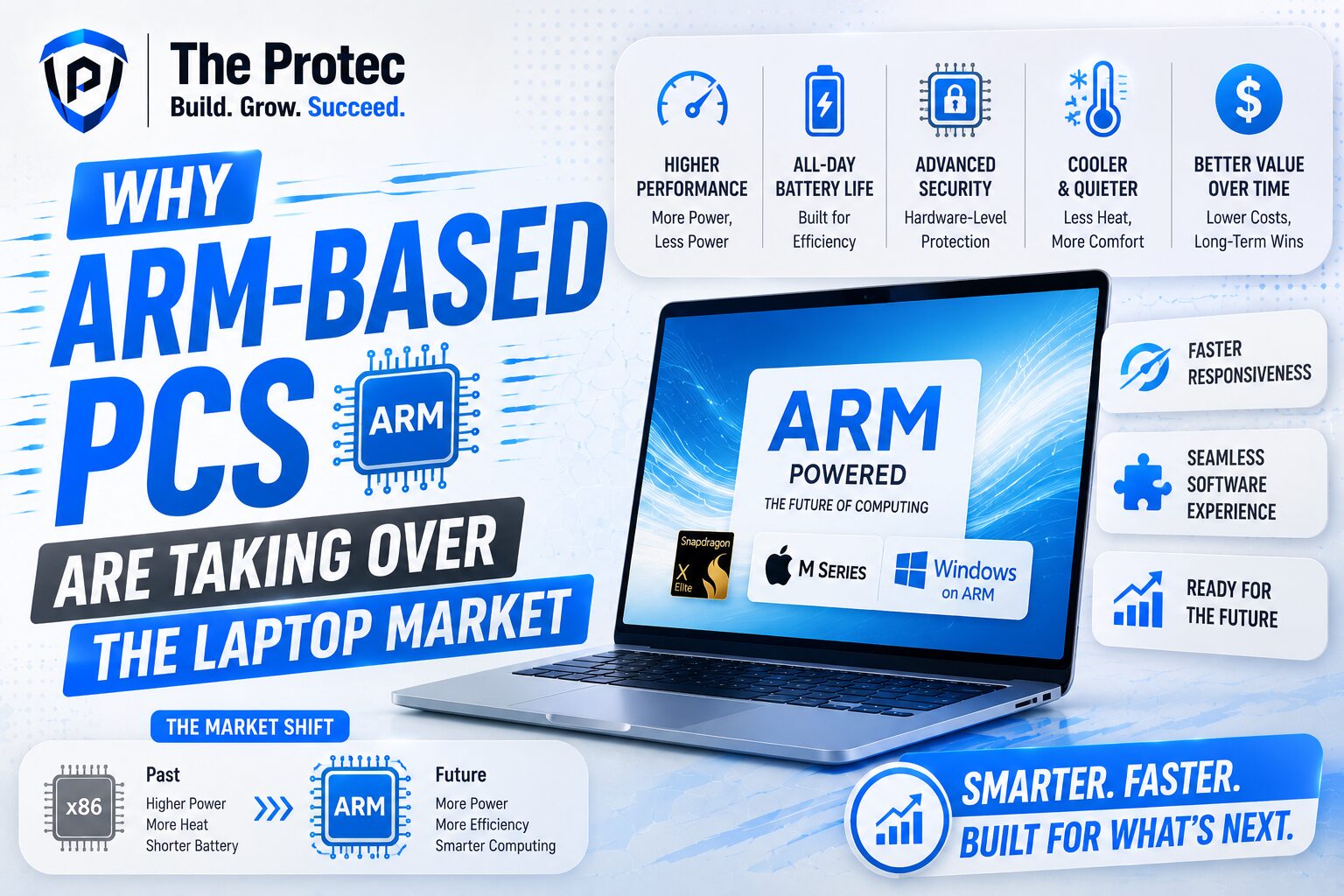
For years, the laptop market seemed locked into one pattern: Intel and AMD powered most Windows notebooks, while Apple quietly proved that ARM chips could deliver serious performance without destroying battery life. That balance has changed fast. ARM-based PCs are no longer an experimental category or a niche for early adopters. They are becoming a mainstream answer to one of the biggest complaints in portable computing: too much power consumption for too little real-world gain.
The shift is being driven by a rare mix of hardware maturity, software readiness, and changing user expectations. Consumers want laptops that last all day, stay cool, wake instantly, and handle modern AI features without constantly searching for a charger. Businesses want thinner devices with lower support costs. Manufacturers want a platform that can scale across premium and midrange models. The result is a market where ARM laptops are suddenly not just viable, but increasingly preferred.
At the center of this transition is Qualcomm’s Snapdragon X Elite, a chip family that changed the conversation around Windows-on-ARM. It showed that ARM systems can compete on performance while delivering battery life that feels almost implausible compared with traditional x86 laptops. But the real story is bigger than one processor. The future of laptops is being rewritten by a platform shift, and ARM is now at the front of that change.
What ARM Actually Means in a Laptop
ARM and x86 are different processor architectures, which means they process instructions in different ways. Traditional Windows laptops have relied on x86 chips from Intel and AMD. ARM processors, by contrast, are built around a design that emphasizes efficiency, lower power draw, and strong performance per watt. That matters enormously in portable devices, where battery capacity, heat, and weight are always constraints.
For a long time, ARM was associated with phones and tablets rather than full laptops. That perception made sense when ARM processors struggled with desktop-class workloads and software compatibility was limited. But the architecture itself was never the problem. The challenge was execution. As chip design, packaging, and software translation improved, ARM became capable of much more than lightweight mobile tasks.
Today’s ARM-based PCs are not watered-down machines. They can run full operating systems, support productivity suites, browser-heavy workflows, creative tools, and increasingly, on-device AI functions. In many ways, they are redefining what most people actually need from a laptop.
Why the Shift Away from Intel Is Happening Now
The move from Intel to ARM architectures in consumer laptops did not happen overnight. It is the result of several overlapping trends that finally reached a tipping point.
- Battery life has become a top buying factor. Users no longer want a laptop that only performs well when plugged in.
- Always-on, always-ready behavior matters. Instant wake, silent operation, and cooler chassis are now expected in premium devices.
- AI features are becoming part of the baseline experience. Laptops need efficient neural processing, not just raw CPU speed.
- Thermal limits are holding x86 designs back. Faster chips often mean more heat, more fan noise, and shorter battery life.
- Consumers are more aware of efficiency. Performance is still important, but not if it comes with constant charging.
Intel has not disappeared from the market, and its latest chips have made real progress in efficiency. But ARM’s advantage is structural. When the architecture is designed around lower power use from the start, it becomes easier to deliver thin-and-light systems that feel modern in everyday use. That efficiency-first approach is now aligning with what laptop buyers value most.
Snapdragon X Elite Changed Expectations
The biggest catalyst for ARM’s momentum in the Windows world has been Snapdragon X Elite. Qualcomm did not simply release another mobile chip in a laptop form factor. It introduced a platform that could deliver desktop-class responsiveness, strong multi-core performance, and standout battery life in the same machine.
That combination matters because laptops are judged by more than benchmark numbers. Users notice whether a device stays fast on battery, whether it runs quietly in a coffee shop, whether it gets hot during a video call, and whether it can handle a full workday without panic charging. Snapdragon X Elite impressed because it addressed all of those pain points at once.
Its NPU also pushed the conversation toward AI-native laptops. As on-device AI becomes more important for Windows features, productivity tools, and content workflows, chips with dedicated neural processing are gaining an edge. Qualcomm positioned Snapdragon X Elite not just as a faster processor, but as a foundation for the next generation of AI PCs.
That matters for the future of laptops because buyers are beginning to compare machines by experience rather than architecture. If an ARM laptop is quieter, lasts longer, and handles AI tasks more efficiently, the underlying instruction set becomes less important to the average consumer.
Battery Life Is the Killer Feature
Ask most laptop users what they want more of, and the answer is almost always battery life. That is where ARM-based PCs have created their strongest advantage. By consuming less power under both light and moderate workloads, ARM laptops can often last dramatically longer than comparable x86 systems.
This is not just about headline battery numbers. Real-world endurance changes how people use a device. When a laptop can reliably last through meetings, travel, streaming, browsing, and office work without needing a charger, it becomes more useful. Users stop planning around outlets. They take it on the road more often. The device feels like a true portable tool rather than a semi-mobile desktop replacement.
Efficiency also compounds across the entire design. Lower power draw means smaller cooling systems, quieter fans, and slimmer chassis. That lets manufacturers build thinner devices without sacrificing comfort or usability. In practical terms, ARM laptops are not just lasting longer; they are making the whole laptop experience more pleasant.
Software Compatibility Is Finally Catching Up
Software support used to be the biggest argument against ARM laptops. Many users worried that their favorite apps, drivers, or enterprise tools would not run properly. That concern was valid when Windows-on-ARM was immature and application emulation was inconsistent.
But the landscape has changed significantly. Microsoft has invested heavily in Windows-on-ARM, and app compatibility has improved across a broad range of consumer and productivity software. Modern browsers, communication tools, creative apps, and cloud-based services now run well enough that many users may never notice the underlying architecture.
Emulation has also become much better, reducing the penalty for older software that has not been natively recompiled. For most everyday users, the compatibility gap has narrowed enough that ARM no longer feels risky. And for developers and software vendors, the growing installed base creates a stronger incentive to support ARM natively.
There are still edge cases. Specialized enterprise software, legacy peripherals, and certain high-performance workflows can remain a challenge. But for the mainstream market—email, documents, web apps, streaming, and even many creative tasks—the software story is no longer a dealbreaker.
AI Is Accelerating the ARM Advantage
One of the most important reasons ARM-based PCs are rising so quickly is that the industry is moving toward AI-first computing. That does not mean every user is suddenly training large models on their laptop. It means the operating system, apps, and services are increasingly relying on local AI processing for tasks like summarization, image enhancements, voice features, background blur, and contextual assistance.
ARM chips are well positioned for this moment because they often integrate efficient NPUs alongside CPU and GPU resources. In a world where AI features need to feel instant and battery-friendly, the ability to offload those tasks to specialized hardware is a major advantage.
Qualcomm’s Snapdragon X Elite is especially relevant here because it helped define the “AI PC” pitch in a way that consumers can understand. Instead of promising abstract performance gains, it delivered longer battery life, lower heat, and new AI capabilities in one package. That is a powerful combination in a market where differentiation is increasingly difficult.
As more software vendors embed AI into everyday tools, the future of laptops may hinge less on raw CPU frequency and more on how efficiently a device can handle intelligent features locally. ARM fits that model naturally.
How Apple Made ARM Feel Normal
Apple’s transition to Apple Silicon changed the industry’s perception of ARM forever. Before that, ARM in laptops was often treated as a compromise. After the MacBook Air and MacBook Pro lines showed what ARM could do in real portable systems, efficiency became a feature people actively wanted.
Apple proved that a laptop could be fast, cool, quiet, and last all day without relying on x86. It also demonstrated that a tightly integrated hardware-software stack could make ARM feel polished and mature. While Windows laptops face a different software ecosystem, Apple’s success removed the stigma around ARM as a “lesser” architecture.
That psychological shift matters more than many people realize. Once consumers saw that ARM could power premium laptops without compromise, expectations changed. Competitors now have to match not just performance numbers, but the overall experience Apple normalized.
In that sense, Apple did not just win with ARM. It educated the market. The current surge in ARM laptops is happening partly because users already understand the benefits, even if they are shopping in the Windows ecosystem.
Why Manufacturers Love ARM-Based PCs
OEMs are embracing ARM for reasons that go beyond marketing. ARM platforms can help them build thinner devices, reduce thermal engineering complexity, and create products with better battery life at competitive price points. That opens up room for design differentiation in a market that often feels homogenized.
For premium laptops, ARM allows manufacturers to chase ultra-portable designs that still feel powerful. For business laptops, it can mean fewer complaints about noise and heat. For mainstream models, it creates a clearer value proposition: longer battery, fast wake times, and modern AI support.
There is also a strategic reason. If the market continues shifting toward AI-enabled mobile computing, manufacturers will want to align with the chip platforms that best support that direction. ARM’s efficiency profile and NPU integration make it appealing for both consumer and enterprise roadmaps.
In other words, ARM is not just a technical alternative. It is becoming a product strategy.
What Intel and AMD Must Do to Compete
Intel and AMD are not standing still. They continue to improve power efficiency, integrate stronger NPUs, and tune their platforms for thinner laptops. The competition is good for consumers because it pushes everyone to improve. But ARM has forced a harder question: can x86 keep up in the areas that matter most to portable computing?
To compete effectively, Intel and AMD need to deliver more than benchmark leadership in bursts. They need sustained efficiency, better battery life on real workloads, quiet thermal behavior, and AI features that feel genuinely useful. If they cannot consistently match ARM on those fronts, they risk losing mindshare even when their chips remain technically impressive.
The challenge is that x86 is carrying a lot of legacy compatibility and ecosystem baggage. That is useful in many settings, but it also makes radical efficiency gains harder. ARM’s cleaner design space gives it room to optimize for the modern laptop user in a way that is increasingly difficult for x86 to match.
What This Means for the Future of Laptops
The future of laptops is likely to be more heterogeneous than it was in the past, but ARM will play a much larger role than many expected. We are moving toward a market where buyers choose laptops based on battery life, AI features, thermals, and real-world responsiveness rather than processor brand loyalty.
That does not mean x86 disappears. It means ARM-based PCs become a standard option across more price points, more categories, and more use cases. As software support improves and consumer trust grows, ARM laptops will continue to expand beyond premium ultrabooks into mainstream business and family devices.
The most important change is philosophical. A laptop is no longer expected to be a hot, noisy machine that sacrifices portability for speed. The new standard is a device that feels instantly ready, stays cool under pressure, and lasts long enough to disappear into the background. ARM is built for that expectation.
In the coming years, the winners in the laptop market will likely be the platforms that deliver the best combination of efficiency, AI readiness, and user experience. Right now, ARM has the clearest momentum in that direction.
FAQ
Are ARM laptops better than Intel laptops?
For many users, yes—especially if battery life, silence, portability, and AI features matter more than legacy software support. Intel laptops still have strengths, but ARM often delivers a better everyday experience.
What makes Snapdragon X Elite important?
Snapdragon X Elite proved that ARM-based Windows laptops can offer strong performance, excellent battery life, and modern AI capabilities at the same time. It helped shift ARM from “interesting” to “competitive.”
Will ARM replace Intel in all laptops?
Not entirely. Intel and AMD will remain important, especially for certain professional and legacy workloads. But ARM is likely to capture a much larger share of mainstream consumer and thin-and-light laptops.
Are ARM laptops good for everyday use?
Yes. For browsing, office work, video calls, streaming, and many creative tasks, ARM laptops are now very capable and often more convenient than traditional x86 systems.
What is the biggest advantage of ARM laptops?
The biggest advantage is efficiency. That translates into longer battery life, less heat, quieter operation, and a more portable overall experience.
Final Take
ARM-based PCs are dominating the laptop conversation because they align with what modern users actually want. Snapdragon X Elite showed the market that ARM can deliver more than just mobile efficiency; it can power serious laptops that feel fast, last longer, and are ready for an AI-driven future. The shift away from Intel is not a fad. It is a structural change in how laptops are designed and judged.
As software compatibility improves and more brands embrace ARM laptops, the category will only grow stronger. The future of laptops is not about raw power alone. It is about usable power, delivered efficiently. And right now, ARM is setting the pace.