








Introduction
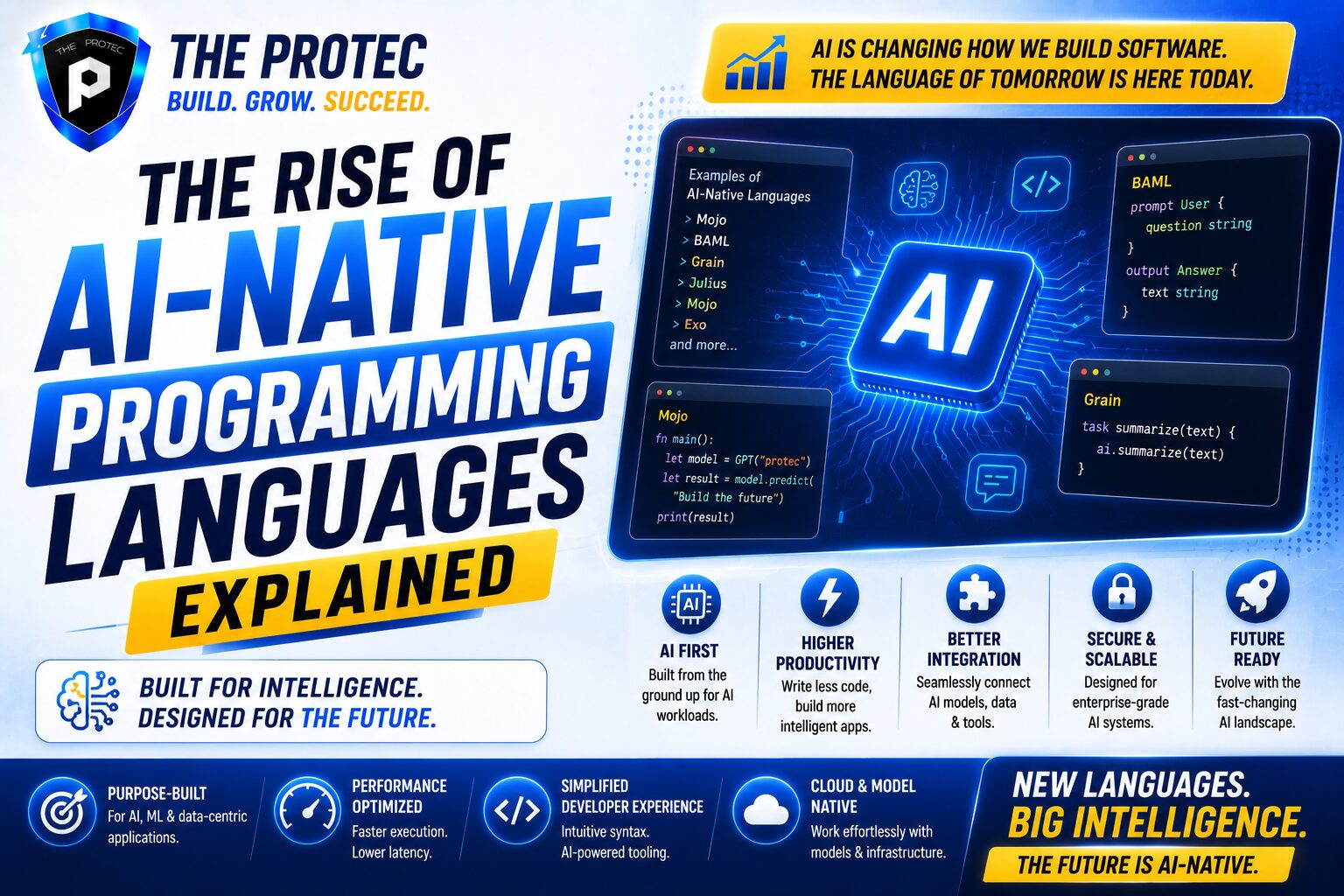
Software development is entering a new phase. For decades, programming languages were designed around a familiar assumption: humans would write instructions, and computers would execute them. That model is still essential, but it is no longer the whole story. Today, developers are increasingly building systems where large language models, code agents, and autonomous workflows participate directly in creation, testing, and deployment. That shift is driving interest in AI programming languages and, more importantly, in languages and abstractions that are native to AI-driven development.
The rise of AI-native programming languages is not just about adding syntax for machine learning. It is about rethinking how software is expressed when code is only one part of the system. In modern AI software development, developers need ways to describe behavior, constraints, reasoning steps, retrieval logic, model interactions, and agent orchestration. Traditional languages can do much of this, but the tooling, patterns, and abstractions are changing fast. As a result, future coding languages may look less like static instruction sets and more like environments built to collaborate with models.
This evolution matters because AI is no longer confined to a separate data science workflow. It is becoming embedded in product engineering, DevOps, analytics, customer support, enterprise automation, and developer tooling itself. Understanding how programming languages are evolving for AI-driven development can help teams choose better stacks, write safer systems, and prepare for the next wave of software architecture.
What Makes a Language AI-Native?
An AI-native programming language is not simply a language used to build AI applications. It is a language, framework, or developer environment designed so that AI systems can participate more naturally in the development process. This can mean several things:
- Readable syntax that is easier for models to generate and modify safely.
- Strong abstractions for prompts, tools, memory, and model routing.
- Built-in support for structured outputs, retries, and validation.
- Workflow primitives for agents, planning, and multi-step execution.
- Tracing, observability, and policy controls tailored to AI behavior.
In practice, AI-native design is often about lowering the friction between intent and implementation. A developer may want to define a task, constrain the possible actions, and let an AI agent handle the details. Languages and frameworks that support this pattern reduce the amount of brittle glue code required to build a reliable system.
That does not mean general-purpose languages are disappearing. Python, JavaScript, TypeScript, Go, and Rust remain central to AI software development. The shift is that these languages are being extended by libraries, DSLs, and runtime patterns that make them feel AI-native. The ecosystem is also seeing emerging languages and declarative formats optimized for model interaction, tool use, and orchestration.
Why AI Programming Languages Are Gaining Momentum
Several developments are pushing AI programming languages into the spotlight. First, code generation quality has improved dramatically. Modern models can produce full functions, refactors, tests, and configuration files with useful accuracy. That makes the interface between human intent and machine-generated implementation more important than ever.
Second, software teams are adopting agentic workflows. Instead of asking a model to answer a question, developers increasingly ask it to perform a sequence of actions: inspect a repository, diagnose a bug, draft a fix, run a test plan, and propose a deployment step. This requires a language or framework that can represent multi-step behavior clearly and safely.
Third, the economics of development are changing. Teams want faster iteration, less repetitive coding, and more automation without sacrificing quality. AI-native tooling can accelerate scaffold generation, documentation, test creation, and migration work. But to scale those gains, systems need structured ways to express what the AI can and cannot do.
Finally, the application layer is changing. Many new products are not just software with AI features; they are AI-first products. That includes copilots, research assistants, autonomous operations tools, and intelligent workflow engines. These products benefit from languages and abstractions that treat reasoning, context, and tool access as first-class concerns.
How Programming Languages Are Evolving for AI-Driven Development
The rise of AI-native programming languages is visible in several important trends. Some are happening inside existing languages, while others are emerging as new design patterns.
1. From code-centric to intent-centric development
Traditional programming languages emphasize exact instructions. AI-driven development increasingly starts with intent: what outcome is desired, what constraints apply, and what tools are available. This shift is leading to languages and frameworks that support higher-level declarations, such as policies, workflows, and prompt schemas.
In practical terms, developers may describe a task in structured form and let an agent determine execution details. The language layer then acts as a control system, not just a syntax layer. This is one reason why natural-language-inspired interfaces, typed prompt templates, and workflow DSLs are growing in popularity.
2. Stronger typing for model outputs
One of the biggest challenges in AI software development is unpredictability. Models can hallucinate, omit fields, or format outputs inconsistently. To manage this, modern AI programming approaches increasingly rely on type systems, schema validation, and constrained decoding.
Developers now expect structured responses such as JSON schemas, typed objects, or validated function calls. This trend is shaping future coding languages and libraries by making structured AI outputs a default, not an afterthought. The result is more reliable integration between model-generated content and production systems.
3. Built-in orchestration primitives
Many AI applications are no longer single prompts. They are pipelines: retrieve data, summarize context, call tools, evaluate output, and route to the next step. This is driving demand for orchestration-friendly programming models.
AI-native environments are adding concepts such as chains, graphs, state machines, task queues, and agents. These primitives help developers define complex behavior without writing thousands of lines of coordination code. The best systems also support tracing so teams can see how a model reached a result.
4. Model-agnostic abstraction layers
Another major trend is portability. Teams do not want to rewrite applications every time they change models. As a result, AI programming languages and frameworks are becoming more model-agnostic, separating application logic from provider-specific APIs.
This abstraction makes it easier to swap between closed and open models, route tasks based on latency or cost, and introduce fallback strategies. For developers, this is a practical necessity. AI software development is moving too quickly for hard-coded model dependence to remain a good default.
What Developers Gain from AI-Native Languages
The main advantage of AI-native programming is not novelty; it is leverage. When the abstractions fit the problem, teams can move faster and build systems that are easier to maintain.
- Faster prototyping: Developers can move from idea to working AI feature with less boilerplate.
- Better reliability: Typed outputs, validation, and workflow controls reduce failure modes.
- Improved collaboration: Product engineers, data teams, and platform teams can share clearer interfaces.
- More maintainable systems: Intent-based design makes complex AI workflows easier to understand and evolve.
- Safer deployment: Guardrails, permissions, and observability make production AI less risky.
These benefits are especially important in enterprise environments, where AI systems must meet standards for compliance, auditability, and uptime. An AI-native approach helps teams move beyond experimental prototypes and into production-grade AI software development.
Where Traditional Languages Still Matter Most
Despite the excitement around AI programming languages, most production systems will continue to rely on established languages. Python remains the dominant choice for model experimentation and application integration. JavaScript and TypeScript are central in web-facing AI products. Go and Rust are important for performance-sensitive infrastructure. Java and C# still power many enterprise platforms that are adding AI capabilities.
The key point is that AI-native development is usually layered on top of existing languages rather than replacing them outright. In many organizations, the real change is not the syntax but the architecture. AI components are being embedded into services, APIs, frontends, and internal tools through frameworks that make them easier to manage.
That said, a few patterns suggest where future coding languages may evolve:
- More declarative workflows: Less imperative code for orchestration-heavy tasks.
- Higher-level AI constructs: Agents, tools, memory, and evaluation may become language-level concepts.
- Safer generation by default: Compilation and runtime checks may constrain model-generated code.
- Unified developer experiences: Build, test, trace, and deploy may be integrated around AI behavior.
Key Challenges in AI Software Development
The rise of AI-native programming languages also exposes real technical and organizational challenges. The first is unpredictability. Even with stronger abstractions, AI systems can behave inconsistently. Developers must design for retries, fallbacks, and explicit failure handling.
The second challenge is evaluation. Traditional software can be tested with exact assertions. AI outputs often require semantic checks, heuristic scoring, or human review. This is pushing teams to adopt new testing strategies that assess correctness, safety, and usefulness rather than only syntax or equality.
Third, context management remains difficult. Models have finite context windows and can lose track of prior state. AI-native environments attempt to address this with memory layers, retrieval systems, and stateful orchestration, but these features add complexity. The language or framework must make these trade-offs visible.
Fourth, security matters more than ever. When models can call tools, access documents, or trigger workflows, the blast radius of a mistake grows. Developers need permissioning, sandboxing, audit logs, and human-in-the-loop controls. AI programming languages that ignore these concerns will not be suitable for serious production use.
How to Evaluate AI Programming Languages and Frameworks
Developers and engineering leaders should assess AI-native tools with a practical lens. The most impressive demos are not always the best production choice.
- Does it support structured outputs? Look for schemas, typing, and validation.
- Can workflows be traced? Observability is essential for debugging and compliance.
- How portable is it? Avoid lock-in to a single model provider when possible.
- Does it handle retries and fallbacks? Production systems need resilience.
- Can it enforce permissions? Agents should not have unrestricted access by default.
- Is the developer experience clear? Teams need readable abstractions, not just clever prompts.
It is also worth considering ecosystem maturity. A promising future coding language may not yet have the package support, documentation, and community needed for enterprise adoption. In many cases, the safest path is to combine a stable base language with AI-native tooling that has strong runtime controls.
The Role of Agentic Development
Agentic development is one of the clearest signals that AI-native programming languages are becoming important. In an agentic workflow, the system does more than respond; it plans, executes, observes, and adapts. That requires careful design at the language and framework level.
For developers, the challenge is to define boundaries. An agent may be allowed to read documentation, generate code, open tickets, or run tests, but not deploy to production without approval. Capturing those boundaries in code is a major design concern, and languages that make such controls explicit are likely to become more valuable.
Agentic systems also increase the need for deterministic coordination around nondeterministic components. In other words, the orchestration layer must remain predictable even when the model is not. That tension is shaping the next generation of AI software development tools.
What the Future of Coding Languages May Look Like
Future coding languages will likely blend several qualities that once seemed separate. They will need to be expressive enough for humans, structured enough for machines, and safe enough for production environments. In many cases, the most useful innovations will come from combining natural language interfaces with rigorous typed systems and observable execution models.
We can expect future coding languages to emphasize:
- Declarative task definitions that are easy for both humans and models to understand.
- Typed AI outputs and schema-first development.
- Workflow graphs that represent reasoning, tool use, and execution paths.
- Integrated evaluation and testing for probabilistic behavior.
- Security controls designed for autonomous tools and agents.
Rather than replacing traditional programming, AI-native languages are likely to redefine the boundary between code, configuration, and reasoning. Developers will spend less time on repetitive glue code and more time designing systems, constraints, and business logic. That is a meaningful shift in how software gets built.
Practical Takeaways for Developers
If you are working in AI software development today, the most important skill is not learning a single new syntax. It is learning how to think in systems that include models, tools, prompts, validation, and orchestration.
- Use established languages as a base, but adopt AI-native abstractions where they improve reliability.
- Prefer structured outputs over free-form text whenever possible.
- Design for observability from the start.
- Assume model outputs can fail, drift, or surprise you.
- Keep security and permissions explicit in every agentic workflow.
Developers who understand these patterns will be better prepared as the ecosystem matures. The rise of AI-native programming languages is not a passing trend; it is a sign that software itself is becoming more adaptive, collaborative, and context-aware.
FAQ
What are AI programming languages?
AI programming languages are languages, frameworks, or abstractions designed to make it easier to build systems that use models, agents, prompts, and structured AI workflows. They often emphasize typed outputs, orchestration, and observability.
Will AI-native languages replace Python or JavaScript?
Probably not in the near term. More likely, AI-native approaches will layer on top of existing languages. Python, JavaScript, TypeScript, Go, Rust, and others will remain important foundations for AI software development.
Why do developers need new abstractions for AI-driven development?
Because AI systems are probabilistic, stateful, and increasingly agentic. Traditional code patterns are not always enough to manage prompts, tools, memory, retries, and safety controls in a maintainable way.
How do future coding languages differ from traditional ones?
Future coding languages are likely to be more declarative, more structured, and more focused on workflows, validation, and model collaboration. They may treat reasoning and orchestration as first-class concepts rather than external add-ons.
What should teams look for when choosing AI development tools?
Teams should prioritize structured outputs, tracing, portability, permission controls, and a clear developer experience. Production AI systems need reliability and governance, not just impressive demos.
Conclusion
The rise of AI-native programming languages reflects a deeper transformation in software development. Code is no longer the only medium through which developers express intent. As models become more capable and embedded in everyday workflows, programming languages and frameworks must evolve to support AI software development at a higher level of abstraction.
For developers, this is both a challenge and an opportunity. The challenge is learning to build systems that are resilient, secure, and observable in the face of probabilistic behavior. The opportunity is greater productivity, smarter automation, and a new generation of future coding languages that help humans and AI work together more effectively. The teams that adapt early will be best positioned to shape what software engineering looks like next.
For a deeper look at current model ecosystems and developer tooling, see the Anthropic news page and the OpenAI updates for recent platform developments.