







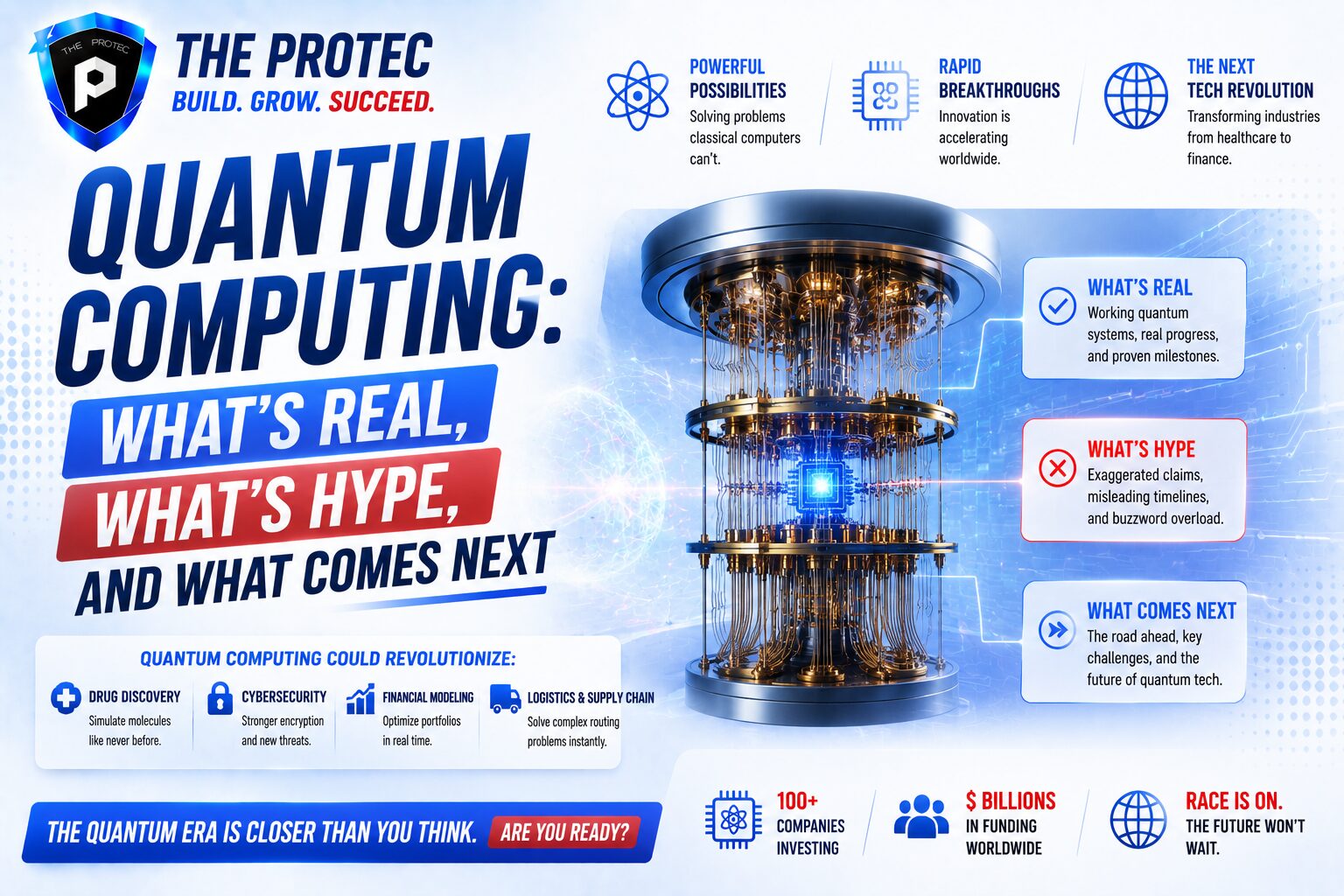
Quantum Computing: What’s Real, What’s Hype, and What Comes Next
Quantum computing has become one of the most talked-about areas in future computing, and for good reason. It promises to solve problems that are out of reach for classical machines, transform industries from cybersecurity to materials science, and redefine how we think about computation itself. But the space is also crowded with inflated claims, misunderstood milestones, and marketing language that often runs ahead of engineering reality.
So what is actually true today? The short answer is that quantum technology has made real progress, but the most dramatic promises are still far from everyday reality. We now have more capable quantum hardware, better error-mitigation methods, stronger cloud access, and a growing ecosystem of software tools and research partnerships. At the same time, large-scale fault-tolerant quantum computers remain a major technical challenge. The gap between “promising lab result” and “commercially useful machine” is still wide.
This article separates genuine breakthroughs from hype, using the latest direction of the field to explain where quantum computing really stands now, where it may be headed next, and why the distinction matters for businesses, developers, and investors alike.
What Quantum Computing Actually Is
Classical computers process information in bits, which are either 0 or 1. Quantum computers use qubits, which can exist in combinations of states thanks to quantum mechanics. That gives them the potential to explore certain types of calculations in ways that classical systems cannot easily match.
The key concepts are superposition, entanglement, and interference. Superposition allows a qubit to represent multiple possibilities at once. Entanglement links qubits so that the state of one can be correlated with another in powerful ways. Interference helps amplify correct answers and suppress wrong ones during a computation.
However, the most important thing to understand is this: quantum computing is not a faster version of a laptop or data center server. It is a specialized model of computation that may outperform classical systems on specific problems, such as simulating quantum systems, certain optimization tasks, and some cryptographic or search-related scenarios under the right conditions.
What’s Real Right Now
The strongest reason to take quantum computing seriously is that the field has moved beyond pure theory. Real machines exist, they are accessible through cloud platforms, and researchers are using them to test algorithms, evaluate error correction, and explore practical applications.
1. Better hardware is emerging
Across superconducting qubits, trapped ions, neutral atoms, photonics, and emerging approaches such as silicon spin qubits, hardware is improving in measurable ways. The industry is seeing longer coherence times, lower gate error rates, more stable control systems, and larger qubit counts in some platforms. None of this means the machines are ready to outperform classical computers broadly, but it does show that the engineering challenge is being tackled methodically.
Neutral-atom systems, in particular, have attracted attention because they can scale arrays of qubits more naturally than some older architectures. Superconducting systems still dominate many commercial efforts because they are relatively mature and supported by large ecosystems. The important point is that quantum technology is no longer one monolithic idea; it is a competitive hardware landscape with different tradeoffs.
2. Error mitigation and early error correction are advancing
One of the biggest barriers in quantum computing is noise. Qubits are fragile, and tiny disturbances can destroy calculations. That makes error correction the central challenge of the field. Full fault tolerance, where a quantum computer can run long, useful programs reliably, requires many physical qubits to encode one logical qubit.
Here’s the real progress: researchers are steadily improving error mitigation, logical qubit experiments, and decoding techniques. That does not mean the problem is solved. It means the path is clearer than it was a few years ago. Some systems have demonstrated repeatable improvements when scaling error-corrected layouts, which is a meaningful signal. It shows that the road to practical quantum computing is becoming more engineering-driven and less purely speculative.
3. Cloud access has made experimentation accessible
One of the least hyped but most important developments is access. Companies, universities, and independent developers can now use quantum hardware remotely through cloud platforms. That has created a broader ecosystem for benchmarking, training, prototyping, and education.
This access matters because progress in future computing is not only about hardware breakthroughs. It is also about building a workforce, creating software tools, and learning which problems are genuinely suitable for quantum methods. The cloud model has helped move the field from closed lab environments toward a more open research-and-development pipeline.
4. Useful research applications are already real
Quantum computers are not yet replacing classical systems, but they are already useful in research settings. Scientists are using them to model molecules and materials, test quantum chemistry methods, and study algorithmic behavior under noisy conditions. These applications are promising because they align closely with the natural strengths of quantum systems.
The most credible near-term value is in simulation. Nature itself is quantum mechanical, so a machine that follows quantum rules may eventually provide a better way to model chemical reactions, catalysts, batteries, and advanced materials. That is a much more grounded claim than “quantum will speed up everything.”
What’s Still Hype
Quantum computing attracts headlines because it is technically complex and easy to oversell. The result is a wave of claims that sound transformative but do not hold up under scrutiny. The hype often comes from misunderstanding the difference between experimental progress and production-grade capability.
1. “Quantum advantage” is not the same as business usefulness
There is a big difference between demonstrating a task that a quantum machine can do in a specialized lab setting and delivering a practical advantage for real-world users. A headline may say a system achieved a major milestone, but the benchmark may involve a contrived problem that has little commercial relevance.
That does not make the experiment worthless. It just means the result should be interpreted carefully. Real-world value requires performance, reliability, cost efficiency, and integration with existing workflows. Right now, many quantum demonstrations are exciting scientifically but not yet economically compelling.
2. “Will replace classical computers” is misleading
Quantum computers are unlikely to replace classical computers in the way smartphones replaced feature phones. Instead, they will probably act as specialized accelerators for narrowly defined workloads. Classical systems will remain essential for most tasks, including web services, databases, AI training, and general-purpose enterprise computing.
Any claim that quantum technology will soon make classical infrastructure obsolete should be treated as marketing, not forecasting. The more realistic future is hybrid computing, where quantum processors are used alongside classical systems for select problems.
3. Large qubit counts alone do not equal progress
One of the most common hype tactics is to focus on qubit number as if it were the only metric that matters. It is not. A machine with more qubits but poor fidelity may be less useful than a smaller machine with better control, lower noise, and stronger error handling.
The field is now increasingly aware of this, which is a healthy sign. The conversation is shifting from raw qubit count to logical qubits, circuit depth, error rates, and application relevance. That shift is one of the clearest signs that quantum computing is maturing.
4. “Quantum AI” is often more branding than substance
Another popular buzzword is quantum AI. In many cases, this phrase is used to imply that quantum processors will dramatically accelerate machine learning or create entirely new forms of artificial intelligence. The reality is more modest.
There are active research efforts exploring quantum machine learning, but most of them are experimental, theoretical, or limited to narrow cases. For now, classical AI remains vastly more practical and scalable. Quantum may contribute to certain optimization or sampling problems in the future, but claims of immediate disruption are overstated.
Where Quantum Computing Could Make a Real Difference
The most credible quantum computing use cases are the ones that align with the physics of the machine. That means problems where classical methods struggle because the underlying system is itself quantum or combinatorially complex.
1. Chemistry and materials science
This is widely viewed as the strongest long-term application. Designing better batteries, catalysts, fertilizers, semiconductors, and drugs requires understanding how atoms and molecules interact. Classical simulation becomes expensive very quickly as complexity grows.
Quantum computers may eventually model these systems more naturally and efficiently. That could shorten R&D cycles, reduce lab experimentation, and improve design accuracy. The keyword here is “eventually,” because useful scale remains a work in progress.
2. Optimization
Logistics, manufacturing, scheduling, portfolio analysis, and supply chain design all involve optimization. Quantum algorithms may offer advantages for certain classes of these problems, particularly when combined with classical heuristics.
But optimization is also one of the most overhyped areas. Many real-world optimization problems are already handled extremely well by classical solvers. A quantum approach must prove not just theoretical interest, but measurable gains in speed, quality, or flexibility.
3. Cryptography and security research
Quantum computing is famous for its potential impact on cryptography, especially because large-scale machines could eventually threaten some widely used public-key systems. That possibility is real enough to drive serious planning around post-quantum cryptography.
For organizations, the practical takeaway is not panic, but preparation. The security community is already migrating toward quantum-resistant algorithms, and that work is important regardless of when fully capable quantum machines arrive. Even if the threat remains years away, data with long-term confidentiality needs to be protected now.
For background on the broader security transition, see the NIST Post-Quantum Cryptography project.
The Biggest Technical Bottlenecks
To understand quantum computing honestly, it helps to understand what still blocks progress. These are not small issues. They are fundamental engineering and physics challenges.
- Decoherence: Qubits lose quantum information quickly unless carefully isolated and controlled.
- Noise: Gate operations are imperfect, which introduces errors that compound rapidly.
- Scaling: Building and controlling hundreds or thousands of high-quality qubits is extremely difficult.
- Error correction overhead: Fault tolerance requires many physical qubits for each logical qubit.
- Useful workloads: Not every problem benefits from a quantum approach, so identifying the right use cases matters.
These bottlenecks explain why the field can feel both exciting and frustrating. The science is real, but the engineering burden is enormous.
How to Judge a Quantum Claim
Because the space is full of inflated language, it helps to have a simple framework for evaluating announcements. Whether you are reading a press release, hearing a pitch, or investing in the space, ask the following questions:
- Does the result improve a real benchmark, or only a lab demo?
- Is the system solving a useful problem, or a specially designed one?
- Are error rates, fidelity, and stability reported clearly?
- Is the claim about near-term utility, or a long-range possibility?
- Does the result compare favorably with the best classical methods?
These questions help separate meaningful advances from optimistic storytelling. In quantum technology, context matters as much as performance.
What the Next Few Years Are Likely to Bring
The most likely near-term future is not a sudden quantum revolution. It is a gradual expansion of capability, more refined software stacks, and a better understanding of where quantum systems actually help. Expect continued progress in error correction experiments, improved hardware reliability, and more industry-specific pilots in chemistry, finance, logistics, and security.
We should also expect more honest language from serious players in the field. The market is maturing, and that means the best companies will increasingly talk about measurable milestones rather than vague transformation. In future computing, credibility will matter more than hype.
For a broader overview of the field’s scientific foundations, the IBM Quantum resource hub is a useful starting point for exploring hardware, software, and research directions.
Conclusion: Real Progress, Measured Expectations
Quantum computing is neither a scam nor an instant revolution. It is a serious, technically demanding field that has moved beyond pure speculation and into early-stage practical development. The real story is more nuanced than the headlines suggest.
What’s real: better hardware, stronger experimental control, early error correction progress, cloud-accessible systems, and credible research applications in simulation and security. What’s hype: claims that quantum machines will soon replace classical computers, solve all optimization problems, or transform AI overnight.
The next chapter of quantum technology will likely be defined by patience, precision, and a lot of engineering. The companies and researchers that succeed will be the ones that treat quantum computing as a specialized tool with real constraints, not a magic box. That distinction is what will separate lasting breakthroughs from short-lived buzz.
FAQ
Is quantum computing useful today?
Yes, but mostly in research, prototyping, and niche experimentation. It is not yet a broad replacement for classical computing, but it is already valuable for testing algorithms, studying quantum systems, and exploring future applications.
What is the biggest obstacle to practical quantum computing?
Error correction is the biggest challenge. Qubits are extremely sensitive to noise and decoherence, so building large, reliable quantum systems requires a huge amount of engineering and many physical qubits for each logical qubit.
Will quantum computers break modern encryption soon?
Not soon in a practical, widespread sense. The risk is real enough that organizations should prepare by adopting post-quantum cryptography, but large-scale machines capable of breaking common public-key systems are still not here.
Which industries are most likely to benefit first?
Chemistry, materials science, and security are among the most promising early areas. Optimization and finance may also see benefits, but only where quantum methods can outperform strong classical tools.
Should businesses invest in quantum now?
Businesses should probably not bet on immediate returns, but they should monitor the field, assess security readiness, and explore pilot projects where the fit is strong. The best approach is informed preparation, not speculative overcommitment.