







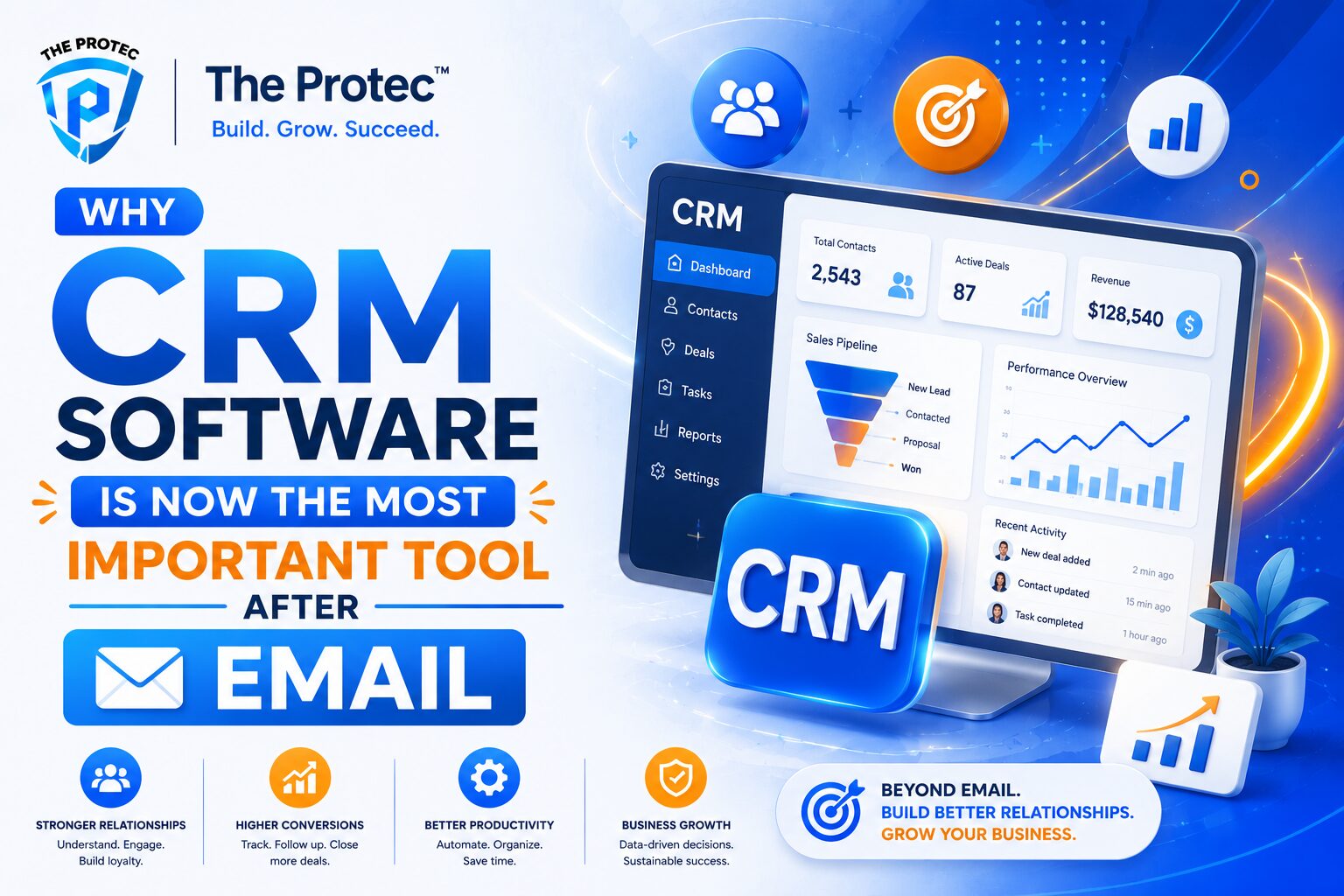
Why CRM Software Has Become the Most Important Business Tool After Email
Email changed the way businesses communicate. It became the universal channel for sales, support, marketing, and internal coordination. But once companies started handling more customers, more leads, more follow-ups, and more data across multiple channels, email alone was no longer enough. That gap is exactly where CRM software stepped in.
Today, the importance of CRM is hard to ignore. A modern CRM system does far more than store contact details. It gives business owners a single place to manage relationships, track every customer interaction, automate follow-ups, improve team visibility, and turn scattered conversations into a repeatable growth system. In other words, business CRM software has become the operational layer that email never could be.
For many companies, customer relationship management is now the second essential digital tool after email because it connects everything around the customer. It helps businesses respond faster, sell smarter, and deliver a better experience across the full customer journey. As customer expectations rise and digital workflows become more complex, CRM software is no longer optional for businesses that want to compete effectively.
What Makes CRM Software So Essential?
The core reason CRM software has become so important is simple: businesses don’t just need messages, they need context. Email tells you what was said. A CRM tells you who said it, when it happened, what was promised, what the customer needs next, and how that relationship is progressing.
That context is what drives better decisions. Instead of searching through inboxes, spreadsheets, and notes, teams can see the full history of a lead or customer in one place. This saves time, reduces mistakes, and gives every department access to the same source of truth.
Modern customer relationship management systems also support how businesses actually work today. Sales teams need lead tracking and pipeline visibility. Marketing teams need segmentation and campaign performance data. Service teams need case history and response tracking. Leadership needs reports, forecasts, and trend analysis. CRM software brings all of that together.
The result is not just better organization. It is better revenue performance, stronger retention, and more scalable operations.
Why Email Alone Is No Longer Enough
Email remains essential, but it has major limitations when used as the main system for customer management. Most inboxes are built for communication, not for business process. That creates friction in fast-moving organizations.
Email is not designed for collaboration
When multiple people need to manage the same customer, email quickly becomes messy. Messages get forwarded, buried, or duplicated. Important details are missed, and teams end up working from different versions of the truth.
Email does not give a full customer view
An inbox shows conversations, but not the full relationship timeline. It does not easily reveal deal stage, lead source, purchase history, support issues, renewal dates, or previous interactions across teams. That missing context makes it harder to personalize communication and follow up effectively.
Email is weak for automation and reporting
Business owners need more than communication. They need visibility into conversion rates, follow-up activity, response times, and sales pipeline health. CRM software offers those insights. Email alone does not.
Email creates manual work
Without CRM software, staff spend more time copying information between tools, updating spreadsheets, and trying to remember next steps. That manual effort slows growth and increases the risk of lost opportunities.
This is why the importance of CRM has increased so much. It fills the operational gap between communication and execution.
The Importance of CRM for Modern Businesses
Business owners often adopt CRM software for sales, but the real value reaches much further. The importance of CRM extends across the entire customer lifecycle, from first contact to long-term loyalty.
1. It improves lead management
Leads can come from websites, referrals, social media, events, ads, and email campaigns. Without a CRM, those leads are easy to lose or mismanage. Business CRM software centralizes them, tracks their source, and helps teams respond quickly before interest fades.
2. It supports better sales follow-up
Most sales are not lost because the product is wrong. They are lost because follow-up is inconsistent. CRM software keeps tasks, reminders, and activity histories organized so sales teams can stay on top of every opportunity.
3. It strengthens customer retention
Acquiring a customer is expensive. Retaining one is usually far more profitable. CRM systems help businesses track customer health, purchase patterns, service issues, renewal dates, and engagement signals so they can intervene early and reduce churn.
4. It creates a better customer experience
Customers expect businesses to remember them. They do not want to repeat the same information to different people. CRM software gives teams a shared record, enabling more relevant, timely, and personalized interactions.
5. It helps leadership make better decisions
Business owners need clear data to guide hiring, forecasting, marketing spend, and sales strategy. A CRM turns customer activity into usable reporting, helping leaders see what is working and where bottlenecks exist.
How CRM Software Has Evolved Beyond Basic Contact Management
Older CRM tools were often little more than digital address books. Today’s platforms are much more advanced. The latest generation of business CRM software uses automation, AI, workflow design, and connected data to reduce manual effort and improve decision-making.
One major shift is the rise of intelligent automation. CRMs can now trigger follow-up emails, create tasks, assign leads, update deal stages, route inquiries, and notify teams when customers need attention. This keeps work moving without relying on memory or endless admin.
Another major development is AI-assisted productivity. Leading CRM platforms increasingly use AI to summarize calls, suggest next steps, draft responses, score leads, and surface likely opportunities. For busy teams, this makes customer relationship management faster and more actionable.
CRM software has also become more connected. It now integrates with email, calendars, phone systems, live chat, social platforms, billing tools, help desks, and analytics dashboards. That connected ecosystem is one reason CRM has become indispensable. Businesses can finally see the full customer journey instead of isolated fragments.
In practice, this means CRM is not just a sales tool anymore. It is a business operating system for customer-facing teams.
Why Business CRM Software Matters for Growth
Growth creates complexity. A business can manage a few customers with email and spreadsheets, but that approach becomes risky as the company scales. Business CRM software gives teams structure before chaos takes over.
It improves speed to lead
Research consistently shows that faster responses improve conversion rates. When leads are routed automatically and assigned immediately, businesses can respond while intent is still high. External research from Salesforce also highlights how CRM helps teams manage customer relationships more effectively across the journey.
It reduces revenue leakage
Revenue is often lost in small, invisible ways: forgotten follow-ups, inconsistent handoffs, missed renewals, duplicate outreach, or poor qualification. CRM software closes those gaps by making processes repeatable and accountable.
It helps businesses segment smarter
Not every lead or customer should be treated the same. CRM systems let businesses segment by industry, company size, deal stage, source, location, purchase behavior, or support history. That improves targeting and makes campaigns more relevant.
It enables scalable processes
When growth depends on individual memory, scaling becomes difficult. CRM software turns best practices into workflows that can be repeated across the team. That consistency is what makes growth sustainable.
How CRM Supports Sales, Marketing, and Service at the Same Time
One reason CRM software is now so important is that it connects departments that used to operate separately. When teams share the same customer data, they can work toward the same outcome instead of creating friction.
Sales teams
Sales teams use CRM to track leads, manage pipelines, log calls, schedule follow-ups, and forecast revenue. They can focus more on selling and less on administrative work.
Marketing teams
Marketing teams use CRM data to understand which campaigns generate qualified leads, which audiences convert best, and which customers are most engaged. That makes campaigns more targeted and measurable.
Customer service teams
Support teams can see previous interactions, purchase history, and outstanding issues before responding. That leads to faster resolutions and more personalized service.
When these teams are aligned, the customer experiences a smoother journey. There are fewer dropped handoffs, fewer repeated questions, and more consistent communication. That alignment is a major competitive advantage.
Current CRM Trends Business Owners Should Pay Attention To
If you are evaluating CRM adoption, it helps to understand where the market is headed. The most relevant trends today are not about flashy features. They are about reducing friction and improving customer intelligence.
AI-powered assistance
CRM platforms are increasingly using AI to help with summarization, prioritization, forecasting, and content generation. This helps teams act faster and stay focused on high-value work.
Unified customer data
Businesses are moving away from disconnected tools and toward systems that combine email, calls, meetings, chats, and transactions in one record. This creates a more complete customer profile.
Automation-first workflows
Modern CRMs are designed to automate repetitive steps. That includes lead assignment, task reminders, pipeline updates, and customer nurturing. Automation is becoming essential for lean teams.
Stronger integration ecosystems
As businesses use more specialized software, CRM integration has become critical. The best systems connect with finance, marketing, support, and communication tools to create one operational layer.
Revenue operations alignment
More businesses are treating sales, marketing, and service as one revenue engine. CRM software is the foundation that makes that alignment possible.
For small and mid-sized businesses, these trends matter because they make CRM software more practical than ever. You no longer need a huge team to benefit from sophisticated customer relationship management.
Signs Your Business Needs CRM Software Now
Not every company needs a complex setup on day one, but certain warning signs show that email alone is starting to hold the business back.
- Leads are being lost or followed up too late.
- Multiple team members are contacting the same prospect without coordination.
- Sales forecasting is based on guesswork.
- Customer information lives in inboxes, spreadsheets, and notebooks.
- Marketing cannot tell which campaigns produce real revenue.
- Service teams do not have access to previous customer interactions.
- Managers spend too much time chasing updates instead of reviewing dashboards.
If several of these sound familiar, CRM adoption is probably overdue. The sooner the business creates a shared customer system, the easier it becomes to grow without losing control.
How to Choose the Right CRM for Your Business
Choosing CRM software is not only about features. The right system should fit your workflow, your team size, and your growth goals. A complicated platform that nobody uses is worse than a simple one that is adopted consistently.
Focus on usability
If the interface is confusing, adoption will suffer. Look for a CRM that makes it easy to log activity, find records, and move deals forward.
Check automation capabilities
Automation is one of the biggest reasons to adopt CRM software. Make sure the platform can reduce repetitive work without requiring heavy technical setup.
Review integration options
Your CRM should connect to email, calendars, forms, calling tools, and any critical business systems you already use.
Look at reporting depth
Business owners need dashboards that reveal pipeline status, conversion trends, team activity, and customer retention patterns.
Plan for adoption
The best CRM software is only valuable if your team uses it consistently. Training, process design, and leadership buy-in are just as important as the platform itself.
For guidance on customer relationship management fundamentals, HubSpot offers a useful overview at HubSpot CRM.
Why CRM Has Become the Most Important Business Tool After Email
Email is still the primary channel for communication, but CRM software is now the system that makes those communications usable at scale. Email helps people talk. CRM helps businesses remember, organize, automate, and act.
That distinction is the reason CRM has become such a critical investment. In a world where customers expect faster responses, more personalized service, and seamless handoffs, businesses cannot afford to rely on inboxes alone. They need customer relationship management tools that turn conversations into revenue and relationships into long-term value.
For business owners, the decision is no longer whether CRM software is useful. The real question is how long a company can keep growing without it.
FAQ
What is the main purpose of CRM software?
The main purpose of CRM software is to help businesses manage customer relationships in one organized system. It tracks leads, conversations, sales activity, customer history, and follow-up tasks so teams can work more efficiently.
Why is CRM software important for small businesses?
Small businesses benefit from CRM because it helps them stay organized as they grow. It reduces missed follow-ups, improves customer service, supports sales tracking, and gives owners better visibility into what is happening across the business.
How is CRM different from email?
Email is a communication tool, while CRM software is a relationship management system. Email handles messages, but CRM stores context, automates workflows, tracks progress, and helps teams coordinate around customers.
Can CRM software improve sales results?
Yes. CRM software can improve sales results by helping teams respond faster, track opportunities more accurately, automate follow-ups, and focus on leads that are most likely to convert.
Is CRM only for sales teams?
No. Modern business CRM software supports sales, marketing, customer service, and leadership. It is used across the organization to improve customer experience and drive revenue growth.