








Contents
- 1 Why the Next Decade Will Be Defined by Technology Shifts
- 2 1. Artificial Intelligence Becomes the Operating Layer of Business
- 3 2. Quantum Computing Moves Closer to Real-World Advantage
- 4 3. Robotics Becomes Smarter, More Flexible, and More Autonomous
- 5 4. Biotech and Synthetic Biology Transform Healthcare and Industry
- 6 5. Energy Storage and Clean Power Systems Become a Strategic Technology Layer
- 7 6. Spatial Computing Blends Digital and Physical Environments
- 8 7. Advanced Connectivity Expands the Reach of Intelligent Systems
- 9 8. Cybersecurity Evolves into Adaptive, AI-Driven Defense
- 10 How These Emerging Technologies Interconnect
- 11 What Businesses Should Do Now
- 12 FAQ
- 13 The Decade Ahead Belongs to Platforms, Not Gadgets
Why the Next Decade Will Be Defined by Technology Shifts
The next ten years are likely to bring more technological change than the previous twenty. That is not because every new idea will succeed, but because a small number of breakthrough platforms are maturing at the same time. Artificial intelligence is moving from novelty to infrastructure. Quantum computing is shifting from theory to practical experimentation. Robotics, biotech, energy systems, and advanced connectivity are converging in ways that could reshape industries, labor, healthcare, and daily life.
When people talk about future tech, the conversation often focuses on gadgets. But the technologies that matter most are usually the ones that disappear into the background. They become part of workflows, supply chains, hospitals, transport systems, and homes. The most important emerging technologies are not just impressive; they are enabling layers for everything else. In this article, we will look at the technology trends most likely to define the next decade, why they matter, and where real-world momentum is already building.
For a broad view of global innovation signals, the World Economic Forum’s analysis of emerging technologies is a useful reference point: https://www.weforum.org/.
1. Artificial Intelligence Becomes the Operating Layer of Business
Artificial intelligence is no longer one technology among many. It is becoming the layer that sits above software, data, and decision-making. The biggest shift is not just better chatbots or faster content generation. It is the rise of AI systems that can reason across tools, automate complex workflows, analyze massive datasets, and act as digital collaborators.
What makes AI one of the defining emerging technologies of the decade is its versatility. In customer service, it can handle routine requests and escalate edge cases with context. In software engineering, it can assist with code generation, testing, debugging, and documentation. In operations, it can forecast demand, optimize staffing, and flag anomalies. In healthcare, it can support diagnostics, triage, and administrative efficiency. In finance, it can improve fraud detection, risk analysis, and personalized advisory services.
Why AI will keep accelerating
- Foundation models continue to improve in reasoning, multimodal understanding, and tool use.
- Smaller, more efficient models are making on-device and private AI more practical.
- Enterprise adoption is moving from pilot projects to production deployments.
- AI agents are beginning to connect multiple tasks instead of handling only one prompt at a time.
The next phase of AI is likely to be less about a single breakthrough and more about integration. Organizations that can combine proprietary data, strong governance, and AI-enabled workflows will gain a meaningful competitive edge. For readers interested in current AI research and responsible deployment topics, Stanford HAI publishes strong ecosystem insights: https://hai.stanford.edu/.
2. Quantum Computing Moves Closer to Real-World Advantage
Quantum computing has spent years in the “promising but distant” category. That is changing. While fully fault-tolerant quantum machines are still ahead, the field is steadily advancing toward practical usefulness in specific domains. The most important shift is that the technology is no longer being evaluated only by raw qubit counts; it is being judged by whether it can solve meaningful problems better than classical systems in narrow but valuable areas.
This matters because certain problems are extremely hard for traditional computing. Quantum systems could help simulate molecules, optimize logistics networks, improve materials discovery, and unlock new approaches in cryptography. If the last decade was about proving quantum could exist, the next decade may be about proving where it delivers commercial advantage.
Potential breakthrough areas
- Drug discovery and molecular simulation
- Advanced materials and battery chemistry
- Complex optimization in logistics and manufacturing
- Cryptography and post-quantum security planning
Quantum computing is not likely to replace standard computing. Instead, it may become a specialized accelerator for high-value problems. The companies that prepare early by assessing data, security, and use-case fit will be better positioned when quantum advantage becomes more tangible.
3. Robotics Becomes Smarter, More Flexible, and More Autonomous
Robotics is entering a new era. Traditional industrial robots were powerful but rigid, built for controlled environments and repetitive tasks. The emerging wave of robotics is different. Thanks to advances in AI, better sensors, stronger compute, and improved simulation, robots are becoming more adaptive, more mobile, and more capable of operating in dynamic settings.
One of the most exciting technology trends is the rise of general-purpose robotics. These systems are still early, but they point toward machines that can learn multiple tasks, navigate unstructured spaces, and collaborate more naturally with humans. In warehouses, factories, agriculture, healthcare, and even retail, robotics could become a major force for productivity and safety.
Where robotics is gaining momentum
- Warehouse automation and autonomous material handling
- Precision agriculture and crop monitoring
- Medical and surgical assistance
- Service robots in hospitality and logistics
- Humanoid and mobile robots for labor-intensive environments
Robotics will not eliminate human work, but it will reshape it. Repetitive, dangerous, and physically demanding tasks are the most likely to be automated first. That creates opportunities for new roles in supervision, maintenance, training, and system design. The long-term impact may be less about replacement and more about extending what work can be done safely and efficiently.
4. Biotech and Synthetic Biology Transform Healthcare and Industry
Biotechnology is one of the most underappreciated emerging technologies in mainstream discussions, yet its long-term impact could be enormous. Advances in gene editing, cell engineering, protein design, and bio-manufacturing are opening up possibilities that were science fiction not long ago. Synthetic biology, in particular, is becoming a platform for creating new medicines, materials, foods, and industrial processes.
In healthcare, biotech is enabling more precise treatments, earlier diagnostics, and personalized medicine. In agriculture, it is helping create crops with better resilience and yield. In manufacturing, biological systems may eventually produce chemicals, materials, and ingredients with lower environmental impact than conventional methods.
Why biotech matters for the next decade
- Drug discovery is becoming faster and more data-driven
- Gene-editing tools are improving in precision and safety
- Bio-manufacturing can reduce dependence on petrochemical processes
- Personalized medicine is becoming more commercially viable
The pace of progress in biotech depends heavily on regulation, public trust, and clinical evidence. Still, the direction is clear: biology is becoming programmable. That makes biotech one of the most transformative future tech areas to watch.
5. Energy Storage and Clean Power Systems Become a Strategic Technology Layer
Energy innovation is often treated as a policy issue, but it is also one of the most important technology trends of the decade. The shift to cleaner, more resilient power systems depends on breakthroughs in storage, grid management, power electronics, and generation. As AI, electrification, and data centers expand, demand for reliable and flexible energy infrastructure will rise sharply.
Battery technology is a major part of this story. Improvements in energy density, charging speed, safety, and lifespan could accelerate electric vehicle adoption and stabilize renewable grids. Beyond batteries, new approaches such as long-duration storage, smart grids, and advanced nuclear technologies may help solve the intermittency problem that has long challenged clean energy systems.
Key developments to watch
- Solid-state and next-generation batteries
- Long-duration grid storage
- AI-optimized power distribution
- Small modular reactors and advanced nuclear concepts
- Decentralized energy systems and microgrids
The most important point is this: energy is no longer just fuel. It is a digital, distributed, and increasingly intelligent system. The companies and countries that build resilient energy infrastructure will have a major advantage in the future economy.
6. Spatial Computing Blends Digital and Physical Environments
Spatial computing, which includes augmented reality, mixed reality, and immersive interfaces, is still emerging, but it could redefine how people interact with information. Instead of looking at a screen and tapping icons, users may work with digital objects layered onto real environments. That shift could affect design, training, collaboration, maintenance, retail, and education.
The promise of spatial computing is not just visual novelty. It is contextual computing. A technician could see repair instructions overlaid on equipment. A doctor could view patient data in a three-dimensional workspace. An engineer could manipulate prototypes in a virtual environment before a physical product is built. These use cases suggest a future where interfaces become more natural and spatially aware.
Why spatial computing may matter more than expected
- It can reduce training time for complex tasks
- It supports remote collaboration with richer context
- It improves visualization for design and engineering
- It may create new forms of entertainment and education
Adoption will depend on hardware comfort, battery life, software ecosystems, and clear business value. But if those pieces come together, spatial computing could become one of the most visible future tech shifts of the next decade.
7. Advanced Connectivity Expands the Reach of Intelligent Systems
The next wave of connectivity is not just about faster downloads. It is about enabling large numbers of devices, vehicles, machines, and sensors to communicate reliably in real time. 5G is still expanding, but the longer-term story includes early work on 6G concepts, edge computing, satellite networks, and integrated sensing.
This matters because future tech depends on fast, secure, low-latency communication. Autonomous vehicles, industrial robots, remote healthcare systems, smart factories, and distributed energy networks all need dependable connections. The more intelligence moves to the edge, the more important connectivity becomes.
Connectivity trends shaping the decade
- Private 5G networks in industrial and enterprise environments
- Edge computing to reduce latency and bandwidth load
- Satellite internet for global coverage
- Early 6G research around sensing and ultra-low latency
Connectivity is often invisible when it works, but it becomes critical when it fails. In the coming decade, advanced networks will be one of the key enablers that allow other emerging technologies to scale.
8. Cybersecurity Evolves into Adaptive, AI-Driven Defense
As systems become more intelligent, attack surfaces grow. That makes cybersecurity one of the most strategically important technology trends of the decade. The future of defense will be shaped by AI-driven monitoring, identity-first security, zero-trust architectures, and automated response systems.
Cybersecurity is not just reacting to threats anymore; it is becoming predictive. Machine learning can identify suspicious behavior patterns faster than traditional rule-based systems. Identity verification is becoming more important than perimeter defense. And as quantum computing advances, organizations must also prepare for post-quantum cryptography to protect long-lived sensitive data.
What will matter most
- AI-assisted threat detection and response
- Zero-trust access models
- Post-quantum cryptographic readiness
- Security for connected devices and critical infrastructure
In the next decade, cybersecurity will be tightly linked to trust. The winners will be organizations that can secure data, people, and automated systems without slowing innovation.
How These Emerging Technologies Interconnect
The most important insight about emerging technologies is that they do not evolve in isolation. AI improves robotics. Quantum computing can accelerate materials research for batteries. Biotech relies on advanced data analysis and automation. Spatial computing depends on powerful connectivity and edge processing. Cybersecurity is needed to protect all of it.
This convergence is what makes the next decade so significant. We are not just watching separate innovations mature. We are watching the creation of a technology stack for the future economy. The organizations that understand these interdependencies will make better strategic decisions than those that treat each trend as a standalone novelty.
In practical terms, that means leaders should ask a different set of questions: Which technologies solve a real bottleneck? Which have declining costs and rising capability? Which will benefit from adjacent breakthroughs? And which ones are still experimental but worth tracking for long-term optionality?
What Businesses Should Do Now
For businesses, the goal is not to chase every new trend. The goal is to build readiness. That means identifying where emerging technologies can create measurable value, then developing the data, governance, and talent needed to adopt them responsibly.
- Map the technology trends most relevant to your industry
- Invest in data quality and digital infrastructure
- Run small pilots with clear success metrics
- Build governance for AI, security, and compliance
- Train teams to work alongside intelligent systems
Companies that wait for perfect clarity will likely fall behind. The technologies that define the next decade will reward experimentation, but only when it is paired with disciplined execution.
FAQ
Which emerging technology is likely to have the biggest impact overall?
Artificial intelligence is the most immediate and broad-based force because it is already changing how software, services, and operations work. However, its biggest impact may come through combining with robotics, biotech, and advanced connectivity.
Are quantum computing and AI competing technologies?
No. They solve different problems and are more likely to complement each other. AI is useful for pattern recognition, automation, and reasoning over data, while quantum computing may help with specialized optimization and simulation tasks.
Which future tech areas are most ready for business adoption?
AI, cybersecurity automation, robotics in controlled environments, and energy management systems are among the most commercially ready. Biotech, quantum computing, and spatial computing may take longer to scale broadly but have strong long-term potential.
How should companies evaluate technology trends?
They should focus on business value, technical maturity, integration requirements, and regulatory risk. The best technologies are not always the most exciting ones; they are the ones that solve a real problem better than existing alternatives.
The Decade Ahead Belongs to Platforms, Not Gadgets
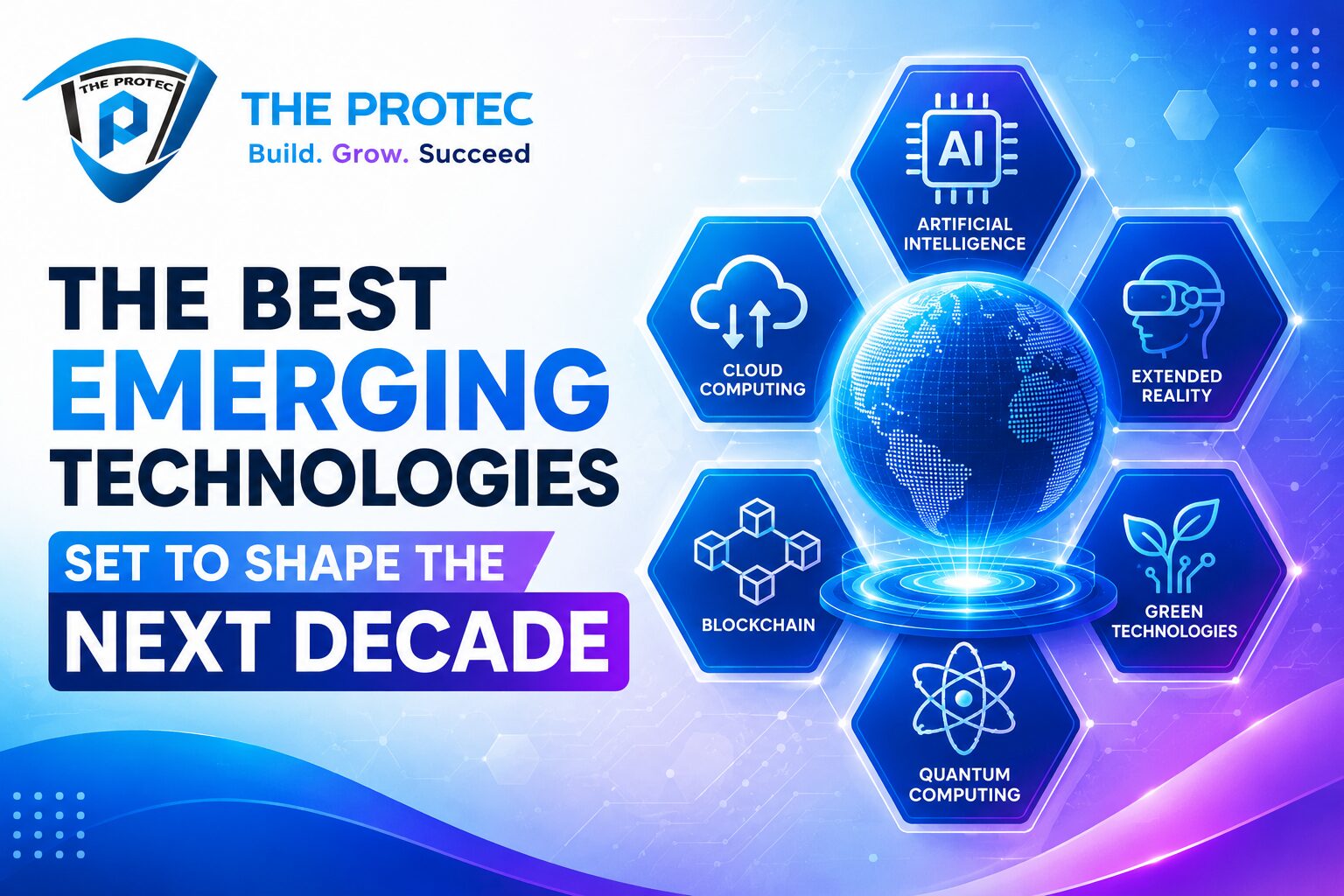
The best emerging technologies of the next decade will not be defined by novelty alone. They will matter because they become foundational. AI will change how work is done. Quantum computing will open new frontiers in computation. Robotics will extend physical capability. Biotech will make biology more programmable. Energy systems will become smarter and more resilient. Spatial computing will change how people interact with digital information. And cybersecurity will hold the entire stack together.
If there is a single lesson in all of this, it is that the most powerful technology trends are rarely isolated inventions. They are platforms that enable new industries, new workflows, and new forms of value creation. The organizations that pay attention now will be better positioned to lead as these emerging technologies move from possibility to everyday reality.