









Contents
- 1 Rust vs Go: The Backend Battle That Still Matters
- 2 Why Rust and Go Keep Dominating Backend Programming Languages
- 3 Rust vs Go Performance: Speed, Memory, and Runtime Behavior
- 4 Server Side Development: Developer Experience and Productivity
- 5 Hiring Trends: Which Backend Language Is Easier to Staff?
- 6 Scalability: Which Language Handles Growth Better?
- 7 Ecosystem, Frameworks, and Production Readiness
- 8 Where Rust Is Winning
- 9 Where Go Is Still Winning
- 10 Rust vs Go: Which Should You Choose?
- 11 External Resources Worth Reading
- 12 FAQ: Rust vs Go for Backend Development
- 13 Final Verdict: Who Is Winning the Backend Battle?
Rust vs Go: The Backend Battle That Still Matters
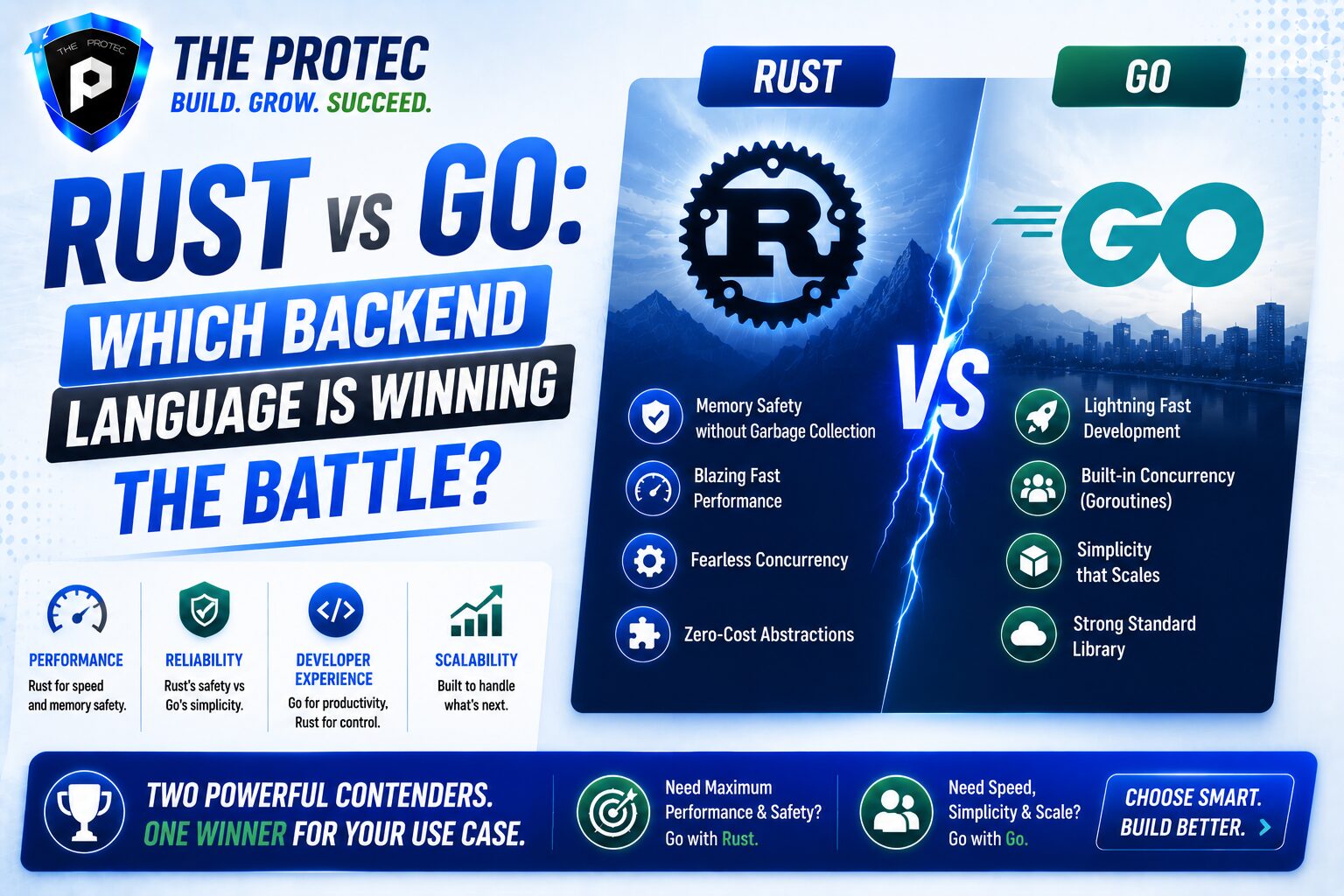
When teams talk about the best backend programming languages for modern products, Rust and Go come up again and again. Both languages are fast, reliable, and built for server side development at scale, but they solve problems in very different ways. Go focuses on simplicity, concurrency, and fast team productivity. Rust focuses on memory safety, precise control, and performance without a garbage collector. That difference is exactly why the Rust vs Go debate keeps growing.
As of June 2026, the backend landscape is more competitive than ever. Cloud-native systems, AI infrastructure, edge services, real-time APIs, and high-throughput platforms all demand better efficiency. At the same time, hiring managers want engineers who can ship quickly, maintain systems safely, and keep infrastructure costs under control. In that environment, the choice between Rust and Go is no longer about language preference alone. It is about performance goals, hiring realities, and the long-term scalability of the stack.
This article breaks down the Rust vs Go conversation from the angles that matter most: raw speed, developer experience, team hiring, ecosystem maturity, and operational scalability. If your organization is deciding which backend programming language to adopt next, this comparison will help you make a practical, future-focused decision.
Why Rust and Go Keep Dominating Backend Programming Languages
Many languages can be used for server side development, but few are as consistently discussed as Rust and Go. The reason is simple: both were designed with modern systems in mind.
- Go was built to make backend engineering straightforward, readable, and easy to scale across teams.
- Rust was built to deliver memory safety and high performance without sacrificing control.
That makes them especially attractive for cloud services, microservices, networking tools, API backends, platform engineering, and performance-sensitive infrastructure. In 2026, both are also benefiting from broader adoption in areas like developer tools, security-focused systems, and distributed services.
What makes the comparison so interesting is that neither language is universally “better.” Go often wins on speed of development and team adoption. Rust often wins on runtime efficiency and safety guarantees. The real question is which trade-off matters more for your product, team, and roadmap.
Rust vs Go Performance: Speed, Memory, and Runtime Behavior
Performance is usually the first topic in any Rust vs Go comparison, and for good reason. Backend systems today are expected to do more with less: more requests, more data, more concurrency, and lower latency targets. In that environment, runtime behavior matters a lot.
Rust performance advantages
Rust is known for near-systems-level performance. Because it does not rely on a garbage collector, it can deliver highly predictable latency and efficient memory usage. That matters in backends where tail latency, resource consumption, and throughput directly affect user experience and cloud spend.
Rust is especially strong when a backend needs:
- low-latency request handling
- tight memory control
- high concurrency with minimal overhead
- efficient use of CPU and RAM in constrained environments
For teams building edge services, high-frequency APIs, streaming components, or performance-heavy infrastructure, Rust often delivers measurable benefits. It can be harder to write, but the payoff is a runtime that is extremely efficient.
Go performance advantages
Go is also fast, though its performance profile is different. It benefits from a lightweight runtime, strong concurrency primitives, and a garbage collector that has improved steadily over time. For many backend workloads, Go is more than fast enough and easier to tune than older managed languages.
Go performs particularly well in:
- microservices
- API servers
- cloud orchestration tools
- network services
- high-concurrency systems with predictable patterns
In practice, Go often offers the better engineering trade-off when a team wants strong speed without the complexity of Rust. For many products, the difference between “very fast” and “extremely fast” is less important than delivery speed, observability, and maintainability.
Who wins on performance?
If the only metric is raw efficiency, Rust usually wins. If the metric is total engineering throughput across development, deployment, and maintenance, Go often comes out ahead. This is why the backend programming languages conversation is not just about benchmarks. The winning language depends on whether your bottleneck is runtime cost or engineering speed.
Server Side Development: Developer Experience and Productivity
For many teams, the biggest factor in backend programming languages is not performance at all. It is developer experience. A language can be technically superior and still lose if it slows down product delivery or creates hiring friction.
Why Go feels easier for backend teams
Go has a famously simple design. The syntax is clean, the standard library is practical, and the language avoids many of the complicated abstractions common in other ecosystems. That simplicity makes onboarding faster and codebases easier to standardize across large teams.
For server side development, this matters a lot. Teams can move from prototype to production quickly, often with fewer debates about architecture and fewer language features to police. Go’s concurrency model, centered on goroutines and channels, is also approachable for backend developers who need to build scalable systems without diving into deep memory management concepts.
Why Rust has a steeper learning curve
Rust is powerful, but it demands more from developers. Ownership, borrowing, lifetimes, and strict compile-time checks are major advantages for safety, but they also create a steeper learning curve. Many teams report that Rust pays off after the initial ramp-up, but the early stage can be slower than with Go.
That does not mean Rust is poor for productivity. In fact, once a team is fluent in the language, Rust can prevent a large class of runtime bugs that would otherwise appear later in production. The challenge is that the productivity curve is front-loaded. You invest more time up front and gain more reliability over the life of the system.
Productivity verdict
For teams optimizing for short iteration cycles and easy onboarding, Go is usually the better choice. For teams optimizing for long-term correctness and fewer production surprises, Rust can be worth the extra effort. In the real world, this often means Go is better for general-purpose backend teams, while Rust is better for specialized infrastructure and performance-sensitive services.
Hiring Trends: Which Backend Language Is Easier to Staff?
Hiring is one of the most important practical considerations in the Rust vs Go debate. A language might be technically ideal, but if it is hard to recruit for, that can slow growth and increase delivery risk.
Go hiring remains broad and mature
Go has established itself as one of the most hireable backend programming languages in cloud-native engineering. A large number of backend developers, DevOps engineers, platform engineers, and distributed systems specialists already know Go or can learn it quickly. That makes it easier to build teams, replace talent, and standardize engineering practices.
Hiring for Go is also helped by its reputation as a production-friendly language. Many engineers see Go as a practical career skill because it appears in infrastructure, fintech, SaaS, observability, and platform tooling. This broad adoption keeps the talent pool healthy.
Rust hiring is growing, but still more specialized
Rust hiring has grown significantly, especially in performance-focused companies, security-sensitive environments, crypto infrastructure, developer tooling, and companies building next-generation systems software. The interest is strong, but the talent pool is still smaller than Go’s.
That means Rust teams often need either experienced Rust developers or strong engineers willing to invest in the learning curve. For some organizations, that is not a problem. For others, especially those needing to scale hiring quickly, it is a meaningful constraint.
The hiring reality in 2026
In 2026, the trend is clear: Go remains easier to hire for at scale, while Rust is increasingly desirable but more selective. Rust may attract highly motivated systems engineers, but Go tends to win in broader backend hiring pipelines. If your company expects rapid team expansion, Go usually lowers staffing risk. If your company needs deep technical specialization, Rust may help you attract the right kind of engineer.
Scalability: Which Language Handles Growth Better?
Scalability is often used loosely, but in backend engineering it usually means several different things: traffic growth, codebase growth, team growth, and infrastructure growth. Rust and Go handle these dimensions differently.
Go scalability: operational simplicity at scale
Go is highly scalable in the operational sense. Its concurrency model makes it easy to build services that handle a large number of simultaneous requests. It also fits naturally into microservice architectures, where services need to stay small, readable, and easy to deploy independently.
Go scales well when teams need:
- consistent service patterns
- fast developer onboarding
- easy deployment and maintenance
- strong ecosystem support for cloud-native architecture
For many organizations, this is the most important form of scalability. It is not just about serving more traffic. It is about keeping engineering manageable as the system grows.
Rust scalability: efficiency and correctness under pressure
Rust scales well when the challenge is resource intensity. If a system needs to process huge volumes of data, reduce cloud usage, or maintain very tight performance envelopes, Rust can be a major advantage. Its memory safety model also reduces the risk of crashes and undefined behavior in complex systems.
This makes Rust appealing for:
- high-performance network services
- data pipelines
- real-time processing engines
- security-critical infrastructure
- latency-sensitive platforms
Rust scalability is often more about maximizing hardware efficiency and minimizing failure modes than maximizing team velocity. That distinction is important.
Scalability verdict
Go tends to scale better organizationally. Rust tends to scale better computationally. If your issue is adding more teams and more services quickly, Go is usually easier. If your issue is squeezing maximum reliability and efficiency from a service under heavy load, Rust may be the stronger option.
Ecosystem, Frameworks, and Production Readiness
Backend programming languages are only as useful as their ecosystems. Modern server side development depends on tooling, libraries, frameworks, observability support, package management, and deployment compatibility.
Go has a mature ecosystem for web services, cloud tooling, metrics, testing, and deployment. It has become a default choice for Kubernetes-adjacent tooling, infrastructure automation, and cloud-native services. The ecosystem is stable and production-friendly, which reduces integration friction.
Rust’s ecosystem is younger but very high quality in many areas. The tooling experience is excellent, the compiler is a major strength, and libraries for async networking, web frameworks, and systems programming continue to improve. Rust is no longer an experimental choice for backend services; it is a serious production language. However, some teams still find Go’s ecosystem more immediately practical for common backend tasks.
For teams evaluating Rust vs Go in 2026, ecosystem maturity matters because it affects how quickly you can build, hire, ship, debug, and maintain. Go remains the safer default for mainstream backend work. Rust is increasingly compelling where its strengths align with the problem.
Where Rust Is Winning
Rust is gaining ground in places where performance and reliability have a direct business impact. The language is increasingly favored for components that require zero-cost abstractions, memory safety, and predictable runtime behavior.
- Infrastructure tools and systems software
- Security-focused services
- High-performance APIs and proxies
- Data-intensive pipelines
- Low-latency and edge computing workloads
Rust also benefits from a strong developer reputation. Engineers who enjoy technical depth often see Rust as a modern, high-trust language for serious backend and systems work. That reputation continues to drive adoption across companies that care deeply about correctness and efficiency.
Where Go Is Still Winning
Go remains the practical winner in many backend environments because it is easier to staff, easier to maintain, and easier to standardize across large organizations. It is especially dominant in cloud-native server side development where teams need to build and operate services quickly.
- Microservices and API backends
- Platform engineering teams
- Developer tools and internal services
- Distributed systems with broad team ownership
- Startups that need speed and simplicity
Go’s biggest strength is that it turns backend complexity into something manageable. For many companies, that is the real competitive advantage. A language that helps teams move fast, maintain consistency, and scale hiring is incredibly valuable.
Rust vs Go: Which Should You Choose?
The answer depends on what you are building and how your organization works.
- Choose Go if you want faster onboarding, easier hiring, a simple language design, and strong backend productivity.
- Choose Rust if you need maximum performance, memory safety, and long-term control over system behavior.
For many businesses, Go is the better default backend programming language because it reduces friction across the entire delivery pipeline. For companies building performance-critical infrastructure, Rust is increasingly the smarter strategic investment. The important thing is not to choose based on hype. Choose based on the kind of scalability your product actually needs.
One useful way to think about it: Go optimizes for speed of team execution, while Rust optimizes for precision and runtime efficiency. That framing explains why both languages continue to grow in popularity rather than one replacing the other outright.
External Resources Worth Reading
FAQ: Rust vs Go for Backend Development
Is Rust faster than Go for backend services?
In most cases, yes. Rust typically delivers better raw performance and lower memory overhead because it does not use a garbage collector. However, Go is often fast enough for real-world backend systems and can be easier to build and maintain.
Which language is better for hiring backend developers?
Go is usually easier to hire for because it has a larger and more mature backend talent pool. Rust hiring is growing quickly, but the market remains more specialized.
Is Go still a good choice for server side development?
Absolutely. Go remains one of the strongest choices for server side development, especially for microservices, APIs, cloud tooling, and distributed systems. Its simplicity and concurrency model make it highly practical.
Should startups choose Rust or Go?
Most startups benefit from Go if they want to move quickly and hire easily. Rust makes more sense if the product is highly performance-sensitive or if runtime efficiency is a major competitive factor.
Will Rust replace Go in backend programming?
Unlikely. Rust and Go solve different problems. Rust is gaining adoption in specialized performance and safety-critical areas, while Go remains dominant in mainstream backend engineering.
Final Verdict: Who Is Winning the Backend Battle?
The honest answer is that there is no single winner in the Rust vs Go battle. Go is winning where teams value speed, simplicity, hiring flexibility, and scalable operations. Rust is winning where teams need performance, memory safety, and tighter control over system behavior.
If you define success in terms of total backend productivity, Go is still ahead for most organizations. If you define success in terms of runtime efficiency and safety at the systems layer, Rust is making serious gains. In 2026, the smartest teams are not asking which language is universally best. They are asking which one best fits their architecture, hiring plan, and scalability needs.
That is why both languages continue to thrive. Go is the pragmatic champion of mainstream backend development. Rust is the precision tool for teams that need to push performance and correctness further. The backend battle is not about replacement. It is about choosing the right weapon for the job.