








Contents
- 1 How Local AI Models Are Challenging ChatGPT and Cloud-Based AI
- 2 Why businesses are rethinking cloud-only AI
- 3 What local AI models actually are
- 4 The biggest advantages of local AI models
- 5 Why local AI has become viable now
- 6 Where businesses are using local AI models today
- 7 Are local models replacing ChatGPT?
- 8 Key challenges of deploying offline AI and private LLMs
- 9 The future of enterprise AI is distributed
- 10 FAQ: Local AI models vs ChatGPT and cloud AI
- 11 Conclusion
How Local AI Models Are Challenging ChatGPT and Cloud-Based AI
For the last few years, cloud-based AI tools have dominated the conversation. Services like ChatGPT made generative AI feel instantly accessible: type a prompt, get a polished response, and scale usage without worrying about hardware. But a major shift is underway. Businesses are increasingly deploying local AI models on their own infrastructure, and that change is reshaping how organizations think about privacy, performance, cost, and control.
This movement is not a rejection of cloud AI so much as a response to its limits. As AI becomes embedded in customer service, document processing, software development, analytics, and internal search, companies are asking harder questions. Where does sensitive data go? How predictable are the monthly costs? Can latency be reduced? Can the model be tuned to the business without exposing proprietary information? For many teams, the answer is turning out to be local AI models, offline AI, and private LLM deployments that run on owned or tightly controlled hardware.
The result is one of the most important trends in enterprise AI today: a growing push to bring intelligence closer to the data.
Why businesses are rethinking cloud-only AI
Cloud AI has a clear appeal. It is easy to start, requires little upfront investment, and gives teams access to powerful foundation models without managing infrastructure. That convenience helped accelerate adoption across nearly every industry. Yet as usage grows, so do concerns that are difficult to ignore in production environments.
First, there is the issue of data sensitivity. Many organizations cannot freely send confidential contracts, patient information, financial records, source code, or internal strategy documents to third-party APIs without careful legal and security review. Even when vendors offer enterprise-grade protections, some companies prefer to keep that data entirely inside their own environment.
Second, cloud AI can become expensive at scale. Token-based pricing is manageable for occasional use, but costs can rise quickly when AI becomes part of daily workflows for hundreds or thousands of employees. A private LLM running on owned GPUs may require upfront investment, but it can offer more predictable long-term economics for high-volume workloads.
Third, latency matters. For applications like real-time support, code completion, fraud detection, manufacturing assistance, and on-prem search, every second counts. Local inference can reduce round-trip delays and improve user experience, especially in locations with unreliable connectivity or strict network segmentation.
Finally, many businesses want deeper customization. Cloud models are powerful generalists, but organizations often need AI that understands their own terminology, policies, products, and workflows. Running models locally makes it easier to fine-tune, route, cache, and integrate them with internal systems.
What local AI models actually are
Local AI models are machine learning models that run on hardware owned or controlled by the organization using them. Instead of sending each request to a remote cloud endpoint, the model is hosted on a local server, workstation, private data center, edge device, or secure private cloud environment under the company’s control.
In practical terms, local AI can range from a compact model running on a single GPU workstation to a larger private LLM deployed across a cluster of servers. Some organizations use open-weight models for on-prem inference, while others use proprietary models packaged for private deployment. The common thread is that the computation happens close to the data.
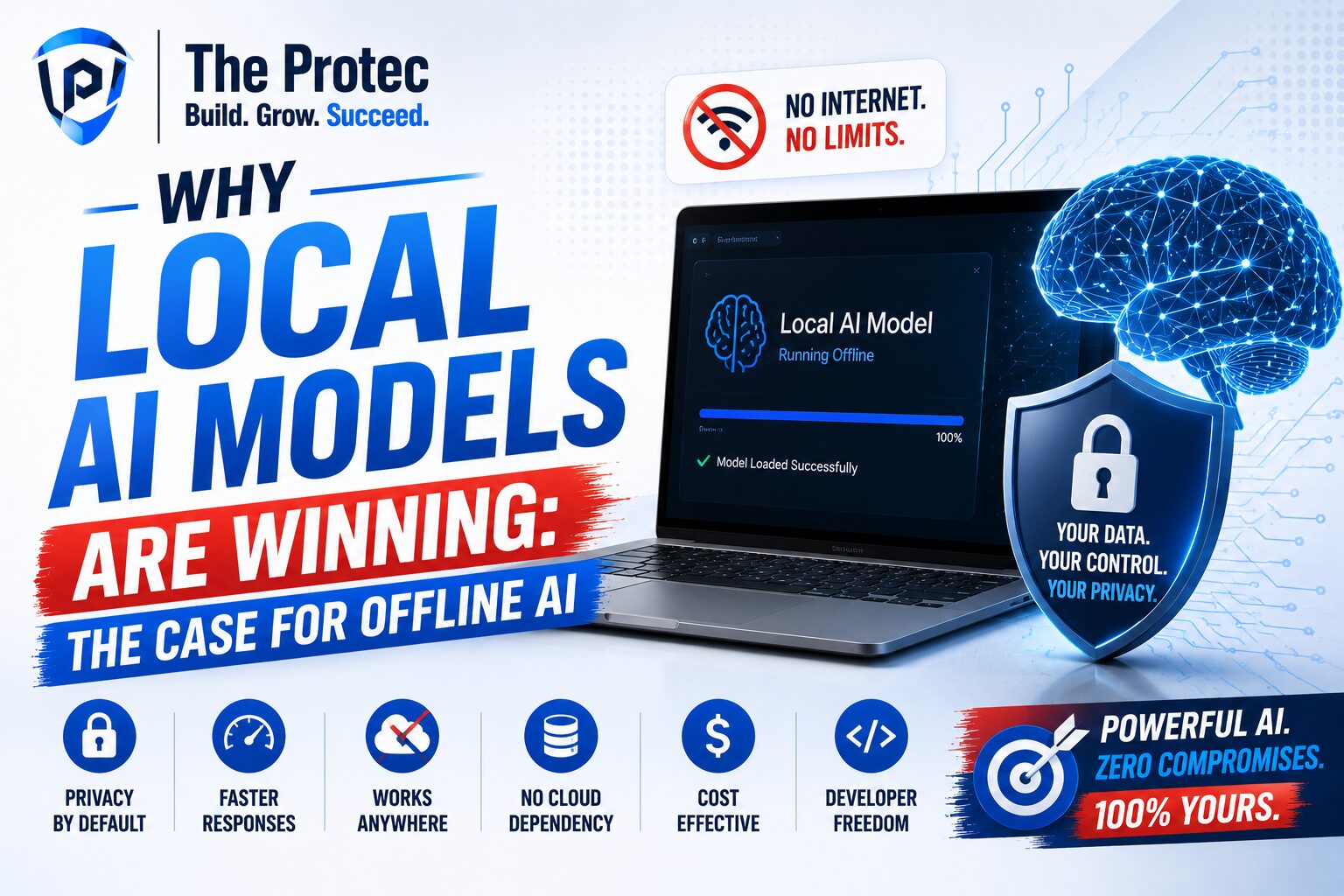
This is where offline AI becomes especially important. Offline AI refers to systems that can operate without a constant internet connection or external API dependency. In regulated industries, remote sites, secure facilities, or disaster recovery scenarios, offline AI can be a decisive advantage. It keeps critical workflows functioning even when connectivity is limited or unavailable.
Private LLMs take this a step further by combining the flexibility of large language models with enterprise-grade control. A private LLM can be configured for internal search, contract review, help desk automation, coding support, knowledge assistants, and more, while remaining inside the company’s security perimeter.
The biggest advantages of local AI models
1. Better data privacy and control
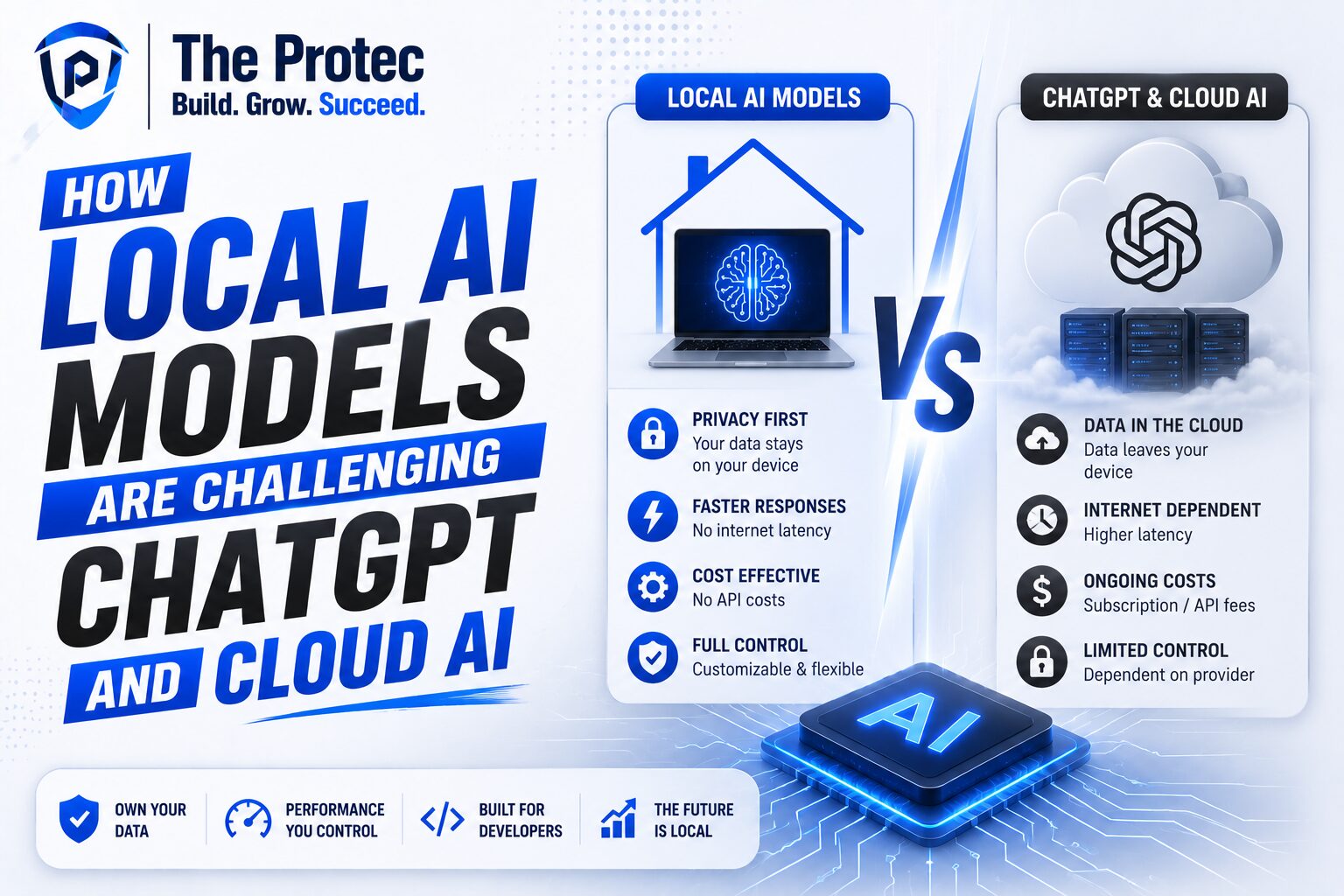
The most obvious advantage is privacy. When an organization runs a model on its own hardware, it can keep prompts, outputs, logs, and embeddings inside its environment. That reduces exposure and simplifies compliance efforts in sectors where data handling matters deeply, including healthcare, finance, legal services, government, and manufacturing.
While cloud providers have improved their enterprise security offerings, local deployment gives security teams more direct control over access policies, retention settings, audit logging, and network boundaries. For many businesses, that control is worth more than the convenience of a managed API.
2. Lower latency and better responsiveness
Local inference removes the need to send every request over the public internet. That can dramatically reduce response times, especially for repetitive or interactive tasks. In customer support tools, document assistants, and search applications, local AI feels faster and more natural because the model is closer to the user and the data source.
Low latency is also valuable for edge environments. Retail stores, factories, warehouses, hospitals, and field service teams increasingly use AI where cloud connectivity is inconsistent. In those settings, offline AI can keep essential systems running without network dependence.
3. Predictable costs at scale
Cloud AI pricing is attractive for experimentation, but production usage can be difficult to forecast. As prompts get longer, context windows grow, and usage expands across teams, token bills can become a major operating expense. Local AI models shift some of that cost into infrastructure planning, which can make budgeting easier over time.
This is particularly relevant for high-throughput tasks such as summarization, classification, extraction, retrieval-augmented generation, and internal search. If a company sends millions of similar requests each month, owning the compute may be more economical than paying per call.
4. Deeper customization and specialization
Many organizations do not need a model that knows everything; they need one that knows their business. Local deployment makes it easier to adapt a model to specific terminology, document styles, approval workflows, and internal knowledge bases. Teams can also design routing systems that send sensitive tasks to a private LLM while less sensitive requests use a smaller model or a public API.
This hybrid approach is becoming common. Businesses are no longer asking, “Cloud or local?” They are asking, “Which model runs where, and for what purpose?”
5. Reduced vendor dependence
Relying entirely on a cloud AI provider creates strategic risk. Pricing can change, rate limits can tighten, model behavior can shift, and product availability can evolve. Local AI models reduce dependence on a single vendor’s roadmap. They also give organizations more leverage when negotiating enterprise contracts because they are not locked into one path for every use case.
Why local AI has become viable now
A few years ago, running advanced language models locally was practical only for specialized teams with serious infrastructure budgets. That changed quickly. Several converging trends have made local AI much more realistic for mainstream businesses.
First, model efficiency improved. Modern architectures, quantization methods, speculative decoding, and optimized inference runtimes have made smaller models far more capable than their size would suggest. A well-tuned compact model can now handle many business tasks that once required much larger systems.
Second, hardware has improved. GPUs and AI accelerators are more capable, memory configurations are larger, and edge inference has become more accessible. Organizations can now deploy a private LLM on commodity servers in ways that would have been impractical only a short time ago.
Third, the software ecosystem is more mature. Inference engines, orchestration tools, vector databases, model gateways, and evaluation frameworks have improved rapidly. That means businesses can build reliable local AI stacks without starting from scratch.
Fourth, the market has shifted toward practical use cases. Companies are less interested in impressive demos and more interested in measurable outcomes: faster support resolution, lower search time, fewer manual document reviews, and more secure automation.
For a useful technical overview of model deployment and inference optimization, the Hugging Face documentation is a strong reference. For broader cloud architecture considerations, the Microsoft Azure Architecture Center offers practical guidance on secure system design.
Where businesses are using local AI models today
Local AI is not limited to experimental labs. It is already being used in production across a wide range of workflows.
- Customer support: Private assistants can answer product questions using internal documentation without exposing customer data to external APIs.
- Knowledge search: Employees can query internal wikis, policies, manuals, and project archives through a private LLM.
- Document processing: Businesses use local AI for summarization, extraction, classification, and compliance review.
- Software engineering: Development teams deploy offline AI coding assistants to support secure repositories and reduce dependency on external tools.
- Healthcare and life sciences: Sensitive clinical and research data can be processed inside controlled environments.
- Finance and legal: Confidential records, contracts, and regulatory materials are kept inside private infrastructure.
- Industrial and edge systems: Factories, warehouses, and remote sites use AI where connectivity is limited or unavailable.
The common theme is operational usefulness. Local deployment is winning where the business value of control outweighs the convenience of outsourcing inference.
Are local models replacing ChatGPT?
Not exactly. ChatGPT and other cloud-based AI tools still offer tremendous value, especially for general-purpose brainstorming, rapid prototyping, and users who need the latest frontier capabilities with minimal setup. In many organizations, cloud AI remains the best entry point for experimentation.
What is changing is the production strategy. Businesses increasingly treat cloud AI as one component in a broader architecture rather than the only option. The strongest systems are becoming hybrid systems. A cloud model may handle broad reasoning or low-risk tasks, while a local AI model handles sensitive, repetitive, or latency-critical workloads.
This hybrid model reflects a more mature view of AI adoption. Companies are learning that the best tool is not always the biggest or most famous model. The right choice depends on the workflow, the data, the compliance requirements, and the total cost of ownership.
Key challenges of deploying offline AI and private LLMs
Local AI is powerful, but it is not a silver bullet. Businesses need to understand the trade-offs before moving workloads in-house.
- Infrastructure management: Running models locally means handling hardware procurement, upgrades, monitoring, and failover.
- Model maintenance: Teams must manage versions, testing, drift, and updates carefully.
- Security responsibility: Keeping data local improves control, but it also increases the organization’s responsibility for protecting systems.
- Talent requirements: Successful deployment may require ML engineers, platform engineers, and infrastructure specialists.
- Performance tuning: Not every model is efficient out of the box; optimization often matters as much as model choice.
These challenges explain why many businesses choose a phased rollout. They start with one use case, validate performance and governance, and expand only after proving the value.
The future of enterprise AI is distributed
The most important takeaway is that AI architecture is becoming distributed. Instead of placing every workflow in the cloud, organizations are deciding where each task belongs based on sensitivity, speed, cost, and reliability. That is why local AI models are becoming so influential: they restore architectural choice.
In the near future, many companies will likely operate a mix of systems: public models for general tasks, private LLMs for sensitive operations, and offline AI for edge or mission-critical environments. This approach gives businesses the flexibility to match the model to the job rather than forcing every problem into a single cloud dependency.
That shift challenges the assumption that cloud AI is automatically the most advanced or most practical choice. For many real-world workloads, the smartest AI is the one you can keep close, control directly, and integrate deeply with your business operations.
FAQ: Local AI models vs ChatGPT and cloud AI
What is the difference between local AI models and cloud AI?
Local AI models run on hardware that your organization owns or controls, while cloud AI runs on a provider’s remote infrastructure and is accessed through APIs or web apps. Local deployment gives more control over data and latency.
Is offline AI good enough for business use?
Yes, for many business tasks it is. Offline AI is especially strong for document workflows, internal search, customer support, coding assistance, and edge environments where privacy or connectivity is a concern.
Why would a company choose a private LLM instead of ChatGPT?
A private LLM is often chosen to protect sensitive data, reduce recurring API costs, improve response times, and allow deeper customization for internal processes. It is especially valuable in regulated or high-volume environments.
Are local AI models harder to maintain?
They can be, because the company is responsible for hardware, updates, monitoring, and security. However, many organizations find that the operational trade-off is worthwhile once AI becomes central to their workflows.
Will local AI replace cloud-based AI?
Probably not. The more likely outcome is a hybrid model where businesses use both. Cloud AI will remain important for convenience and frontier capabilities, while local AI models will grow in areas where privacy, cost, and control matter most.
Conclusion
Local AI models are not just a technical alternative to ChatGPT and cloud-based AI; they represent a broader change in how businesses want to use intelligence. As AI becomes more embedded in daily operations, organizations are prioritizing security, predictability, responsiveness, and ownership. That is why offline AI and private LLM deployments are gaining momentum across industries.
The future of enterprise AI will likely be defined less by a single dominant platform and more by flexible, distributed architectures. Businesses that understand when to use cloud AI, when to deploy locally, and how to combine both will be best positioned to capture the real value of generative AI.