








Contents
- 1 Best AI Search Engines Ranked by Accuracy and Speed
- 2 What Makes the Best AI Search Engine?
- 3 How We Ranked These AI Search Tools
- 4 Ranked: Best AI Search Engines by Accuracy and Speed
- 5 Accuracy vs Speed: Which Matters More?
- 6 Best AI Search Engine for Different Use Cases
- 7 What to Watch as AI Search Evolves
- 8 Final Verdict
- 9 FAQ
Best AI Search Engines Ranked by Accuracy and Speed
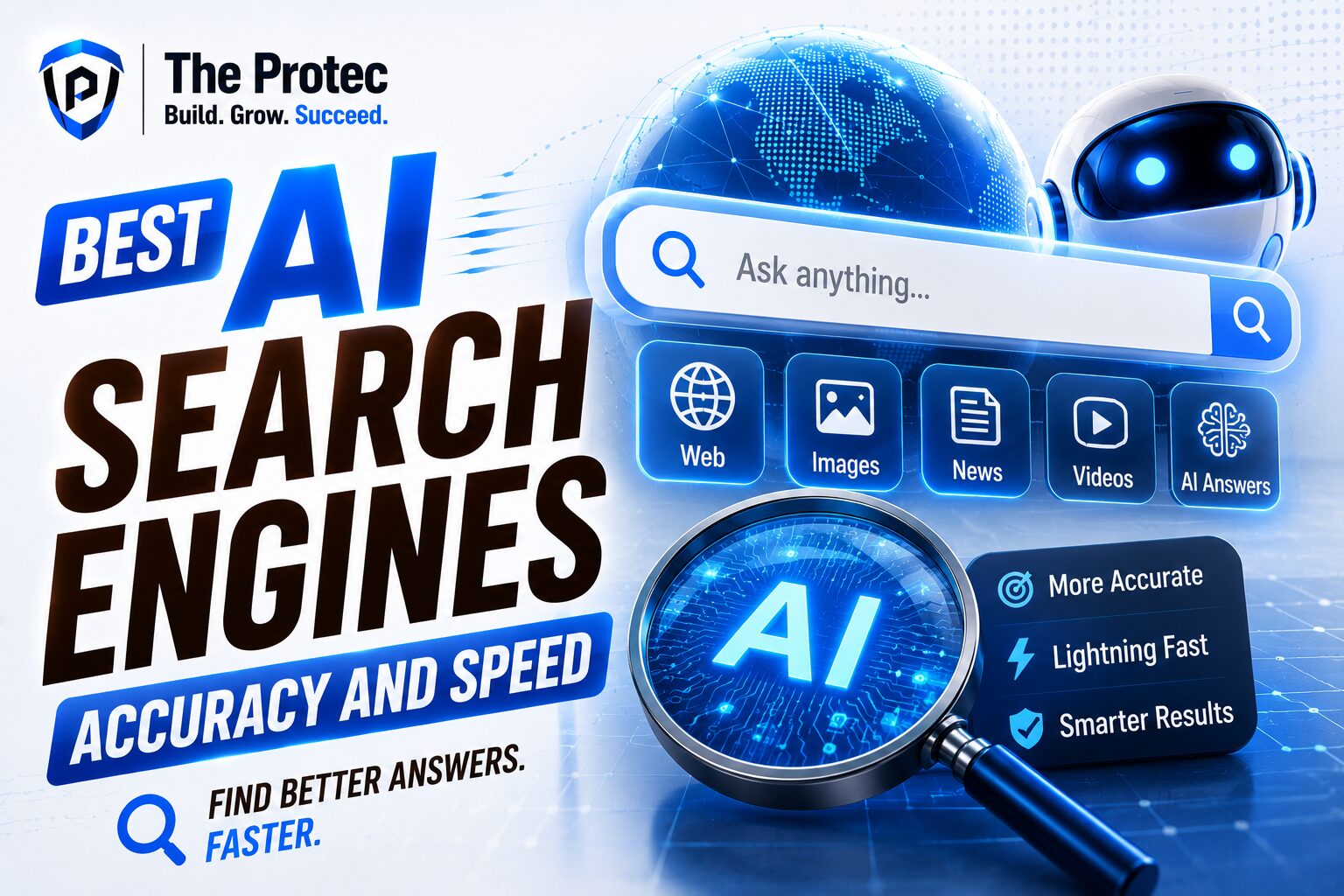
Search is changing fast. Users no longer want a list of blue links and a long session of tab-hopping just to answer a simple question. They want a direct, trustworthy answer, fast. That shift is why the best AI search engine is now a real category, not a novelty. In practice, modern AI search tools combine live web retrieval, summarization, source citations, and conversational follow-up to help people research faster and with less friction.
In this guide, we compare the strongest Google AI alternatives using a practical lens: accuracy, speed, source quality, answer depth, and daily usability. The goal is not to crown a single winner for every scenario. Instead, it is to show which platform works best for different kinds of search behavior, from quick fact-checking to research-heavy workflows. We also focus on what matters in real use: whether the engine gives a correct answer, whether it explains where that answer came from, and whether it does so quickly enough to feel natural.
To keep this comparison grounded, we looked at typical search tasks such as finding current events, product comparisons, technical explanations, and topic summaries. That matters because AI search is strongest when it can synthesize information from multiple reputable sources without losing precision. It is weakest when it hallucinates, omits context, or buries the evidence. Speed matters too, but only if the result is usable.
What Makes the Best AI Search Engine?
A strong AI search engine is more than a chatbot with web access. The best platforms combine several capabilities that directly affect search quality.
- Accuracy: Does the engine answer the question correctly and stay faithful to the source material?
- Freshness: Can it retrieve recent information from the web instead of relying on stale model knowledge?
- Citations: Does it show clear sources so users can verify claims quickly?
- Speed: How long does it take to produce a useful answer?
- Clarity: Is the answer easy to scan, compare, and act on?
- Follow-up support: Can users refine the query conversationally without starting over?
In 2026, AI search platforms are also being judged on how well they reduce search fatigue. The best tools do not just answer questions. They summarize tradeoffs, identify consensus, and point out uncertainty. That is especially valuable when comparing products, interpreting news, or researching technical topics. For readers who want a broader overview of how AI search is evolving, Google’s own explanation of AI-powered search experiences is a useful reference: Google Search blog.
How We Ranked These AI Search Tools
This ranking focuses on real-world performance, not marketing claims. We prioritized the following criteria:
- Answer accuracy: Correctness, consistency, and resistance to obvious errors.
- Search speed: Time to first useful answer and time to complete a follow-up request.
- Source transparency: Whether citations are visible, relevant, and easy to inspect.
- Research utility: How well the tool handles comparison queries and multi-step exploration.
- Everyday usability: Interface quality, prompt flexibility, and result readability.
One important note: AI search is not static. Platforms ship updates frequently, and performance can change depending on query type, region, and load. So this ranking reflects the current practical experience most users will have when evaluating the best AI search engine for personal or professional use.
Ranked: Best AI Search Engines by Accuracy and Speed
1. Perplexity
Perplexity remains one of the most balanced AI search tools available. It is especially strong when users want fast, sourced answers that feel closer to research than to casual chat. In testing, it consistently delivered quick responses with clean citations and a strong ability to summarize multiple sources without overcomplicating the result.
Why it ranks first: It combines speed, source visibility, and strong answer structure better than most competitors. For many users, it is the best AI search engine when the goal is to move from question to answer with minimal friction.
- Strengths: Fast response time, citations on most results, good follow-up handling, strong general research flow.
- Weaknesses: Can still compress nuance too aggressively on complex topics, and some answers need verification for high-stakes use.
- Best for: Students, marketers, analysts, and professionals who want a quick research-first search experience.
2. Google AI Overviews and AI Mode
Google remains the default search engine for most people, and its AI-powered layers have become much more practical. For broad consumer questions, breaking news, and queries with clear intent, Google’s AI results are often very fast and convenient. The biggest advantage is integration: users can move from an AI summary to classic search results, shopping, maps, and related sources without leaving the ecosystem.
Where Google stands out is speed and familiarity. For many queries, it returns an answer almost instantly. The downside is that citations and source granularity can vary, and the experience is not always as research-friendly as dedicated AI search tools. Still, as a Google AI alternative benchmark, it is not really an alternative at all; it is the baseline many others are trying to beat.
- Strengths: Extremely fast, strong query understanding, broad web coverage, seamless integration with traditional search.
- Weaknesses: Less consistent citation visibility and less conversational depth than specialist platforms.
- Best for: Everyday search, broad discovery, and users who want AI assistance without changing habits.
3. ChatGPT Search
ChatGPT Search is compelling because it brings conversational refinement to web search. It is a strong choice when a user wants to ask a follow-up, narrow a topic, or explore a problem step by step. In testing, it performed well on synthesis and explanation, especially when the query needed context rather than just links.
The tradeoff is that speed can feel slightly slower than the fastest dedicated search engines, and the experience is strongest when the question is well-formed. It is not always the first choice for a quick fact lookup, but it shines when users want a deeper answer with room to iterate.
- Strengths: Natural conversation flow, good synthesis, strong follow-up prompting, helpful for explanation-heavy search.
- Weaknesses: Not always the fastest option, and answer style can be more verbose than necessary.
- Best for: Research, brainstorming, and users who prefer an interactive search experience.
4. Microsoft Copilot Search
Microsoft’s AI search experience is increasingly relevant, especially for users inside the Microsoft ecosystem. Copilot Search is good at blending AI summaries with live web results, and it often performs well for workplace-oriented questions. The results are usually clear and visually manageable, with enough structure to make scanning easy.
Copilot is not always the most precise tool on niche topics, but it is dependable for general queries, productivity use cases, and quick fact gathering. Its speed is competitive, and its integration with Microsoft products gives it extra value for business environments.
- Strengths: Good interface, solid speed, strong ecosystem value, useful for workplace research.
- Weaknesses: Can be uneven on specialized or deeply technical searches.
- Best for: Business users, Office-heavy teams, and general productivity research.
5. Brave Search with AI Answers
Brave Search has become more interesting as a privacy-conscious Google AI alternative. Its AI Answers feature is useful when users want a concise synthesis without surrendering too much personal data. The platform is appealing for users who value independence from the largest ad-driven ecosystems.
In practical terms, Brave performs well on direct questions and light research, though it is usually less polished than Perplexity or Google in terms of answer flow and breadth. The speed is good, and the privacy angle is a meaningful differentiator for many users.
- Strengths: Privacy positioning, fast enough for everyday use, straightforward search interface.
- Weaknesses: Less refined synthesis and fewer advanced research features.
- Best for: Privacy-focused users and people who want a lightweight AI search option.
6. You.com
You.com continues to offer a flexible search experience with AI assistance layered into the workflow. It is useful for people who like experimenting with different search styles and want more control over how results are organized. The platform is good at aggregating information, and it can be handy for comparison queries.
Its main limitation is consistency. On some searches, it performs very well; on others, it feels less authoritative than the top-ranked tools. Still, it remains a worthy option for users who value customization and a broader set of AI search modes.
- Strengths: Flexible, customizable, useful for comparison searches.
- Weaknesses: Inconsistent answer quality compared with the top tier.
- Best for: Power users who want multiple search styles in one place.
7. DuckDuckGo AI Assist
DuckDuckGo’s AI experience is designed for users who want a simpler, privacy-respecting way to get summarized answers. It is not the most advanced system in this list, but it has a clear appeal: fast access, low friction, and a familiar search-first interface. For straightforward queries, it does the job well enough.
It ranks lower because it is less capable as a deep research platform. Users looking for rigorous citations, extensive synthesis, or advanced conversational refinement will likely prefer higher-ranked tools. Still, it is a respectable option for basic AI-assisted search.
- Strengths: Privacy-first approach, easy to use, minimal learning curve.
- Weaknesses: Limited research depth and less robust source presentation.
- Best for: Quick queries and privacy-conscious browsing.
Accuracy vs Speed: Which Matters More?
The right answer depends on the task. If you are asking a simple question like a definition, a product feature, or a current headline, speed may matter most. The best AI search engine in that scenario is one that gives a reliable answer in seconds. But if you are evaluating software, researching a medical topic, or making a business decision, accuracy matters far more than raw speed.
In many tests, the best tools are not the ones that answer the fastest. They are the ones that answer fast enough while showing enough evidence to trust the response. That is why citations matter so much. A slightly slower answer with clear sources is often better than a rapid but opaque summary. This is also where AI search tools differ from traditional search engines: the value is not just retrieval, but interpretation.
Best AI Search Engine for Different Use Cases
- For research and citations: Perplexity
- For everyday search and instant answers: Google AI Overviews and AI Mode
- For conversational exploration: ChatGPT Search
- For workplace productivity: Microsoft Copilot Search
- For privacy-focused browsing: Brave Search
- For customizable search workflows: You.com
- For simple private queries: DuckDuckGo AI Assist
If you are choosing just one platform, start by deciding whether you need a research tool or a convenience tool. Research tools prioritize citations and answer quality. Convenience tools prioritize speed and familiarity. The best AI search engine for your workflow depends on that tradeoff.
What to Watch as AI Search Evolves
AI search is moving quickly, and several trends are shaping the next wave of improvement. First, source attribution is getting better, which is critical for trust. Second, multimodal search is becoming more useful, allowing users to search with text, images, and sometimes files in one workflow. Third, search engines are increasingly trying to answer complex queries in a single step rather than forcing users into multiple searches.
Another major trend is the blending of classic search and AI summaries. This hybrid model appears likely to dominate because it gives users the best of both worlds: direct answers for convenience and links for verification. The platforms that win will be the ones that stay fast while improving factual reliability and citation quality.
Final Verdict
There is no single AI search engine that wins every scenario, but there is a clear top tier. Perplexity is the strongest all-around option for people who want a research-oriented search experience with citations and speed. Google remains unbeatable for sheer reach and instant convenience. ChatGPT Search is excellent for conversational research, while Microsoft Copilot Search is a smart pick for productivity users. Brave, You.com, and DuckDuckGo each serve valuable niches, especially for privacy-conscious users and those seeking more control.
If you are searching for the best AI search engine today, the most practical approach is to test two or three platforms against the same query set. Compare how quickly they answer, how clearly they cite sources, and how much confidence they inspire. The winner is not always the flashiest tool. It is the one that consistently gives you correct, usable answers with the least effort.
FAQ
What is the best AI search engine right now?
For most users, Perplexity is the best balance of accuracy, speed, and citation quality. Google is still the fastest for everyday search, but Perplexity is often better for research.
Are AI search tools better than Google Search?
They are better for certain tasks, especially when you want a summarized answer with sources. Google is still stronger for broad discovery, navigation, and many local or shopping queries.
Which Google AI alternatives are most reliable?
Perplexity, ChatGPT Search, and Microsoft Copilot Search are among the most reliable alternatives, depending on whether you value citations, conversation, or workplace integration most.
Can AI search engines replace traditional search?
Not completely. AI search engines are excellent for synthesis and quick understanding, but traditional search is still essential for browsing multiple viewpoints, checking primary sources, and exploring topics in depth.
How should I test an AI search engine myself?
Use the same five or six questions across multiple platforms. Include a current event, a comparison query, a technical question, and a fact that can be verified easily. Then compare speed, accuracy, and citations.