







Contents
- 1 Why Traditional APIs Are Being Reconsidered
- 2 What Traditional APIs Do Well—and Where They Fall Short
- 3 Model Context Protocol: The Strongest Contender for Future APIs
- 4 How AI Agents Change the Integration Model
- 5 Why Emerging Communication Standards Matter
- 6 Will MCP Replace REST, GraphQL, and gRPC?
- 7 What Future APIs May Look Like
- 8 How AI Integrations Are Changing Developer Workflows
- 9 Security and Governance in an Agent-Native World
- 10 What Businesses Should Do Now
- 11 The Road Ahead for APIs, MCP, and AI Agents
- 12 FAQ
Why Traditional APIs Are Being Reconsidered
For decades, APIs have been the backbone of software integration. They let applications exchange data, trigger workflows, and expose services in a predictable way. REST, GraphQL, gRPC, and event-driven architectures have all helped teams build connected systems at scale. But the center of gravity is shifting. As software becomes more autonomous, more conversational, and more dependent on AI integrations, the old request-response model starts to feel limited.
The question is no longer whether APIs are useful. They absolutely are. The real question is whether traditional APIs will remain the primary interface between systems, or whether they will be partially replaced by newer communication layers designed for AI agents, tools, and context-aware applications. That is where future APIs, the Model Context Protocol, and emerging standards enter the conversation.
Instead of asking only “How do I expose this endpoint?”, teams are now asking “How should an AI system discover, interpret, and safely use this capability?” That shift sounds subtle, but it changes everything from authentication and permissions to schema design and operational observability.
What Traditional APIs Do Well—and Where They Fall Short
Traditional APIs are excellent at one thing: structured communication. They define endpoints, request formats, response payloads, and error handling rules. This makes them ideal for deterministic software-to-software interaction. A client knows exactly what to send, what to expect back, and how to retry when something fails.
However, AI-driven systems introduce a different set of requirements. Large language models, AI agents, and orchestration layers are not just fetching data. They need to understand intent, discover available tools, manage context over time, and make decisions based on changing conditions. In that environment, a simple endpoint is often not enough.
- APIs assume the caller knows the interface. AI agents often need to discover capabilities dynamically.
- APIs optimize for machine precision. AI systems also need semantic meaning and structured context.
- APIs are usually stateless. AI workflows often depend on memory, session context, and multi-step reasoning.
- APIs expose data. AI integrations frequently need access to tools, permissions, documents, and action boundaries.
This does not make APIs obsolete. It means they are increasingly becoming one layer in a broader stack rather than the whole integration story.
Model Context Protocol: The Strongest Contender for Future APIs
Among the most important developments in this space is the Model Context Protocol, often abbreviated as MCP. MCP is designed to standardize how AI applications connect to external tools, services, and data sources. Instead of forcing every AI product to invent its own integration pattern, MCP creates a shared interface for context exchange and tool access.
Think of MCP as a protocol that helps AI systems ask: What tools are available? What data can I access? What is safe to do here? How do I format the request? How do I interpret the result? That matters because the future of AI integrations is not only about generating text. It is about taking meaningful action in real systems.
MCP is gaining attention because it addresses one of the biggest pain points in the AI ecosystem: fragmentation. Every platform has been building custom connectors, custom tool schemas, and custom agent interfaces. That approach is hard to scale. A common protocol could make integrations more portable, more maintainable, and easier to govern.
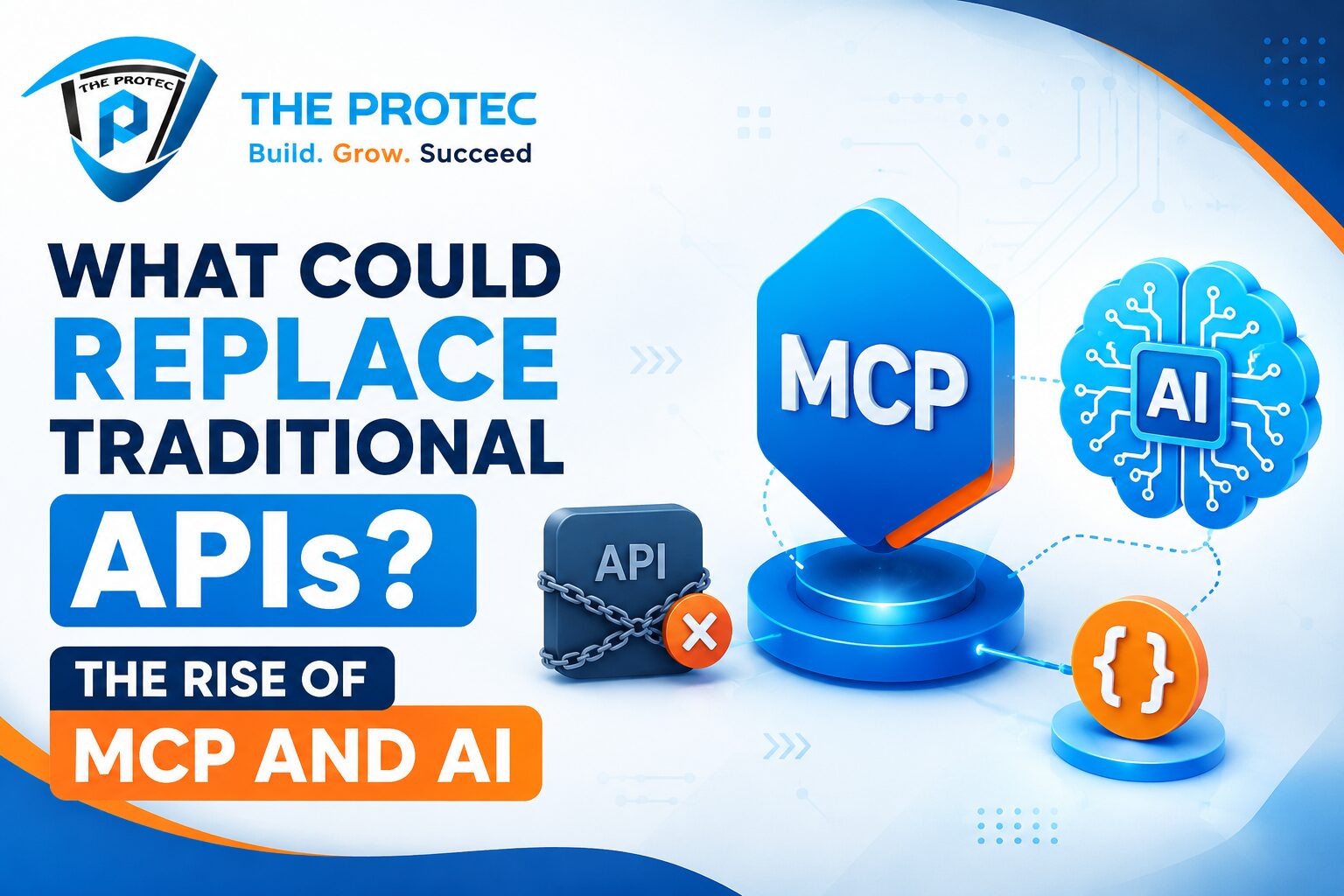
One useful way to understand MCP is as the communication layer between AI apps and the outside world. It does not replace all APIs outright. Instead, it can sit above them, translating AI-native requests into structured interactions with existing services. That is a major reason many teams view MCP as a likely foundation for future APIs.
For more technical background, the official specification and ecosystem discussions are evolving quickly at modelcontextprotocol.io.
How AI Agents Change the Integration Model
AI agents are different from traditional software clients. They do not just call endpoints. They plan, reason, chain actions, and adapt based on feedback. An agent might read a document, search a database, summarize findings, draft a response, and then trigger a workflow. In other words, the agent is not a passive consumer of an API; it is an active participant in a task.
This shift has huge implications for integration design. Future-facing systems need to support:
- Tool discovery so agents can identify capabilities without hardcoded logic.
- Permission boundaries so agents only access what they are allowed to use.
- Structured outputs that are reliable enough for downstream automation.
- Context transfer so the agent understands the task, user intent, and constraints.
- Observability so engineers can trace what the agent used, changed, or inferred.
These requirements are pushing the industry toward more expressive communication standards. The future API may not look like a single endpoint at all. It may look like a capability graph, a tool registry, or a context-aware protocol that agents can query before acting.
Why Emerging Communication Standards Matter
The rise of AI agents exposes a weakness in many existing integration patterns: they were designed for developers, not for autonomous systems. Humans can read documentation, understand edge cases, and adapt to ambiguous instructions. Agents need something more explicit.
That is why emerging standards are becoming so important. They create a shared language for tool use, metadata, capability discovery, and response structure. In practical terms, that means fewer custom integrations, faster onboarding, and better portability across platforms.
Several trends are converging here:
- Protocol-based tool access instead of one-off vendor-specific plugins.
- Schema-first design so AI systems can reason over inputs and outputs reliably.
- Contextual permissions that adapt based on user, session, and environment.
- Composable services that can be orchestrated by agents rather than only by application code.
- Interoperability across AI assistants, IDEs, enterprise apps, and workflow systems.
This is where the conversation moves from APIs as “interfaces” to APIs as “capabilities.” A capability is richer than a simple endpoint because it includes semantics, constraints, and operational behavior. That distinction will shape the next generation of integrations.
Will MCP Replace REST, GraphQL, and gRPC?
Probably not in the literal sense. REST, GraphQL, and gRPC solve core networking and data-access problems extremely well. Businesses have huge investments in them, and they will remain essential for years. The more realistic scenario is layered adoption.
In that model, MCP and similar standards become the preferred way for AI agents to interact with tools, while traditional APIs continue to power the underlying services. The agent speaks MCP. The platform translates that into REST calls, database queries, event emissions, or internal service requests.
This layered pattern is important because it preserves existing infrastructure while making it more AI-friendly. It also means organizations do not need to rewrite everything to participate in the future API ecosystem. Instead, they can expose selected services through an agent-ready protocol and keep the core system stable.
That said, some parts of traditional API design may change. For example:
- Endpoints may become more descriptive and capability-oriented.
- Responses may include richer metadata for agent reasoning.
- Authentication may become more granular and context-aware.
- Documentation may be generated in machine-readable formats first, human-readable formats second.
What Future APIs May Look Like
Future APIs are likely to be less about static URLs and more about dynamic interaction models. Instead of manually browsing docs and wiring up requests, developers and agents may discover services through standardized catalogs, context servers, or capability registries.
Here are some characteristics that may define future APIs:
1. Context-aware by default
APIs will need to carry more meaning than a simple payload. They may include user intent, session state, policy constraints, and task metadata so AI systems can act appropriately.
2. Machine-readable first
Documentation will increasingly be structured for both people and software. JSON schemas, capability manifests, and protocol descriptors will matter more than prose alone.
3. Multi-step and stateful
Instead of one request and one response, the next wave of integrations may support conversations, partial results, retries, clarifications, and tool chaining.
4. Governance-aware
Future APIs will likely encode what an agent can access, what it can change, and which actions require approval. Security will be built into the protocol, not bolted on afterward.
5. Portable across environments
A tool exposed in one platform should be usable in another without a complete rewrite. That portability is one of the biggest promises of standards like MCP.
In practice, the future is probably not “API vs. no API.” It is “API plus protocol plus agent layer.” That stack gives teams flexibility without abandoning the reliability of existing systems.
How AI Integrations Are Changing Developer Workflows
One of the most immediate impacts of AI integrations is inside the developer workflow itself. Teams are already using AI assistants to generate code, query logs, summarize incidents, and navigate internal systems. As this becomes more agentic, the integration requirements become more demanding.
Developers do not just want a chatbot that answers questions. They want systems that can inspect services, retrieve documentation, open tickets, test changes, and update configurations with guardrails. That is a very different use case from a simple public API.
For engineering teams, this means building software that is:
- Inspectable so agents can understand what the service does.
- Safe so actions are bounded and auditable.
- Composable so multiple tools can work together in a workflow.
- Stable so model behavior does not break when interfaces shift.
As AI integrations mature, the best APIs may be the ones that are easiest for both humans and agents to reason about. That creates a new design standard: not just developer experience, but agent experience too.
Security and Governance in an Agent-Native World
If AI agents can act on behalf of users, then security becomes a first-class design problem. Traditional API security focuses on authentication, authorization, rate limiting, and logging. Those are still necessary, but agent-native systems introduce additional risks.
An agent may combine multiple tools in sequence. It may misinterpret instructions. It may overreach if permissions are too broad. It may also surface sensitive data if context boundaries are unclear. As a result, organizations need stronger controls around tool exposure and policy enforcement.
Best practices in this environment include:
- Least-privilege access for every tool and capability.
- Explicit approval flows for destructive or high-impact actions.
- Clear audit trails showing what the agent requested and why.
- Scoped credentials tied to user intent and session context.
- Policy layers that can inspect and block unsafe operations.
MCP-style architectures can help here because they encourage formalized tool boundaries rather than ad hoc integrations. But the technology itself is only part of the answer. Governance needs to be designed alongside the protocol.
What Businesses Should Do Now
If your organization is wondering how to prepare for future APIs, the best move is not to wait for one universal standard. Start by making your services more agent-ready today.
That means:
- Documenting capabilities clearly and consistently.
- Defining schemas that are precise and easy to validate.
- Separating read-only and write operations wherever possible.
- Exposing tool metadata that describes purpose, inputs, and constraints.
- Reviewing authentication flows for delegated, context-aware access.
- Designing observability so every agent action can be traced.
It also helps to identify which parts of your stack are good candidates for protocol-based exposure. Internal knowledge bases, workflow engines, support systems, analytics tools, and administrative tasks are often better fits for AI-native integration than public consumer-facing endpoints.
Businesses that prepare early will be able to adopt MCP and similar standards faster, without a major refactor. More importantly, they will be ready for a software landscape where AI systems are not just calling services, but collaborating with them.
The Road Ahead for APIs, MCP, and AI Agents
The most likely future is not a sudden replacement of traditional APIs, but a gradual redefinition of what an interface means. APIs will remain foundational, but they will increasingly be wrapped in richer layers that speak the language of AI agents and context-aware applications.
Model Context Protocol is one of the clearest signs of this transition. It points toward a world where tools are discoverable, portable, and semantically rich. In that world, AI integrations become less brittle, easier to govern, and more capable of real work.
For organizations building modern software, the strategic question is no longer whether AI will affect integration architecture. It already has. The better question is how to design systems that can support both human developers and autonomous agents without creating a maze of custom connectors.
The companies that succeed will be the ones that treat future APIs as an evolution of software communication, not just a trend. They will build for interoperability, context, security, and adaptability. That is where the next major platform shift is happening.
FAQ
What are future APIs?
Future APIs are integration layers designed for AI-native systems, agents, and context-aware applications. They go beyond simple request-response patterns by supporting discovery, tool use, metadata, and multi-step workflows.
Is Model Context Protocol replacing APIs?
No. MCP is more likely to sit alongside traditional APIs than replace them entirely. It provides a standardized way for AI systems to access tools and context, while existing APIs continue to power the underlying services.
Why are AI agents changing integration design?
AI agents need more than data access. They need to discover tools, understand context, follow permissions, and complete multi-step tasks safely. That requires richer communication standards than many traditional APIs were built to provide.
Should businesses rebuild their APIs for MCP?
Not necessarily. Most organizations should first make their services more structured, well-documented, and governance-friendly. Then they can expose selected capabilities through MCP or similar standards without rebuilding their core systems.
What is the biggest advantage of emerging communication standards?
The biggest advantage is interoperability. Standards like MCP can reduce custom integrations, improve portability across platforms, and make it easier for AI agents to work with services in a safe, consistent way.
External reference: Model Context Protocol