








Contents
- 1 Introduction: Navigating the Evolution of Backend Development
- 2 Understanding the Traditional API-Driven Backend
- 3 Rise of AI Agents: A New Paradigm in Backend Systems
- 4 The Agent-Based Architecture Approach
- 5 AI Agents vs APIs: Can Agents Replace APIs?
- 6 Implications for Backend Developers
- 7 Emerging Trends Shaping the Backend Future
- 8 Challenges and Considerations for Adoption
- 9 Conclusion: A Complementary Future for APIs and AI Agents
- 10 FAQ
Backend development is experiencing a fundamental transformation driven by rapid advancements in artificial intelligence and distributed systems. For decades, APIs (Application Programming Interfaces) have been the cornerstone of backend architecture, enabling communication between different software components through standardized interfaces. However, the emergence of sophisticated AI agents capable of autonomous decision-making and adaptive behaviors signals a potential paradigm shift. This article examines whether the traditional API model will be supplanted by agent-driven systems and explores how agent-based architecture is influencing the future of backend development.
Understanding the Traditional API-Driven Backend
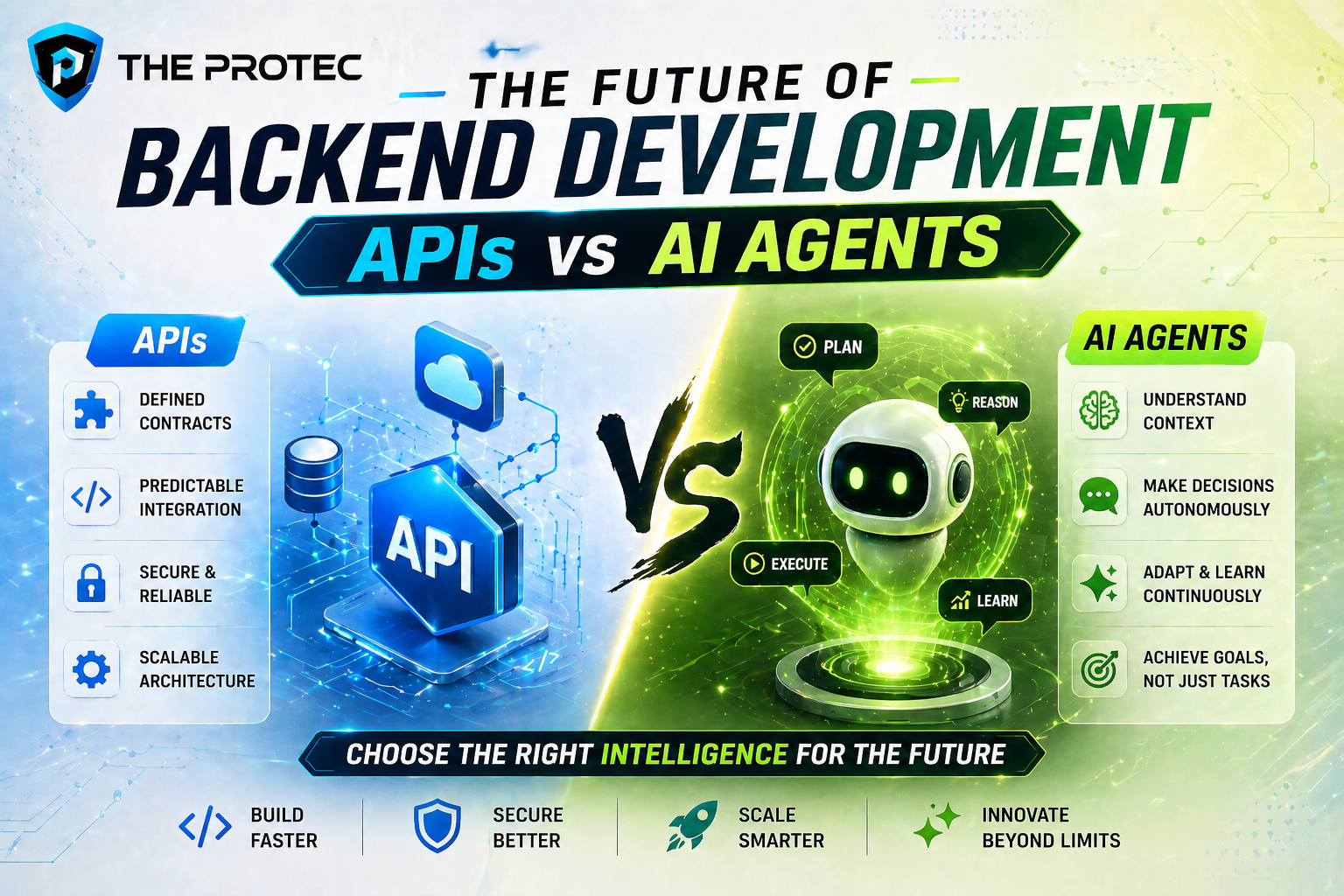
APIs have become the backbone of modern web and mobile applications, providing a reliable and structured way to expose data and services. The API-driven approach offers several key advantages, including:
- Decoupling: APIs enable separation of frontend and backend concerns, allowing development teams to work independently and iterate faster.
- Standardization: REST, GraphQL, gRPC, and other specifications provide consistent methods for resource access and manipulation.
- Interoperability: APIs facilitate integration between disparate systems, fostering ecosystems of third-party applications.
- Scalability: Backend services can scale independently to meet demand.
Despite these strengths, traditional APIs rely heavily on predefined contracts and explicit request-response cycles, which may limit flexibility when handling complex, dynamic workflows or context-sensitive interactions.
Rise of AI Agents: A New Paradigm in Backend Systems
AI agents represent autonomous or semi-autonomous software entities capable of perceiving their environment, reasoning, learning, and acting without direct human intervention. Unlike APIs that require explicit invocation, AI agents can initiate interactions, adapt to changing conditions, and collaborate with other agents or systems.
Recent breakthroughs in natural language processing, reinforcement learning, and multi-agent systems have accelerated the capabilities of AI agents. These systems can analyze vast data sets, make intelligent decisions in real time, and even predict user needs proactively.
Key characteristics of AI agents influencing backend development include:
- Autonomy: Ability to perform tasks without constant supervision.
- Context-awareness: Understanding environmental and application context to tailor responses.
- Learning and Adaptation: Continuous improvement through experience and feedback.
- Collaboration: Interaction with other agents or APIs for complex workflows.
The Agent-Based Architecture Approach
Agent-based architecture leverages collections of intelligent agents to form distributed systems capable of managing complex operations more naturally than rule-based APIs. Instead of responding solely to client requests, agents can orchestrate multiple services, negotiate conflicts, and dynamically allocate resources.
This approach offers several strategic advantages:
- Enhanced Flexibility: Agents can dynamically adjust their behavior to user preferences or system states.
- Improved Resilience: Distributed agents reduce single points of failure and enable graceful degradation.
- Personalization: Better user experiences through adaptive, context-sensitive responses.
- Autonomous Orchestration: Agents can autonomously coordinate complex backend processes across services.
Agent architectures excel in domains such as IoT management, decentralized finance, complex logistics, and adaptive user interfaces.
AI Agents vs APIs: Can Agents Replace APIs?
The question of whether AI agents will replace APIs is nuanced. APIs provide a well-understood, lightweight communication method with predictable interactions, essential for reliability, security, and debugging. AI agents, by contrast, introduce complexity, unpredictability, and learning-driven behavior, which can blur system boundaries.
Rather than outright replacement, the trend points to increasingly hybrid architectures where AI agents complement APIs. For example:
- APIs remain foundational for exposing core data and services with clear contracts.
- AI agents operate on top of APIs, orchestrating multi-step workflows and handling exceptions intelligently.
- Agents may expose their own APIs, allowing integration with traditional systems.
- New middleware layers leverage agent-driven decision-making to optimize API usage dynamically.
Ultimately, AI agents and APIs serve different but complementary purposes. APIs deliver deterministic interfaces, and agents bring adaptive, intelligent behavior. The future backend will likely combine these to harness the strengths of both worlds.
Implications for Backend Developers
Backend developers must evolve to leverage emerging agent-based models effectively:
- Learning New Paradigms: Understanding multi-agent systems, machine learning workflows, and decentralized architectures is essential.
- Designing for Interoperability: Creating APIs that can be effectively utilized and extended by AI agents.
- Managing Complexity: Implementing observability and debugging tools to handle non-deterministic agent behavior.
- Security Considerations: Agent-based systems introduce novel attack vectors requiring robust authentication, authorization, and anomaly detection.
- Ethical and Compliance Awareness: Agents making autonomous decisions demand transparency, auditability, and fairness.
Emerging Trends Shaping the Backend Future
Several trends underscore the growing role of AI agents alongside APIs in backend development:
- Agent Frameworks and Platforms: Open-source and commercial platforms like Langchain, Ray, and Microsoft Semantic Kernel facilitate agent creation and deployment.
- API-Driven AI Services: AI capabilities are increasingly exposed as APIs, blurring lines between AI agents and traditional APIs.
- Hybrid Cloud and Edge Deployment: Distributed agents enable autonomous operations closer to data sources, reducing latency.
- Conversational and Intelligent Automation: Agents enable richer chatbots, virtual assistants, and business process automation.
- Event-Driven Architectures: Agents thrive in reactive environments, complementing event-based APIs and streaming platforms.
Challenges and Considerations for Adoption
While promising, adopting agent-based architecture presents challenges:
- Complexity Management: Increased system complexity requires advanced tooling and expertise.
- Performance Uncertainty: Adaptive agents may introduce latency or unpredictability.
- Security Risks: Autonomous agents could be exploited if not properly contained.
- Scalability: Coordinating vast numbers of agents demands robust orchestration mechanisms.
- Integration with Legacy Systems: Ensuring compatibility with existing API-first infrastructure.
Conclusion: A Complementary Future for APIs and AI Agents
The future of backend development is not a binary choice between APIs and AI agents but a synergistic integration of both. Traditional APIs will continue to provide stable, well-defined communication contracts, while AI agents introduce flexibility, autonomy, and intelligence that enable advanced, adaptive backend systems.
Developers and organizations embracing agent-based architectures alongside robust APIs will unlock new possibilities in system resilience, personalization, and automation. As these technologies mature, the backend landscape will evolve into a dynamic ecosystem where agents orchestrate complex processes atop a foundation of standardized APIs.
Staying informed about the latest tools and design patterns for combining APIs and AI agents will be critical to future-proof backend development strategies.
FAQ
1. What is the difference between AI agents and traditional APIs?
Traditional APIs provide fixed interfaces for requesting and manipulating resources, requiring explicit client commands. AI agents are autonomous software entities that perceive context, learn, and act with decision-making capabilities, often initiating interactions without direct requests.
2. Can AI agents fully replace APIs in backend systems?
AI agents are unlikely to fully replace APIs because APIs offer simplicity, stability, and predictability essential for many services. Instead, agents typically operate on top of APIs or alongside them to introduce intelligent orchestration and adaptability.
3. What industries benefit most from agent-based backend architecture?
Industries with complex, dynamic workflows and heavy automation needs, such as IoT, finance, supply chain logistics, customer service, and personalized healthcare, can benefit significantly from agent-based backend systems.