







Contents
Introduction
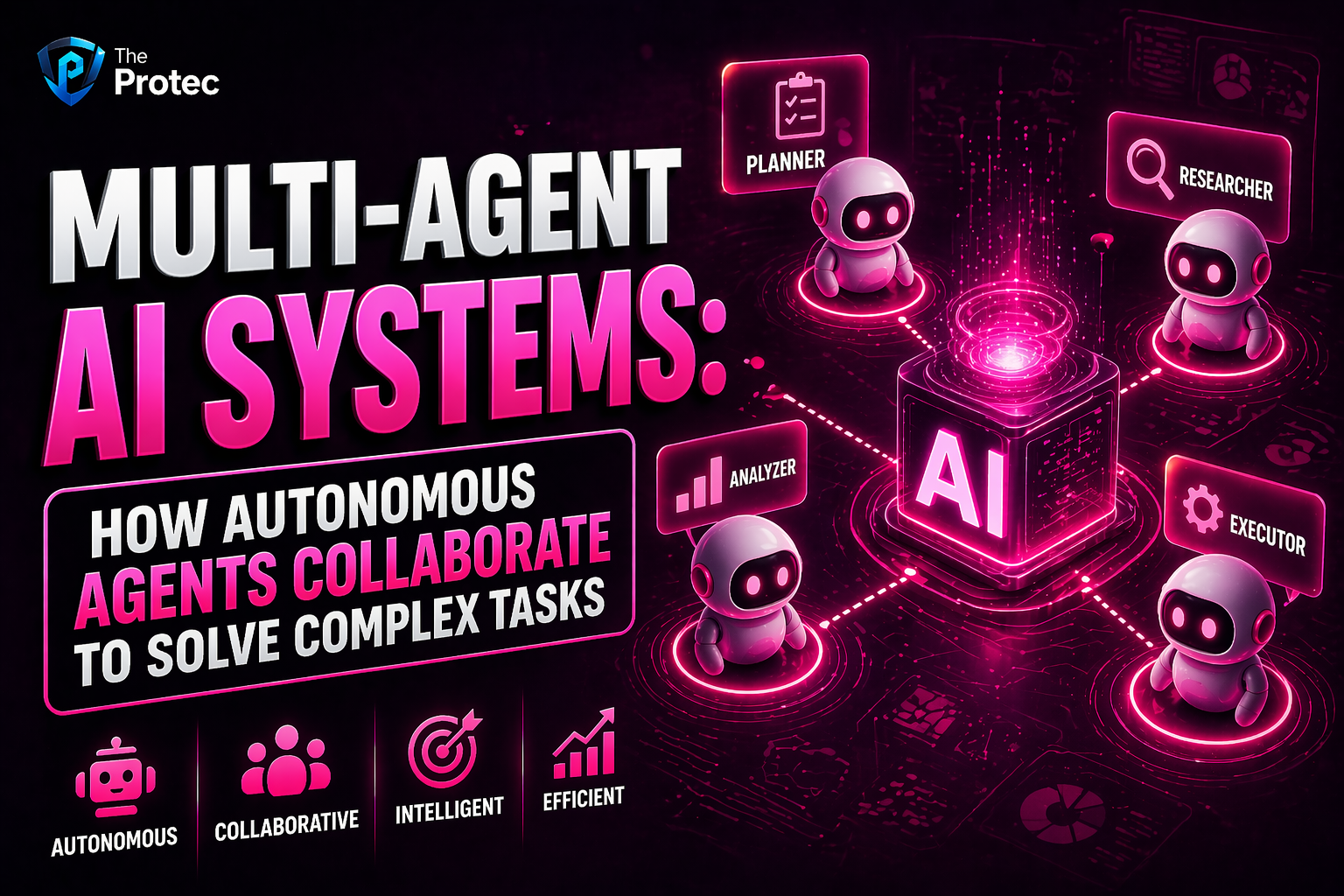
As artificial intelligence continues to evolve, the paradigm of single-agent AI solutions is rapidly giving ground to more sophisticated multi-agent systems. Unlike isolated AI models, multi-agent AI systems consist of several autonomous agents that collaborate, negotiate, and coordinate to solve complex tasks that are beyond the capability of any individual agent. This shift reflects not only advancements in AI architectures but also the increasing demand for intelligent, adaptable, and scalable problem-solving methods.
In this article, we delve into the architecture patterns behind multi-agent AI systems, explore how agent orchestration drives AI collaboration, and highlight practical real-world use cases where these systems are revolutionizing industries.
Understanding Multi-Agent Systems
Multi-agent systems (MAS) involve multiple interacting intelligent agents within an environment. Each agent operates autonomously but can cooperate or compete with others to achieve overarching objectives. This collective intelligence enables tackling complex tasks ranging from robotics to financial modeling to large-scale simulations.
Key Characteristics of Multi-Agent Systems
- Autonomy: Agents independently perceive their environment and make decisions.
- Social Ability: They communicate and interact with other agents.
- Reactivity: Agents respond in real-time to environmental changes.
- Pro-activeness: They exhibit goal-directed behaviors to pursue objectives.
Why Move Beyond Single Agents?
Single-agent AI may excel in narrowly defined problems but often hits limits in scalability, fault tolerance, and dynamic adaptability. Multi-agent systems inherently provide:
- Scalability: Tasks can be decomposed among multiple agents.
- Robustness: Failure of one agent doesn’t cripple the whole system.
- Parallelism: Multiple agents operate concurrently for efficiency.
- Flexibility: Agents with different capabilities collaborate dynamically.
Architecture Patterns of Multi-Agent AI Systems
The design of a multi-agent system hinges on how autonomous agents are structured, communicate, and synchronize their activities. Let’s examine key architecture patterns enabling effective agent orchestration:
1. Centralized Coordination Pattern
In this pattern, a central coordinator agent manages task assignments and monitors overall progress. Other agents perform assigned subtasks and report back. While simple in terms of control flow, this approach can face bottlenecks and single points of failure.
2. Distributed Coordination Pattern
Multiple agents cooperate by sharing local information and making collective decisions without a central controller. Examples include consensus algorithms and decentralized task allocation frameworks. This pattern offers greater fault tolerance and scalability but demands sophisticated communication protocols.
3. Hierarchical Multi-Agent Systems
Here, agents are organized into a hierarchy with higher-level agents overseeing groups of lower-level agents. This mimics organizational structures where strategic agents set goals and tactical agents handle execution details. Hierarchies help manage complexity and integrate diverse capabilities efficiently.
4. Blackboard Architecture
This pattern relies on a shared knowledge base (blackboard) that agents read from and write to asynchronously. Agents detect relevant changes and contribute new information to collaboratively advance problem-solving.
5. Contract Net Protocol
An auction-based mechanism where task managers announce jobs and agents bid based on capabilities and resources. This dynamic contracting fosters efficient task distribution and flexible resource allocation.
Agent Orchestration: The Heart of AI Collaboration
Agent orchestration refers to the coordination mechanisms ensuring that autonomous agents work harmoniously toward common goals. Effective orchestration overcomes challenges such as concurrency, conflict resolution, and knowledge sharing.
Core Elements of Agent Orchestration
- Communication Protocols: Standardized methods like FIPA-ACL facilitate message exchange enabling rich semantic interactions.
- Negotiation Strategies: Agents negotiate task division, resource sharing, and conflict mitigation using game theory, auctions, or heuristic approaches.
- Knowledge Management: Shared data stores, ontologies, and reasoning modules enable agents to access and update relevant information consistently.
- Workflow Scheduling: Mechanisms to sequence, parallelize, or interrupt agent activities for optimized performance.
- Monitoring and Feedback: Continuous assessment and adaptation to environmental changes and agent states improve system resilience.
Emerging Trends in Agent Orchestration
Recent advances include using reinforcement learning to let agents learn optimal collaboration policies autonomously, employing blockchain for trustworthy decentralized coordination, and integrating natural language processing to enhance heterogeneous agent communication.
Real-World Use Cases of Multi-Agent AI Systems
The practical impact of multi-agent AI systems extends across diverse domains where complex problem-solving and dynamic coordination are essential.
1. Autonomous Vehicle Fleets
Self-driving cars operating as a fleet demonstrate one of the most compelling examples of multi-agent AI systems. Each vehicle is an agent sensing surroundings, making navigation decisions, and communicating with other vehicles for traffic optimization, hazard avoidance, and cooperative lane changing. Centralized traffic management agents may orchestrate flow, while distributed coordination ensures robust response to real-time changes.
2. Smart Manufacturing and Industry 4.0
Factories increasingly adopt multi-agent systems to manage production lines where robots, sensors, and quality control devices act as autonomous agents. These agents negotiate scheduling, resource allocation, and maintenance operations to boost productivity, reduce downtime, and adapt to customization demands.
3. Energy Grid Management
Modern energy grids integrate various distributed energy resources, including solar panels, wind turbines, and storage units. Multi-agent systems manage power generation, distribution, and consumption by dynamically balancing supply and demand, detecting faults, and optimizing energy flows through agent orchestration techniques.
4. Healthcare and Patient Monitoring
In healthcare, multi-agent systems enable continuous patient monitoring where wearable devices, diagnostic tools, and healthcare professionals’ AI assistants operate as agents. Collaboration between these agents enhances early detection of anomalies, personalized treatment plans, and emergency response coordination.
5. Disaster Response and Management
Multi-agent AI systems coordinate robots, drones, and rescue teams during disaster scenarios. Agents distribute search and rescue tasks, analyze environmental hazards, and optimize resource deployment to save lives effectively under unpredictable conditions.
Challenges and Future Directions
While multi-agent AI systems hold great promise, several challenges remain:
- Scalability of Communication: As agent numbers grow, maintaining efficient communication channels is difficult.
- Security and Trust: Ensuring secure interaction among autonomous agents, especially in open networks, is critical.
- Standardization: Diverse technologies and protocols hinder interoperability across systems.
- Ethical Considerations: Autonomous agents must align with human values and comply with regulations.
Future research aims to address these challenges through hybrid architectures combining centralized and decentralized elements, advances in decentralized ledger technologies, and embedding ethical AI frameworks into agent decision-making. These developments will enhance the capability and trustworthiness of multi-agent systems.
Frequently Asked Questions (FAQ)
What distinguishes multi-agent systems from traditional AI models?
Multi-agent systems involve multiple autonomous agents interacting within an environment to collectively solve problems, whereas traditional AI models often focus on single-agent, standalone solutions. This collaboration enables tackling complex, dynamic tasks with improved scalability and robustness.
How does agent orchestration improve AI collaboration?
Agent orchestration provides coordination frameworks and protocols that allow autonomous agents to communicate, share knowledge, negotiate tasks, and align actions. This ensures coherent teamwork among agents, optimizing overall system behavior for complex objectives.
Can multi-agent AI systems operate in fully decentralized environments?
Yes, many multi-agent systems employ decentralized coordination patterns where agents communicate peer-to-peer without a centralized controller. This enhances fault tolerance and scalability but requires complex algorithms for consensus, conflict resolution, and synchronization.
Conclusion
Multi-agent AI systems represent a transformative shift from single-point intelligence to distributed, collaborative intelligence. By leveraging architectural patterns and robust agent orchestration, these systems address challenges too complex for individual agents. From autonomous vehicles to smart grids, they demonstrate scalable, adaptable, and efficient solutions critical to advancing intelligent automation.
For those interested in exploring the foundations and latest research on multi-agent collaboration, the International Foundation for Autonomous Agents and Multiagent Systems offers comprehensive resources and community insights.